Page 141 of 188
that meets Ford specification
ESE-M97B44±A. Ford Premium
Engine Coolant is an optimized
formula that will protect all metals
and rubber elastomers used in
Ford cooling systems for four years
or 80,000 km (50,000 miles).
Do not use alcohol or methanol
antifreeze or any engine coolants
mixed with alcohol or methanol
antifreeze. Do not use
supplemental coolant additives in
your vehicle. These additives may
harm your engine cooling system.
The use of an improper coolant
may void your warranty of your
vehicle's engine cooling system.
Recycled engine coolant
Ford Motor Company recommends
that Ford and Lincoln-Mercury
dealers use recycled engine
coolant produced by
Ford-approved processes. Not all
coolant recycling processes
produce coolant which meets Ford
specification ESE-M97B44±A, and
use of such coolant may harm
engine and cooling system
components.
Always dispose of used
automotive fluids in a responsible
manner. Follow your community's
regulations and standards for
recycling and disposing of
automotive fluids.
Coolant refill capacity
To find out how much fluid your
vehicle's cooling system can hold,
Maintenance and care
142
Page 142 of 188

refer toRefill capacitiesin the
Capacities and specifications
chapter.
Have your dealer check the engine
cooling system for leaks if you
have to add more than a liter
(quart) of engine coolant per
month.
Severe winter climate
If you drive in extremely cold
climates (less than ±36ÉC [±34ÉF]),
it may be necessary to increase the
coolant concentration above 50%.
Refer to the chart on the coolant
container to ensure the coolant
concentration in your vehicle is
such that the coolant will not
freeze at the temperature level in
which you drive during winter
months. Never increase the engine
coolant concentration above 60%.
Leave a 50/50 mixture of engine
coolant and water in your vehicle
year-round in non-extreme
climates.
What you should know about
fail-safe cooling
If the engine coolant supply is
depleted, this feature allows the
vehicle to be driven temporarily
before incremental component
damage is incurred. The ªfail safeº
distance depends on ambient
temperatures, vehicle load and
terrain.
Maintenance and care
143
Page 143 of 188
How fail-safe cooling works
If the engine overheats, the engine
will automatically switch from
eight to alternating four cylinder
operation. Each disabled cylinder
acts as an air pump and cools the
engine.
When this occurs:
²the engine coolant temperature
gauge will move to the H (hot)
area
²the
symbol will illuminate
²a tone will sound 3 times
²the service engine soon light will
illuminate
If the engine coolant temperature
exceeds 166ÉC (330ÉF):
²the
symbol will begin to
flash
²a tone will sound 5 times
²the service engine soon light will
remain on
²the coolant temperature gauge
remains on H (hot)
²the engine will shut down.
As the engine temperature cools,
the engine may be re-started. Take
your vehicle to a service facility as
soon as possible to minimize
engine damage.
When fail-safe mode is
activated
²Pull off the road as soon as
possible.
H
Maintenance and care
144
Page 144 of 188
²Immediately turn the engine off
to prevent severe engine
damage.
²Wait for the engine to cool.
²Check the coolant level.
CHECKING AND ADDING
POWER STEERING FLUID
Check the power steering fluid at
least twice a year. If adding fluid is
necessary, use only MERCONt
ATF power steering fluid.
1. Start the engine and let it run
until it reaches normal operating
temperature (the engine coolant
temperature gauge will be near the
center of the NORMAL band).
2. While the engine idles, turn the
steering wheel left and right
several times.
3. Turn the engine off.
4. Check the fluid level in the
reservoir. It should be between the
MIN and MAX lines. Do not add
fluid if the level is in this range.
Maintenance and care
145
Page 146 of 188
notice some sign of fluid leakage.
Transmission fluid should be
checked at normal operating
temperatures 66ÉC-77ÉC
(150ÉF-170ÉF) on a level surface.
The normal operating temperature
can be reached after approximately
32 km (20 miles) of driving.
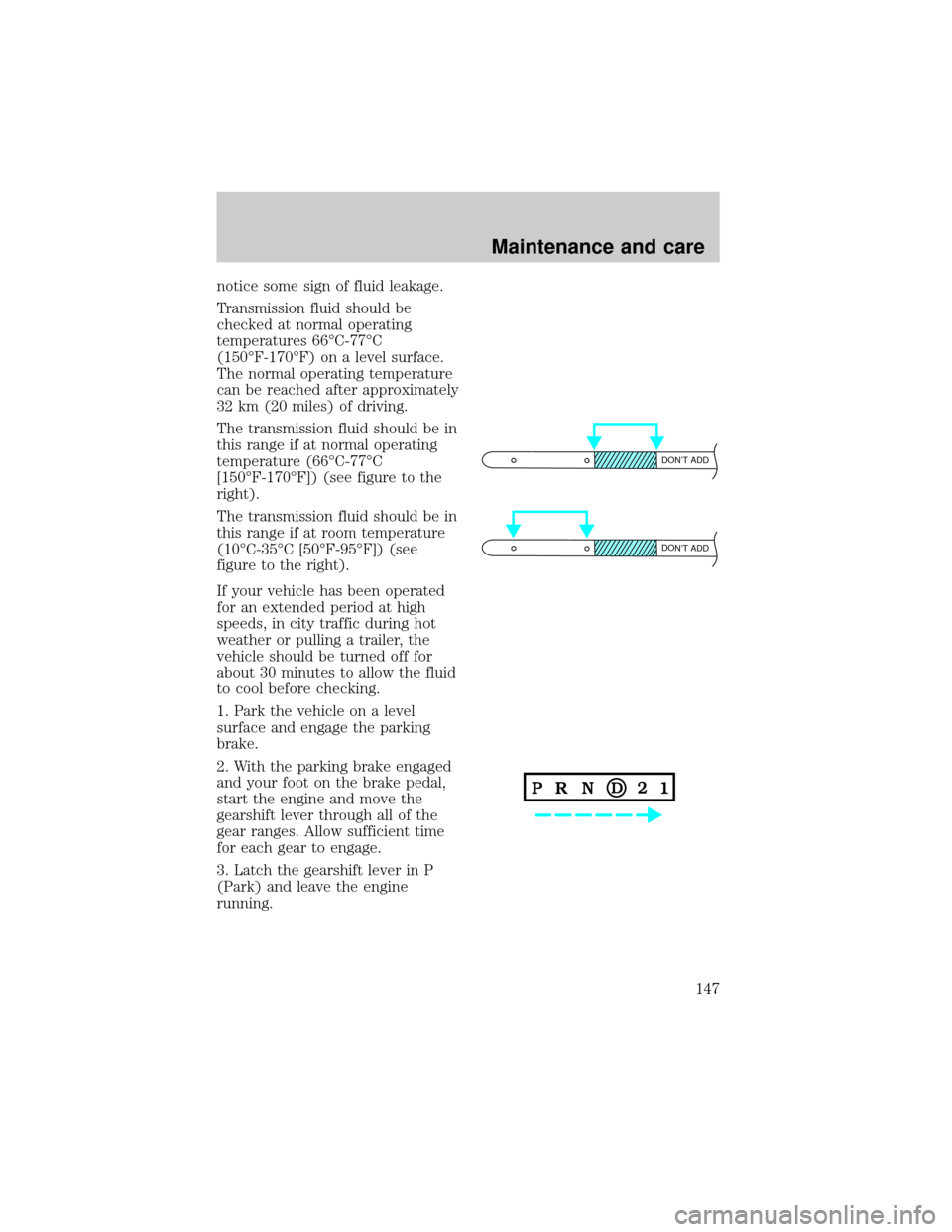
The transmission fluid should be in
this range if at normal operating
temperature (66ÉC-77ÉC
[150ÉF-170ÉF]) (see figure to the
right).
The transmission fluid should be in
this range if at room temperature
(10ÉC-35ÉC [50ÉF-95ÉF]) (see
figure to the right).
If your vehicle has been operated
for an extended period at high
speeds, in city traffic during hot
weather or pulling a trailer, the
vehicle should be turned off for
about 30 minutes to allow the fluid
to cool before checking.
1. Park the vehicle on a level
surface and engage the parking
brake.
2. With the parking brake engaged
and your foot on the brake pedal,
start the engine and move the
gearshift lever through all of the
gear ranges. Allow sufficient time
for each gear to engage.
3. Latch the gearshift lever in P
(Park) and leave the engine
running.
DON’T ADD
DON’T ADD
Maintenance and care
147
Page 149 of 188

quantity of grease to the top of
each battery terminal to help
prevent corrosion.
If your battery has a
cover/shield, make sure it is
reinstalled after the battery is
replaced.
Because your vehicle's engine is
electronically controlled by a
computer, some control conditions
are maintained by power from the
battery. When the battery is
disconnected or a new battery is
installed, the engine must relearn
its idle conditions before your
vehicle will drive properly. To
begin this process:
1. Put the gearshift in P (Park),
turn off all accessories and start
the vehicle.
2. Let the engine idle for at least
one minute.
3. The relearning process will
automatically complete as you
drive the vehicle.
²If you do not allow the engine to
relearn its idle, the idle quality
of your vehicle may be adversely
affected until the idle is
eventually relearned.
²If the battery has been
disconnected or a new battery
has been installed, the clock and
the preset radio stations must
be reset once the battery is
reconnected.
Maintenance and care
150
Page 159 of 188

clothing and wash skin
thoroughly with soap and water.
²If fuel is splashed in the eyes,
remove contact lenses, flush
with water for 15 minutes and
seek medical attention.
²Be particularly careful if you are
taking ªAntabuseº or other
forms of disulfiram for the
treatment of alcoholism.
Breathing gasoline vapors or
skin contact could cause an
adverse reaction. Consult a
physician immediately.
Choosing the right fuel
Use only UNLEADED FUEL. The
use of leaded fuel is prohibited by
law and could damage your
vehicle.
Your vehicle was not designed to
use fuel or fuel additives with
metallic compounds, including
manganese-based compounds
containing MMT.
Vehicles certified to California
emission standards (indicated on
the underhood Vehicle Emissions
Control Information label) are
designed to operate on California
reformulated gasolines. If
California reformulated gasoline is
not available when you refuel, your
vehicle can be operated on
non-California fuels. However, even
though your engine will perform
adequately on other gasolines, the
performance of the emission
control devices and systems may
be adversely affected.
Maintenance and care
160
Page 160 of 188
Repair of damage caused by using
a fuel that your vehicle was not
designed for may not be covered
by your warranty.
Octane recommendations
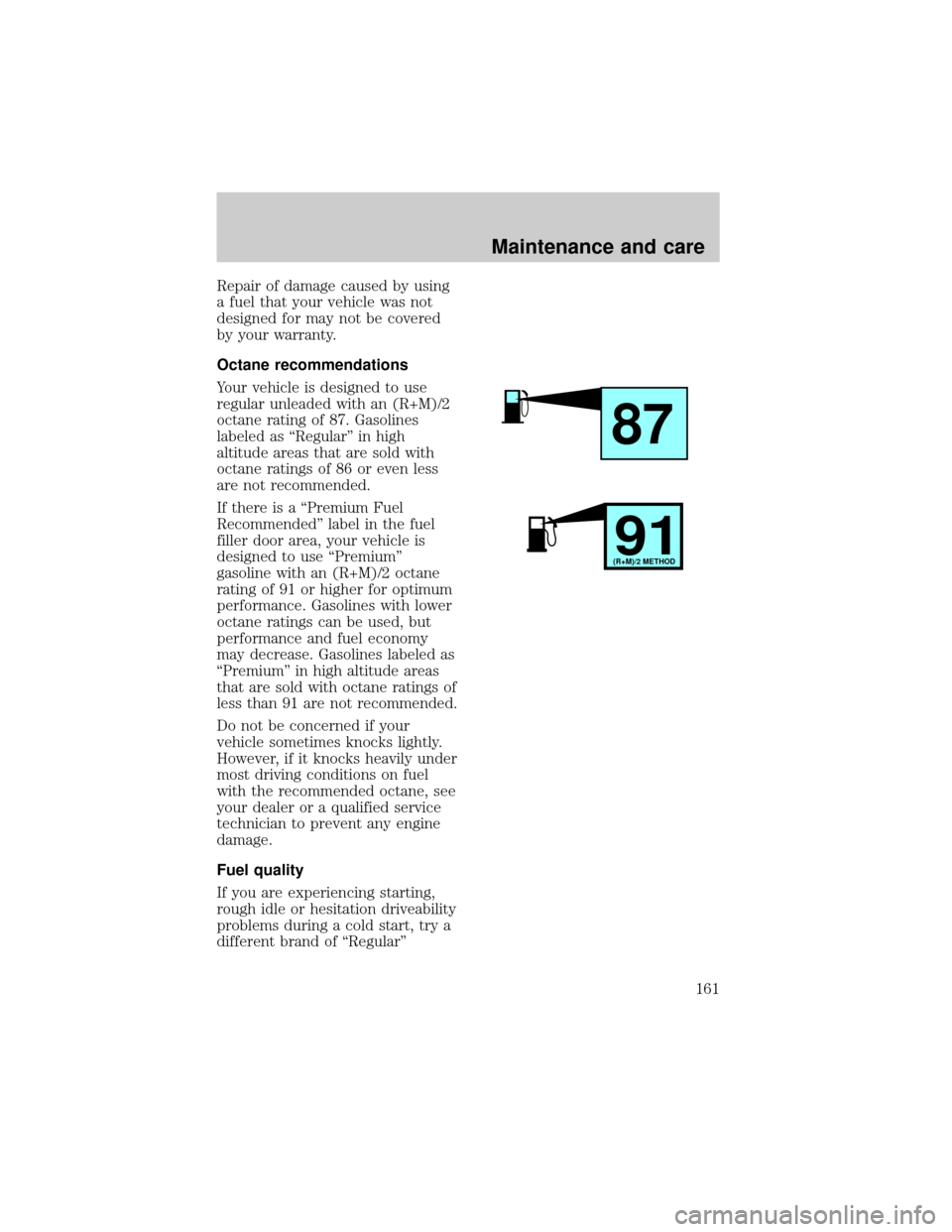
Your vehicle is designed to use
regular unleaded with an (R+M)/2
octane rating of 87. Gasolines
labeled as ªRegularº in high
altitude areas that are sold with
octane ratings of 86 or even less
are not recommended.
If there is a ªPremium Fuel
Recommendedº label in the fuel
filler door area, your vehicle is
designed to use ªPremiumº
gasoline with an (R+M)/2 octane
rating of 91 or higher for optimum
performance. Gasolines with lower
octane ratings can be used, but
performance and fuel economy
may decrease. Gasolines labeled as
ªPremiumº in high altitude areas
that are sold with octane ratings of
less than 91 are not recommended.
Do not be concerned if your
vehicle sometimes knocks lightly.
However, if it knocks heavily under
most driving conditions on fuel
with the recommended octane, see
your dealer or a qualified service
technician to prevent any engine
damage.
Fuel quality
If you are experiencing starting,
rough idle or hesitation driveability
problems during a cold start, try a
different brand of ªRegularº
87
91(R+M)/2 METHOD
Maintenance and care
161

