Page 11 of 188
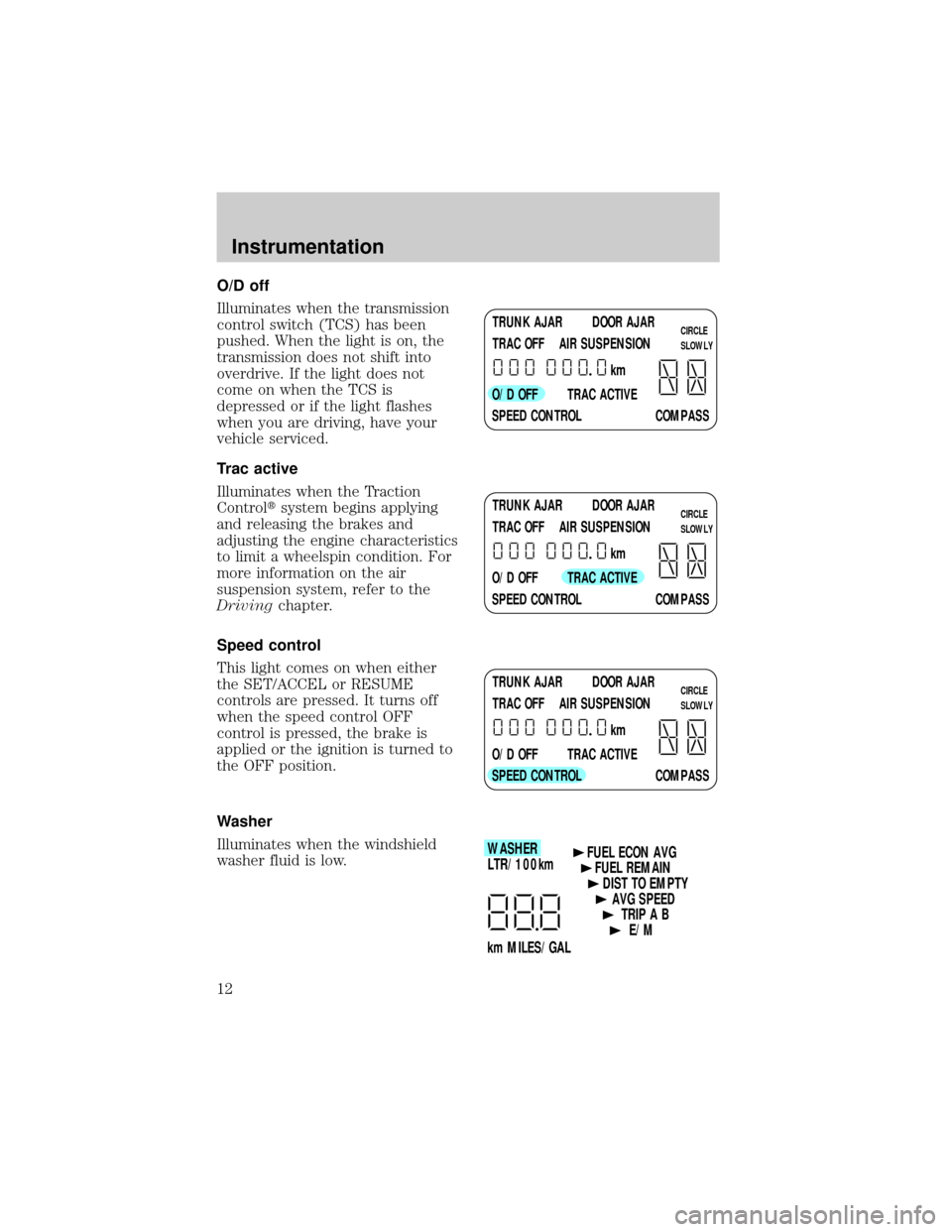
O/D off
Illuminates when the transmission
control switch (TCS) has been
pushed. When the light is on, the
transmission does not shift into
overdrive. If the light does not
come on when the TCS is
depressed or if the light flashes
when you are driving, have your
vehicle serviced.
Trac active
Illuminates when the Traction
Controltsystem begins applying
and releasing the brakes and
adjusting the engine characteristics
to limit a wheelspin condition. For
more information on the air
suspension system, refer to the
Drivingchapter.
Speed control
This light comes on when either
the SET/ACCEL or RESUME
controls are pressed. It turns off
when the speed control OFF
control is pressed, the brake is
applied or the ignition is turned to
the OFF position.
Washer
Illuminates when the windshield
washer fluid is low.
TRUNK AJAR DOOR AJAR
TRAC OFF AIR SUSPENSION
O/D OFF TRAC ACTIVE
SPEED CONTROL COMPASSkmCIRCLE
SLOWLY
TRUNK AJAR DOOR AJAR
TRAC OFF AIR SUSPENSION
O/D OFF TRAC ACTIVE
SPEED CONTROL COMPASSkmCIRCLE
SLOWLY
TRUNK AJAR DOOR AJAR
TRAC OFF AIR SUSPENSION
O/D OFF TRAC ACTIVE
SPEED CONTROL COMPASSkmCIRCLE
SLOWLY
WASHER
LTR/100km
km MILES/GALFUEL ECON AVG
FUEL REMAIN
DIST TO EMPTY
AVG SPEED
TRIP A B
E/M
Instrumentation
12
Page 106 of 188
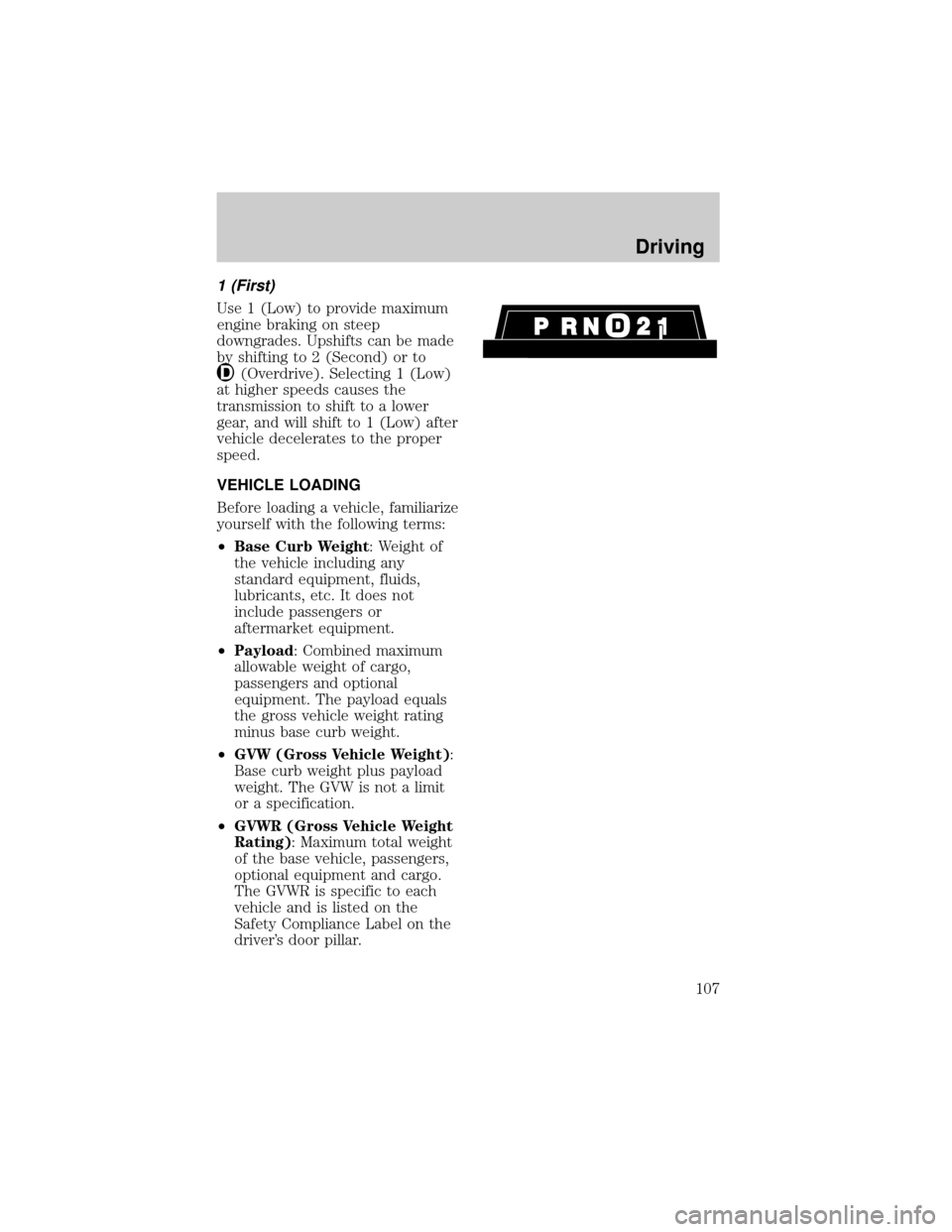
1 (First)
Use 1 (Low) to provide maximum
engine braking on steep
downgrades. Upshifts can be made
by shifting to 2 (Second) or to
(Overdrive). Selecting 1 (Low)
at higher speeds causes the
transmission to shift to a lower
gear, and will shift to 1 (Low) after
vehicle decelerates to the proper
speed.
VEHICLE LOADING
Before loading a vehicle, familiarize
yourself with the following terms:
²Base Curb Weight: Weight of
the vehicle including any
standard equipment, fluids,
lubricants, etc. It does not
include passengers or
aftermarket equipment.
²Payload: Combined maximum
allowable weight of cargo,
passengers and optional
equipment. The payload equals
the gross vehicle weight rating
minus base curb weight.
²GVW (Gross Vehicle Weight):
Base curb weight plus payload
weight. The GVW is not a limit
or a specification.
²GVWR (Gross Vehicle Weight
Rating): Maximum total weight
of the base vehicle, passengers,
optional equipment and cargo.
The GVWR is specific to each
vehicle and is listed on the
Safety Compliance Label on the
driver's door pillar.
Driving
107
Page 133 of 188
IDENTIFYING COMPONENTS IN
THE ENGINE COMPARTMENT
4.6L 2V engine
1. Transmission fluid dipstick
2. Brake fluid reservoir
3. Engine oil fill cap
4. Engine oil dipstick
5. Power steering fluid reservoir
6. Windshield washer fluid
reservoir
7. Air filter assembly
8. Battery
9. Engine coolant reservoir
61234
9578
Maintenance and care
134
Page 145 of 188

5. If the fluid is low, add fluid in
small amounts, continuously
checking the level until it reaches
the range between the MIN and
MAX lines. Be sure to put the cap
back on the reservoir.
TRANSMISSION FLUID
Checking and adding automatic
transmission fluid
Follow the scheduled service
intervals outlined in the ªService
Guide.º
Before adding any fluid, make sure
the correct type is used. The type
of fluid used is normally indicated
on the dipstick and/or dipstick
handle and also in theLubricant
specificationssection in the
Capacities and specifications
chapter.
An overfill condition of
transmission fluid may cause
shift and/or engagement
concerns and/or possible
damage.
Do not drive the vehicle if the fluid
level is below the bottom hole on
the dipstick and outside
temperatures are above 10ÉC
(50ÉF) (see figure to the right).
Your transmission does not use up
fluid. However, it is recommended
that you check the transmission
fluid at least twice a year. The
fluid level should be checked if the
transmission is not working
properly, i.e., if the transmission
slips or shifts slowly or if you
DON’T ADD
Maintenance and care
146
Page 146 of 188
notice some sign of fluid leakage.
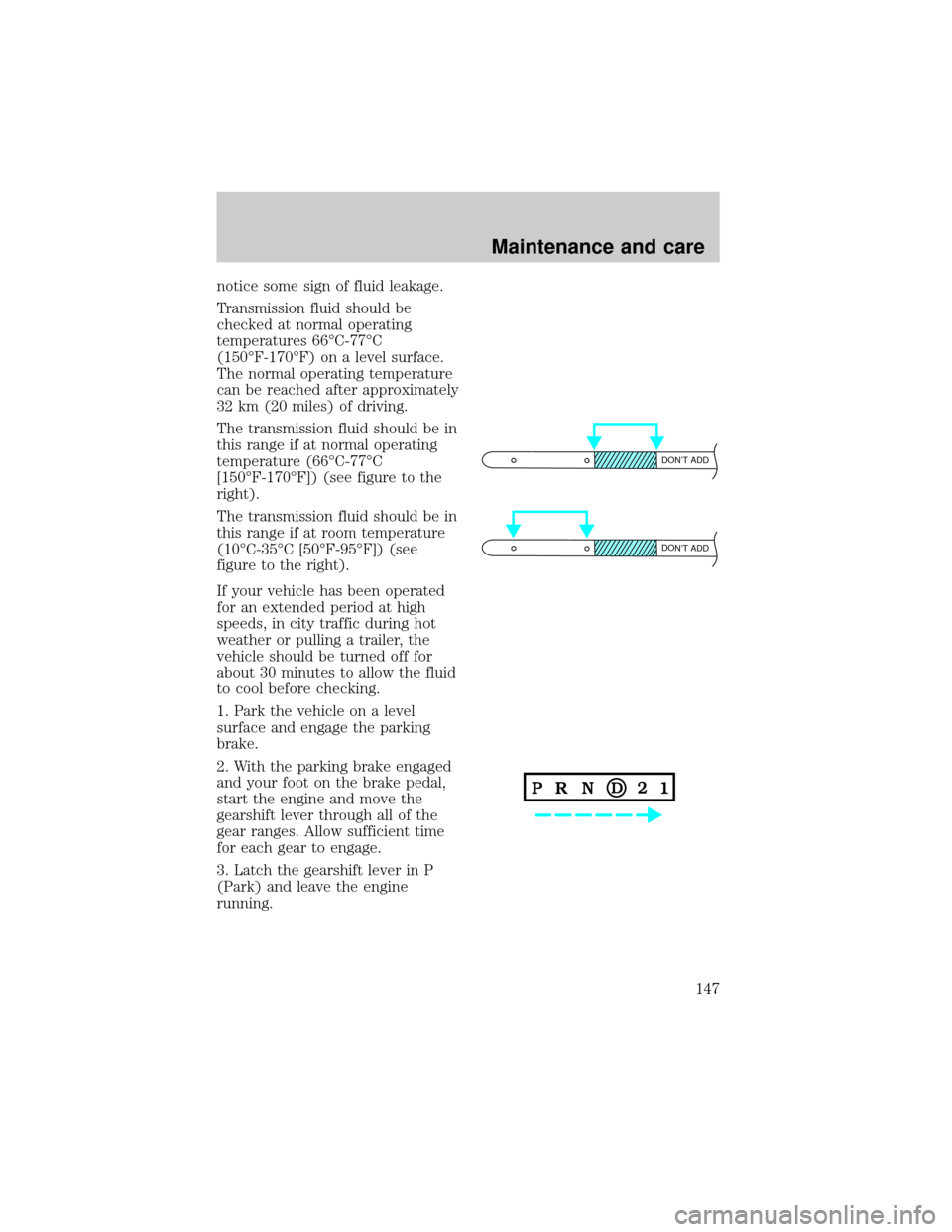
Transmission fluid should be
checked at normal operating
temperatures 66ÉC-77ÉC
(150ÉF-170ÉF) on a level surface.
The normal operating temperature
can be reached after approximately
32 km (20 miles) of driving.
The transmission fluid should be in
this range if at normal operating
temperature (66ÉC-77ÉC
[150ÉF-170ÉF]) (see figure to the
right).
The transmission fluid should be in
this range if at room temperature
(10ÉC-35ÉC [50ÉF-95ÉF]) (see
figure to the right).
If your vehicle has been operated
for an extended period at high
speeds, in city traffic during hot
weather or pulling a trailer, the
vehicle should be turned off for
about 30 minutes to allow the fluid
to cool before checking.
1. Park the vehicle on a level
surface and engage the parking
brake.
2. With the parking brake engaged
and your foot on the brake pedal,
start the engine and move the
gearshift lever through all of the
gear ranges. Allow sufficient time
for each gear to engage.
3. Latch the gearshift lever in P
(Park) and leave the engine
running.
DON’T ADD
DON’T ADD
Maintenance and care
147
Page 147 of 188
4. Remove the dipstick, wiping it
clean with a clean, dry lint free
rag.
5. Install the dipstick making sure
it is fully seated in the filler tube.
6. Remove the dipstick and inspect
the fluid level. The fluid level
should be within the top hole area
on the dipstick.
7. If necessary, add fluid in 250ml
(1/2 pint) increments through the
filler tube until the level is correct.
8. If an overfill occurs, excess fluid
should be removed by a qualified
technician.
An overfill condition of
transmission fluid may cause
shift and/or engagement
concerns and/or possible
damage.
If the fluid level is above the
crosshatch (hot operating range)
area after driving the vehicle for
approximately 30 km (20 miles),
excess transmission fluid should be
removed by a qualified technician.
DON’T ADD
Maintenance and care
148
Page 179 of 188
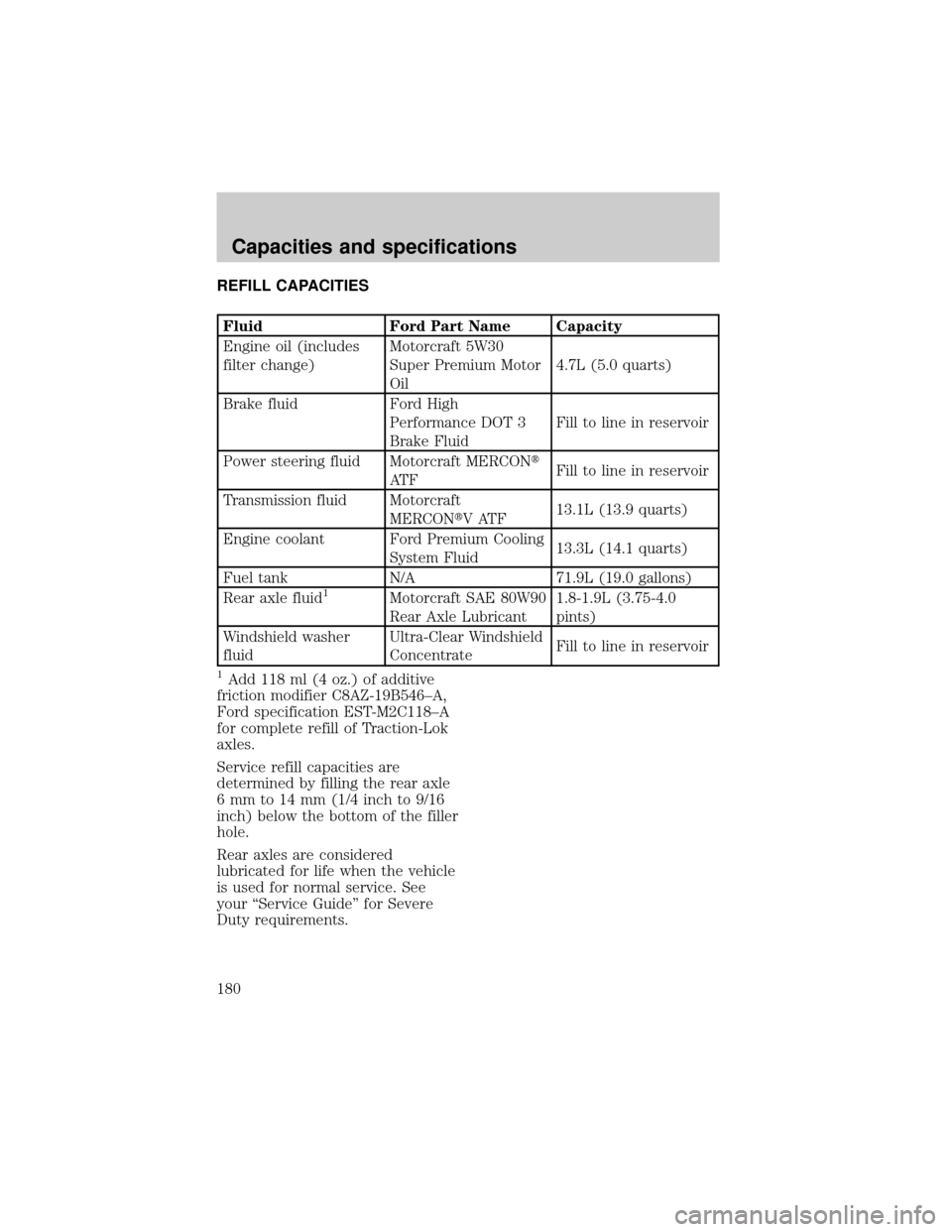
REFILL CAPACITIES
Fluid Ford Part Name Capacity
Engine oil (includes
filter change)Motorcraft 5W30
Super Premium Motor
Oil4.7L (5.0 quarts)
Brake fluid Ford High
Performance DOT 3
Brake FluidFill to line in reservoir
Power steering fluid Motorcraft MERCONt
AT FFill to line in reservoir
Transmission fluid Motorcraft
MERCONtVATF13.1L (13.9 quarts)
Engine coolant Ford Premium Cooling
System Fluid13.3L (14.1 quarts)
Fuel tank N/A 71.9L (19.0 gallons)
Rear axle fluid
1Motorcraft SAE 80W90
Rear Axle Lubricant1.8-1.9L (3.75-4.0
pints)
Windshield washer
fluidUltra-Clear Windshield
ConcentrateFill to line in reservoir
1Add 118 ml (4 oz.) of additive
friction modifier C8AZ-19B546±A,
Ford specification EST-M2C118±A
for complete refill of Traction-Lok
axles.
Service refill capacities are
determined by filling the rear axle
6 mm to 14 mm (1/4 inch to 9/16
inch) below the bottom of the filler
hole.
Rear axles are considered
lubricated for life when the vehicle
is used for normal service. See
your ªService Guideº for Severe
Duty requirements.
Capacities and specifications
180
Page 180 of 188
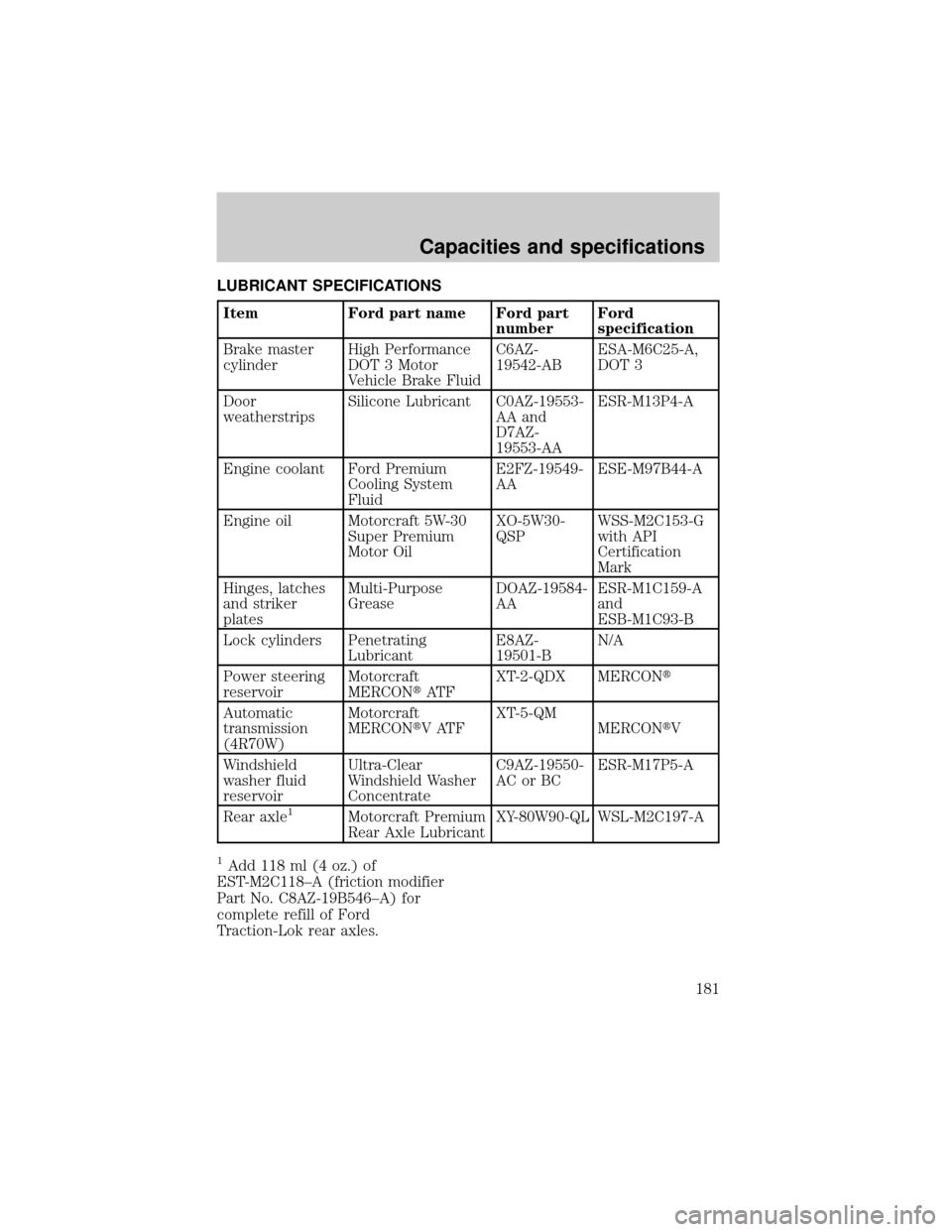
LUBRICANT SPECIFICATIONS
Item Ford part name Ford part
numberFord
specification
Brake master
cylinderHigh Performance
DOT 3 Motor
Vehicle Brake FluidC6AZ-
19542-ABESA-M6C25-A,
DOT 3
Door
weatherstripsSilicone Lubricant C0AZ-19553-
AA and
D7AZ-
19553-AAESR-M13P4-A
Engine coolant Ford Premium
Cooling System
FluidE2FZ-19549-
AAESE-M97B44-A
Engine oil Motorcraft 5W-30
Super Premium
Motor OilXO-5W30-
QSPWSS-M2C153-G
with API
Certification
Mark
Hinges, latches
and striker
platesMulti-Purpose
GreaseDOAZ-19584-
AAESR-M1C159-A
and
ESB-M1C93-B
Lock cylinders Penetrating
LubricantE8AZ-
19501-BN/A
Power steering
reservoirMotorcraft
MERCONtAT FXT-2-QDX MERCONt
Automatic
transmission
(4R70W)Motorcraft
MERCONtVATFXT-5-QM
MERCONtV
Windshield
washer fluid
reservoirUltra-Clear
Windshield Washer
ConcentrateC9AZ-19550-
AC or BCESR-M17P5-A
Rear axle
1Motorcraft Premium
Rear Axle LubricantXY-80W90-QL WSL-M2C197-A
1Add 118 ml (4 oz.) of
EST-M2C118±A (friction modifier
Part No. C8AZ-19B546±A) for
complete refill of Ford
Traction-Lok rear axles.
Capacities and specifications
181

