1998 JAGUAR X308 rear suspension
[x] Cancel search: rear suspensionPage 311 of 2490

P
INPOINT TEST A : BRAKES NOISY
TE
ST
CONDITIONS
D
ETAILS/RESULTS/ACTIONS
A1
: INSPECT BRAKE PADS
Inspect the condi
tion of the front and rear brake
pads. Check for damage to any anti-squeal shims.
1
Are th
e brake pads OK?
Yes GO to A2
.
No
CLEAN the front brake pads or INSTALL new front brak e pads if necessary. For additional information,
refer toSection 206
-03
Front Disc Brake
. CLEA
N the rear brake pads or INSTALL new rear brake pads
if necessary. For additional information, refer toSection 206
-0
4 Rear Disc Brake
.
Test vehicle for
presence of brake squeal.
A2
: INSPECT BRAKE DISCS
Inspe
ct the brake discs for excessive corrosi
on, wear or disc thickness variation.
1
D
oes excessive corrosion, wear or
disc thickness variation exist?
REFER to Specification
- in t
his section.
Yes INSTALL new front brake discs and brake pads. For additional information, refer toSection 206
-03
Fr
ont Disc Brake
. INSTALL n
ew rear brake discs and brake
pads. For additional information, refer
toSection 206
-0
4 Rear Disc Brake
. TEST
the system for normal operation.
No Vehicle is OK.
P
INPOINT TEST B : VIBRATIO
N WHEN BRAKES ARE APPLIED
TE
ST
CONDITIONS
D
ETAILS/RESULTS/ACTIONS
B1
: ROAD TEST VEHICLE
R
oad test the vehicle between 40-80 km/h (25-50 mph) without applying brakes.
1
Is th
e vibration present?
Yes TEST for noise vibration and harshness. REPEAT road test if necessary.
No GO to B2
. .
B2
: CHECK FOR BRAKE VIBRATION
R
oad test the vehicle between 40-80 km/h (25-50
mph) with light and medium application on the
brake pedal.
1
Is a vibration
present?
Yes If the vibration is from the front of the vehicle GO to B3
. If
the vibration is
from the rear of the
vehicle or can not be di agnosed between front or rear of the vehicle GO to B6
.
No
Vehicle is OK.
B3: CHECK
THE SUSPENSION
AND STEERING COMPONENTS
Chec
k the condition of the front susp
ension bushes and ball joints
REFER to Section 204
-01
Front Suspension
.
Chec
k the condition of the steering linkage components
REFER to Section 211
-0
2 Power Steering
/
211
-0
3 Steering Linkage
.
1
D
o any of the front suspension components or steering comp
onents require replacement?
Yes INSTALL new components as necessary
REFER to Section 204
-01
Front Suspension
/
211
-0
2 Power Steering
/
211
-0
3 Steering Linkage
.
R
oad test the vehicle between 40-80 km/h (25-50
mph) with light and medium application on the
brake pedal. If vibr ation still exists GO to B4
.
No
GO to B4
.
B4: CHECK
THE FRONT BRAKE PA
DS AND FRONT BRAKE DISCS
Chec
k the condition of the front br
ake pads and front brake discs.
1
D
oes excessive brake disc runout or br
ake disc thickness variation exist?
Page 312 of 2490
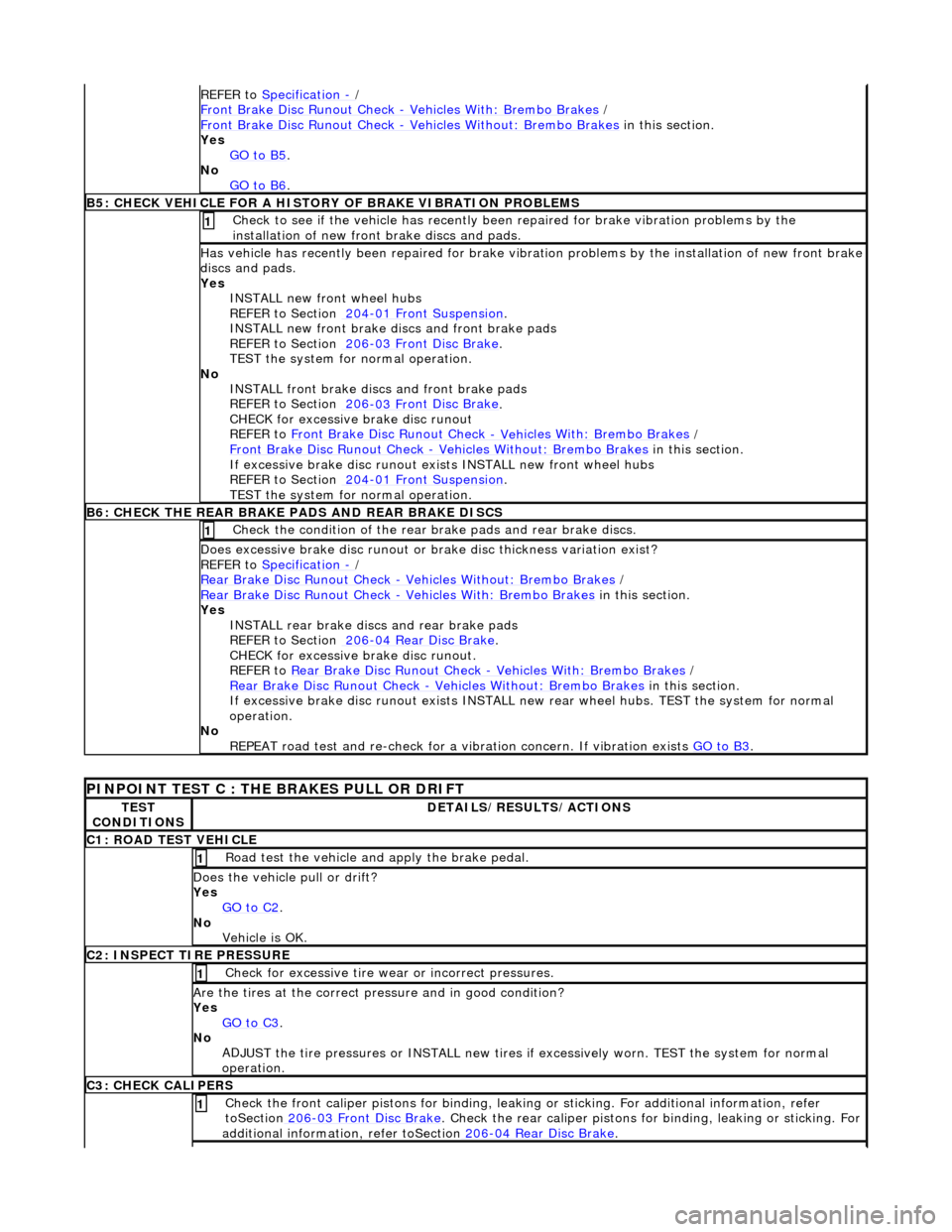
REFE
R to
Specification
- /
F r
ont Brake Disc Runout Check
- V
eh
icles With: Brembo Brakes
/
F
ront Brake Disc Runout Check
- V
e
hicles Without: Brembo Brakes
in this
section.
Yes GO to B5
.
No
GO to B6
.
B5: CHECK VEHICLE
FOR A HISTORY OF BRAKE VIBRATION PROBLEMS
Chec
k to se
e if the vehicle has recently been
repaired for brake vibration problems by the
installation of new front brake discs and pads.
1
Has vehicl
e has recently been repaired for brake vibrat
ion problems by the installation of new front brake
discs and pads.
Yes INSTALL new front wheel hubs
REFER to Section 204
-01 Fron
t Suspension
.
INST ALL new fr
ont brake disc
s and front brake pads
REFER to Section 206
-03 Fr
ont Disc Brake
.
TEST the system for normal
operation.
No INSTALL front brake discs and front brake pads
REFER to Section 206
-03 Fr
ont Disc Brake
.
CHECK for excessiv
e brake disc runout
REFER to Front Brake Disc Runout Check
- Veh
icles With: Brembo Brakes
/
F
ront Brake Disc Runout Check
- V
e
hicles Without: Brembo Brakes
in this
section.
If excessive brake disc runout exis ts INSTALL new front wheel hubs
REFER to Section 204
-01 Fron
t Suspension
.
TEST the system for normal
operation.
B
6:
CHECK THE REAR BRAKE PADS AND REAR BRAKE DISCS
Chec
k
the condition of the rear brake pads and rear brake discs.
1
D
o
es excessive brake disc runout or br
ake disc thickness variation exist?
REFER to Specification
- /
Rear B
rake Disc Runout Check
- Ve
hicles Without: Brembo Brakes
/
Rear
Brake Disc Runout Check
- Veh
icles With: Brembo Brakes
in this
section.
Yes INSTALL rear brake discs and rear brake pads
REFER to Section 206
-04
Rear Disc Brake
.
CHECK for excessiv
e brake disc runout.
REFER to Rear Brake Disc Runout Check
- Veh
icles With: Brembo Brakes
/
Rear
Brake Disc Runout Check
- V
e
hicles Without: Brembo Brakes
in this
section.
If excessive brake disc runout exists INSTALL ne w rear wheel hubs. TEST the system for normal
operation.
No REPEAT road test and re-check for a vi bration concern. If vibration exists GO to B3
.
PINPOINT TEST
C : THE BRAKES PULL OR DRIFT
TE
S
T
CONDITIONS
D E
TAILS/RESULTS/ACTIONS
C1
:
ROAD TEST VEHICLE
Road test th
e veh
icle and apply the brake pedal.
1
D
o
es the vehicle pull or drift?
Yes GO to C2
.
No
Vehicle is OK.
C2:
INS
PECT TIRE PRESSURE
Check f
or ex
cessive tire wear
or incorrect pressures.
1
Are the ti
res at the correct pressure and in good condition?
Yes GO to C3
.
No
AD
JUST the tire pressures or IN
STALL new tires if excessively wo rn. TEST the system for normal
operation.
C3 : CH
ECK CALIPERS
Check the fr
on
t caliper pistons for binding, leakin
g or sticking. For additional information, refer
toSection 206
-03 Fr
ont Disc Brake
. Check the rear cal
i
per pistons for
binding, leaking or sticking. For
additional information, refer toSection 206
-04
Rear Disc Brake
.
1
Page 313 of 2490

Do t
he disc brake caliper pistons
and pins bind, leak or stick?
Yes INSTALL new calipers as necessary. TE ST the system for normal operation.
No GO to C4
.
C4: INSPECT BR
AKE DISCS
Check the brake discs fo
r excess
ive damage, thickness variatio n or runout. For additional
information, refer to General Procedures in this section.
1
D
oes excessive damage or runout exist?
Yes INSTALL new brake discs and brak e pads as necessary. TEST the system for normal operation.
No GO to C5
.
C5: INSPECT THE FRONT HU
B AND WHEEL BEARING ASSEMBLY
Check the fr
ont hub and wheel bearing assembly.
For additional information, refer toSection 204
-00
Su
spension System
- General
Information
. 1
Are th
e wheel bearings OK?
Yes GO to C6
.
No
INSTALL new wheel bearings. For additional inform ation, refer toSection 204
-01
Front Suspension
.
TEST the system
for normal operation.
C
6: CHECK SUSPENSION BUSHES AND BALL JOINTS.
Chec
k all suspension bu
shes and ball joints.
1
Are th
e suspension bushes and ball joints OK?
Yes Vehicle is OK.
No INSTALL new front suspension bushes and ball joints as required. For additional information, refer
toSection 204
-01
Front Suspension
. INSTALL n
ew rear suspension bush
es and ball joints as required.
For additional informat ion, refer toSection 204
-0
2 Rear Suspension
.
P
INPOINT TEST D : THE PEDAL FEELS SPONGY
TE
ST
CONDITIONS
D
ETAILS/RESULTS/ACTIONS
D
1: CHECK FOR SPONGY PEDAL (ENGINE OFF)
Check f
or a firm brake pedal.
1
Is th
e brake pedal effort an
d brake pedal travel normal?
Yes Vehicle is OK.
No GO to D2
.
D2:
CHECK BRAKE PEDAL RESERVE (ENGINE OFF)
Pump th
e brake pedal 10 times and
hold on the final application.
1
Does th
e brake pedal feel fi
rm on final application?
Yes GO to D3
.
No
BLEED the brake system. For additional information, re fer to General Procedures in this section. TEST
the system for normal operation.
D3:
CHECK BRAKE PEDAL RESERVE (ENGINE ON)
Engine is
idle.
1
Apply the brake pedal ligh
tl
y three or four times.
2
W
ait 15 seconds for the vacuum to recover.
3
Push down on
the brake pedal until it stops moving
downward or an increased resistance to the brake
pedal travel occurs.
4
Hol
d the brake pedal in the applied position while increasing the engine speed to 2000 revs/min.
5
Re
lease the accelerator pedal.
6
Does th
e brake pedal move downward as
the engine speed returns to idle?
Yes GO to D4
.
No
CHECK the vacuum to brake booster. For additional information, refer toSection 206
-0
7 Power Brake
Actuation.
Page 317 of 2490

Yes
Vehicle is OK.
No GO to J2
.
J
2: CHECK BRAKE FLUID LEVEL
Check the brake master cyli
nder reservoir fluid level.
1
Is the fl
uid level OK?
Yes GO to J3
.
No
CHECK brake master cylinder reservoir sealing points. For additional information, refer to Brake
Master Cylinder in this section. ADD brake fl uid and BLEED the brake system. For additional
information, refer to General Proc edures in this section. TEST the system for normal operation.
REPEAT road test if necessary.
J
3: CHECK BRAKE PEDAL RESERVE
Engine is
idle.
1
Apply the brake pedal ligh
tl
y three or four times.
2
W
ait 15 seconds for the vacuum to replenish.
3
Push down on
the brake pedal until it stops moving
downward or an increased resistance to the brake
pedal travel occurs.
4
Hol
d the brake pedal in the applied position while increasing the engine speed to 2000 revs/min.
5
Re
lease the accelerator pedal.
6
Does th
e brake pedal move downward as
the engine speed returns to idle?
Yes GO to J4
.
No
CHECK the vacuum to the brake booster. Fo r additional information, refer toSection 206
-0
7 Power
Brake Ac
tuation
.
J
4: CHECK THE FRONT HUB AND BEARING ASSEMBLY
Check the fr
ont hub and bearing assembly. Fo
r additional information, refer toSection 204
-01
Front
Suspe
nsion
. 1
Are th
e front wheel bearings loose?
Yes INSTALL a new front wheel bearin g if damaged. For additional information, refer toSection 204
-01
F
ront Suspension
. TEST
the system for normal operation.
No CHECK the front brake discs for thickness variances. For additional information, refer to General
Procedures in this section.
PINPO
INT TEST K : SLOW OR INCOMPLETE BRAKE PEDAL RETURN
TE
ST
CONDITIONS
D
ETAILS/RESULTS/ACTIONS
K1: C
HECK FOR BRAKE PEDAL RETURN
Ru
n the engine at fast idle while
making several brake applications.
1
Pull the
brake pedal rearward with approximately 44.5 N (10lb) force.
2
Relea
se the brake pedal and measure
the distance to the toe board.
3
Make a hard brake
application.
4
Relea
se the brake pedal and measure the brake
pedal to toe board distance. The brake pedal
should return to its original position.
5
Does th
e brake pedal return
to its original position?
Yes Vehicle is OK.
No GO to K2
.
K
2: CHECK FOR BRAKE PEDAL BINDING
Check the brake pedal to make
s
ure it is operating freely.
1
Is th
e brake pedal operating freely?
Yes INSTALL a new brake booster. For addi tional information, refer toSection 206
-0
7 Power Brake
Actuation. TEST
the system for normal operation.
No REPAIR or INSTALL new brake pedal. TE ST the system for normal operation.
Page 460 of 2490

Vehicl
e wanders from side to
side on the road, when the vehicle is driven straight ahead and the steering wheel is held in a firm position
Incorrect ti re
pressure or
tire size.
CHECK and ADJ
UST the tire pressure. For
additional information,
REFER to Section 204
-0 4
Wheels and Tires
. IN
ST
ALL a new tire as necessary. For
additional information,
REFER to Section 204
-0 4
Wheels and Tires
.
Vehi
cl
e is unevenly or
excessively loaded.
A D
JUST the load evenly.
Loose/worn ti
e-
rods.
INST
ALL a ne
w tie-rod
end. For additional
information,
REFER to Section 211
-0 3
Steering Linkage
.
Steeri
ng gear bolts loose
o
r damaged.
TIGHTE
N or INSTALL
new bolts.
Loose or worn suspensi
on
ball jo
int(s).
INST
ALL a ne
w suspension ball joint
assembly. For additional information,
REFER to Section 204
-01 Fron
t Suspension
.
Steeri
ng column uni
versal
joint pinch bolt loose.
TI G
HTEN the steering column universal joint
pinch bolt. For additi onal information,
REFER to Section 211
-0 4
Steering Column
.
Incorre
ct
toe adjustment.
ADJUS
T as necessary. For additional
information,
REFER to Section 204
-00 Sus
pension
Sy
ste
m
- General
Information
.
Loose or worn rear
susp
ension.
TIGHTEN
loose, or IN
STALL new rear
suspension components. For additional information,
REFER to Section 204
-0 2
Rear Suspension
.
Vehicle t
e
nds to pull to one
side when driven on a level surface
Incorrect ti
re pressure.
Incorrect
ti
re size or
different tire/tread type.
Uneven tire wear
CHECK and ADJ
UST the tire pressure. For
additional information,
REFER to Section 204
-0 4
Wheels and Tires
. IN
ST
ALL a new tire as necessary. For
additional information,
REFER to Section 204
-04
Wheels and Tires
.
Vehicl
e is unevenly loaded
or overloaded.
Adjust the load
.
Incorre
ct
toe adjustment.
ADJUS
T as necessary. For additional
information,
REFER to Section 204
-00 Sus
pension
Sy
ste
m
- General
Information
.
Dam
a
ged front suspension
components.
I N
STALL new front suspension components
as necessary. For addi tional information,
REFER to Section 204
-01 Fron
t Suspension
.
Damaged rear
suspen
sion
components.
INST ALL ne
w rear suspension components
as necessary. For addi tional information,
REFER to Section 204
-0 2
Rear Suspension
.
Steeri
ng gear val
ve effort
out of balance.
SHIF T the
transmission into NEUTRAL while
driving at no more than 30 miles/hour (50 km/h) and turn the ignition to position I
(engine OFF-coasting). If the vehicle does
not pull with the engine off, INSTALL a new steering gear. For additional information,
REF E
R to Section 211
-0
2
Power Steering
. If t
he
vehicle does drift with the engine off,
CROSS SWITCH front wheel assemblies.
If the
vehicle pulls to
the opposite side,
SWITCH wheels that were on the rear to the
same side on the front.
If the v
ehicle pull dire
ction is not changed,
CHECK the front susp ension components
and toe adjustments. For additional information,
REFER to Section 204
-01 Fron
t Suspension
.
Chec
k
the front and rear
brakes for correct operation.
ADJUS
T as necessary. For additional
information,
REFER to Section 206
-0 0
Brake System
-
General Informati on.
Check fo
r bent rear
INST
ALL ne
w rear suspension components
Page 461 of 2490

sus
pension components
and for damaged coil springs in the front suspension.
as necessary. For addi tional information,
REF
ER to Section 204
-0
2 Rear Suspension
. I
NSTALL new front suspension components
as necessary. For addi tional information,
REFER to Section 204
-01
Front Suspension
.
Chec
k the rear suspension
for loose or worn
suspension components.
TIGHTE
N or INSTALL new components as
necessary. For additi onal information,
REFER to Section 204
-0
2 Rear Suspension
.
Incorre
ct underbody
alignment.
CHECK
underbody alignment. For additional
information,
REFER to Section 502
-00
Uni
-Body, Subframe and M
ounting System
.
Poor r
eturnability of the
steering
Lower steeri
ng column
interference.
CHECK
the steering co
lumn is free from
interference from the en gine harness, sound
proofing or the floor covering.
Incorrect
tire pressure.
CHECK
and ADJUST the tire pressure. For
additional information,
REFER to Section 204
-0
4 Wheels and Tires
.
Incorrect
tire size or type.
IN
STALL a new tire as necessary. For
additional information,
REFER to Section 204
-0
4 Wheels and Tires
.
Steeri
ng column upper
shroud fouling on the steering wheel.
CHECK
steering column upper shroud for
fouling. ADJUST as necessary.
Steeri
ng column universal
joints binding.
IN
STALL a new steering column. For
additional information,
REFER to Section 211
-0
4 Steering Column
.
Steeri
ng column shaft floor
seal binding.
CHE
CK the steering column shaft floor seal
for correct fitm ent and REFIT as necessary.
Steeri
ng column shaft floor
seal may be torn.
IN
STALL a new steering column shaft floor
seal as necessary.
Bin
ding or damaged tie-
rods.
CHECK
tie-rod end for excessive wear or
tightness in ball joint. INSTALL a new tie- rod end. For additional information,
REFER to Section 211
-0
3 Steering Linkage
.
D
amaged or worn front
suspension components.
I
NSTALL new front suspension components
as necessary. For addi tional information,
REFER to Section 204
-01
Front Suspension
.
Incorre
ct toe adjustment.
AD
JUST as necessary. For additional
information,
REFER to Section 204
-00
Suspension
Sy
stem
- General
Information
.
Excessive steeri
ng efforts
required during low speed
manoeuvring and/or during parking manoeuvres
Low power steer
ing fluid.
CHE
CK steering system
for signs of steering
fluid loss.
BLEE
D the power steering system. For
additional information,
REFER to Section 211
-0
0 Steering System
- General Informati
on
.
Damaged accessory driv
e
belt tensioner.
INST
ALL a new accessory drive belt
tensioner.
Hose or cooler li
ne
restriction.
CHECK
hose or cooler lines for correct
routing.
INST
ALL a new hose as necessary.
Fl
uid aeration.
BLEE
D the system. For additional
information,
REFER to Power Steering System Bleeding
in t
his section.
Steeri
ng transducer not
closed - no feed voltage.
CHECK
the steering transducer circuit. For
additional information, REFER to the wiring diagrams.
Carry ou
t the electrical checks and tests.
For additional information, REFER to the
Electrical Checks and Tests in this section.
Steeri
ng transducer not
closed - cable fault.
CHECK
the steering transducer circuit. For
additional information, REFER to the wiring diagrams.
Carry ou
t the electrical checks and tests.
Page 480 of 2490

The steering rack assembly :
Is mounted on the
rear face of the
front suspension crossbeam by two forg ed mounting brackets with resilient
bushes. The bushes are handed (pinion side and non-pinion side) and are orientated according to the vehicle range
application.
Convert s
the rotary motion of the steering wheel, via the steering gear pinion, to the lateral motion of the rack.
F
e
atures a variable ratio steering
rack with integral hydraulic po wer steering cylinder and piston.
Has a hydrauli
c control valve with Servotronic co
ntrol and positive center feel torsion bar.
The basic steering rack assembly is not serviceable. The following components are serviceable items:
Transfer pipework
.
Servotronic valve. Cent
ralizing cap.
O
u
ter ball joint.
Rac
k
gaiter.
Clips and
fittings.
Steering Rack Components
It e
m
Par
t
Number
De
scr
iption
1—Front
su
spension crossbeam
2—Steeri
ng rack housi
ng
3—Hydraulic
control valve housing
4—Moun
ting bracke
t
5—Gait
er
6—Tie
rod
7—O
u
ter ball joint
Steering R
a
ck Assembly
Page 1522 of 2490
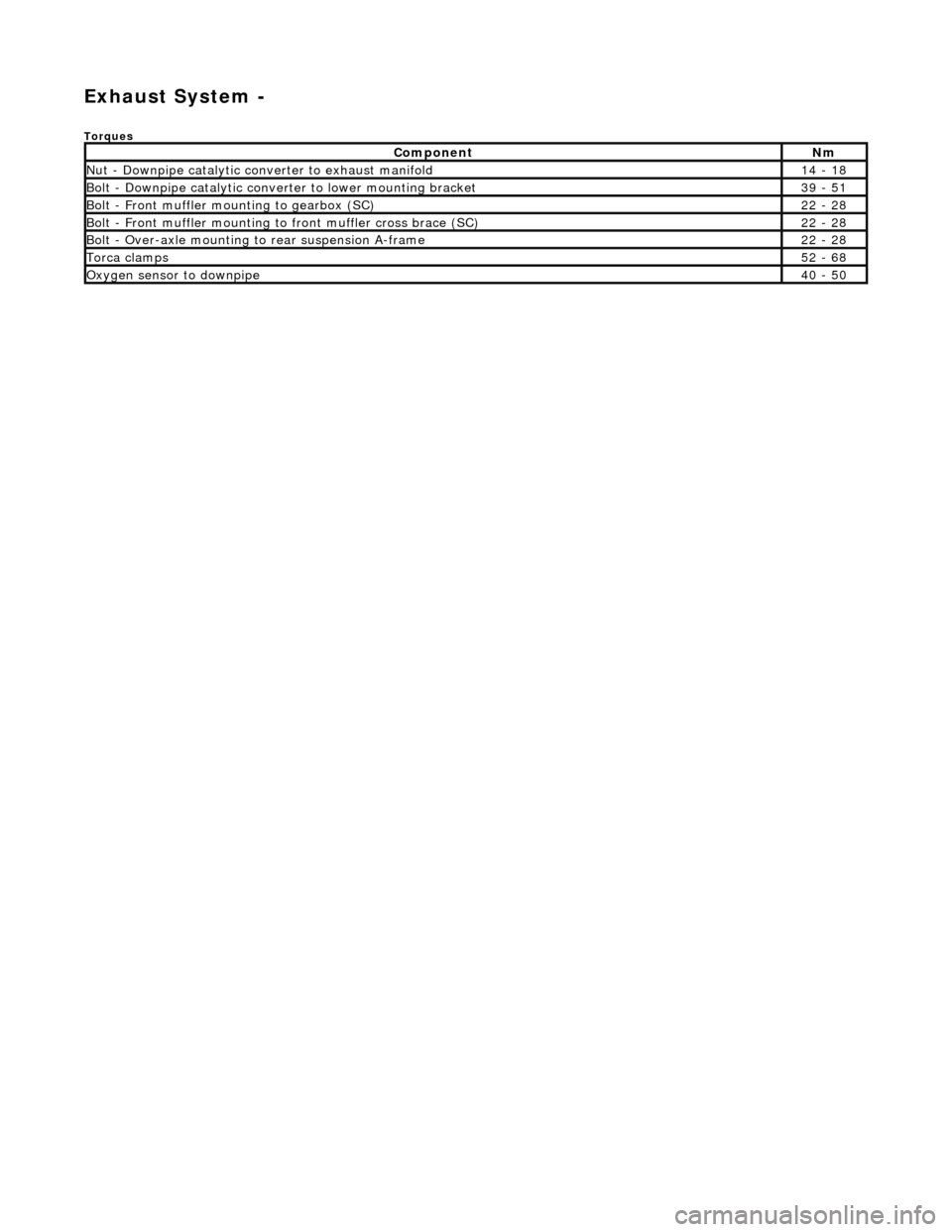
Exhaust System -
Torques
ComponentNm
Nut - Downpipe catalytic converter to exhaust manifold14 - 18
Bolt - Downpipe catalytic converter to lower mounting bracket39 - 51
Bolt - Front muffler mounting to gearbox (SC)22 - 28
Bolt - Front muffler mounting to front muffler cross brace (SC)22 - 28
Bolt - Over-axle mounting to rear suspension A-frame22 - 28
Torca clamps52 - 68
Oxygen sensor to downpipe40 - 50