1998 ISUZU TROOPER air condition
[x] Cancel search: air conditionPage 63 of 3573

00 Ð 24 SERVICE INFORMATION
CHECKING REFRIGERANT SYSTEM
WITH MANIFOLD GAUGE
Conditions;
·Ambient temperature at approx. 25 ~30°C (77
~86°F)
·Run the engine at Idling
·A/C switch is ÒONÓ
·Run the blower motor at Ò4Ó (high) position
·Temperature control knob sets at ÒMAX COLDÓ
·Air source selector lever at ÒCIRCÓ
·Close the all doors
Normal pressures kpa (kgácm
2/ PSI);
Low-pressure side:
Approx. 147 Ð 294 (1.5 Ð 3.0 / 21 Ð 43)
High-pressure side:
Approx. 1373 Ð 1863 (14 Ð 19 / 199 Ð 270 )
Connect the manifold gauge
Low-pressure hose (LOW)~Suction side
High-pressure hose (HI)~Discharge side (Low side) (High side)
Page 64 of 3573

RESULT SYMPTOM TROUBLE CAUSE CORRECTION
SERVICE INFORMATION 00 Ð 25
Reduced or no air flow through
the condenser
No bubbles in sight glass when
condenser is cooled by water
(Insufficient cooling)
After stopping air conditioning,
pressure drops approx. 196 kPa
(28 PSI) quickly
Insufficient cooling and excessive
bubbles in the sight glass
Low pressure gauge indicates
vacuum
Frost or dew on refrigerant line
before and after receiver/ drier or
expansion valve, and low pres-
sure gauge indicates vacuum
After turning off air conditioning,
high and low pressure gauge
balanced quickly
Low pressure gauge is lowered
after condenser is cooled by
water
Low pressure hose temperature
around the compressor refriger-
ant line connector is lower than
around evaporator
After turning off air conditioning,
high and low pressure gauge is
balanced quickly
Air conditioning turns off before
passenger compartment is suffi-
ciently cool·Condenser clogged or dirty
·Radiator (condenser) fan
does not operate properly
·Excessive refrigerant in
system
·Air in system
·Insufficient refrigerant in
system
·Clogged or defective expan-
sion valve
·Restriction caused by debris
or moisture in receiver/drier
·Compressor seal defective
·Poor compression due to
defective compressor gasket
·Excessive refrigerant in
system
·Unsatisfactory valve opera-
tion due to defective temper-
ature sensor of expansion
valve
·Expansion valve opens too
long
·Compressor gasket is defec-
tive
·Electronic thermostat defec-
tive·Clean
·Check cooling fan
operation
·Check sight glass.
(See ÒReading Sight
GlassÓ)
·Discharge and
recover refrigerant.
Recharge to speci-
fied amount
·Evacuate and
charge refrigerant
system
·Check sight glass.
(See ÒReading Sight
GlassÓ)
·Check for leaks
·Discharge and
recover refrigerant.
Recharge to speci-
fied amount
·Replace the expan-
sion valve
·Check system for
restriction and
replace
receiver/drier
·Replace or repair
compressor
·Discharge and
recover refrigerant
Recharge to speci-
fied amount
·Replace the expan-
sion valve
·Replace
·Check the electronic
thermostat and
replace as neces-
saryDischarge
(High) pres-
sure gauge
abnormally
high
Discharge
(High) pres-
sure gauge
abnormally
low
Suction
(Low) pres-
sure gauge
abnormally
high
* For the charging and discharging operations in the table above, refer to ÒRECOVERY, RECYCLING,
EVACUATION AND CHARGINGÓ in this section.
Page 66 of 3573

SERVICE INFORMATION 00 Ð 27
MAGNETIC CLUTCH
When the A/C switch and the fan control knob (fan
switch) are turned on with the engine running,
current flows through the thermostat and the com-
pressor relay to activate the magnetic clutch.
The air conditioning can be stopped by turning off
the A/C switch or the fan control knob (fan switch).
However, even when the air conditioning is in oper-ation, the electronic thermostat, the pressure switch
or the PCM (6VD1/6VE1 Engine) is used to stop the
air conditioning temporarily by turning off the mag-
netic clutch in the prearranged conditions to reduce
the engine load which is being caused by the rise in
the engine coolant temperature, and the accelera-
tion of the vehicle, etc.
123
45 6
RELAY; A/C
B-36C-20
10A
A/C FL-1
80A
MAIN
1
2
B-2
C-25
2
4
X-5
1
3 (3)
(1)
4
13
24
1
A/C SW.
FAN SW.
I-23
PRESSURE
SW.
RELAY;
THERMOSTAT
B-2
X-7 C-25
C-1C-3E-3I-23
BATTERY
X-7
RELAY: A/C
COMPRESSOR
1
E-3
MAGNETIC
CLUTCHMg
OFF
I-18
2
6
1
321123
12
3412
11
213
5 46
I-18
X-5
B-1(LHD) (RHD)
B-1
1
2 34
W/ CONDENSER
FAN
2
4
1
3
C-3PCM (E15)
C-1PCM (B14)
3
1
2
ELECTRONIC
THERMOSTAT
I-42
I-42B-36
Pin number with ( ); RHD
A1 A2 A3 A4 A5 A6 A7 A8 A9A10 A11 A12 A13 A14 A15 A16B1 B2 B3 B4 B5 B6 B7 B8 B9B10 B11 B12 B13 B14 B15 B16E1 E2 E3 E4 E5 E6 E7 E8 E9E10 E11 E12 E13 E14 E15 E16F1 F2 F3 F4 F5 F6 F7 F8 F9F10 F11 F12 F13 F14 F15 F16
6VD1/6VE1 ENGINE
D08RY00295
Page 89 of 3573

00 Ð 50 SERVICE INFORMATION
Legend
1. Clutch Driver
2. Rotor Bearing Retainer
3. Pulley Rotor and Bearing
Assembly
4. Clutch Coil Assembly
5. Connector
6. Shaft Seal Parts
7. Pump Assembly
8. High Pressure Relief Valve
9. Shipping Cap
10. Special 134a Suction Port
11. Special 134a Discharge Port
Caution
The operations described below are based
on bench overhaul with the compressor
removed from the vehicle, except as noted.
They have been prepared in order of
accessibility of the components. When a
compressor is removed from the vehicle for
servicing, the amount of PAG lubricant
remaining in the compressor should be
drained, measured and recorded. This PAG
lubricant should then be discarded and an
equal amount of new PAG lubricant added to
the compressor.
The service compressor is shipped without
PAG oil. When service procedures require,
use only Isuzu approved PAG oil.
HEATING, VENTILATION AND AIR CONDITIONING(HVAC)
1
2
3
4
5
68
97
10
11
871RW002
Page 96 of 3573
CAUTION
When fasteners are removed, always
reinstall them at the same location from
which they were removed. If a fastener
needs to be replaced, use the correct part
number fastener for that application. If the
correct part number fastener is not available,
a fastener of equal size and strength (or
stronger) may be used. Fasteners that are not reused, and those
requiring thread locking compound, will be
called out. The correct torque values must
be used when installing fasteners that
require it. If the above conditions are not
followed, parts or system damage could
result.
HEATING AND VENTILATION 1A Ð 1
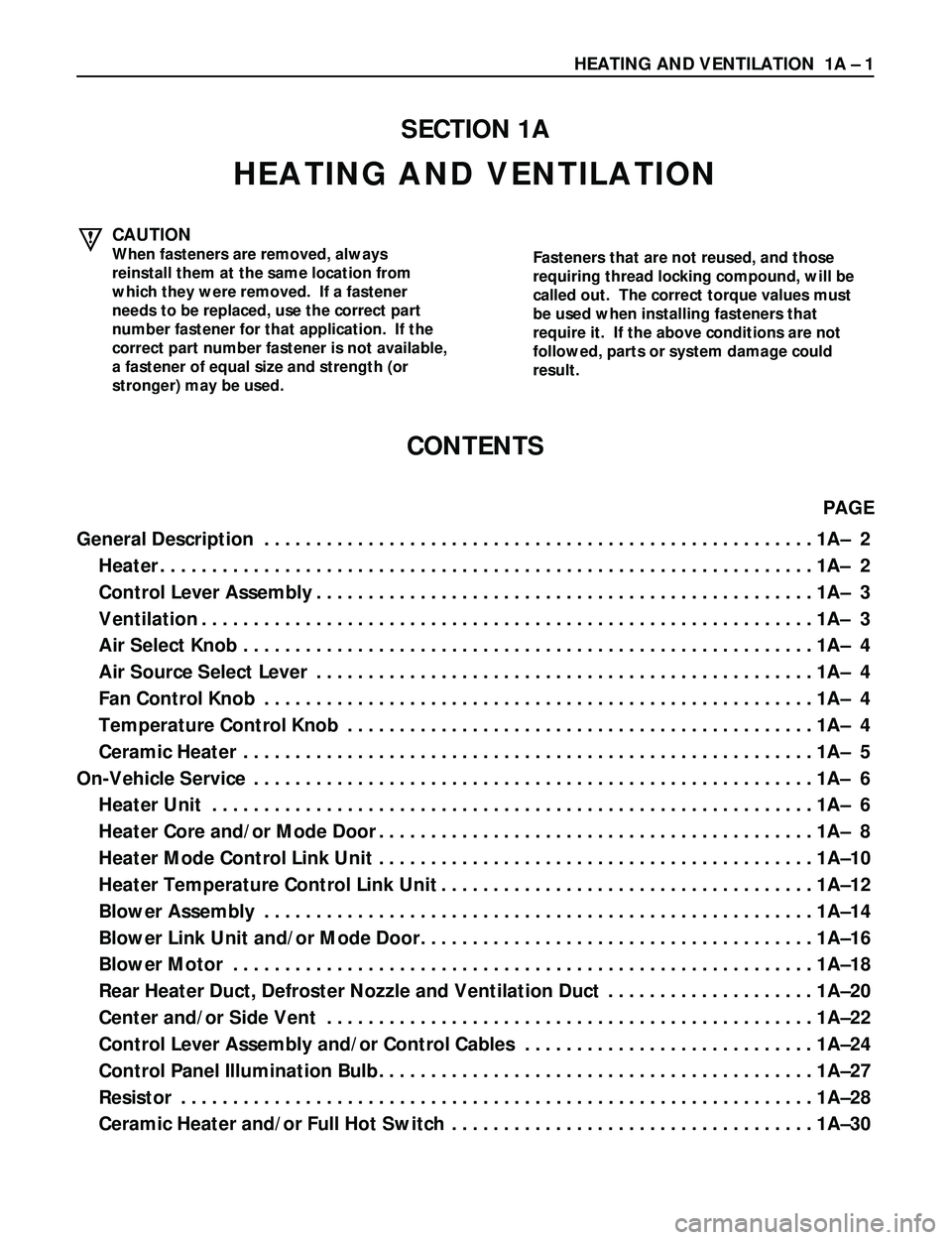
SECTION 1A
HEATING AND VENTILATION
CONTENTS
PAGE
General Description.....................................................1AÐ 2
Heater...............................................................1AÐ 2
Control Lever Assembly................................................1AÐ 3
Ventilation...........................................................1AÐ 3
Air Select Knob.......................................................1AÐ 4
Air Source Select Lever................................................1AÐ 4
Fan Control Knob.....................................................1AÐ 4
Temperature Control Knob.............................................1AÐ 4
Ceramic Heater.......................................................1AÐ 5
On-Vehicle Service......................................................1AÐ 6
Heater Unit..........................................................1AÐ 6
Heater Core and/or Mode Door..........................................1AÐ 8
Heater Mode Control Link Unit..........................................1AÐ10
Heater Temperature Control Link Unit....................................1AÐ12
Blower Assembly.....................................................1AÐ14
Blower Link Unit and/or Mode Door......................................1AÐ16
Blower Motor........................................................1AÐ18
Rear Heater Duct, Defroster Nozzle and Ventilation Duct....................1AÐ20
Center and/or Side Vent...............................................1AÐ22
Control Lever Assembly and/or Control Cables............................1AÐ24
Control Panel Illumination Bulb..........................................1AÐ27
Resistor.............................................................1AÐ28
Ceramic Heater and/or Full Hot Switch...................................1AÐ30
Page 97 of 3573

When the engine warming up, the warmed engine
coolant is sent out into the heater core. The heater
system supplies warm air into the passenger
compartment to warm it up.
Outside air is circulated through the heater core of
the heater unit and then back into the passenger
compartment. By controlling the mixture of outside
air and heater core air, the most comfortable
passenger compartment temperature can be
selected and maintained.
The temperature of warm air sent to the passenger
compartment is controlled by the temperature
control knob. This knob acts to open and close the
air mix door, thus controlling the amount of air
passed through the heater core.The air select knob, with its different modes, also
allows you to select and maintain the most
comfortable passenger compartment temperature.
The air source select lever is used to select either
ÒFRESHÓ for the introduction of the outside air, or
ÒCIRCÓ for the circulation of the inside air. When
the lever is set to ÒFRESHÓ, the outside air is always
taken into the passenger compartment. When
setting the lever to ÒCIRCÓ position, the circulation
of air is restricted only to the inside air with no
introduction of the outside air and the air in the
passenger compartment gets warm quickened.
However, the lever is normally set to ÒFRESHÓ to
prevent the windshield from clouding.
1A Ð 2 HEATING AND VENTILATION
GENERAL DESCRIPTION
HEATER
Side def hose
Vent box
Upper center vent duct
Lower center
vent ductBlower assembly
Control lever assembly Evaporator
assembly W/A/C
W/O A/C
Duct Heater unit
Lap vent nozzle Vent box Side def hoseDefroster nozzle
Rear heater duct
A/C - Air Conditioning This illustration is based on LHD
Page 102 of 3573
HEATING AND VENTILATION 1A Ð 7
INSTALLATION
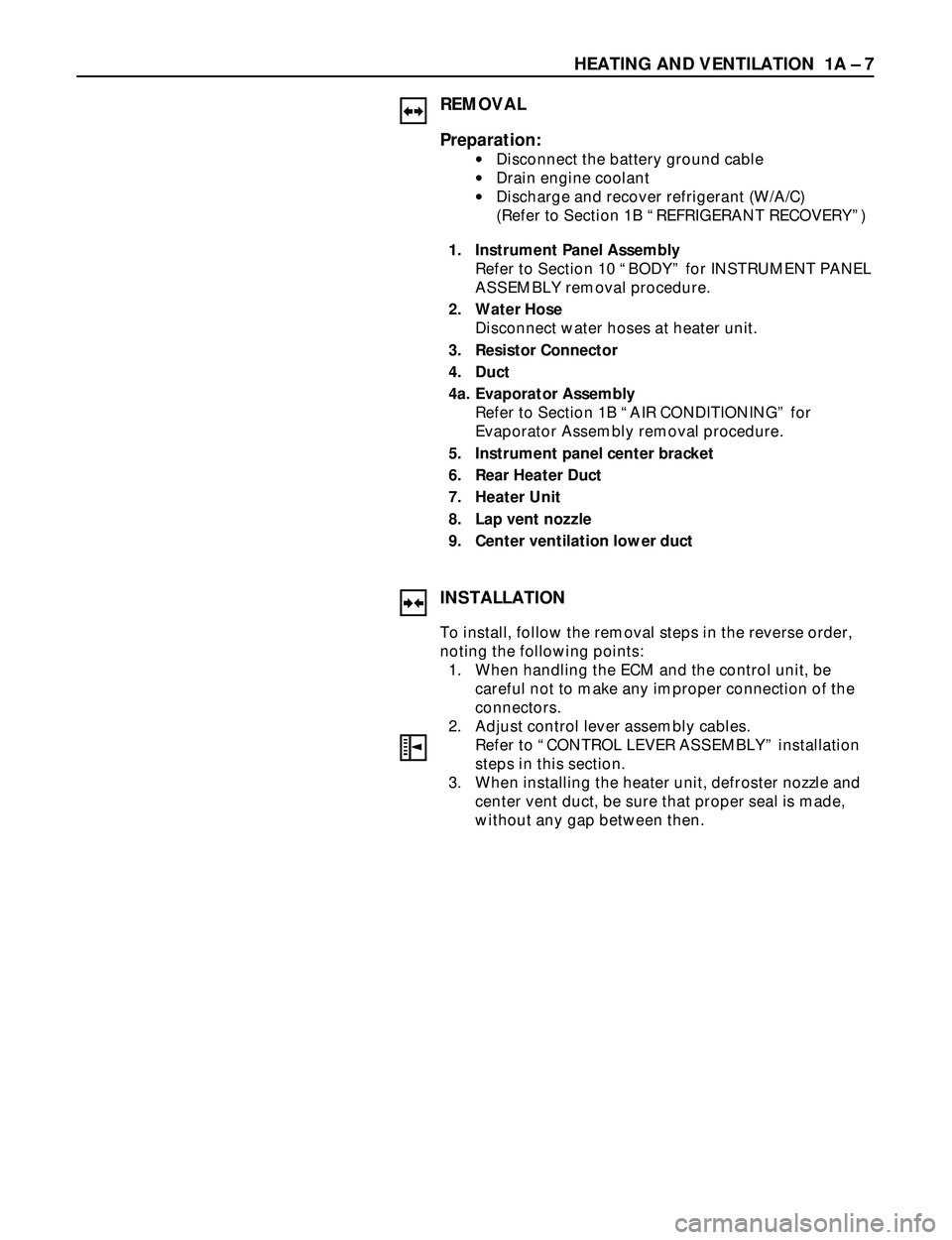
To install, follow the removal steps in the reverse order,
noting the following points:
1. When handling the ECM and the control unit, be
careful not to make any improper connection of the
connectors.
2. Adjust control lever assembly cables.
Refer to ÒCONTROL LEVER ASSEMBLYÓ installation
steps in this section.
3. When installing the heater unit, defroster nozzle and
center vent duct, be sure that proper seal is made,
without any gap between then.
REMOVAL
Preparation:
·Disconnect the battery ground cable
·Drain engine coolant
·Discharge and recover refrigerant (W/A/C)
(Refer to Section 1B ÒREFRIGERANT RECOVERYÓ)
1. Instrument Panel Assembly
Refer to Section 10 ÒBODYÓ for INSTRUMENT PANEL
ASSEMBLY removal procedure.
2. Water Hose
Disconnect water hoses at heater unit.
3. Resistor Connector
4. Duct
4a. Evaporator Assembly
Refer to Section 1B ÒAIR CONDITIONINGÓ for
Evaporator Assembly removal procedure.
5. Instrument panel center bracket
6. Rear Heater Duct
7. Heater Unit
8. Lap vent nozzle
9. Center ventilation lower duct
Page 110 of 3573
HEATING AND VENTILATION 1A Ð 15
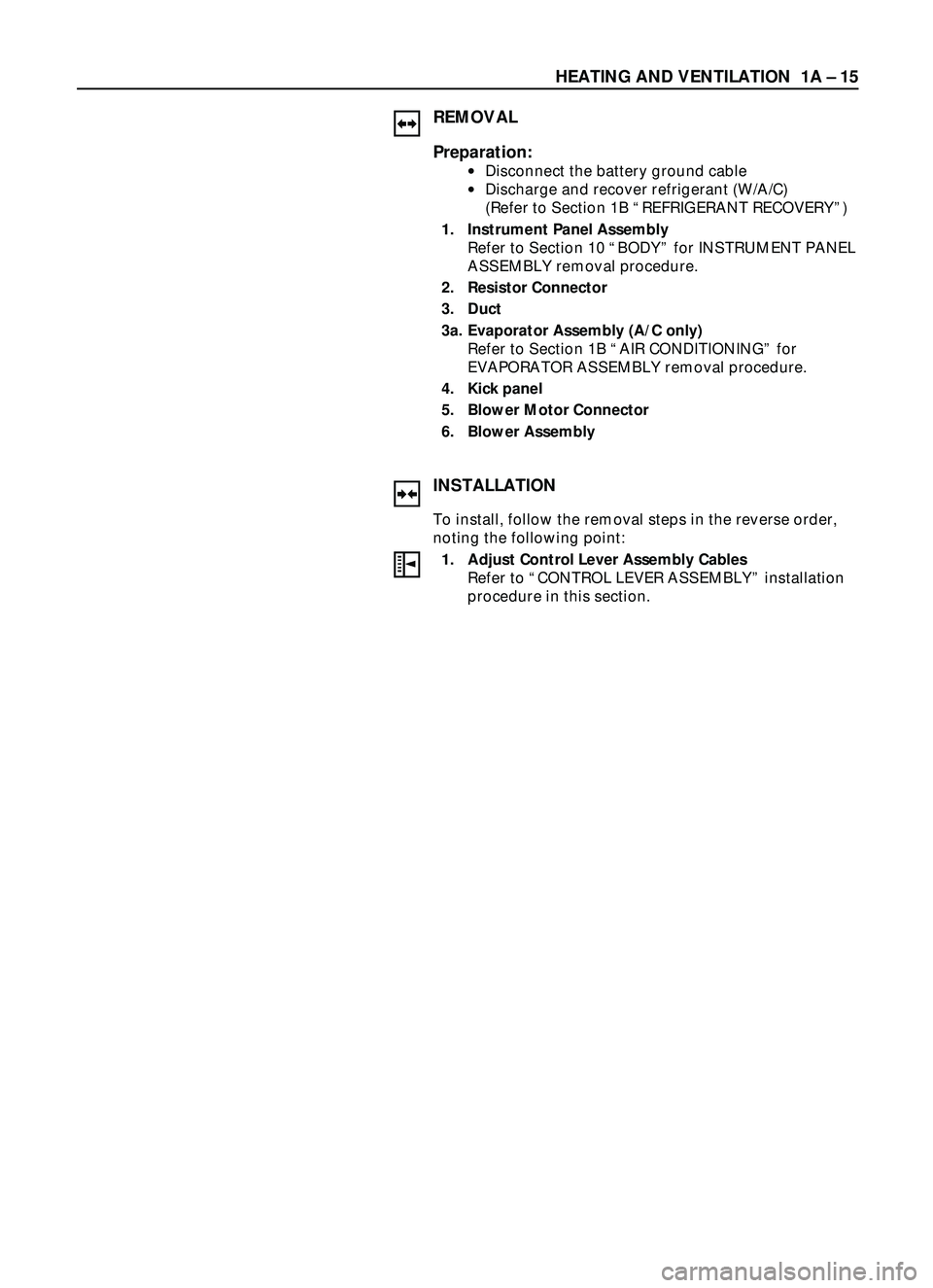
REMOVAL
Preparation:
·Disconnect the battery ground cable
·Discharge and recover refrigerant (W/A/C)
(Refer to Section 1B ÒREFRIGERANT RECOVERYÓ)
1. Instrument Panel Assembly
Refer to Section 10 ÒBODYÓ for INSTRUMENT PANEL
ASSEMBLY removal procedure.
2. Resistor Connector
3. Duct
3a. Evaporator Assembly (A/C only)
Refer to Section 1B ÒAIR CONDITIONINGÓ for
EVAPORATOR ASSEMBLY removal procedure.
4. Kick panel
5. Blower Motor Connector
6. Blower Assembly
INSTALLATION
To install, follow the removal steps in the reverse order,
noting the following point:
1. Adjust Control Lever Assembly Cables
Refer to ÒCONTROL LEVER ASSEMBLYÓ installation
procedure in this section.