Page 98 of 272
Heating and Cooling
To Cool with A/C
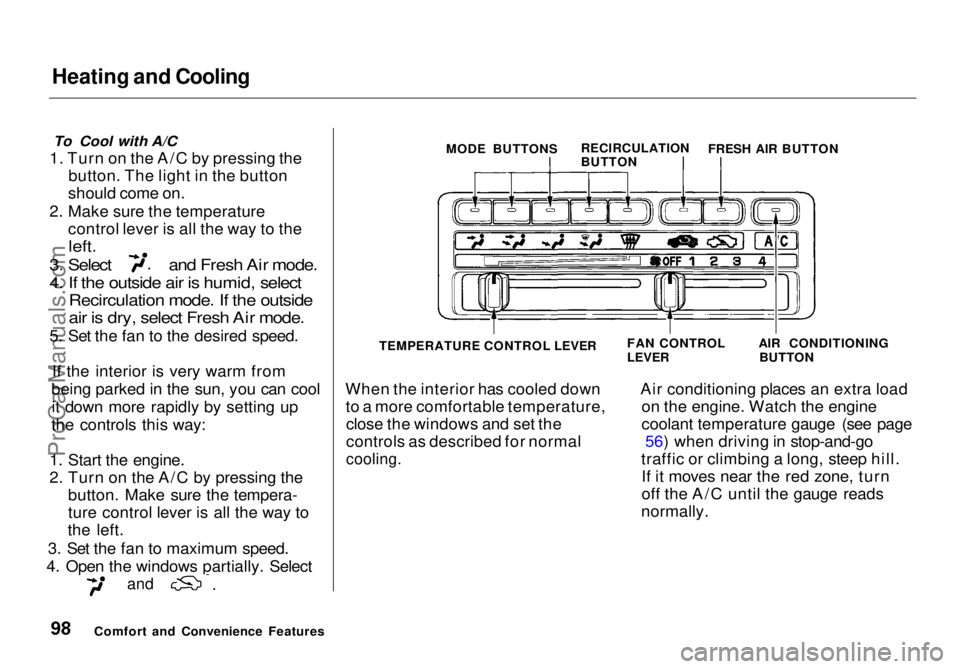
1. Turn on the A/C by pressing the button. The light in the button
should come on.
2. Make sure the temperature control lever is all the way to the
left.
3. Select and Fresh Air mode.
4. If the outside air is humid, select
Recirculation mode. If the outside
air is dry, select Fresh Air mode.
5. Set the fan to the desired speed.
If the interior is very warm from
being parked in the sun, you can cool it down more rapidly by setting up
the controls this way:
1. Start the engine.
2. Turn on the A/C by pressing the button. Make sure the tempera-
ture control lever is all the way to
the left.
3. Set the fan to maximum speed.
4. Open the windows partially. Select
and
When the interior has cooled down
to a more comfortable temperature,close the windows and set the
controls as described for normal
cooling.
Air conditioning places an extra load
on the engine. Watch the engine
coolant temperature gauge (see page 56) when driving in stop-and-go
traffic or climbing a long, steep hill. If it moves near the red zone, turn
off the A/C until the gauge reads
normally.
Comfort and Convenience Features MODE BUTTONS
RECIRCULATION
BUTTONFRESH AIR BUTTON
TEMPERATURE CONTROL LEVER
FAN CONTROL
LEVER
AIR CONDITIONING
BUTTONProCarManuals.comMain Menu Table of Contents s t
Page 99 of 272
Heating and Cooling
To Heat
To warm the interior:
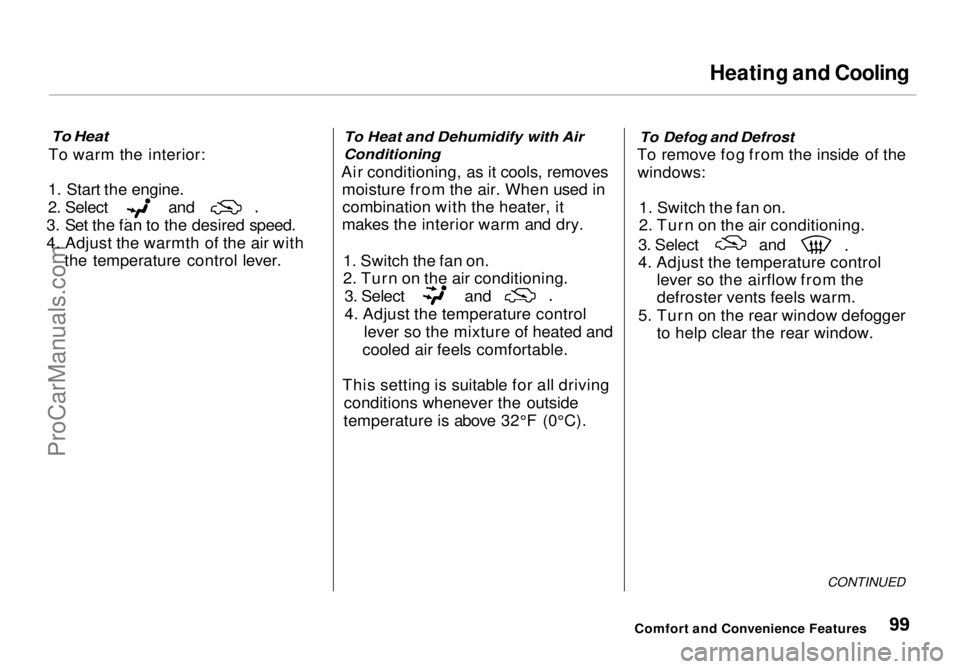
1. Start the engine. 2. Select and
3. Set the fan to the desired speed.
4. Adjust the warmth of the air with the temperature control lever.
To Heat and Dehumidify with Air
Conditioning
Air conditioning, as it cools, removes moisture from the air. When used incombination with the heater, it
makes the interior warm and dry.
1. Switch the fan on.
2. Turn on the air conditioning. 3. Select and
4. Adjust the temperature control
lever so the mixture of heated and
cooled air feels comfortable.
This setting is suitable for all driving conditions whenever the outside
temperature is above 32°F (0°C).
To Defog and Defrost
To remove fog from the inside of the windows:
1. Switch the fan on.
2. Turn on the air conditioning. 3. Select and
4. Adjust the temperature control
lever so the airflow from the
defroster vents feels warm.
5. Turn on the rear window defogger to help clear the rear window.
CONTINUED
Comfort and Convenience FeaturesProCarManuals.comMain Menu Table of Contents s t
Page 100 of 272
Heating and Cooling
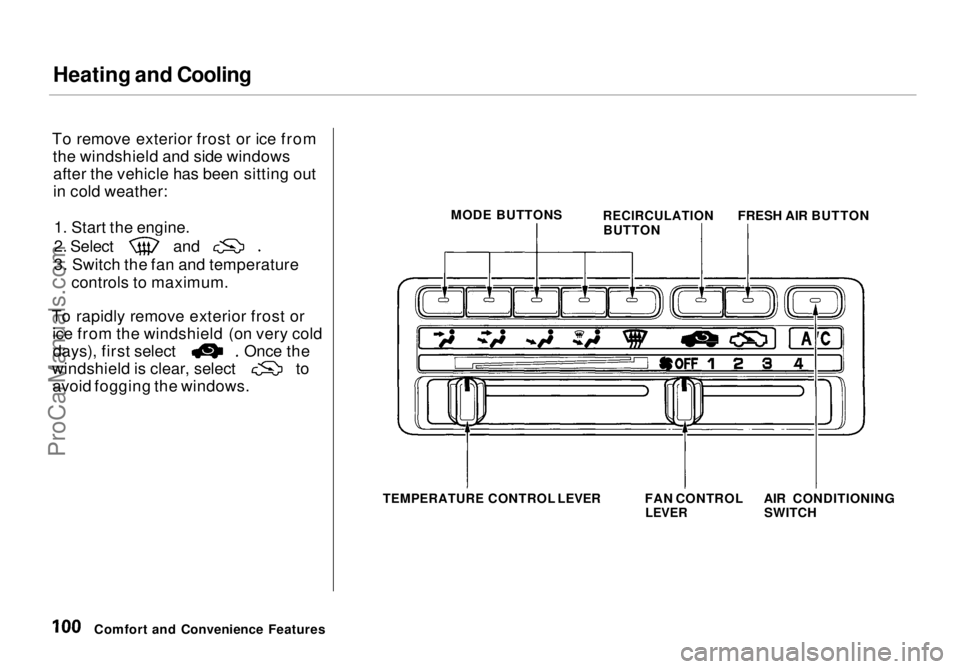
To remove exterior frost or ice from the windshield and side windowsafter the vehicle has been sitting out
in cold weather:
1. Start the engine. 2. Select and
3. Switch the fan and temperature
controls to maximum.
To rapidly remove exterior frost or ice from the windshield (on very cold days), first select Once the
windshield is clear, select to
avoid fogging the windows.
Comfort and Convenience Features MODE BUTTONS
RECIRCULATION
BUTTON FRESH AIR BUTTON
TEMPERATURE
CONTROL LEVER FAN CONTROL
LEVER
AIR CONDITIONING
SWITCHProCarManuals.comMain Menu Table of Contents s t
Page 101 of 272
Heating and Cooling
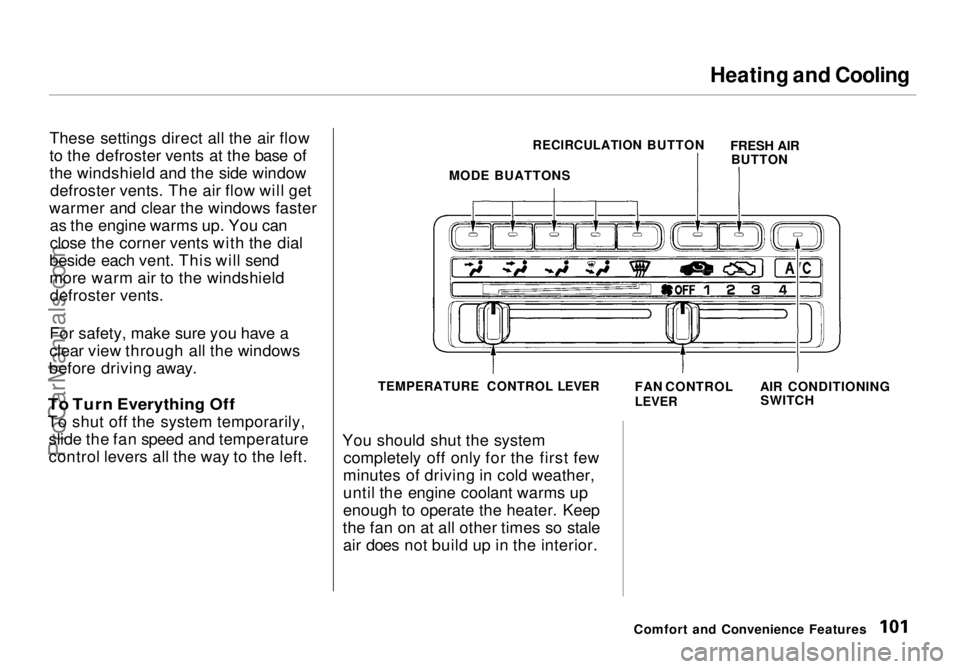
These settings direct all the air flow
to the defroster vents at the base of
the windshield and the side window defroster vents. The air flow will get
warmer and clear the windows faster as the engine warms up. You can
close the corner vents with the dial
beside each vent. This will send
more warm air to the windshield defroster vents.
For safety, make sure you have a
clear view through all the windows
before driving away.
To Turn Everything Off
To shut off the system temporarily, slide the fan speed and temperature
control levers all the way to the left. You should shut the system
completely off only for the first few
minutes of driving in cold weather,
until the engine coolant warms up
enough to operate the heater. Keep
the fan on at all other times so stale air does not build up in the interior.
Comfort and Convenience Features
MODE BUATTONS
RECIRCULATION BUTTON
FRESH AIR
BUTTON
TEMPERATURE CONTROL LEVER
FAN CONTROL
LEVER
AIR CONDITIONING
SWITCHProCarManuals.comMain Menu Table of Contents s t
Page 102 of 272
Heating and Cooling
Rear A/C Unit (U.S. models only)
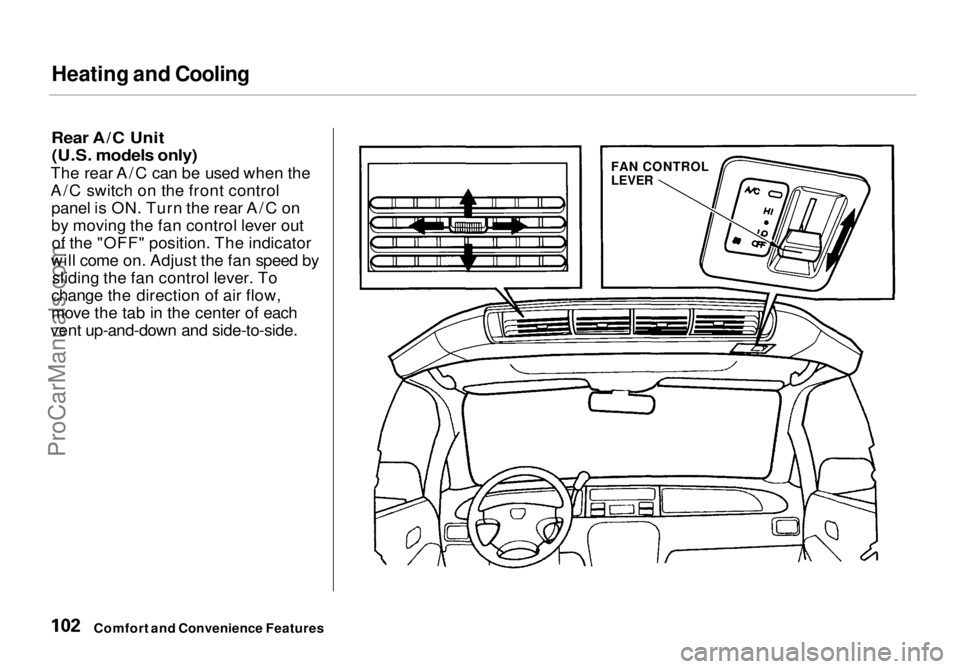
The rear A/C can be used when the
A/C switch on the front control panel is ON. Turn the rear A/C on
by moving the fan control lever outof the "OFF" position. The indicator
will come on. Adjust the fan speed by sliding the fan control lever. To
change the direction of air flow,
move the tab in the center of each
vent up-and-down and side-to-side.
Comfort and Convenience Features
FAN CONTROL
LEVERProCarManuals.comMain Menu Table of Contents s t
Page 156 of 272
Towing a Trailer
Towing Safety
Your vehicle will not stop as quicklywith a trailer in tow. Leave extra distance between your vehicle and
other vehicles. Avoid braking or
turning suddenly. This could cause
the trailer to jackknife or possibly
turn over.
Keep in mind that your total vehicle
is now much longer. Leave more
room when making turns. The trailer
tracks a smaller arc than the vehicle
and can hit or run over something
that the vehicle misses. When
passing another vehicle, make sure
the trailer is clear before changing
lanes.
The vehicle/trailer combination is
more affected by crosswinds and
buffeting. When being passed by a
large vehicle, keep a constant speed and steer straight ahead. If there is
too much wind buffeting, slow down
to get out of the other vehicle's air
turbulence.
Towing a trailer puts an extra load on your vehicle. You should have
your vehicle serviced according to the "Maintenance Schedule undersevere driving conditions" on page 164. This extra load is magnified when
you are driving in hilly terrain.
Watch the temperature gauge closely when climbing hills. If it gets
near the hot area, turn off the air
conditioning (if it is on). If this does
not reduce the heat, it may be
necessary to pull to the side of the
road and wait for the engine to cool.
If the automatic transmission shifts
frequently between 3rd and 4th gears, put it in D3. This will help
prevent the transmission fromoverheating. Help keep the brakes
from overheating by shifting to a lower gear when going downhill.
DrivingProCarManuals.comMain Menu Table of Contents s t
Page 229 of 272
If Your Engine Overheats
The pointer of your vehicle's temperature gauge should stay in
the midrange under most conditions.
It may go higher if you are driving up
a long steep hill on a very hot day. If
it climbs to the red mark, you should
determine the reason.
Driving with the temperature gauge
pointer at the red mark can cause serious damage to your engine.
Your vehicle can overheat for several
reasons, such as lack of coolant or a
mechanical problem. The only
indication may be the temperature
gauge climbing to or above the red mark. Or you may see steam or
spray coming from under the hood.
In either case, you should take
immediate action.
1. Safely pull to the side of the road.
Put the transmission in Neutral or
Park and set the parking brake.
Turn off the heating and cooling system and all other accessories.
Turn on the hazard warning indicators.
2. If you see steam and/or spray coming from under the hood, turn
off the engine.
3. If you do not see steam or spray, leave the engine running and
watch the temperature gauge. If the high heat is due to overloading (climbing a long, steep hill on a
hot day with the A/C running, for example), the engine should start
to cool down almost immediately. If it does, wait until the tempera-
ture gauge comes down to the mid-
point then continue driving.
Taking Care of the Unexpected
NOTICE
Steam and spray from an
overheated engine can
seriously scald you.
Do not open the hood if steam
is coming out.ProCarManuals.comMain Menu Table of Contents s t
Page 265 of 272
Index
Coolant
Adding......................................... 177
Checking..................................... 132
Proper Solution.......................... 177
Temperature Gauge.................... 55
Corrosion Protection..................... 218
Crankcase Emission Control
System......................................... 255
Cruise Control Operation............... 64
Customer Relations Office........... 251
DANGER, Explanation of................. ii
Dashboard........................................ 50 Dashboard Compartment............... 88
Daytime Running Lights................. 58
Dead Battery, What to Do............ 230 Defects, Reporting Safety............. 264
Defogger, Rear Window................. 61
Defrosting the Windows................. 99
DEXRON ®
III Automatic
Transmission Fluid.................... 182
Dimensions..................................... 248
Dimming the Headlights................ 58 Dipstick
Automatic Transmission........... 182
Engine Oil................................... 131
Directional Signals........................... 59
Disabled, Towing Your Car If...... 244
Disc Brake Wear Indicators......... 147
Disposal of Used Oil...................... 176
Doors Locking and Unlocking............... 70
Power Door Locks....................... 70
DOT Tire Quality Grading........... 251
Driver and Passenger Safety............ 3
Drive Belts...................................... 195
Driving............................................ 139 Economy..................................... 133
In Bad Weather.......................... 148
In Foreign Countries................. 254
Economy, Fuel............................... 133
Emergencies on the Road............. 221
Battery, Jump Starting.............. 230
Brake System Indicator............ 237
Changing a Flat Tire................. 223
Chargilng System Indicator ...... 235 Checking the Fuses................... 240
Low Oil Pressure Indicator...... 234
Malfunction Indicator Lamp.... 236
Manually Closing Sunroof........ 238
Overheated Engine................... 232
Emergency Brake............................ 85
Emergency Flashers....................... 61
Emission Controls......................... 255
Engine Belts............................................. 195
Coolant Temperature Gauge ..... 56
Malfunction IndicatorLamp................................. 32, 236
Oil Pressure Indicator......... 32, 234
Oil, What Kind to Use............... 173 Overheating................................ 232
Specifications............................. 249
Ethanolin Gasoline....................... 254 Evaporative Emission Controls.... 255
Exhaust Fumes................................ 47
Expectant Mothers, Use of Seat Belts by......................................... 17
Exterior, Cleaning the................... 214
CONTINUEDProCarManuals.comMain Menu s t