1998 HONDA INTEGRA Control arm
[x] Cancel search: Control armPage 516 of 1681

Pressure Testing
a While testing, be careJulot the rotating front wheels.
a Make sule litts, iacks, and safety stands are placed
properly (see section 1).
CAUTION: Befoie testing, be sure the transmission fluid
is filled to the proper level.
'1. Raise the vehicle {see section 'll.
2. Warm up the engine (the radiator fan comes on),
then stop the engine and connect a tachometer.
3. Connect the special tool to each inspection hole(s).
TOROUE: 18 N.m l1-8 kgt.m, 13lbf.ftl
CAUTION: Connect the A/T pressure gauge secure-
ly, be sure not to allow dust and olher foreign pani-
cles to enter the inspection hole.
A/T PRESSURE GAUGESET W/PANEL07406 -0020400
A/T LOW PRESSUREGAUGE W/PANEI.07406-OO70300
A/T PRESSURE HOSE,2210 mmOTMAJ _PY4O1 1A{4 Required}
A/T PRESSURE HOSEADAPTER07MAJ -PY40120
l4 Requiredl
NOTE: Use the A/T Pressure Gauge Set (07406-
OO2O0O3) or A/T Low Pressure Gauge (07406-
OOTOOOO), and the A/T pressure gauge hoses and adap-
ters shown above.
4. Start the engine, and measure the respective pres
sures as follows.
a Line Pressure
a Clutch Pressure
a Clutch Low/High Pressure
a Throttle B Pressure
5. Install a new sealing washer and the sealing bolt in
the inspection hole and tighten to the specified
torque.
TOROUE:18 N.m (1.8 kgf.m, 13lbf.ft)
NOTE: Do not reuse old sealing washers; alwaysreplace washers.
Line Pressure Measurement
-1. Set the parking brake, and block both rear wheels
securely.
-2. Run the engine at 2,000 rpm
3. Shift to S or @ position.
4. lMeasure line pressure.
LINE PRESSUREINSPECTION HOLE
LOCK-UP CONTROLSOLENOID VALVEASSEMBLY
PRESSURESHIFT LEVER
POST ONSYMPTOMPROBABLE CAUSEFLUID PRESSURE
StandardService Limit
LineNo,BNo (or low)
Irne pressure
Torque converter,
ATF pump, pressure
regulator, torque
converter check
830 88o kPa
(8.5 9.O kgf/cm',
1 20 130 psi)
78O kPa(8.O kgf/cm', 1 10 psi)
NOTE: Higher pressures may be indicated if measurements are made in shitt lever positions other than S or f, position.
{cont'd )
14-99
Page 530 of 1681

IfD ATF FEED PIPE
O AccUMULAToR covER
@ o-RING Reptace.(O ATF FEED PIPES
(!) ATF FEED PIPE
@ sERvo DETENT BASE
O LocK WASHER Reptace.
[8) ATF STRAINER
@ sucTroN ptpE coLLAR
@ sERVO EODY(, THRoTTLE coNTRoL SHAFT(t E R|NG
Q9 SERVO SEPARATOR PLATE(D 1ST ACCUMULAToR cHoKE
C' CHECK EALL
@ sToP SHAFT STAY
@) SECONDARY VALVE BODY
OO DOWEL PIN
(t SEcoNDARY SEPARAToR PLATE
@ LUBRICAToR PTATE
8] ATF FEED PIPE
@ LocK-uP vALvE BoDy
@ DowEL PrN
@ LocK-uP SEPARAToR PLATE
E TORoUE CoNVERTER cHEcK VALVE SPRING
€0 ToRouE CoNVERTER cHEcK vALvE
Q) COOLER CHECK VALVE SPRING
@ cooLER cHEcK VALVE
TOROUE SPECIFICATIONS
@ REGULAToR vALvE BoDY
@ sToP SHAFT
@ o-RING Reptace.
6, STATOR SHAFT
@ ATF FEED PIPE
@ MA|N VALVE BOOY
@ cHEcK BALL
@ DowEL PrN
@ ATF PUMP DRIVE GEAR
@ ATF PUMP DRIVEN GEAR SHAFT
OO ATF PUMP DRIVEN GEAR
@ MA|N SEPARAToR PLATE
6' DowEL PIN
@ CONTROL SHAFT
@ DETENT ARM SPRING
@ OETENT ARM SHAFT
@ DETENT ARM
@ coUNTERSHAFT ToRoUE coNVERTER HoUSING
NEEOLE BEARING
@ ATF GUIDE PLATE
@ ToRouE coNvERTER HoustNG
@ MAINSHAFT ToRoUE coNvERTER HousING BEARING
@ oll SEAL ReDtace.
@ LocK-up coNTRoL soLENotD vALvE A/B ASSEMBLy
@ coNNEcToR BRACKET
@ LocK-UP coNTRoL SoLENoID vALvE FILTER/GASKET
Replace.
Bolt/Nut No.Torque ValueSizeRemarks
6A12 N.m {1 .2 kgf.m,8.7 lbf.ft)6 x 1.0 mm
I
14-113
Page 536 of 1681

I
l"
I
J
NOTE:
a Clean all parts thoroughly in solvent or carburetor
cleaner and dry with compressed air.
a Blow out all passages.
a When removing the valve body replace the lollowing:. O-rings. Lock washers
1 . Remove the ATF feed pipes from the servo body, ser-vo detent base, accumulator cover, lock-up valve
body and main valve body.
2. Remove the three bolts securing the ATF strainer
and servo detent base, then remove the strainer
and detent base.
3. Remove the three bolts securing the accumulator
cover, then remove the accumulator cover.
4. Remove the six bolts securing the servo body. then
remove the servo body and separator plate.
5. Remove the one bolt securing the secondary valvebody, then remove lhe secondary valve body andseparator plate.
6. Remove the eight bolts securing the lubricator plate
and lock-up valve body, then remov€ th€ lubricator
plate. Iock-up valve body, and separator plate.
7. Remove the one bolt securing the regulator valve
body, then remove the regulator valve body.
8. Remove the stator shaft and stop shaft.
9. Remove the detent spring from the detent arm, then
remove the control shaft from the torque converter
housrng.
1O. Remove the detent arm and detent arm shatt from
the main valve body.
1 'l . Remove the four bolts securing the main valve body,
then remove the main valve body.
'I2. Remove the ATF pump driven gear shatt, then re-
move the ATF pump gears.
13. Remove the main separator plate with two dowel
pins.
15.
14. Clean the inlet opening ot the ATF st,ainer thorough-
ly with compressed air, then check that it is in good
condition. and the inlet opening is not clogged.
INLET OPENING
Replace the ATF strainer if it is clogged or damaged.
NOTE: The ATF strainer can be reused if it is notclogged.
14-119
Page 577 of 1681

)
)
A
1.
ATF PUMP DRIVENGEAR SHAFT
ATF PUMPDRIV€N GEAR
J.
6
Grooved and ch6mleredside faces separatorplate.
Install the suction pipe collar in the torque conven-
er housing.
Install the main separator plate with two dowel pins
on the torque convener housing. Then install the ATF
pump drive gear, driven gear and driven gear shaft.
NOTE: Install the ATF pump driven gear with its
grooved and chamfered side facing down.
ATF PUMPDRIVE GEAR
Loosely install the main valve body with four bolts.
Make sure the ATF pump drive gear rotates smoothly
in the normal operating direction and the ATF pump
driven gear shalt moves smoothly in the axial and
normal operating directions.
Install the secondary valve body, separator plate and
two dowel pins on the main valve body.
lnstallthe control shaft in the housing, with the con-
trol shaft and manual valve together.
Installthe detent arm and arm shaft in the main valve
body, then hook the detent arm spring to the detent
arm.
SERVO SEPARATOR PLATE
I
DETENT ARM SPRING
'17. Install the ATF feed oipes.
14-161
7. Install the servo body and separator plate (six bolts|.
8. Install the accumulator cover (three bolts).
9. Install the servo detent base and ATF strainer and
new lock washers (three bolts).
1O. Tighten the four bolts to '12 N.m (1.2 kgt.m, 8.7
Ibf.ft) on the main valve body.
Make sure the ATF pump drive gear and ATF pump
driven gear shaft move smoothly.
11. lf the ATF pump drive gear and ATF pump driven
gear shaft do not move freely, loosen the four bolts
on the main valve bodv and disassemble the valve
bodies. Realign the ATF pump driven gear shaft and
reassemble the valve bodies, then retighten the bolts
to the soecified toroue.
CAUTION: Failure to align the ATF pump ddven gear
shaft corr€ctly will result in a seized ATF pump driv€
gear or ATF pump dliven g€ar shatt,
ATF PUMP ATF PUMP
DRtvEN GEAR ORIVEN GEARSHAFT
12. lnstall the stator shatt and stop shaft.
13. Inslall the stop shaft stay on the secondary valve
body (one bolt).
14. Install the regulator valve body with the bolt.
1 5. Install the torque converter check valve, cooler check
valve and valve springs in the regulator valve body.
16. Install the lock-up valve body, separator plate, two
dowel pins and lubricator plate (eight bolts).
(cont'd)
Page 595 of 1681

Throttle Control Cable
Inspection
NOTE: Before inspecting the throttle controlcable, makesure:
a Throttle cable tree play is correct (see section I 1).a ldle speed is correct (see section 1l).a To warm up the engine to normal operating tempera-
ture (the cooling fan comes on).
1 . Verify that the throttle control cable is clamped cor-rectly in three positions.
CONTROL CABLE
LOWERHOSEClamp at the end ofblue tape on the cable.
Verily that the throttle controldrum is synchronized
with the throttle linkage while depressing and releas-
ing the accelerator pedal.
ll the throttle control drum is not synchronized with
the throttle linkage, adjust rhe throttle control cable.
(cont'd)
14-179
Page 597 of 1681

Adjustment
NOTE: Before adjusting the throttle controlcable, make
sure:
a Throttle cable lree play is correct (see section 11).a ldle speed is correct (see section 11).a To warm up the engine to normal operating tempera-
ture {the cooling fan comes on)
1 . Verify that the throttle control cable is clamped correctly in three positions.
THROTTLEATF COOLERPIPE
LOWERHOSEClamp at the end ofblue tape on the cable.
Verily that the throttle linkage is in the fully-closedposttron.
Loosen the locknut of the throttle control cable at
the throttle linkage.
CONTROL CABLE
LOCKNUTS
14-181
Push in this directron.
Remove the free play of the throttle control cable
with the locknut, while pushing the throttle control
drum to the tull-closed potision as shown.
5. Tighten the locknuts.
6.After tightening the locknuts, inspect the synchroni-
zation and throttle control drum movement.
Page 671 of 1681
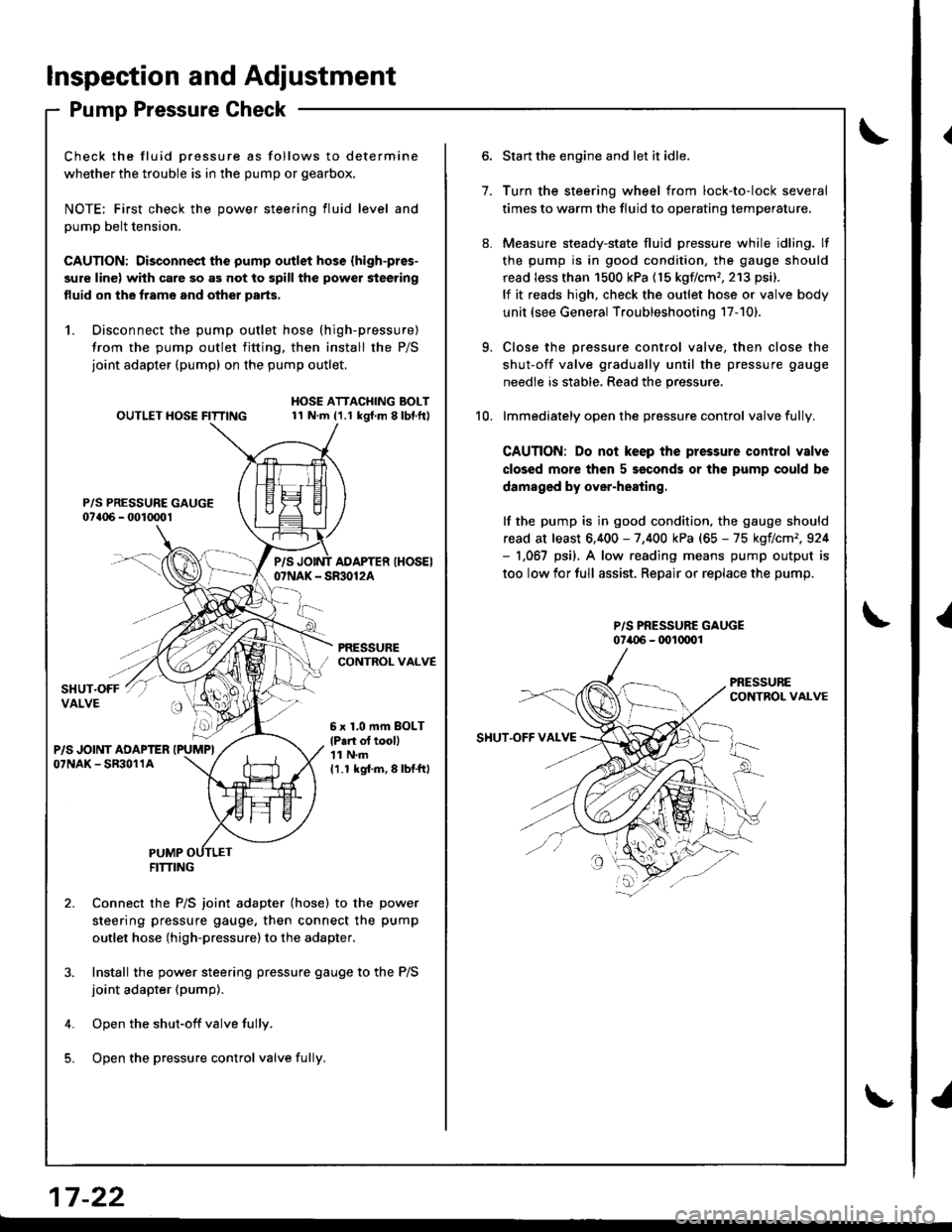
Inspection and Adjustment
Pump Pressure Check
Check the fluid Dressure as follows to determine
whether the trouble is in the pump or gearbox.
NOTE; First check the power steering fluid level and
pump belt tension.
CAUTION: Disconnect the pump outlet hose (high-pres-
sure line) with care so as not to spill the power steering
fluid on the frame and other parts,
1. Disconnect the pump outlet hose (high-pressure)
from the pump outlet fitting, then install the P/S
joint adapter (pump) on the pump outlet.
P/S PRESSURE GAUGE07a06 - 001mo1
OUTLET HOSE FITTINGHOSE ATTACHING BOLT11 N.m (1.1 kgt.m 8lbl.ft)
PRESSURECONTROL VALVE
P/SAOAPTER IHOSEI07NAK - SR30124
6 x 1,0 mm BOLT
lP.n ol tooll'| 1 N.m
11.1 kgi.m,8lbtftl
PUMPFITTING
Connect the P/S joint adapter (hose) to the power
steering pressure gauge, then connect the pump
outlet hose (high-pressure)to the adapter.
Install the power steering pressure gauge to the P/S
joint adapter (pump).
Open the shut-off valve fully.
Open the pressure control valve fulli.
1.
Start the engine and let it idle.
Turn the steering wheel from lock-to-lock several
times to warm the fluid to operating temperature.
Measure steady-state fluid pressure while idling. lf
the pump is in good condition, the gauge should
read less than 1500 kPa (15 kgflcm',213 psi).
lf it reads high, check the outlet hose or valve body
unit (see General Troubleshooting 17-101.
Close the pressure control valve, then close the
shut-off valve gradually until the pressure gauge
needle is stable, Read the pressure.
lmmediately open the pressure control valve fully.
CAUTION: Do not keep the pressure control valve
closed more then 5 seconds or the pump could be
damaged by over-heating.
lf the pump is in good condition, the gauge should
read at least 6,400 - 7,400 kPa (65 - 75 kgflcm',924- 1,067 psi). A low.eading means pump output is
too low for full assist. Repair or replace the pump.
P/S PRESSURE GAUGE07i.{)6 - (x)l(xrol
9.
10.
SHUT.OFF VAI.VE
17 -22
{
I
Page 814 of 1681

ABS Control Unit
RemovaUlnstallation
1. Remove the right quarter trim panel.
2. Disconnect the ABS control unit connectors.
3. Remove the ABS control unit.
Pulsers/Wheel Sensors
Inspection
/t
l\
I
Check the front and rear pulser for chipped or dam-
aged teeth.
Measure the air gap between tho wheel sensor and
pulser sllthe way around while rotating the pulser.
Standard: 0.4 - 1.0 mm (0.02 - 0.04 in)
NOTE: lf the gap exceeds 1.0 mm (0.04 in), the
probability is a distorted suspension arm which
should be reDlaced.
Front/R..1
L-TJ
.t-
t=
l-
Et-E_
Install the ABS control unit in the reverse order of
removal.
Start the engine, and check that the ABS indicator
goes off.
Test-drive the vehicle, and check that the ABS indi-
cator does not come on.
19-62