1998 GMC SIERRA brake
[x] Cancel search: brakePage 250 of 452
To engage a PTO:
1. Hold the clutch pedal down.
2. Set the parking brake.
3. Shift the transmission into NEUTRAL (N).
4. Engage the PTO.
NOTICE:
Using a PTO for more than four hours without
driving your vehicle can damage the transfer case
or transmission. If using a
PTO for more than
four hours without driving your vehicle, drive
your vehicle for a while to allow the transfer case
and transmission to cool.
If you are going to drive the vehicle, shift the
transfer case into the range you want
(if you have
four-wheel drive). Then shift
the transmission into
the gear you want, apply the regular brakes and
release the parking brake.
5. Release the clutch (and the regular brakes) as you
normally would. When
you release the clutch, the
PTO will start.
To engage a PTO while the vehicle is moving:
1. Hold the clutch pedal down.
2. Shift the transmission into NEUTRAL (N).
3. Engage the PTO.
4. Shift the transmission into the gear you want.
5. Release the clutch as you normally would. When you
release the clutch, the
PTO will start.
Using a Transfer Case Mounted Power
Take-Off (Manual Transmission)
1.
2.
3.
4.
5.
6.
Hold the clutch pedal down.
Set the parking brake.
Shift
the transfer case into NEUTRAL (N).
If the vehicle will remain in the same place, shift the
transmission into
the highest gear.
Engage the PTO.
If you are going to drive the vehicle, shift the
transmission into the gear you want. Then shift the
transfer case into the range you want, apply the
regular brakes and release the parking brake.
Release the clutch (and the regular brakes) as
you
normally would. When you release the clutch, the
PTO will start.
4-62
ProCarManuals.com
Page 251 of 452
Using a Transfer Case Mounted Power
Take-Off (Automatic Transmission)
1.
2.
3.
4.
5.
6.
7.
Set the parking brake.
Turn the ignition off.
Shift the transfer case into NEUTRAL
(N).
Shift the transmission into NEUTRAL (N).
Engage the PTO.
If you are going to drive the vehicle. shift the
transfer case into the range you want. Turn
the
ignition to START. Then apply the regular brakes
and release the. parking brake.
Shift the transmission to THIRD
(3) to start the PTO.
Release the regular brakes to drive the vehicle.
Disengaging a Power Take-OFF
1. Turn the ignition off.
2. Put the transmission in PARK (P).
3. Release the PTO
4. Restart the engine.
Step-Bumper Pad
If your vehicle has a rear step bumper, it may be
equipped with
a rear step pad at the center of
the bumper.
If you will be using the
bumper to tow a trailer,
you
must remove the center
cutout circle to install the
trailer ball.
You must also
remove both outer cutouts
to attach the trailer safety chains.
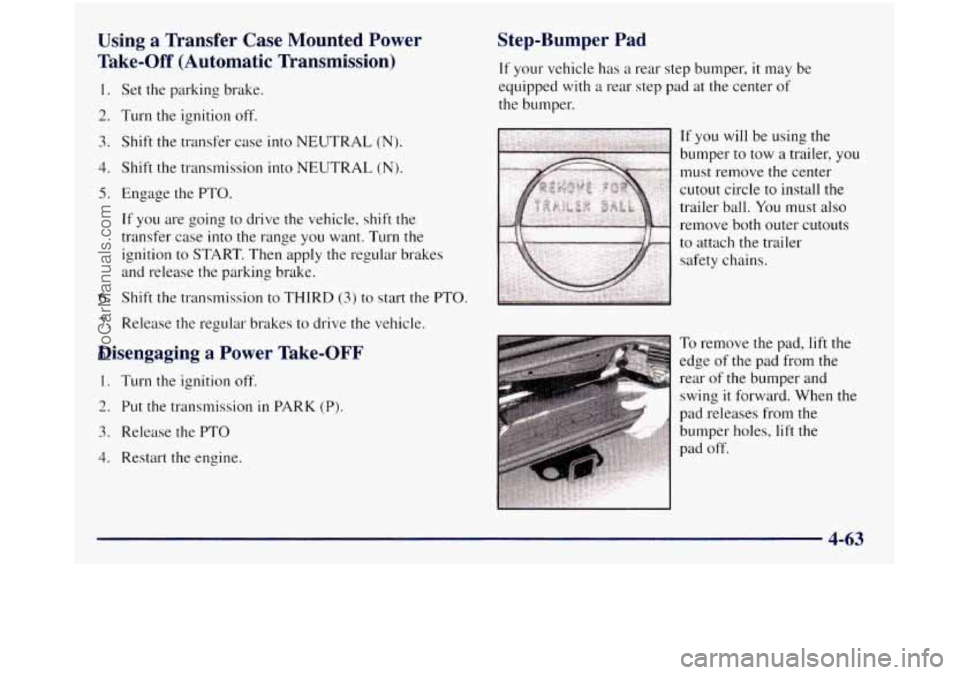
To remove the pad,
lift the
edge of the pad from the
rear of the bumper and
swing it forward. When the
pad releases from the
bumper holes,
lift the
pad off.
4-63
ProCarManuals.com
Page 256 of 452
2. Get the vehicles close enough so the jumper cables
can reach, but be sure the vehicles aren’t touching
each other. If they are, it could cause a ground
connection
you don’t want. You wouldn’t be able
to start your vehicle, and the bad grounding could
damage the electrical systems.
To avoid the possibility
of the vehicles rolling, set
the parking brake firmly on both vehicles involved
in the jump start procedure. Put an automatic
transmission in
PARK (P) or a manual transmission
in NEUTRAL (N).
If you have a four-wheel-drive
vehicle, be sure the transfer case is not in
NEUTRAL
(N).
3. Turn off the ignition on both vehicles. Unplug
unnecessary accessories plugged into the cigarette
lighter or accessory power outlets. Turn
off all lamps
that aren’t needed as well as radios. This will avoid
sparks and help save both batteries. In addition, it
could save your radio!
I NOTICE:
If you leave your radio on, it could be badly
damaged. The repairs wouldn’t be covered by
your warranty.
4. Open the hoods and locate the batteries. Find the
positive
(+) and negative (-) terminals on each battery.
If your vehicle has air conditioning, the auxiliary
electric fan under the hood can start up even
when the engine is not running and can injure
you. Keep hands, clothing and tools
away from
any underhood electric fan.
5-4
t
ProCarManuals.com
Page 262 of 452
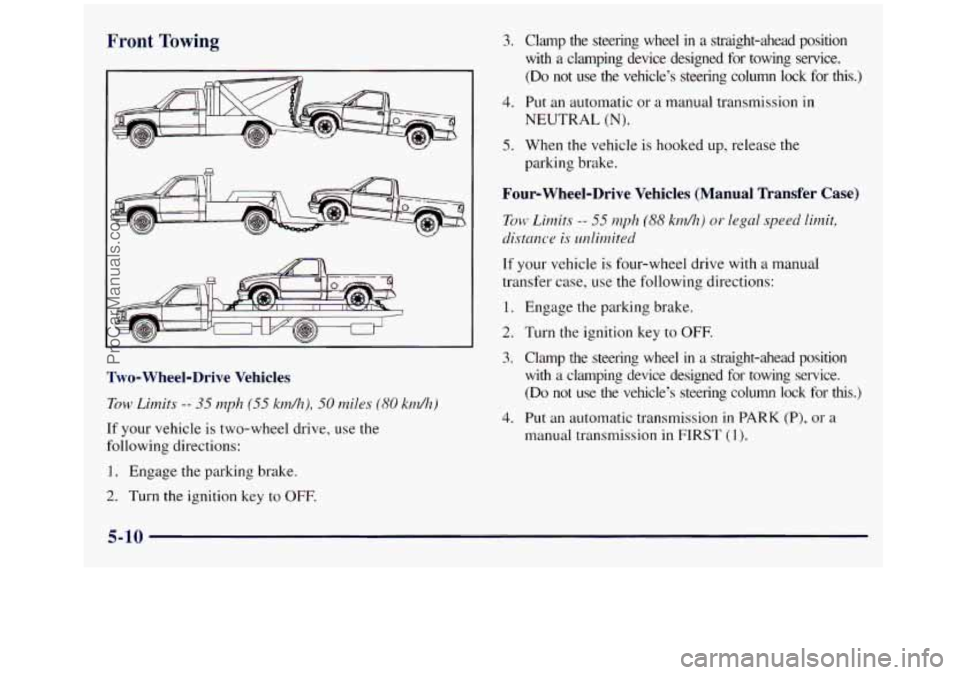
Front Towing
Two- Wheel-Drive Vehicles
Tow Lirnits -- 35 nzph (55 kdh), 50 miles (80 kr.n/h)
If your vehicle is two-wheel drive, use the
following directions:
I. Engage the parking brake.
2. Turn the ignition key to OFF.
3. Clamp the steering wheel in a straight-ahead position
with a clamping device designed for towing service.
(Do not use the vehicle’s steering column lock for this.)
4. Put an automatic or a manual transmission in
NEUTRAL (N).
5. When the vehicle is hooked up, release the
parking brake.
Four-Wheel-Drive Vehicles (Manual Transfer Case)
Tow Lirnits -- 55 rnph (88 knzdh) or legtrl speed limit,
distance
is unlimited
If your vehicle is four-wheel drive with a manual
transfer case, use the following directions:
1. Engage the parking brake.
2. Turn the ignition key to OFF.
3. Clamp the steering wheel in a straight-ahead position
with
a clamping device designed for towing service.
(Do not use the vehicle’s steering column lock for this.)
4. Put an automatic transmission in PARK (P), or a
manual transmission
in FIRST (1).
5-10
ProCarManuals.com
Page 263 of 452
5. Put the transfer case in NEUTRAL (N). See
“Four-wheel Drive” in the Index
for the proper
procedure to select NEUTRAL
(N).
6. When the vehicle is hooked up, release the
parking brake.
4. Put the transmission in NEUTRAL (N).
5. Put the transfer case in 2 High (2HI).
6. When the vehicle is hooked up, release the
parking brake.
Four- Wheel Drive-Vehicles (Electronic
Transfer Case)
Tow Limits -- 35 mph (55 krdh), 50 miles (80 krn/l1)
If your vehicle is four-wheel drive with an electronic
transfer case, use the following directions:
1. Engage the parking brake.
2. Turn the ignition key to OFF.
3. Clamp the steering wheel in a straight-ahead position
with a clamping device designed for towing service.
(Do not use the vehicle’s steering column lock for this.)
NOTICE:
If your vehicle is equipped with an electronic
transfer case and the tow limits must be
exceeded, a towing dolly must be used under the rear wheels or vehicle/powertrain damage
will occur.
5-11
ProCarManuals.com
Page 264 of 452
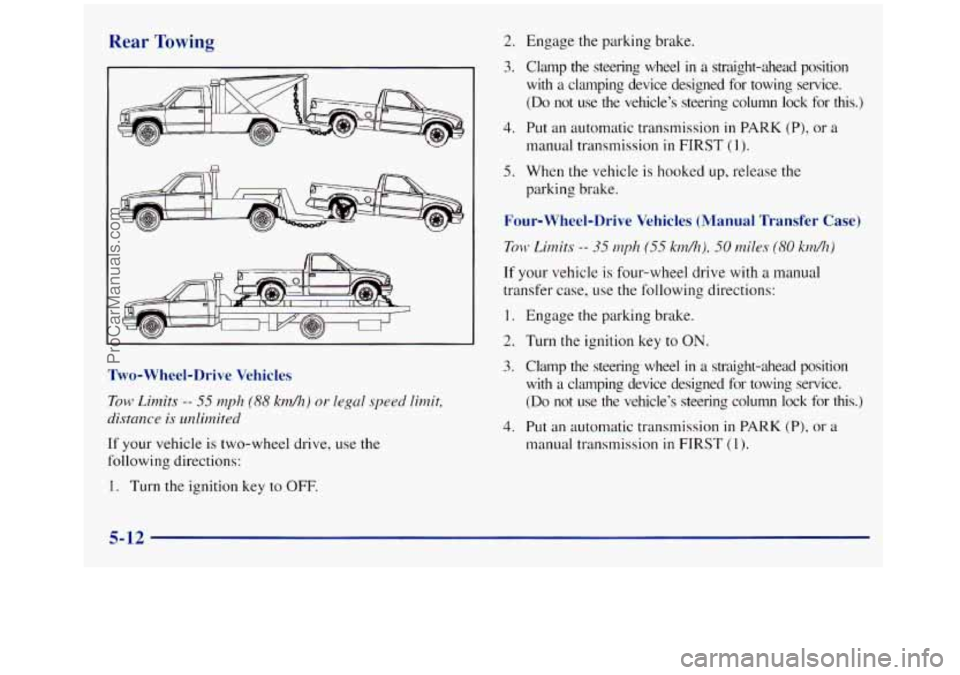
Rear Towing
Two-Wheel-Drive Vehicles
Tow Limits -- 55 ~zph (88 krdh) or legal speed limit,
distmce is ditnited
If your vehicle is two-wheel drive, use the
following directions:
1. Turn the ignition key to OFF.
2.
3.
4.
5.
Engage the parking brake.
Clamp the steering wheel in a straight-ahedd position
with a clamping device designed for towing service.
(Do not use the vehicle’s steering column lock for this.)
Put an automatic transmission
in PARK (P), or a
manual transmission in FIRST (1).
When the vehicle is hooked up, release the
parking brake.
Four-Wheel-Drive Vehicles (Manual Transfer Case)
If your vehicle is four-wheel drive with a manual
transfer case, use the following directions:
1.
2.
3.
4.
Engage the parking brake.
Turn the ignition
key to ON.
Clamp the steering wheel in a straight-ahead position
with a clamping device designed for towing service.
(Do not use the vehicle’s steering column lock for this.)
Put an automatic transmission
in PARK (P), or a
manual transmission in FIRST (1).
5-12
ProCarManuals.com
Page 265 of 452
5. Put the transfer case in NEUTRAL (N). See
“Four-Wheel Drive’’
in the Index for the proper
procedure to select NEUTRAL
(N).
6. When the vehicle is hooked up. release the
parking brake.
7. Turn the ignition key to OFF.
Four- Wheel-Drive Vehicles (Electronic
Transfer Case)
Eml Limits -- 35 mph (55 km/JZ), 50 milc?s (80 kndh)
If your vehicle is four-wheel drive with an electronic
transfer case, use the following directions:
I. Engage the parking brake.
2. Turn the ignition key to ON.
3. Clamp the steering wheel in a straight-ahead position
with
a clamping device designed for towing service.
(Do not use the vehicle’s steering column lock for this.)
4. Put the transmission in NEUTRAL (N).
5. Put the transfer case in 2 High (2HI).
6. When the vehicle is hooked up, release the
parking brake.
7. Turn the ignition key to OFF.
NOTICE:
If your vehicle is equipped with four-wheel drive
and the towing limits must be exceeded, a towing
dolly must be used under the front wheels or
vehicle/powertrain damage will occur.
I NOTICE:
Towing pickup models from the rear while loaded
with heavy cargo may cause the frame side rails
to flex sufficiently to allow the pickup box to
contact the cab and could cause damage to the
cab and/or box.
Engine Overheating (Gasoline Engine)
You will find a coolant temperature gage on your
vehicle’s instrument panel. See “Engine Coolant
Temperature Gage”
in the Index.
If your vehicle has a diesel engine, see “Engine
Overheating”
in the Diesel Engine Supplement.
5-13
ProCarManuals.com
Page 275 of 452

Engine Fan Noise If a Tire Goes Flat
Your vehicle has a clutched engine cooling fan. When
the clutch is engaged, the fan spins faster to provide
more air to cool the engine.
In most everyday driving
conditions, the fan is spinning slower and the clutch
is
not fully engaged. This improves fuel economy and
reduces fan noise. Under heavy vehicle loading. trailer
towing and/or high outside temperatures, the fan speed
increases as the clutch more
fully engages. So you may
hear an increase
in fan noise. This is normal and should
not be mistaken as the transmission slipping or making
extra shifts.
It is merely the cooling system functioning
properly. The fan
will slow down when additional
cooling
is not required and the clutch disengages.
You may
also hear this fan noise when you start
the engine.
It will go away as the fan clutch
partially disengages. It‘s
unusual for
a tire to “blow out’’ while you’re driving,
especially if you maintain your tires properly.
If air goes
out of a tire, it’s much more likely to leak out slowly.
But if you should ever have a “blowout,” here are a
few tips about what to expect and what to do:
If a front tire hils, the flat tire will create a drag that
pulls the vehicle toward that side. Take your foot off the
accelerator pedal and grip the steering wheel firmly.
Steer to maintain lane position, and then gently brake to
a stop well out of the traffic lane.
A rear blowout, particularly on a curve, acts much like a
skid and may require the same correction you’d use in
a skid. In any rear blowout, remove your foot from
the accelerator pedal. Get
the vehicle under control by
steering the way you want the vehicle to go.
It may be
very bumpy and noisy, but you can still steer. Gently
brake to
a stop -- well off the road if possible.
If a tire goes flat, the next part shows how to use your
jacking equipment to change a flat tire safely.
5-23
ProCarManuals.com