1998 GMC SIERRA ESP
[x] Cancel search: ESPPage 201 of 452
Loss of Control
Let’s review what driving experts say about what
happens when the three control systems (brakes, steering
and acceleration) don’t have enough friction where
the
tires meet the road to do what the driver has asked.
In any emergency, don’t give up. Keep trying to steer and
constantly seek an escape route or area of less danger.
Skidding
In a skid, a driver can lose control of the vehicle. Defensive
drivers avoid most skids by taking reasonable care suited
to
existing conditions, and by not “overdriving” those
conditions. But skids are always possible.
The three types of skids correspond
to your vehicle’s
three control systems. In the braking skid, your wheels
aren’t rolling. In the steering or cornering skid,
too
much speed or steering in a curve causes tires to slip and
lose cornering force. And
in the acceleration skid, too
much throttle causes the driving wheels to spin.
A cornering skid and an acceleration skid are best
handled by easing your foot off the accelerator pedal. If
your vehicle starts
to slide, ease your foot off the
accelerator pedal and quickly steer the way you want the
vehicle
to go. If you start steering quickly enough, your
vehicle may straighten out. Always be ready for
a
second skid if it occurs.
Of course, traction
is reduced when water, snow, ice.
gravel or other material
is on the road. For safety, you’ll
want to slow down and adjust your driving to these
conditions.
It is important to slow down on slippery
surfaces because stopping distance will be longer and
vehicle control more limited.
While driving on a surface
with reduced traction, try
your best to avoid sudden steering, acceleration or
braking (including engine braking
by shifting to a lower
gear). Any sudden changes could cause the tires
to slide.
You may not realize the surface is slippery until your
vehicle is skidding. Learn to recognize warning clues
--
such as enough water, ice or packed snow on the road to
make
a “mirrored surface” -- and slow down when you
have any doubt.
Remember:
Any anti-lock brake system (ABS) helps
avoid only the braking skid.
4-13
ProCarManuals.com
Page 204 of 452
Traveling to Remote Areas
It makes sense to plan your trip, especially when going
to a remote area. Know
the terrain and plan your route.
You are much less likely to get bad surprises. Get
accurate maps of trails and terrain. Try to learn of any
blocked or closed roads. Controlling your vehicle
is
the key to successful
off-road driving. One of the best ways
to control your
vehicle
is to control your speed. Here are some things to
keep
in mind. At higher speeds:
0 you approach things faster and you have less time to
scan the terrain for obstacles.
It’s also
a good idea to travel with at least one other
vehicle. If something happens to one of them, the other
can help quickly. you have less time to react.
0 you have more vehicle bounce when you drive
over obstacles.
Does your vehicle have a winch?
If so, be sure to read
the winch instructions. In a remote area, a winch can be
handy
if you get stuck. But you’ll want to know how to
use
it properly.
Getting Familiar with Off-Road Driving
It’s a good idea to practice in an area that’s safe and
close to home before you
go into the wilderness.
Off-road driving does require some new and different
driving skills. Here’s what we mean.
Tune your senses to different kinds of signals. Your
eyes, for example, need to constantly sweep the terrain
for unexpected obstacles. Your ears need to listen for
unusual tire or engine sounds. With your arms, hands,
feet and body, you’ll need
to respond to vibrations and
vehicle bounce.
0 you’ll need more distance for braking, especially
since you’re on an unpaved surface.
When you’re driving off-road, bouncing and
quick changes in direction can easily throw you
out of position. This could cause you to lose
control and crash.
So, whether you’re driving on
or
off the road, you and your passengers should
wear safety belts.
ProCarManuals.com
Page 205 of 452
Scanning the Terrain
Off-road driving can take you over many different kinds
of terrain. You need to
be familiar with the terrain and its
many different features. Here are some things to consider.
Su$ace Conditions. Off-roading can take you over
hard-packed dirt, gravel, rocks, grass, sand, mud, snow or
ice. Each
of these surfaces affects the steering, acceleration
and braking of your vehicle in different ways. Depending
upon the kind of surface
you are on, you may experience
slipping, sliding, wheel spinning, delayed acceleration,
poor traction and longer braking distances.
Su$ace Obstacles. Unseen or hidden obstacles can be
hazardous. A rock, log, hole, rut or bump can startle you if
you’re not prepared for them. Often these obstacles are
hidden by grass, bushes, snow or even the
rise and fall of
the terrain itself. Here are some things to consider:
Is the path ahead clear?
Will the surface texture change abruptly up ahead?
Does the travel take you uphill or downhill? (There’s
more discussion of these subjects later.)
Will you have to stop suddenly or change
direction quickly? When
you drive over obstacles or
rough terrain, keep a
firm grip on the steering wheel. Ruts, troughs or
other
surface features can jerk the wheel out of your hands if
you’re not prepared.
When you drive over bumps, rocks, or other obstacles,
your wheels can leave the ground. If this happens, even
with
one or two wheels, you can’t control the vehicle as
well or at all.
Because
you will be on an unpaved surface, it’s
especially important to avoid sudden acceleration,
sudden turns or sudden braking.
In a way, off-road driving requires a different kind of
alertness from driving
on paved roads and highways.
There are
no road signs, posted speed limits or signal
lights. You have to use your own good judgment about
what is safe and what isn’t.
Drinking and driving can be very dangerous on any
road. And this is certainly true for off-road driving. At
the very time you need special alertness and driving
skills, your reflexes, perceptions and judgment can be
affected by even a small amount
of alcohol. You could
have a serious
-- or even fatal -- accident if you drink
and drive or ride with a driver who has been drinking.
See “Drunken Driving’’ in the Index.
4-17
ProCarManuals.com
Page 215 of 452
steering, suspension, wheels, tires ana exhaust system
for damage.
Also, check the fuel lines and cooling
system for any leakage. Night driving is more dangerous than
day driving. One
reason is that some drivers are likely to
be impaired -- by
alcohol or
drugs, with night vision problems, or by fatigue.
Your vehicle will require more frequent service due to
off-road use. Refer
to the Maintenance Schedule for
additional information.
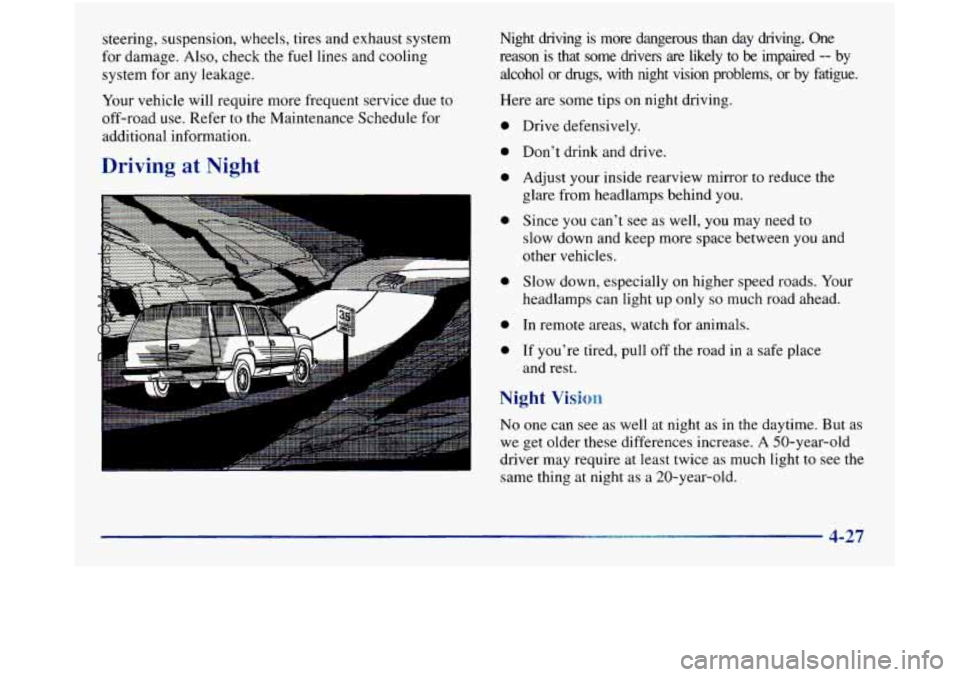
Driving at Night
Here are some tips on night driving.
0
0
0
0
0
0
0
Drive defensively.
Don’t drink and drive.
Adjust your inside rearview mirror
to reauce me
glare from headlamps behind you.
Since you can’t see as well,
you may need to
slow down and keep more space between you and
other vehicles.
Slow down, especially on higher speed roads. Your
headlamps can light
up only so much road ahead.
In remote areas, watch for animals.
If you’re tired, pull off
the road in a safe place
and rest.
Night Vision
No one can see as well at night as in the daytime. But as
we get older
these differences increase. A 50-year-old
driver may require at least twice as much light
to see the
same thing at night as a 20-year-old.
4-27
ProCarManuals.com
Page 218 of 452
J L
Wet brakes can cause accidents. They won’t work
as well in a quick stop and may cause pulling to
one side. You could lose control
of the vehicle.
After driving through
a large puddle of water or
a car wash, apply your brake pedal lightly until
your brakes work normally.
Hydroplaning
Hydroplaning is dangerous. So much water can build up
under your tires that they can actually ride
on the water.
This can happen if the road
is wet enough and you’re
going
fast enough. When your vehicle is hydroplaning,
it has little or no contact with the road.
Hydroplaning doesn’t happen often. But it can if your
tires do not have much tread or if the pressure in
one or
more
is low. It can happen if a lot of water is standing on
the road. If you can see reflections from trees, telephone
poles or other vehicles, and raindrops “dimple” the
water’s surface, there could be hydroplaning. Hydroplaning usually happens at higher
speeds, There
just
isn’t a hard and fast rule about hydroplaning. The
best advice
is to slow down when it is raining.
Driving Through Deep Standing Water
c
NOTICE:
If you drive too quickly through deep puddles or
standing water, water can come in through your
engine’s air intake and badly damage your
engine. Never drive through water that is slightly
lower than the underbody
of your vehicle. If you
can’t avoid deep puddles or standing water, drive
through them very slowly.
Some Other Rainy Weather Tips
0 Besides slowing down, allow some extra following
distance. And be especially careful when you pass
another vehicle. Allow yourself more clear room
ahead, and be prepared to have your view restricted
by road spray.
0 Have good tires with proper tread depth. (See
“Tires”
in the Index.)
4-30
ProCarManuals.com
Page 228 of 452
Snow can trap exhaust gases under your vehicle.
This can cause deadly CO (carbon monoxide) gas
to get inside.
CO could overcome you and kill
you.
You can’t see it or smell it, so you might not
know it is
in your vehicle. Clear away snow from
around the base
of your vehicle, especially any
that is blocking your exhaust pipe. And check
around again from time to time to be sure snow
doesn’t collect there.
Open
a window just a little on the side of the
vehicle
that’s away from the wind. This will help
keep
CO out.
Run your engine only as long as you must. This saves
fuel. When you run
the engine, make it go a little faster
than just idle. That is, push the accelerator slightly. This
uses less fuel for the heat that you get and it keeps
the
battery (or batteries) charged. You will need a
well-charged battery
(or batteries) to restart the vehicle,
and possibly for signaling later on with your headlamps.
Let the heater run for a while.
If you have a diesel engine, you may have to run it at a
higher speed to get enough heat. Then, shut the engine
off and close the window almost all the way to preserve
the heat. Start the engine again and repeat this only
when you feel really uncomfortable from the cold. But
do it
as little as possible. Preserve the fuel as long as you
can.
To help keep warm, you can get out of the vehicle
and do some fairly vigorous exercises every half hour or
so until help comes.
4-40
ProCarManuals.com
Page 232 of 452
NOTICE:
Some vehicles may be equipped with RPO VYU
(snow plow prep package). With this option, the
payload your vehicle can carry is reduced when
a
snow plow is installed. Your vehicle can be
damaged if either the front or rear axle ratings,
or the GVW are exceeded.
As a general guideline, with a 650 Ib. (295 kg)
snow plow, the weight of the occupants and cargo
must not exceed
300 lb. (135 kg). However, this
may depend on the vehicle's option content.
Therefore, to help avoid vehicle damage:
0 Make sure the weight on the front and
rear axles does not exceed their respective
axle ratings.
GVW rating.
Total vehicle weight must not exceed the
NOTICE: (Continued)
I NOTICE: (Continued) I
If more cargo or passengers need to be
carried, appropriate counter ballast must
be installed rear of the rear axle and
properly secured.
0 See your dealer for advice and information
about using
a snow plow on your vehicle.
Do not load your vehicle any heavier than the
GVWR, or either the maximum front or rear
GAWR.
If' you do, parts on your vehicle can break,
or it can change the
way your vehicle handles.
These could cause you to lose control.
Also,
overloading can shorten the life of your vehicle.
Using heavier suspension components to get added
durability might not change your weight ratings.
Ask
your dealer to help you load your vehicle the right way.
4-44
ProCarManuals.com
Page 244 of 452
Safety Chains
You should always attach chains between your vehicle
and your trailer. Cross the safety chains under the tongue
of the trailer so that’the tongue will not drop to the road
if it becomes separated from the hitch. Instructions
about safety chains may be provided by the hitch
manufacturer or by the trailer manufacturer. Follow the
manufacturer’s recommendation for attaching safety
chains and do not attach them to the bumper. Always
leave just enough slack
so you can turn with your rig.
And, never allow safety chains
to drag on the ground.
Trailer Brakes
If your trailer weighs more than 1,000 Ibs. (450 kg)
loaded, then it needs its own brakes
-- and they must be
adequate. Be sure to read and follow the instructions for
the trailer brakes so you’ll be able to install, adjust and
maintain them properly.
Your trailer brake system can tap into the vehicle’s
hydraulic brake system only if
0 The trailer parts can withstand 3,000 psi
(20 650 kPa) of pressure.
0 The trailer’s brake system will use less than
0.02 cubic inch (0.3 cc) of fluid from your vehicle’s
master cylinder. Otherwise, both braking systems
won’t work well. You could even lose your brakes.
If everything checks out this far, make the brake tap at
the port
on the master cylinder that sends the fluid to the
rear brakes.
But don’t use copper tubing for this. If you
do,
it will bend and finally break off. Use steel
brake tubing.
Driving with a Trailer
Towing a trailer requires a certain amount of experience.
Before setting out for the open road, you’ll want to get
to
know your rig. Acquaint yourself with the feel of
handling and braking with the added weight of
the
trailer. And always keep in mind that the vehicle you are
driving is now a good deal longer and not nearly as
responsive as your vehicle
is by itself.
Before you start, check
the trailer hitch and platform
(and attachments), safety chains, electrical connector,
lamps, tires and mirror adjustment.
If the trailer has
electric brakes, start your vehicle and trailer moving and
then apply
the trailer brake controller by hand to be sure
the brakes are working. This lets you check your
electrical connection at the same time.
4-56
ProCarManuals.com