Page 174 of 388
Steering in Emergencies
There are times when steering can be more effective than
braking.
For example, you come over a hill and find a
truck stopped in your lane, or a car suddenly pulls out
from nowhere, or a child
darts out from between parked
cars and stops right in front of you. You can avoid these
problems by braking
-- if you can stop in time. But
sometimes you can’t; there isn’t room. That’s the time for
evasive action
-- steering around the problem.
Your vehicle
can perform very well in emergencies like
these. First apply your brakes. (See “Braking in
Emergencies” earlier in this section.) It is better
to
remove as much speed as you can from a possible
collision. Then steer around the problem, to the left or
right depending on the space available. An
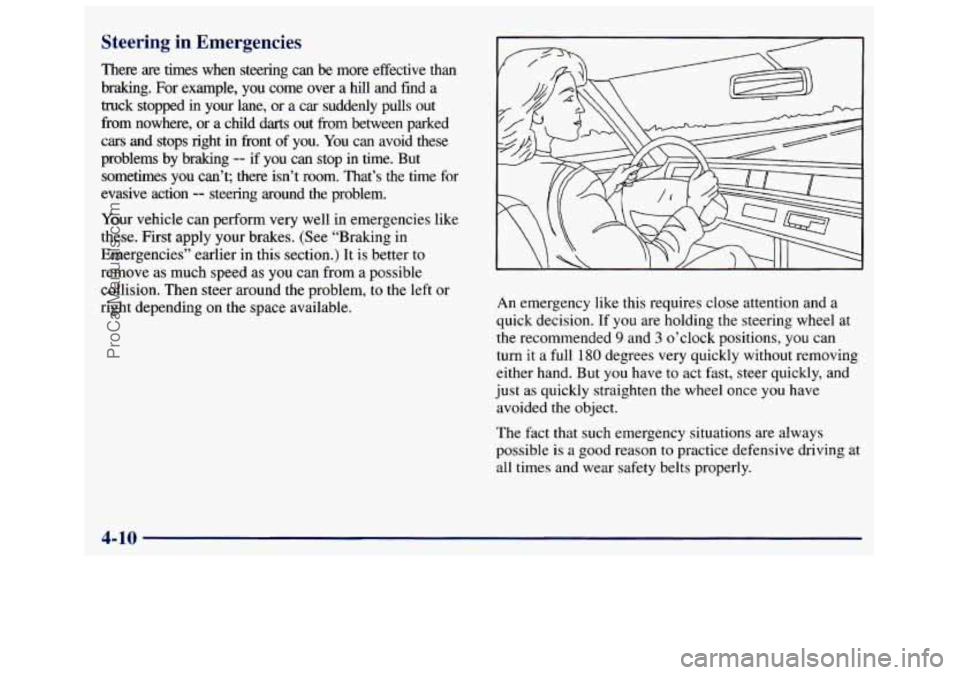
emergency like this requires close attention
and a
quick decision. If you are holding the steering wheel at
the recommended
9 and 3 o’clock positions, you can
turn
it a full 180 degrees very quickly without removing
either hand.
But you have to act fast, steer quickly, and
just
as quickly straighten the wheel once you have
avoided the object.
The fact that such emergency situations are always
possible is
a good reason to practice defensive driving at
all times and wear safety belts properly.
4-10
ProCarManuals.com
Page 177 of 388
In a skid, a driver can lose control of the vehicle.
Defensive drivers avoid most skids by taking reasonable
care suited to existing conditions, and by not
“overdriving” those conditions. But skids
are
always possible.
The three types of skids correspond to your vehicle’s
three control systems. In the braking skid, your wheels aren’t rolling. In the steering
or cornering skid, too
much speed or steering in a curve causes tires
to slip and
lose cornering force. And in the acceleration skid, too
much throttle causes the driving wheels
to spin.
A cornering skid and an acceleration skid
are best
handled by easing your foot off the accelerator pedal.
If your vehicle starts to slide,
ease your foot off the
accelerator pedal and quickly steer the way you want the
vehicle to go. If you start steering quickly enough, your
vehicle may straighten out. Always be ready for a
second skid if it occurs. Of
course, traction is reauced when water, snow, ice,
gravel or other material is on the road. For safety, you’ll
want to slow down and adjust your driving to these
conditions.
It is important to slow down on slippery
surfaces because stopping distance will be longer and
vehicle control more limited.
While driving
on a surface with reduced traction, try
your best to avoid sudden steering, acceleration or
braking (including engine braking by shifting to a lower
gear). Any sudden changes could cause the tires to
slide. You may not realize the surface is slippery until
your vehicle is skidding. Learn to recognize warning
clues
-- such as enough water, ice or packed snow on
the road to make a “mirrored surface”
-- and slow
down when you have any doubt.
Remember: Any anti-lock brake system (ABS) helps
avoid only the braking skid.
4-13
ProCarManuals.com
Page 188 of 388
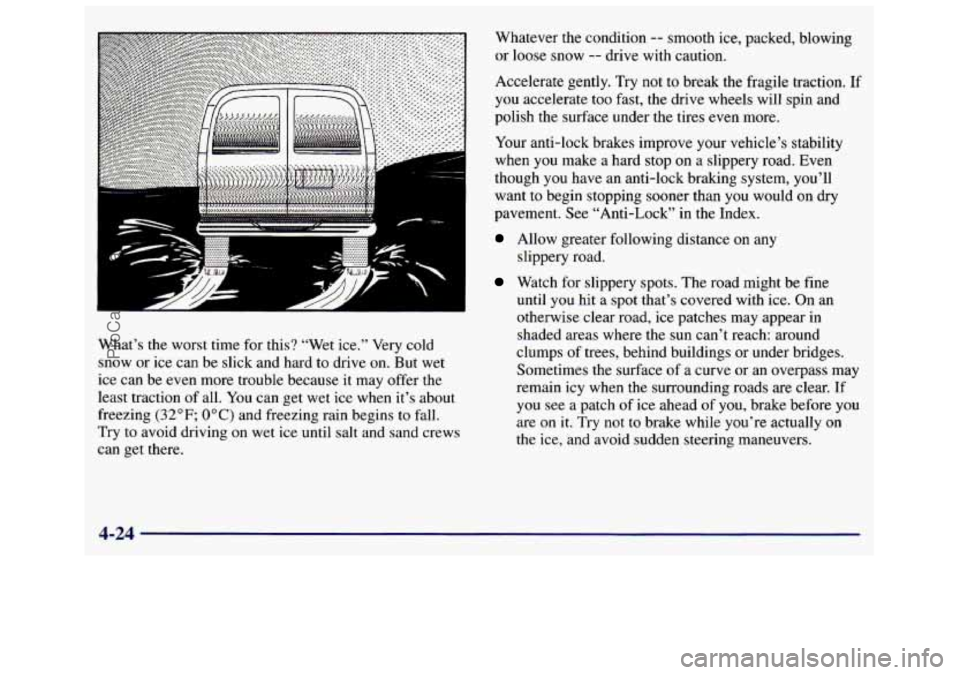
What’s the worst time for this? “Wet ice.” Very cold
snow or ice can be slick and hard to drive on.
But wet
ice can be even more trouble because it may offer the
least traction of all. You can get wet ice when it’s about
freezing
(32°F; OOC) and freezing rain begins to fall.
Try
to avoid driving on wet ice until salt and sand crews
can get there. Whatever the condition
-- smooth
ite, packed, blowing
or loose snow
-- drive with caution.
Accelerate gently. Try not to break the fragile traction. If
you accelerate too fast, the drive wheels will spin and
polish the surface under the tires even more.
Your anti-lock brakes improve your vehicle’s stability
when you make a hard stop on a slippery road. Even
though you have an anti-lock braking system, you’ll
want to begin stopping sooner than you would on dry
pavement. See “Anti-Lock” in the Index.
Allow greater following distance on any
slippery road.
Watch for slippery spots. The road might be fine
until you hit a spot that’s covered with ice.
On an
otherwise clear road, ice patches may appear
in
shaded areas where the sun can’t reach: around
clumps of trees, behind buildings or under bridges.
Sometimes the surface of a curve or an overpass may
remain icy when the surrounding roads are clear.
If
you see a patch of ice ahead of you, brake before you
are on it. Try not to brake while you’re actually on
the ice, and avoid sudden steering maneuvers.
4-24
ProCarManuals.com
Page 190 of 388
Snow can trap exhaust gases under your vehicle.
This can cause deadly
CO (carbon monoxide) gas
to get inside.
CO could overcome you and kill
you. You can’t see it or smell it, so you might not
know it is in your vehicle. Clear away snow from
around the base
of your vehicle, especially any
that is blocking your exhaust pipe. And check
around again
from time to time to be sure snow
doesn’t collect there.
Open
a window just a little on the side of the
vehicle that’s away
from the wind. This will help
keep
CO out.
Run your engine only as long as you must. This saves
fuel. When you run the engine, make it go a little faster
than just idle. That is, push
the accelerator slightly. This
uses less fuel for the heat that
you get and it keeps the
battery (or batteries) charged.
You will need a
well-charged battery (or batteries) to restart the vehicle,
and possibly for signaling later on with your headlamps.
Let the heater
run for a while.
If
you have a diesel engine, you may have to run it at a
higher speed to get enough heat. Then, shut the engine
off and close the window almost all the way to preserve
the heat. Start the engine again and repeat this only
when you feel really uncomfortable from the cold. But
do
it as little as possible. Preserve the fuel as long as you
can.
To help keep warm, you can get out of the vehicle
and do some fairly vigorous exercises every half hour or
so until help comes.
4-26
ProCarManuals.com
Page 209 of 388
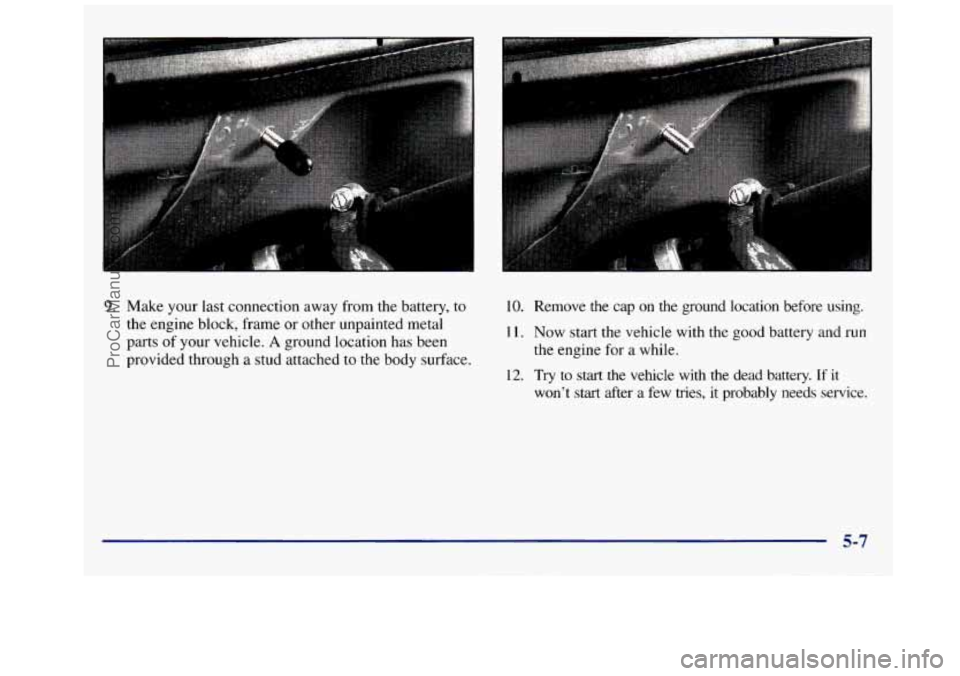
9. Make your last connection away from the battery, to
the engine block, frame or other unpainted metal
parts
of your vehicle. A ground location has been
provided through a stud attached
to the body surface.
10. Remove the cap on the ground location before using.
11. Now start the vehicle with the good battery and run
the engine for a while.
12. Try to start the vehicle with the dead battery. If it
won’t start after
a few tries, it probably needs service.
5-7
ProCarManuals.com
Page 210 of 388
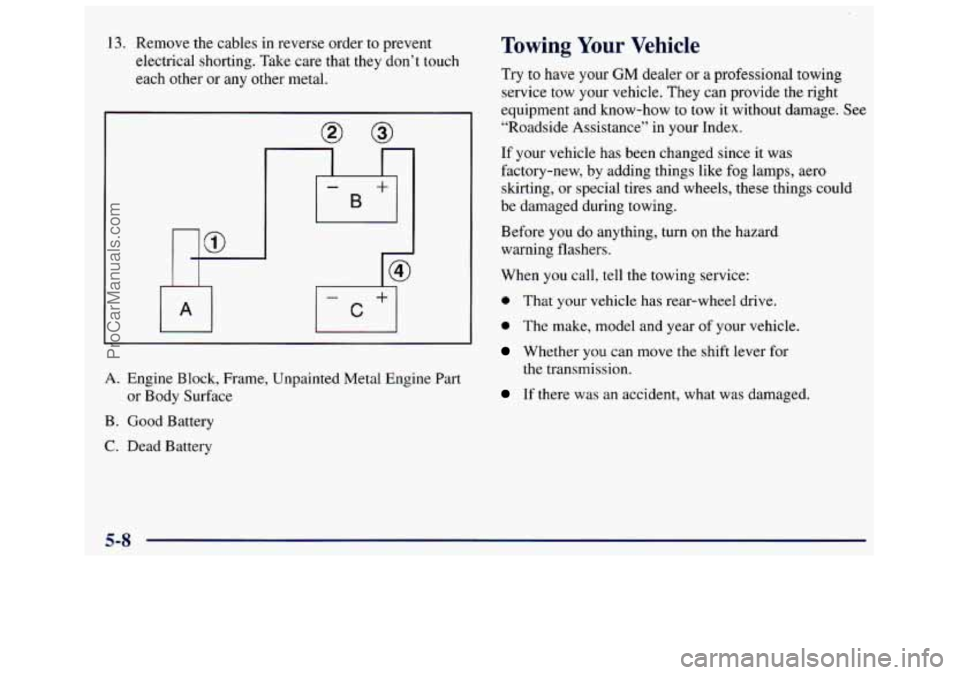
13. Remove the cables in reverse order to prevent
electrical shorting. Take care that they don’t touch
each other or any other metal.
A. Engine Block, Frame, Unpainted Metal Engine Part
or Body Surface
Towing Your Vehicle
Try to have your GM dealer or a professional towing
service tow your vehicle. They can provide the right
equipment and know-how to
tow it without damage. See
“Roadside Assistance” in your Index.
If your vehicle has been changed since it was
factory-new,
by adding things like fog lamps, aero
skirting, or special tires and wheels, these things could
be damaged during towing.
Before you do anything, turn
on the hazard
warning flashers.
When
you call, tell the towing service:
0 That your vehicle has rear-wheel drive.
0 The make, model and year of your vehicle.
Whether you can move the shift lever for
the transmission.
If there was an accident, what was damaged.
B. Good Battery
C. Dead Battery
5-8
ProCarManuals.com
Page 211 of 388
A I
I /! CAUTION:
To
0
0
0
0 0
help avoid injury
to you or others:
Never let passengers ride in a vehicle that is
being towed.
Never tow faster than safe or posted speeds.
Never tow with damaged parts not
fully secured. Never get under your vehicle after it has
been lifted by the tow truck.
Always use separate safety chains on each
side when towing a vehicle.
When your vehicle is being towed, have the ignition
key off. The steering wheel should be clamped in a
straight ahead position, with a clamping device designed
for towing service.
Do not use the vehicle’s steering
column lock for this. The transmission should be
in NEUTRAL (N) and the parking brake should
be released.
A CAUTION:
A vehicle can fall from a car carrier if it isn’t
adequately secured. This can cause a collision,
serious personal injury and vehicle damage. The
vehicle should be tightly secured with chains or
steel cables before it is transported.
Don’t use substitutes (ropes, leather straps,
canvas webbing, etc.) that can be cut by sharp
edges underneath the towed vehicle.
5-9
ProCarManuals.com
Page 220 of 388
Haw to Add Coolant to the Radiator
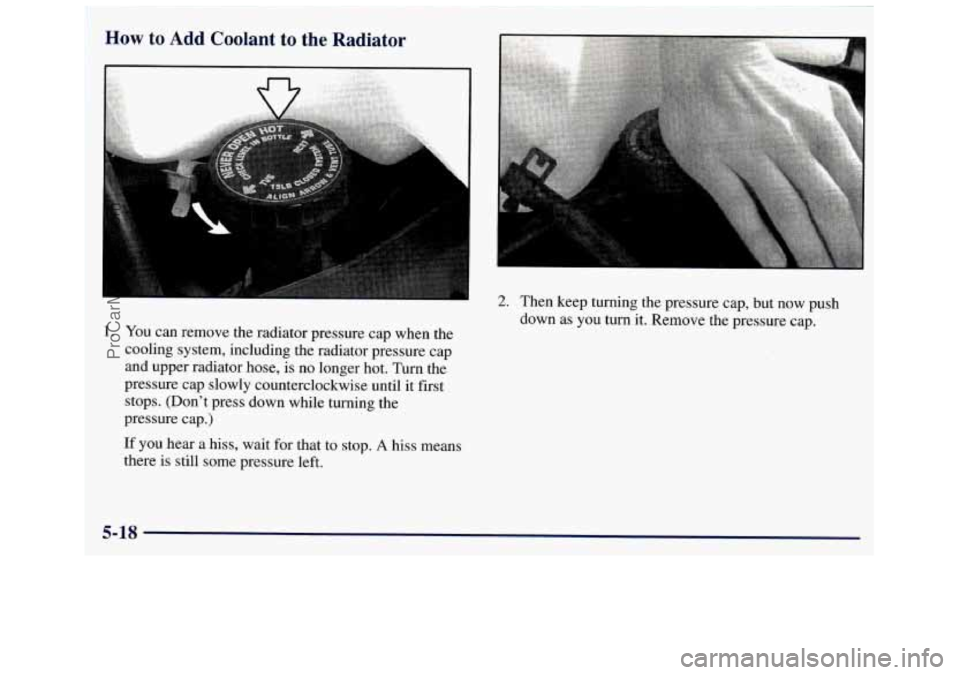
1. You can remove the radiator pressure cap when the
cooling system, including the radiator pressure cap
and upper radiator hose, is no longer hot. Turn the
pressure cap slowly counterclockwise until it first
stops. (Don’t press down while turning the
pressure cap.)
If you hear a hiss, wait for that to stop. A hiss means
there is still some pressure left.
2. Then keep turning the pressure cap, but ROW push
down as you turn it. Remove the pressure cap.
5-18
ProCarManuals.com