Page 141 of 388
Rear Air Conditioning and Rear Heater
If your vehicle has a rear air conditioning and rear heater
system combination, controls are provided
to regulate the
temperature, location and speed
of the airflow.
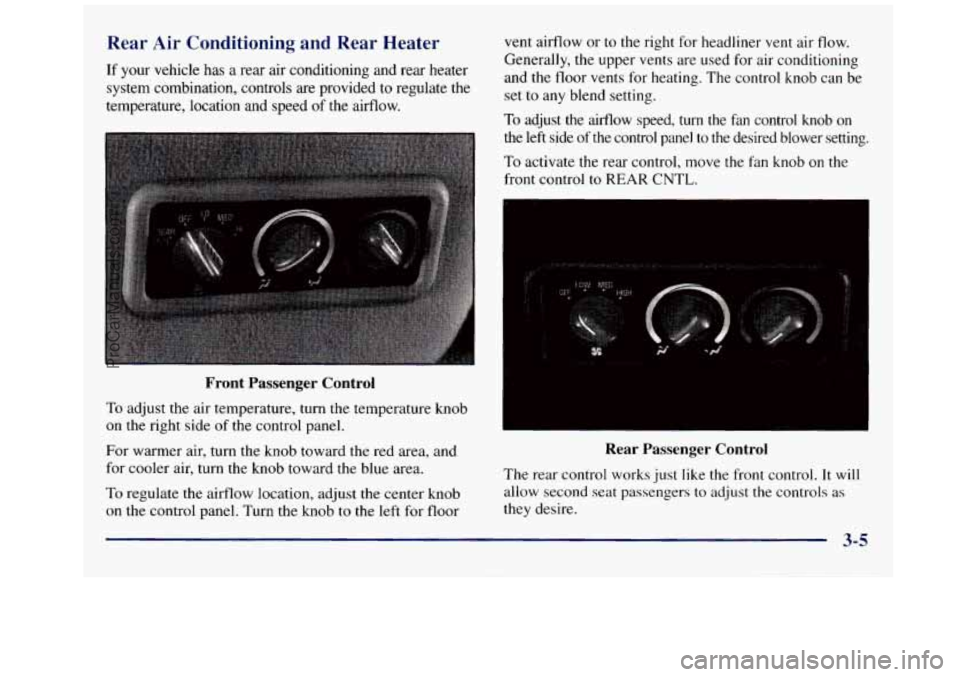
Front Passenger Control
To adjust the air temperature, turn the temperature knob
on the right side
of the control panel.
For warmer air, turn the knob toward the red area, and
for cooler air, turn the knob toward the blue area.
To regulate the airflow location, adjust the center knob
on the control panel. Turn the knob to the left for floor vent airflow
or to
the right for headliner vent air flow.
Generally, the upper vents are used
for air conditioning
and the floor vents for heating. The control knob can be
set to any blend setting.
To adjust the airflow speed, turn the fan control knob on
the left side of the control panel to the desired blower setting.
To activate the rear control, move the fan knob on the
front control
to REAR CNTL.
Rear Passenger Control
The rear control works just like the front control. It will
allow second seat passengers to adjust the controls as
they desire.
3-5
ProCarManuals.com
Page 142 of 388
Air Conditioning Heating
Before using your vehicle’s air conditioning, open the
windows to clear the vehicle
of hot air. This reduces the
time it takes for your vehicle to cool down. Then keep
your windows closed for the air conditioner to work at
its best.
You can use MAX
AIC with the temperature knob in the
blue area when it’s really hot outside and you need to
cool
the inside air quickly. MAX A/C lets in only a little
air from the outside.
If you first
use MAX A/C, you can then use A/C with
the temperature knob in the blue area, as soon as the
vehicle has cooled down,
so outside air will be going
through your vehicle.
If your vehicle has rear air conditioning, setting it on
LO
may enhance front A/C performance by allowing
trapped refrigerant in rear lines to circulate.
When the air conditioning,
DEFROST or BLEND is on,
you may notice a slight increase
or decrease in engine
speed, due to compressor operation. This
is normal
because the system
is designed to cycle the compressor
on and off to keep the desired temperature.
On cold days, use HEATER with the temperature knob
in the red area. Outside air will be brought in through
the floor outlets. The heater works best if you keep your
windows closed while using it.
If you use the optional engine coolant heater before
starting your engine, your heating system will produce
warmer air faster
to heat the passenger compartment in
cold weather. See “Engine Coolant Heater” in the Index.
Ventilation Tips
0
0
0
Keep the hood and front air inlet free of ice, snow, or
any other obstruction (such
as leaves). The heater
and defroster will work
far better, reducing the
chance of fogging
the inside of your windows.
When you
enter a vehicle in cold weather, turn the
blower fan to
HI for a few moments before driving
off. This helps clear the intake ducts of snow and
moisture, and reduces the chance
of fogging the
inside
of your windows.
Keep the air path under the front seats clear of objects.
This helps air
to circulate throughout your vehicle.
Your vehicle has air vents in
the center and on the sides
of your instrument panel.
3-6
ProCarManuals.com
Page 190 of 388
Snow can trap exhaust gases under your vehicle.
This can cause deadly
CO (carbon monoxide) gas
to get inside.
CO could overcome you and kill
you. You can’t see it or smell it, so you might not
know it is in your vehicle. Clear away snow from
around the base
of your vehicle, especially any
that is blocking your exhaust pipe. And check
around again
from time to time to be sure snow
doesn’t collect there.
Open
a window just a little on the side of the
vehicle that’s away
from the wind. This will help
keep
CO out.
Run your engine only as long as you must. This saves
fuel. When you run the engine, make it go a little faster
than just idle. That is, push
the accelerator slightly. This
uses less fuel for the heat that
you get and it keeps the
battery (or batteries) charged.
You will need a
well-charged battery (or batteries) to restart the vehicle,
and possibly for signaling later on with your headlamps.
Let the heater
run for a while.
If
you have a diesel engine, you may have to run it at a
higher speed to get enough heat. Then, shut the engine
off and close the window almost all the way to preserve
the heat. Start the engine again and repeat this only
when you feel really uncomfortable from the cold. But
do
it as little as possible. Preserve the fuel as long as you
can.
To help keep warm, you can get out of the vehicle
and do some fairly vigorous exercises every half hour or
so until help comes.
4-26
ProCarManuals.com
Page 215 of 388
If No Steam Is Coming From Your Engine
If you get the overheat warning but see or hear no
steam, the problem may not be too serious. Sometimes
the engine can get a little too hot when
you:
0 Climb a long hill on a hot day.
0 Stop after high-speed driving.
0 Idle for long periods in traffic.
0 Tow a trailer. See “Driving on Grades” in the Index.
If
you get the overheat warning with no sign of steam,
try this for a minute or
so:
1. If you have an air conditioner, turn it off.
2. Turn on your heater to full hot at the highest fan
speed and open the window as necessary. If
you no longer
have the overheat warning, you can
drive. Just
to be safe, drive slower for about 10 minutes.
If the warning doesn’t come back on,
you can
drive normally.
If the warning continues, pull over, stop, and park your
vehicle right away.
If there’s still no sign
of steam, push the accelerator until
the engine speed
is about twice as fast as normal idle
speed. Bring the engine speed back to normal idle speed
after two
or three minutes. Now see if the warning stops.
But then, if
you still have the warning, turn ofSthe
engine
and get everyone out of the vehicle until it
cools down.
You may decide not to lift the hood but to get service
help right away.
3. If you’re in a traffic jam, shift to NEUTRAL (N);
otherwise, shift to the highest gear while
driving
-- DRIVE (D).
5-13
ProCarManuals.com
Page 217 of 388
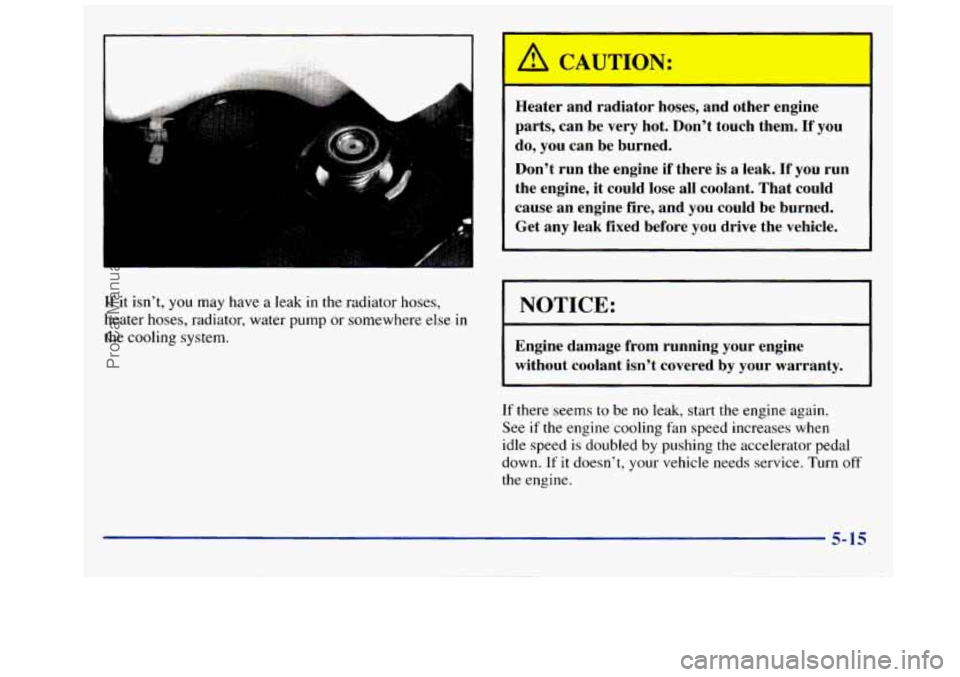
If it isn’t, you may have a leak in the radiator hoses,
heater hoses, radiator, water pump or somewhere else
in
the cooling system.
Heater and radiator hoses, and other engine
parts, can be very hot. Don’t touch them.
If you
do, you can be burned.
Don’t run the engine if there is
a leak. If you run
the engine, it could lose all coolant. That could
cause an engine fire, and you could be burned.
Get any leak fixed before
you drive the vehicle.
I NOTICE:
Engine damage from running your engine
without coolant isn’t covered by your warranty.
If there seems to be no leak, start the engine again.
See
if the engine cooling fan speed increases when
idle speed
is doubled by pushing the accelerator pedal
down.
If it doesn’t, your vehicle needs service. Turn off
the engine.
5-15
ProCarManuals.com
Page 218 of 388
How to Add Coolant to the Coolant
Recovery
Tank
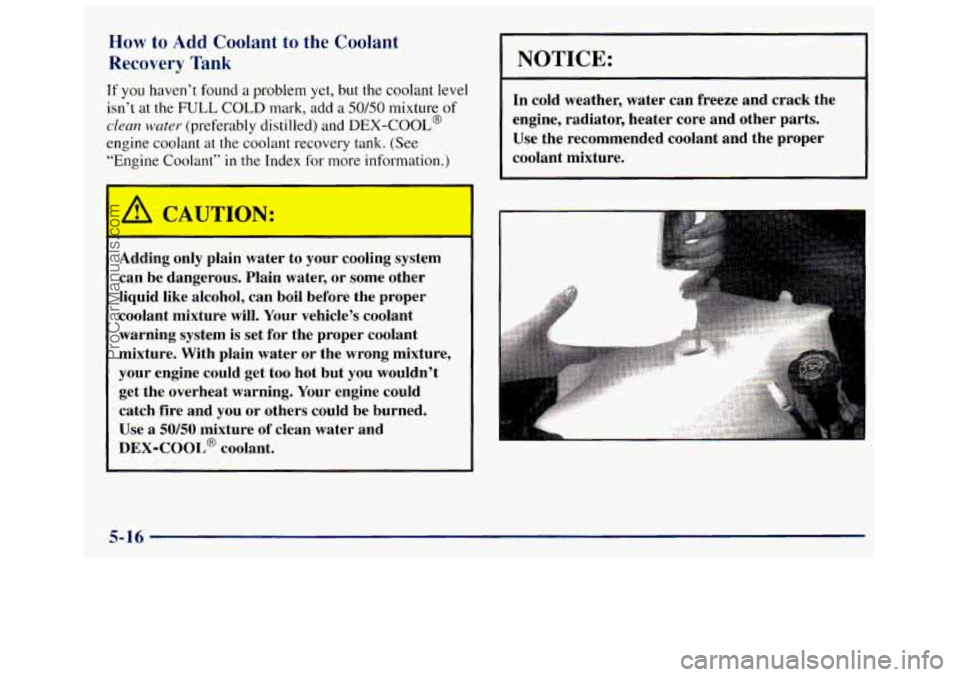
If you haven’t found a problem yet, but the coolant level
isn’t
at the FULL COLD mark, add a 50/50 mixture of
clean water (preferably distilled) and DEX-COOL@
engine coolant at the coolant recovery tank. (See
“Engine Coolant“
in the Index for more information.)
A C”UT1 )N:
Adding only plain water to your cooling system
can be dangerous. Plain water, or some other
liquid like alcohol, can boil before the proper
coolant mixture will. Your vehicle’s coolant
warning system is set for the proper coolant
mixture. With plain water or the wrong mixture,
your engine could get too hot but you wouldn’t
get the overheat warning. Your engine could
catch fire and you or others could be burned.
Use a
50/50 mixture of clean water and
DEX-COOL@ coolant.
I NOTICE:
In cold weather, water can freeze and crack the
engine, radiator, heater core and other parts.
Use the recommended coolant and the proper
coolant mixture.
5-16
ProCarManuals.com
Page 262 of 388
NOTICE:
When adding coolant, it is important that you
use only
DEX-COOL@ (silicate-free) coolant.
If coolant other than DEX-COOL is added to
the system, premature engine, heater core or
radiator corrosion may result. In addition, the
engine coolant will require change sooner
-- at
30,000 miles (50 000 km) or 24 months,
whichever occurs
first. Damage caused by the
use of coolant other than DEX-COOL@ is not
covered by your new vehicle warranty.
What to Use
Use a mixture of one-half clean water (preferably
distilled) and one-half
DEX-COOL@ coolant which
won’t damage aluminum parts. If you
use this mixture,
you don’t need
to add anything else.
I
A CAC LILA:
Adding only plain water to your cooling system
can be dangerous. Plain water, or some other
liquid like alcohol, can boil before the proper
coolant mixture will. Your vehicle’s coolant
warning system
is set for the proper coolant
mixture. With plain water or the wrong mixture,
your engine could get too hot but you wouldn’t
get the overheat warning. Your engine could
catch fire and you or others could be burned.
Use
a 50/50 mixture of clean water and
DEX-COOL@ coolant.
6-22
ProCarManuals.com
Page 263 of 388
NOTICE:
If you use an improper coolant mixture, your
engine could overheat and be badly damaged.
The repair cost wouldn’t be covered by your
warranty.
Too much water in the mixture can
freeze and crack the engine, radiator, heater core
and other parts.
If you have to add coolant more than four times a year,
have your dealer check your cooling system.
NOTICE:
If you use the proper coolant, you don’t have to
add extra inhibitors or additives which claim to
improve the system. These can be harmful.
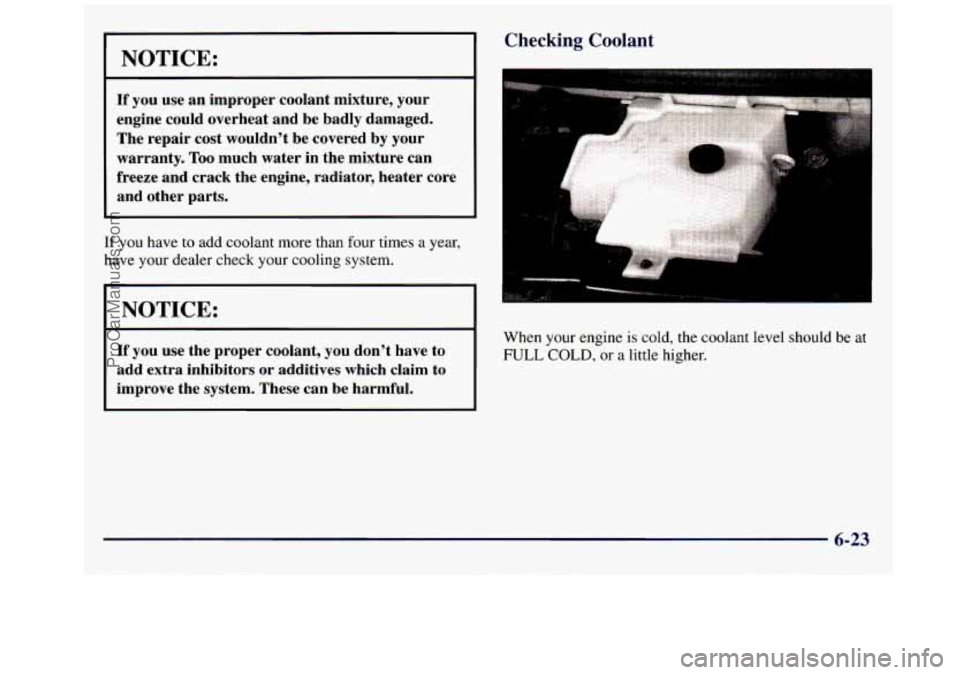
Checking Coolant
When your engine is cold, the coolant level should be at
FULL COLD, or a little higher.
6-23
ProCarManuals.com