1998 GMC ENVOY high beam
[x] Cancel search: high beamPage 72 of 386

Key in the Ignition
If you leave your vehicle with the keys inside, it’s an
easy target for joy riders or professional thieves
-- so
don’t do it.
When you park your vehicle and open the driver’s door,
you’ll hear a chime reminding
you to remove your key
from the ignition and take
it with you. Always do this.
Your steering wheel will be locked, and
so will your
ignition and transmission. And remember to lock
the doors.
Parking at Night
Park in a lighted spot, close all windows and lock your
vehicle. Remember to keep your valuables out
of sight.
Put them
in a storage area, or take them with you.
Parking Lots
If you park in a lot where someone will be watching
your vehicle, it’s best to lock it up and take your keys.
But what
if you have to leave your ignition key? What if
you have to leave something valuable in your vehicle?
Put your valuables in a storage area, like your
glove box.
Lock all the doors except the driver’s.
Content Theft-Deterrent
Your vehicle is equipped
with
a Content
Theft-Deterrent
SECURITY alarm system.
With this system, the SECURITY light will flash as
you
open the door (if your ignition is off).
This light reminds you to activate the theft-deterrent
system. Here’s how
to do it:
1. Open the door.
2. Lock the door with the power door lock switch or the
remote keyless entry transmitter. The SECURITY
light should come
on and stay on.
3. Close all doors. The SECURITY light should go off
after approximately
30 seconds. The alarm is not
armed until the SECURITY light goes off.
If a door is opened without the key or the remote keyless
entry transmitter, the alarm will go
off. Your vehicle’s
high-beam headlamps will flash
and the horn will sound
for
30 seconds, then will turn off to save the battery power.
2-11
I
ProCarManuals.com
Page 73 of 386

Remember, the theft-deterrent system won‘t activate if
you lock the doors with a key or use the manual door
lock. It activates only if
you use a power door lock
switch with the door open, or with the remote keyless
entry transmitter. You should
also remember that you
can start your vehicle with the correct ignition key
if’ the
alarm has been set
off.
Here’s how to avoid setting off the alarm by accident:
If you don’t want to activate the theft-deterrent
system, the vehicle should be locked
with the door
key
after the doors are closed.
Always unlock a door with a key, or use the remote
keyless entry transmitter. Unlocking
a door any other
way will set off the alarm.
If you set off the alarm by accident, unlock any door
with the key. You can
also turn off the alarm by pressing
UNLOCK on the remote keyless entry transmitter.
The alarm won’t stop if you try to unlock a door any
other way.
Testing the Alarm
The alarm can be tested by following these steps:
I. From inside the vehicle, lower the driver‘s window
and open the driver’s door.
3.
4.
Activate the system by locking the doors with the
power door
lock switch while the door is open, or
with the remote keyless entry transmitter.
Get out
of the vehicle, close the door and wait for the
SECURITY light to
go out.
Then reach
in through the window, unlock the door
with the manual door lock and open the door. This
should set
off the alarm.
If the alarm does not sound when it should but the
vehicle’s high-beam headlamps flash, check
to see if the
horn works. The horn fuse may be blown.
To replace the
f~~se, see “Fuses and Circuit Breakers”
in the Index.
If the alarm does not sound or the vehicle’s high-beam
headlamps do not flash, the vehicle should be serviced
by
an authorized service center.
Passlock’
Your vehicle is equipped with the Passlock
theft-deterrent system.
Passlock is
a passive theft-deterrent system. The system
is armed once the key is removed from the ignition.
Passlock enables fuel
if the ignition lock cylinder is
turned with a valid key. If a correct key is not used, fuel
is disabled.
2-12
ProCarManuals.com
Page 91 of 386

Tilt Wheel
You should adjust the tilt
steering wheel before
you drive.
Turn Signal/Multifunction Lever
You can raise it to the highest level to give your legs
more room when
you enter and exit the vehicle.
To tilt the wheel, hold the steering wheel and pull the
lever toward
YOU. Move the steering wheel to a
comfortable level, then release the lever to lock the
wheel in place.
Do not adjust the steering wheel while driving. The
lever on the left side
of the steering column
includes your:
0 Turn Signal and Lane Change Indicator
Headlamp High/Low Beam Changer
Windshield Wipers
0 Windshield Washer
0 Cruise Control
2-30
ProCarManuals.com
Page 92 of 386

Turn and Lane Change Signals
The turn signal has two upward (for right) and two
downward (for left) positions. These positions allow
you to signal a turn or a lane change.
To signal a turn, move the lever all the way up
or down. When the turn
is finished, the lever
will return automatically.
I 1 I An arrow on the instrument
panel will flash
in the
direction of the turn or
lane change.
To signal a lane change, just raise or lower the lever
until the arrow starts to flash. Hold it there until you
complete your lane change. The lever will return by
itself when you release it.
The signal indicator will flash even if a turn signal bulb
is burned out. Check the front and rear turn signal lamps
regularly
to make sure they are working. If
a bulb is burned out, replace it to help avoid an
accident. If the
arrows don’t go on at all when you
signal a turn, check the fuse (see “Fuses and Circuit
Breakers”
in the Index) and for burned-out bulbs.
Turn Signal On Chime
If your turn signal is left on for more than 3/4 of a mile
(1.2 km), a chime will sound at each flash of the turn
signal.
To turn off the chime, move the turn signal lever
to the off position.
Headlamp High/Low Beam Changer
To change the headlamps from low beam to high or high
to low, pull the multifunction lever all the way toward
you. Then release
it.
When the high beams are
on, this indicator light on
the instrument panel will
also be on.
2-31
ProCarManuals.com
Page 99 of 386

The DRL system will make your high-beam headlamps
come
on at reduced brightness when:
Fog Lamps
the ignition is on,
the headlamp switch is in automatic headlamp
mode and
the parking brake is released.
When the DRL are on, only your high-beam headlamps
will be on. The taillamps, sidemarker and other lamps
won’t be on. The instrument panel won’t be lit up either.
When it begins to get dark, the high-beam headlamps
will automatically switch from DRL to the regular
low-beam headlamps.
When you turn
the headlamp switch off, the regular
low-beam headlamps will
go off, and your high-beam
headlamps will change to the reduced brightness
of DRL
provided it is not dark outside.
To idle your vehicle with
the DRL off, set the parking
brake. The DRL will stay off until
you release the
parking brake.
As with any vehicle, you should turn on the regular
headlamp system
when you need it. Use your fog lamps
for better vision in foggy or misty
conditions. Your low-beam headlamps or your parking
lamps must be on for your fog lamps to work.
The fog lamp switch is
on the instrument panel under
the lamps switch. Press
the switch to turn the fog lamps
on. Press the switch again to turn them
off. A light will
glow in
the switch when the fog lamps are on.
Remember,
fog lamps alone will not give off as much
light as your headlamps. Never use your fog lamps in
the dark without turning on your headlamps.
The
fog lamps will go off whenever your high-beam
headlamps come on. When the high beams
go off, the
fog lamps will come on again.
2-38
ProCarManuals.com
Page 187 of 386
You can be temporarily blinded by approaching
headlamps. It can take
a second or two, or even several
seconds,
for your eyes to readjust to the dark. When you
are faced with severe glare
(as from a driver who
doesn’t lower the high beams, or a vehicle with
misaimed headlamps), slow down a little. Avoid staring
directly into the approaching headlarnps.
Keep your windshield and all the
glass oi=ryour vehicle
clean
-- inside and out. Glare at night is made much
worse by dirt on the glass. Even the inside
of the glass
can build up
a film caused by dust. Dirty glass makes
lights dazzle and flash more than clean glass would,
making
the pupils of your eyes contract repeatedly.
Remember that your headlamps light
up far less of a
roadway when you are in a turn or curve. Keep your
eyes moving; that way, it’s easier to pick out dimly
lighted objects. Just
as your headlamps should be
checked regularly for proper
aim, so should your eyes
be examined regularly. Some drivers suffer from night
blindness
-- the inability to see in dim light -- and aren’t
even aware
of it.
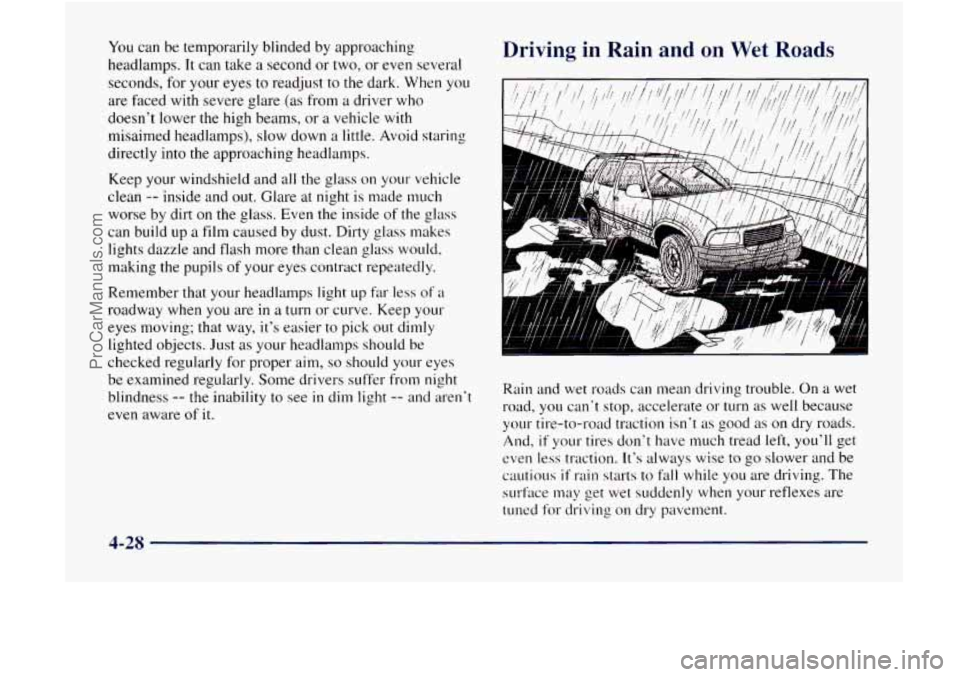
Driving in Rain and on Wet Roads
Rain and wet roads can mean driving trouble. On a wet
road, you can‘t stop, accelerate or turn
as well because
your tire-to-road traction isn‘t as good
as on dry roads.
And,
if your tires don’t have much tread left, you’ll get
even
less traction. It’s always wise to go slower and be
cautious
if rain starts to fall while you are driving. The
surface may get wet suddenly when your reflexes are
tuned for driving
on dry pavement.
ProCarManuals.com
Page 278 of 386

If you’re not going to drive your vehicle for 25 days
or more, remove the black, negative
(-) cable from
the battery. This will help keep your battery from
running down.
A CAUTION:
Bulb Replacement
Before you replace any bulbs, be sure that all the lamps
are off and the engine isn’t running. See “Replacement
Bulbs”
in the Index.
For any bulb changing procedure not listed
in this
section, contact your GM dealer’s service department.
High Intensity Discharge (HID) Lighting
Batteries have acid that can burn you and gas
that can explode. You can be badly hurt if you
aren’t careful. See “Jump Starting” in the Index
for tips on working around
a battery without
getting hurt.
Contact your dealer to learn how to prepare your vehicle
for longer storage periods.
Also, for your audio system, see “Theft-Deterrent
Feature”
in the Index.
I A CAUTION: I
The low beam High Intensity Discharge lighting
system operates at a very high voltage.
If you try
to service
any of the system components, you
could be injured. Have your dealer or
a qualified
technician service them.
6-31
ProCarManuals.com
Page 306 of 386

Name
RT TRN
RR PRK
TRL PRK
LT HDLP
RT HDLP
LT HI
RT HI
FR PRK
INT BAT
ENG
I
ECM B
ABS
ECM
1
HORN
BTS
I
BIU LP
IGN E
AIC
RAP
OXYSEN
Usage
Right Turn Signal Rear
Right Rear Parking Lamps
Trailer Park Lamps Left Headlamp
Right Headlamp
Left High Beam
Right High Beam
Front Parking Lamps
I/P Fuse Block Feed
Engine SensorsISolenoids, MAP,
CAM. PURGE, VENT
Engine Control Module, Fuel Pump,
Module, Oil Pressure
Anti-Lock Brake System
Engine Control Module Injectors Horn
Brake-Transmission Shift Interlock
Back-up
Lalllps
Engine
Air Conditioning
Retained Accessory Power
Oxygen Sensor
Name
IGN B
DRL
FOG LP
IGN
A
STUD #2
PARKLP
LR PRK
IGN C
HTDSEAT ATC
RRDFOG
HVAC
TRCHMSL
RR W/W
CRANK
LD LEV
HI BEAM
HAZLP
VECHMSL
HTDMIR
STOPLP
TBC
Usage
Column Feed, IGN 2, 3,4
Daytime Running Lamps
Fog Lamps
Starting and Charging IGN
I
Accessory Feeds, Electric Brake
Parking La~nps
Left Rear Parking Lamps Starter Solenoid, Fuel Pump. PRNDL
Heated Seat
Electronic Transfer Case
Rear Defogger
HVAC System
Trailer Center High Mount Stop Light
Rear Window Wiper
Clutch Switch, NSBU Switch
Electronic Load Leveling
HID Headlamps Hazard Lamps
Vehicle Center High
Mount Stop Lamp
Heated Mirror
Stoplamps
Truck Body Computer
6-59
1
ProCarManuals.com