1998 GMC ENVOY light
[x] Cancel search: lightPage 191 of 386
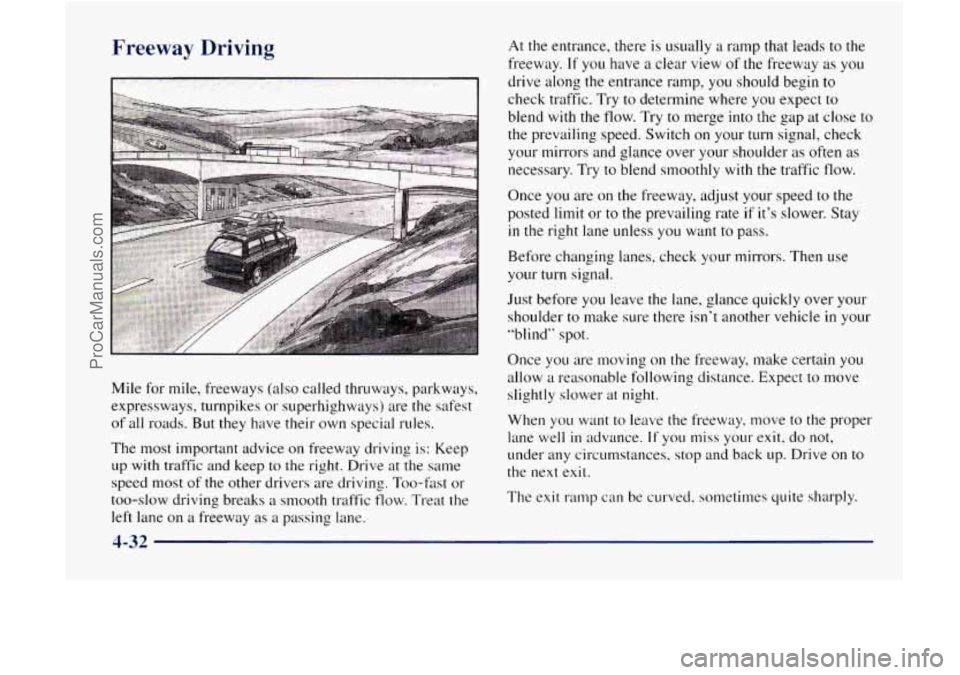
Freeway Driving
Mile for mile, freeways (also called thruways, parkways,
expressways, turnpikes or superhighways) are the safest
of all roads. But they have their own special rules.
The most important advice
on freeway driving is: Keep
up with traffic and keep to the right. Drive at the same
speed most of the other drivers are driving. Too-fast
or
too-slow driving breaks a smooth traffic flow. Treat the
left lane on a freeway as a passing lane.
At the entrance, there is usually a ramp that leads to the
freeway.
If you have a clear view of the freeway as you
drive along the entrance ramp, you should begin to
check traffic. Try to determine where you expect to
blend with the flow. Try to merge into the gap at close to
the prevailing speed. Switch
on your turn signal, check
your mirrors and glance over your shoulder as often as
necessary. Try to blend smoothly
with the traffic flow.
Once you are on the freeway, adjust your speed
to the
posted limit or to the prevailing rate if it’s slower. Stay
in the right lane unless you want to pass.
Before changing lanes, check your mirrors. Then use
your turn signal.
Just before
you leave the lane, glance quickly over your
shoulder
to make sure there isn’t another vehicle in your
“blind” spot.
Once you are
moving on the freeway, make certain you
allow
a reasonable following distance. Expect to move
slightly slower at night.
When you want to leave the freeway. move to
the proper
lane well
in advance. If you miss your exit, do not,
under any circumstances, stop and back up. Drive on to
the next exit.
The exit ramp can be curved. sometimes quite sharply.
4-32
ProCarManuals.com
Page 195 of 386
You may see highway signs on mountains that warn
of special problems. Examples are long grades,
passing or no-passing zones,
a falling rocks area
or winding roads. Be alert
to these and take
appropriate action.
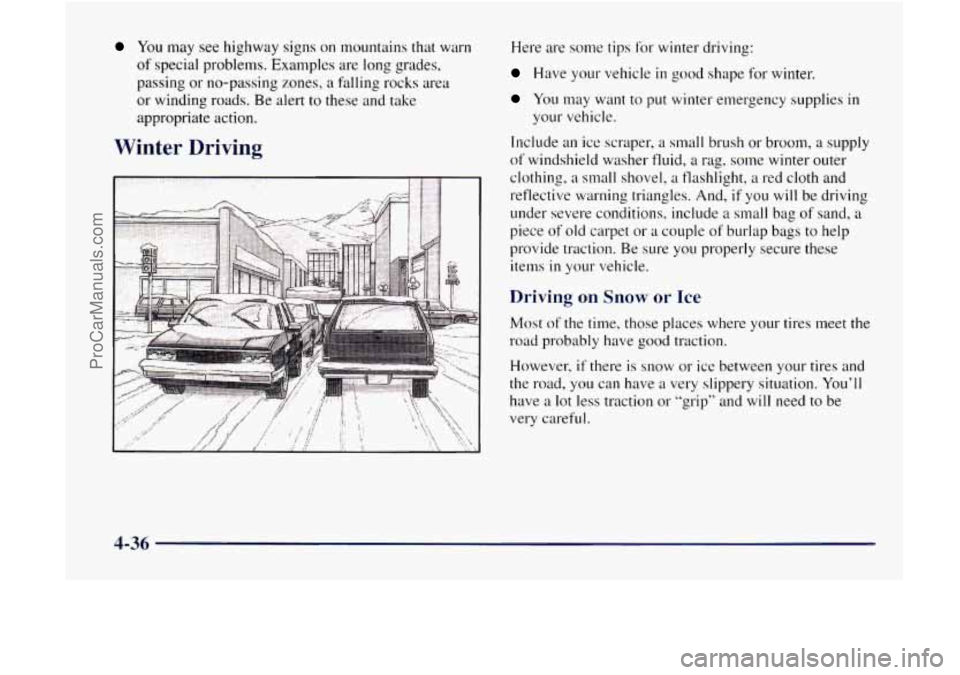
Winter Driving
Here are solne tips for winter driving:
Have your vehicle in good shape for winter.
You may want to put winter emergency supplies in
Tnclude an ice scraper, a small brush or broom, a supply
of windshield washer fluid, a rag, some winter outer
clothing,
a small shovel, a flashlight, a red cloth and
reflective warning triangles.
And, if you will be driving
under severe conditions, include a small bag
of sand, a
piece of old carpet or a couple of burlap bags to help
provide traction. Be sure
you properly secure these
your vehicle.
items
in your vehicle.
Driving on Snow or Ice
Most of the time, those places where your tires
road probably have
good traction.
However,
if there is snow or ice between your t
the road, you can have a very slippery situation meet the
ires and . You’ll
have a lot less traction or “,I-ip” and will need to be
very careful. -- -
4-36
ProCarManuals.com
Page 198 of 386

Snow can trap exhaust gases under your vehicle.
This can cause
deadly CO (carbon monoxide) gas
to get inside. CO could overcome
you and kill
you. You can’t see it
or smell it, so you might not
know it
is in your vehicle. Clear away snow from
around the base
of your vehicle, especially any
that is blocking your exhaust pipe. And check
around again from time to time to be sure snow
doesn’t collect there.
Open a window just
a little on the side of the
vehicle that’s away from the wind. This will help
keep
CO out.
Run your engine only as long as you must. This saves
fuel. When you
run the engine. make it go a little faster
than just idle. That is. push the accelerator slightly. This
uses less fuel for the heat that you get and
it keeps the
battery charged.
YOLI will need a well-charged battery to
restart the vehicle, and possibly for signaling later
on
with your headlamps. Let the heater run for a while.
Then, shut the engine off and close the window almost
all the way to preserve the heat. Start the engine again
and repeat this only when you feel really uncomfortable
from the cold.
But do it as little as possible. Preserve the
fuel
as long as you can. To help keep warm, you can get
out of the vehicle and do some fairly vigorous exercises
every half hour or
so until help comes.
Recreational Vehicle Towing
Vehicles with the electronic shift transfer case require
special modifications before they can be towed
in this
manner. Please contact your dealer
.for the towing
information that is appropriate
for yoc~r
particular vehicle.
4-39
ProCarManuals.com
Page 211 of 386

Trailer Wiring Harness
The heavy-duty trailer wiring is an eight-wire harness
assembly. The harness is stored under the vehicle, on the
driver’s side corner frame rear crossmember. The
heavy-duty trailer wiring has a 30-amp feed wire
with
an in-line fuse located by the junct.ion block. See “Fuses
and Circuit Breakers”
in the Index. The harness does not
have a cannector and should be wired by
a qualified
electrical technician. The technician can use the
following color code chart when connecting the wiring
harness
to your trailer.
0
0
0
0
0
0
0
0
Dark Blue: Use for electric trailer brakes or
auxiliary wiring.
Red: Use for battery charging;
it connects to the
starter solenoid.
Light Green: Back-up lamps.
Brown: Taillamps and parking lamps.
Yellow: Left stoplamp and turn signal.
Dark Green: Right stoplamp
and turn signal.
White (Heavy Gage): Ground wire.
White (Light Gage): Auxiliary stoplamp.
Securely attach the harness to the trailer, then tape or
strap
it to your vehicle’s frame rail. Be sure you leave it
loose enough so the wiring doesn’t bend or break, but
not
so loose that it drags on the ground. Store the
harness
in its original place. Wrap the harness together
and tie
it neatly so it won’t be damaged.
4-52
ProCarManuals.com
Page 215 of 386

2. Get the vehicles close enough so the jumper cables
can reach, but be sure
the vehicles aren’t touching
each other.
If they are, it could cause a ground
connection you don’t want.
You wouldn’t be able to
start your vehicle, and the bad grounding could
damage
the electrical systems.
To avoid the possibility of the vehicles rolling, set
the parking brake firmly on each vehicle. Put your
vehicle
in PARK (P).
3. Turn off the ignition on both vehicles. Unplug
unnecessary accessories plugged into the cigarette
lighter or the accessory power outlets. Turn
off all
lamps that aren’t needed as well as radios. This will
avoid sparks and help save both batteries. In
addition, it could save your radio!
NOTICE:
If you leave your radio on, it could be badly
damaged. The repair wouldn’t be covered by
your warranty.
L
4. Open both hoods and locate the batteries. Find the
positive
(+) and negative (-) terminals on
each battery.
A
Using a match near a battery can cause battery
gas to explode. People have been hurt doing this,
and some have been blinded. Use
a flashlight if
you need more light.
Be sure the battery has enough water.
You don’t
need
to add water to the ACDelco Freedom’
battery installed in every new
GM vehicle. But if
a battery has filler caps, be sure the right amount
of fluid is there. If it is low, add water to take care
of that first. If you don’t, explosive gas could
be present.
Battery fluid contains acid that can burn you.
Don’t get it
on you. If you accidentally get it in
your eyes or on your skin, flush the place with
water and get medical help immediately.
5-4
ProCarManuals.com
Page 244 of 386
Rocking Your Vehicle To Get It Out
First, turn your steering wheel left and right. That will
clear
the area around your front wheels. Shift the transfer
case into
4HI. Then shift back and forth between
REVERSE
(R) and a forward gear, spinning the wheels as
little as possible. Release the accelerator pedal while you shift, and press lightly
on the accelerator pedal when the
transmission is in gear.
If that doesn’t get you out after a
few tries,
you may need to be towed out. Or, you can use
your recovery
hooks. If you do need to be towed out, see
“Towing Your Vehicle”
in the Index.
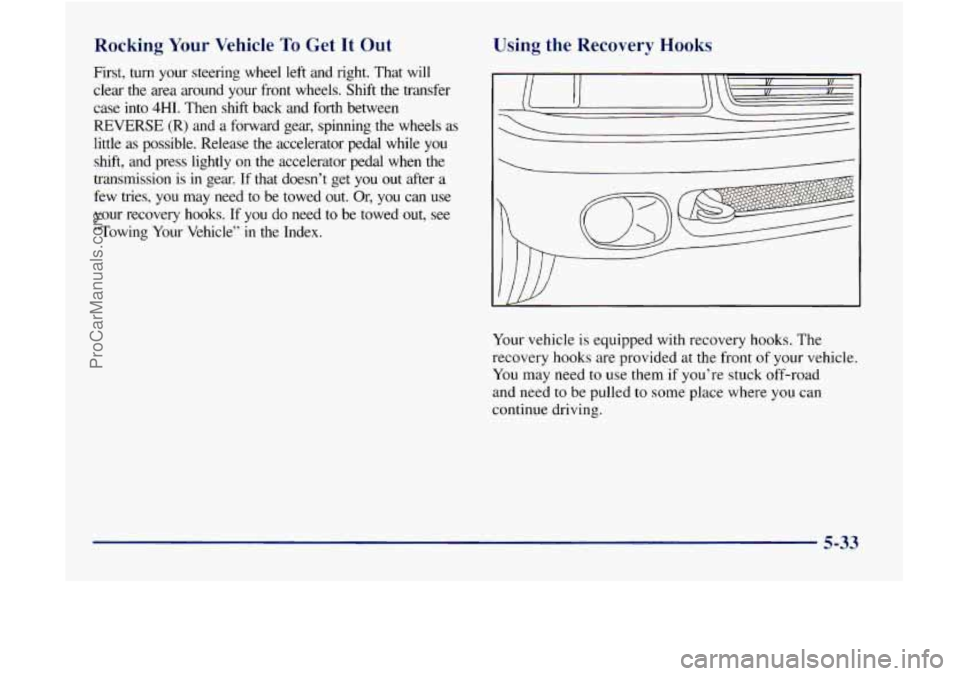
Using the Recovery Hooks
Your vehicle is equipped with recovery hooks. The
recovery hooks are provided at the front
of your vehicle.
You may need
to use them if you’re stuck off-road
and need
to be pulled to some place where you can
continue driving.
5-33
ProCarManuals.com
Page 254 of 386

When you put the cap back on, turn it to the right
(clockwise) until you hear a clicking sound. Make
sure you fully install the cap. The diagnostic system
can determine if the fuel cap has been left off or
improperly installed. This would allow fuel to
evaporate into the atmosphere. See “Malfunction Indicator Lamp” in the Index.
NOTICE:
If you need a new cap, be sure to get the right
type. Your dealer can get one for you.
If you get
the wrong type, it may not fit properly. This may
cause your malfunction indicator lamp to light
and your fuel tank and emissions system may be
damaged. See “Malfunction Indicator Lamp” in
the Index.
Filling a Portable Fuel Container
Never fill a portable fuel container while it is in
your vehicle. Static electricity discharge from the
container can ignite the gasoline vapor. You can
be badly burned and your vehicle damaged if this
occurs.
To help avoid injury to you and others:
Dispense gasoline only into
approved containers.
Do not fill a container while it is inside a
vehicle, in a vehicle’s trunk, pickup bed or
on any surface other than the ground.
inside of the
fill opening before operating
the nozzle. Contact should be maintained
until the filling
is complete.
Bring the fill nozzle in contact with the
Don’t smoke while pumping gasoline.
6-7
ProCarManuals.com
Page 269 of 386
A 50/50 mixture of water and DEX-COOL@ coolant will:
0 Give freezing protection down to -34°F (-37°C).
Give boiling protection up to 265 “F ( 129°C).
0 Protect against rust and corrosion.
0 Help keep the proper engine temperature.
Let the warning lights and gages work as
they should.
NOTICE:
When adding coolant, it is important that you use
only
DEX-COOL@ (silicate-free) coolant.
If coolant other than DEX-COOL is added to the
system, premature engine, heater core or
radiator corrosion may result. In addition, the
engine coolant will require change sooner
0- at
30,000 miles (50 000 km) or 24 months,
whichever occurs
first. Damage caused by the use
of coolant other than DEX-COOL@ is not
covered by your new vehicle warranty.
What to Use
Use a mixture of one-half clean water (preferably
distilled) and one-half
DEX-COOL@ coolant which
won’t damage aluminum
parts. If you use this mixture,
you don’t need to add anything else.
Adding only plain water to your cooling system
can be dangerous. Plain water, or some other
liquid like alcohol, can boil before the proper
coolant mixture will. Your vehicle’s coolant
warning system is set for the proper coolant
mixture. With plain water or the wrong mixture,
your engine could get too hot but you wouldn’t
get the overheat warning. Your engine could
catch fire and you or others could be burned.
Use
a 50/50 mixture of clean water and
DEX-COOL@ coolant.
ProCarManuals.com