Page 4 of 192
EFC HFUEL DOOR>
SERVICE
ENGINE
SOONLOW
COOLANTTHEFT102030405060
70
80
90
100
1202060100
140
180P R N D 2 1MPH km/h0000000000P!
BRAKE
+ –
110CRUISE
RPMx1000
ABSO/D
OFFREAR
LAMP
OUTPREMIUM UNLEADED
FUEL RECOMMENDED0 1234
5
6
78
Parking
brake
release
(pg. 92) Headlamp
control
(pg. 16)
Speed
control*
(pg. 29) Driver side
air bag
(pg. 67) Trunk
release
(pg. 40)
Turn signal and
wiper/washer
control (pg. 33)Instrument
cluster
(pg. 6)
*if equipped
Instrumentation
4
Page 6 of 192
WARNING LIGHTS AND CHIMES
Standard instrument cluster
Optional instrument cluster
Turn signal
Illuminates when the
left or right turn signal
or the hazard lights are
turned on. If one or
both of the indicators stay on continuously or flash
faster, check for a burned-out turn signal bulb. Refer
toExterior bulbsin theMaintenance and care
chapter.
High beams
Illuminates when the
high beam headlamps
are turned on.
CRUISE
RPMx1000
0 1234
5
6
7EFC H
FUEL DOOR>
SERVICE
ENGINE
SOON1020304050 60
70
80
90
100
110
00 20406080100
120
140
160
180P R N D D 1MPH km/h
00
122
00013
P!
BRAKEABS
+ –
UNLEADED FUEL ONLY
THEFT LOW
COOLANTO/D
OFF
EFC H
FUEL DOOR>
SERVICE
ENGINE
SOON
THEFT102030405060
70
80
90
100
1202060100
140
180
P R N D 2 1MPH km/h
00
000
00000
P!
BRAKELOW
COOLANT
+ –
110CRUISE
RPMx1000
ABSO/D
OFFPREMIUM UNLEADED
FUEL RECOMMENDED0 1234
5
6
78
Instrumentation
6
Page 8 of 192

What you should do if the Service Engine Soon
light illuminates
Light turns on solid:
This means that the OBD II system has detected a
malfunction.
Temporary malfunctions may cause yourService
Engine Soonlight to illuminate. Examples are:
1. The vehicle has run out of fuel. (The engine may
misfire or run poorly.)
2. Poor fuel quality or water in the fuel.
3. The fuel cap may not have been properly installed
and securely tightened.
These temporary malfunctions can be corrected by
filling the fuel tank with good quality fuel and/or
properly installing and securely tightening the gas
cap. After three driving cycles without these or any
other temporary malfunctions present, theService
Engine Soonlight should turn off. (A driving cycle
consists of a cold engine startup followed by mixed
city/highway driving.) No additional vehicle service is
required.
If theService Engine Soonlight remains on, have
your vehicle serviced at the first available
opportunity.
Light is blinking:
Engine misfire is occurring which could damage your
catalytic converter. You should drive in a moderate
fashion (avoid heavy acceleration and deceleration)
and have your vehicle serviced at the first available
opportunity.
Under engine misfire conditions, excessive
exhaust temperatures could damage the
catalytic converter, the fuel system, interior floor
coverings or other vehicle components, possibly
causing a fire.
Instrumentation
8
Page 9 of 192

Low fuel
Illuminates when the
fuel tank has
approximately eight
liters (two gallons)
remaining. The lamp will also illuminate when the
ignition key is turned to ON and the engine is off.
Low coolant (if equipped)
This lamp will
illuminate when the
engine coolant inside
the reservoir is low.
This lamp will come on
when the ignition is first turned on, but then should
turn off. If the lamp stays on, you should check the
coolant level inside the reservoir. For instructions on
adding coolant, seeEngine coolantin the
Maintenance and carechapter.
Anti-theft system (if equipped)
Refer toAnti-theft
systemin theControls
and featureschapter.
O/D off (if equipped)
Illuminates when the
transmission control
switch has been
pushed. When the light
is on, the transmission does not shift into overdrive.
If the light does not come on when the transmission
control switch is depressed or if the light flashes
when you are driving, have your vehicle serviced.
LOW
COOLANT
THEFT
O/D
OFF
Instrumentation
9
Page 12 of 192
Key-in-ignition warning chime
Sounds when the key is left in the ignition in the
OFF/LOCK or ACC position and either front door is
opened.
Headlamps on warning chime
Sounds when the headlamps or parking lamps are
on, the ignition is off (and the key is not in the
ignition) and either front door is opened.
GAUGES
Standard instrument cluster gauges
Optional instrument cluster gauges
CRUISE
RPMx1000
0 1234
5
6
7EFC H
FUEL DOOR>
SERVICE
ENGINE
SOON1020304050 60
70
80
90
100
110
00 20406080100
120
140
160
180P R N D D 1MPH km/h
00
122
00013
P!
BRAKEABS
+ –
UNLEADED FUEL ONLY
THEFT LOW
COOLANTO/D
OFF
EFC H
FUEL DOOR>
SERVICE
ENGINE
SOON
THEFT102030405060
70
80
90
100
1202060100
140
180
P R N D 2 1MPH km/h
00
000
00000
P!
BRAKELOW
COOLANT
+ –
110CRUISE
RPMx1000
ABSO/D
OFFPREMIUM UNLEADED
FUEL RECOMMENDED0 1234
5
6
78
Instrumentation
12
Page 13 of 192
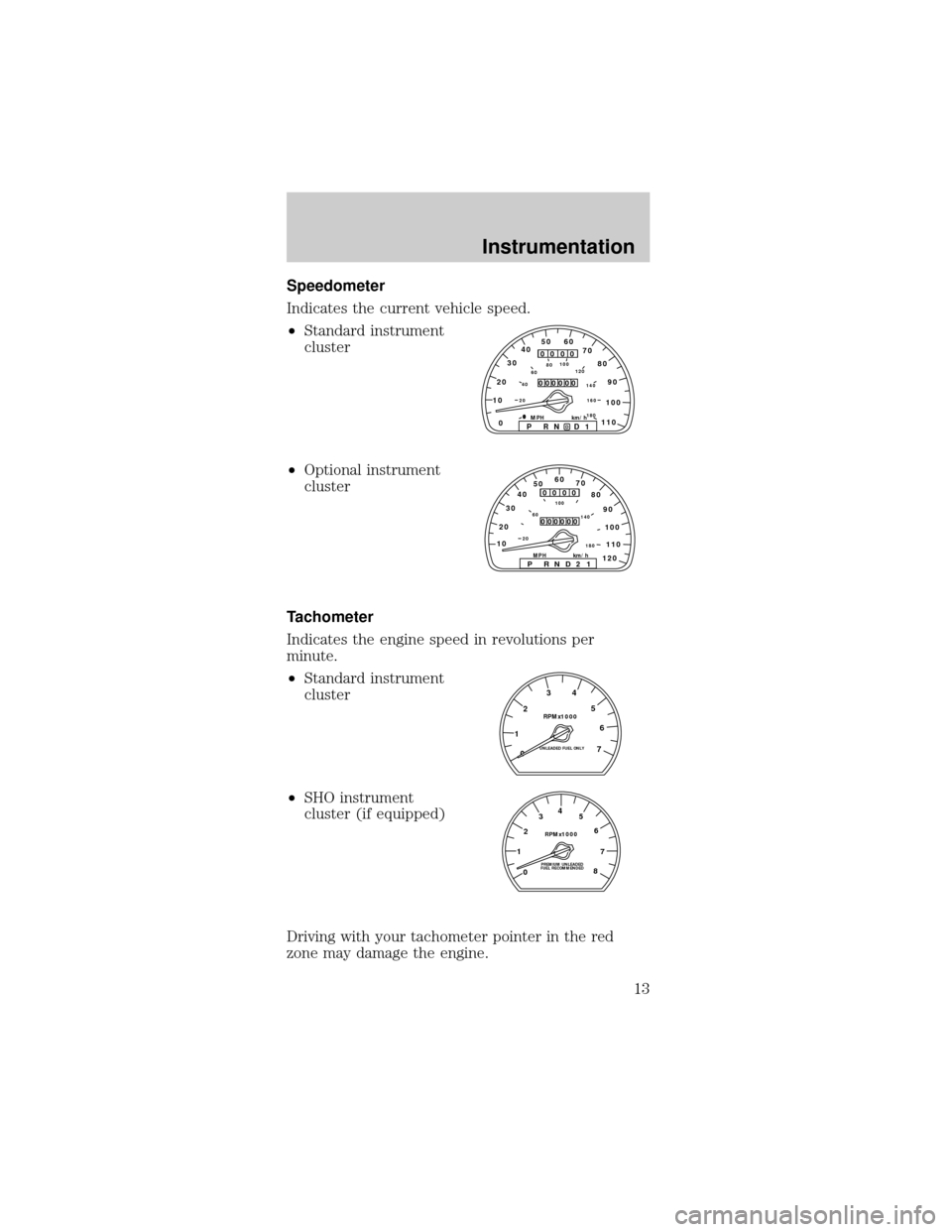
Speedometer
Indicates the current vehicle speed.
²Standard instrument
cluster
²Optional instrument
cluster
Tachometer
Indicates the engine speed in revolutions per
minute.
²Standard instrument
cluster
²SHO instrument
cluster (if equipped)
Driving with your tachometer pointer in the red
zone may damage the engine.
1020304050 60
70
80
90
100
110
0
0 20406080100
120
140
160
180P R N D D 1MPH km/h
00
000
00000
102030405060
70
80
90
100
1202060100
140
180
P R N D 2 1MPH km/h
00
000
00000
110
RPMx1000
0 1234
5
6
7UNLEADED FUEL ONLY
RPMx1000
PREMIUM UNLEADED
FUEL RECOMMENDED0 1234
5
6
78
Instrumentation
13
Page 15 of 192
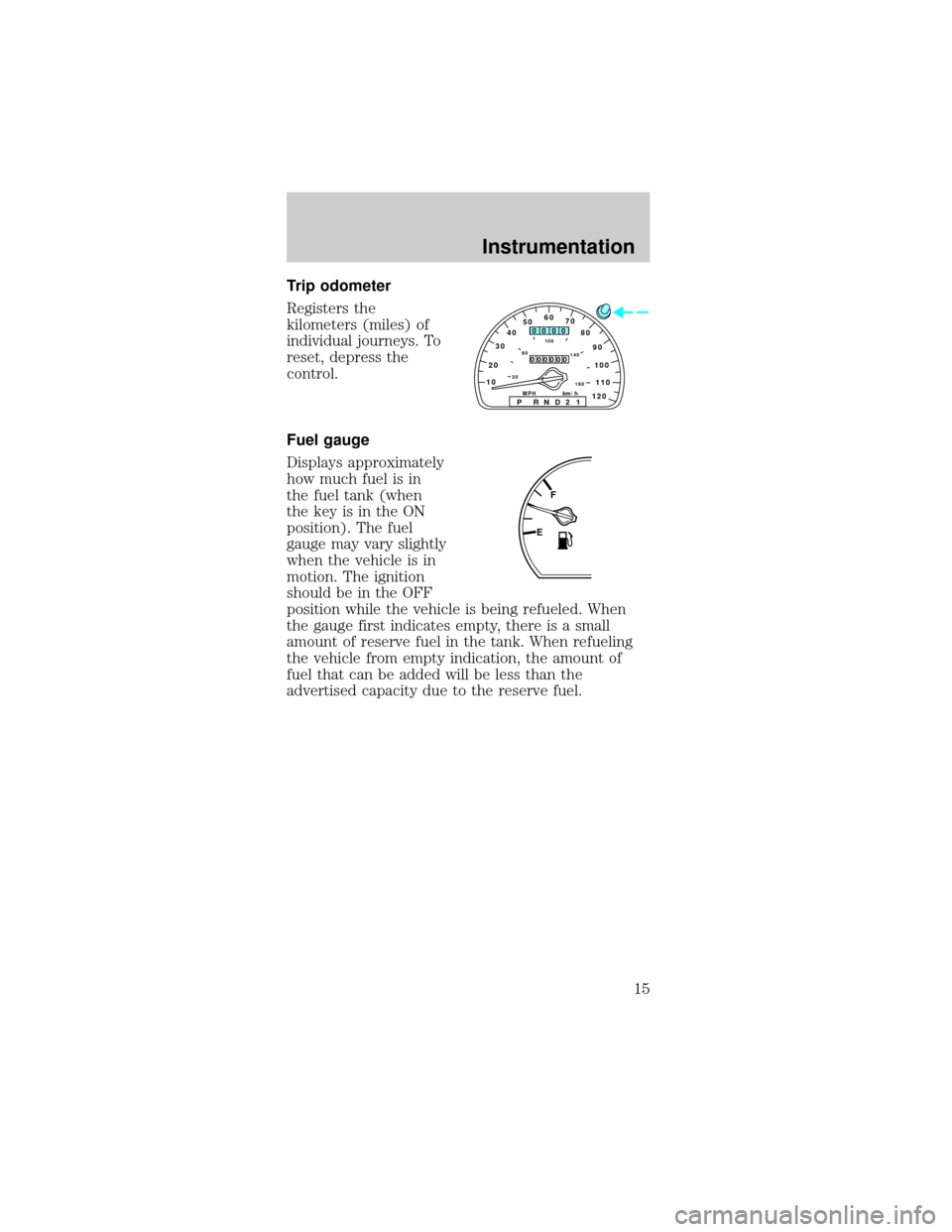
Trip odometer
Registers the
kilometers (miles) of
individual journeys. To
reset, depress the
control.
Fuel gauge
Displays approximately
how much fuel is in
the fuel tank (when
the key is in the ON
position). The fuel
gauge may vary slightly
when the vehicle is in
motion. The ignition
should be in the OFF
position while the vehicle is being refueled. When
the gauge first indicates empty, there is a small
amount of reserve fuel in the tank. When refueling
the vehicle from empty indication, the amount of
fuel that can be added will be less than the
advertised capacity due to the reserve fuel.
102030405060
70
80
90
100
1202060100
140
180
P R N D 2 1MPH km/h
00
000
00000
110
EF
Instrumentation
15
Page 67 of 192
Failure to inspect and if necessary replace
the safety belt asembly under the above
conditions could result in severe personal injuries
in the event of a collision.
Refer toCleaning and maintaining the safety
beltsin theMaintenance and caresection.
AIR BAG SUPPLEMENTAL RESTRAINT SYSTEM
(SRS)
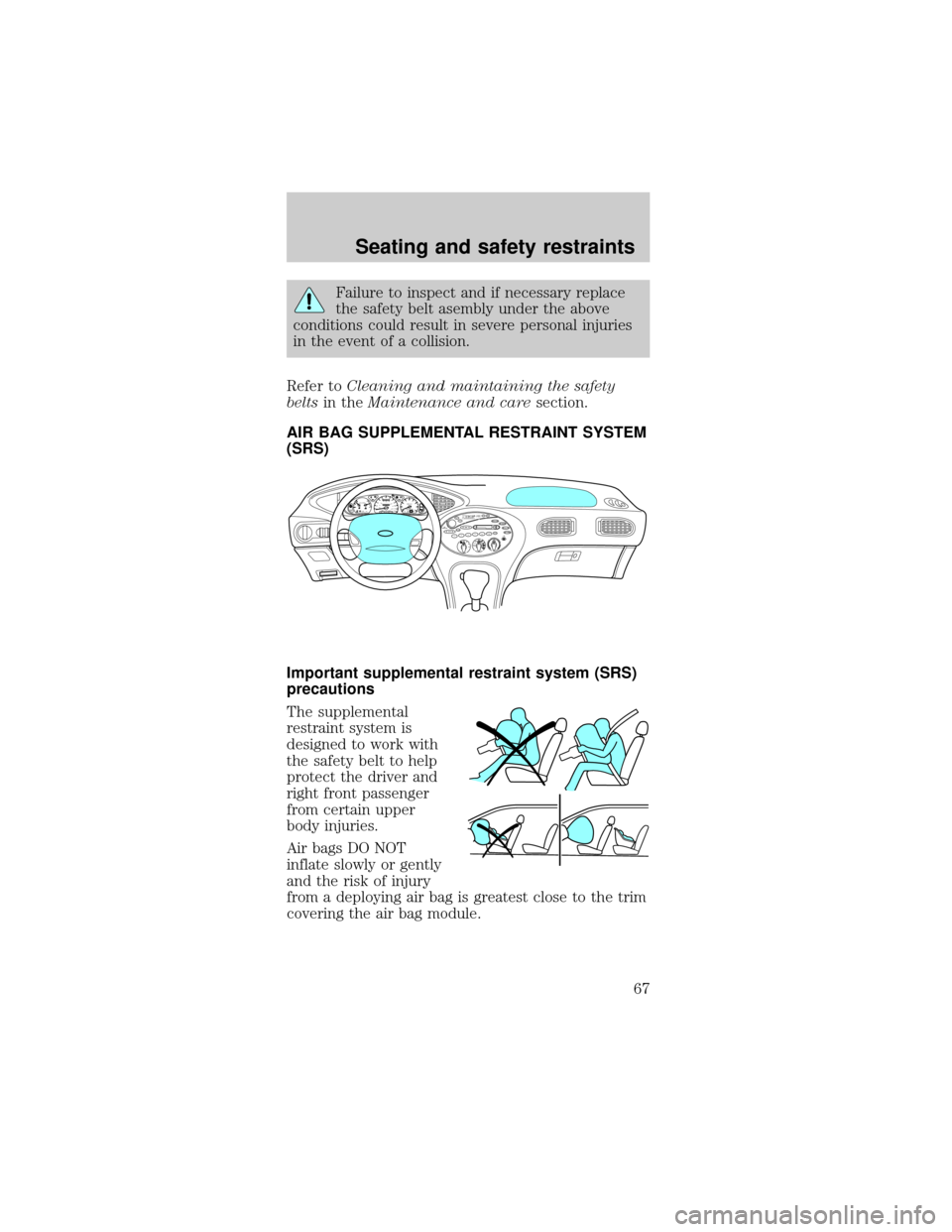
Important supplemental restraint system (SRS)
precautions
The supplemental
restraint system is
designed to work with
the safety belt to help
protect the driver and
right front passenger
from certain upper
body injuries.
Air bags DO NOT
inflate slowly or gently
and the risk of injury
from a deploying air bag is greatest close to the trim
covering the air bag module.
BASSTREBBALFADEREWFFEJECT1234
56wTAPE SIDETAPE
R-DEFTUNESEEKSCAN AM
FMMH
LO
HIOFF
A/C
MAX
A/CVENTVOL
PUSH-ONwSTFM 12
AMCBLRFEFC HFUEL DOOR>SERVICE
ENGINE
SOONLOW
COOLANTTHEFT102030405060
70
80
90
100
1202060100
140
180P R N D 2 1MPH km/h0000000000P!
BRAKE+ –110CRUISERPMx1000ABSO/D
OFFREAR
LAMP
OUTPREMIUM UNLEADED
FUEL RECOMMENDED0 1234
5
6
78
Seating and safety restraints
67