Page 110 of 192
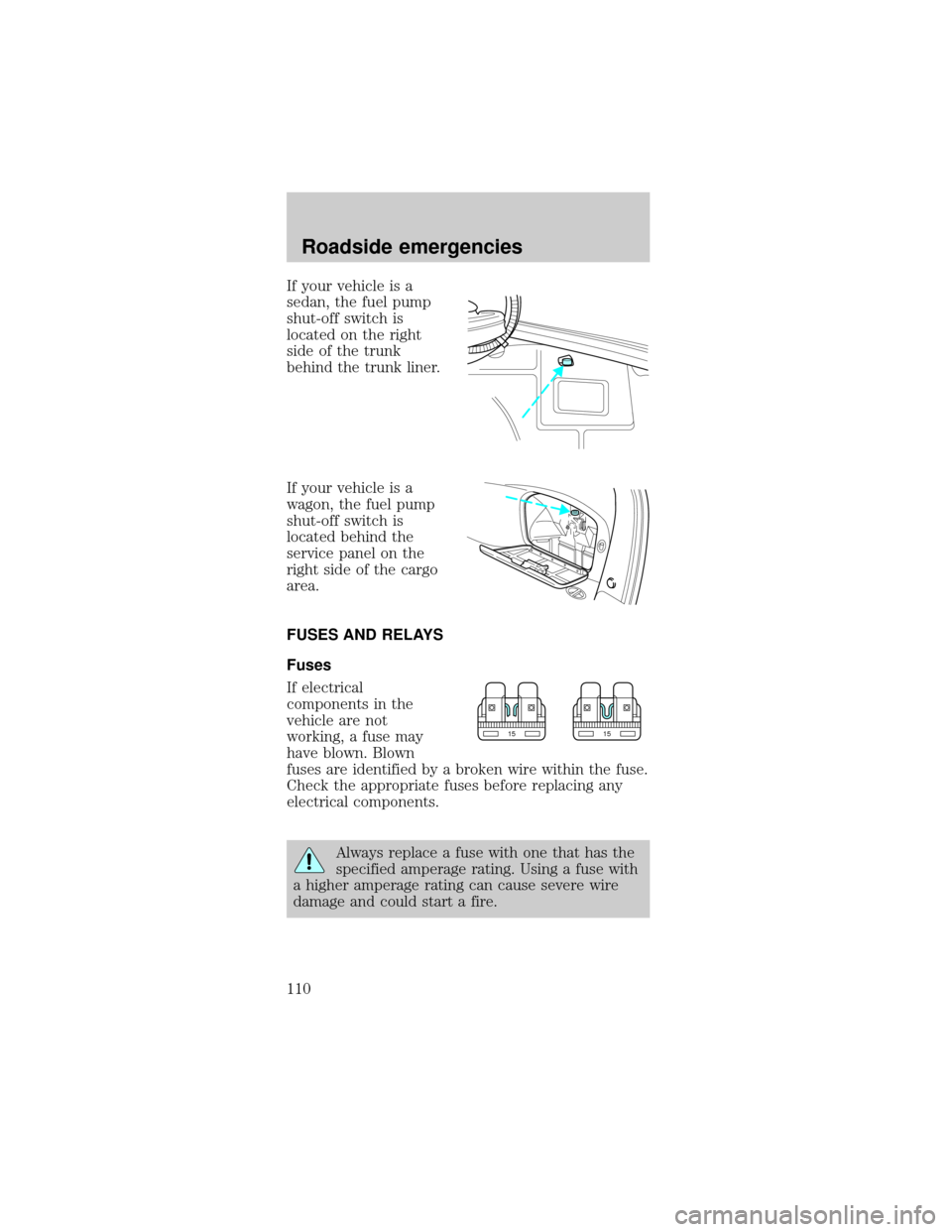
If your vehicle is a
sedan, the fuel pump
shut-off switch is
located on the right
side of the trunk
behind the trunk liner.
If your vehicle is a
wagon, the fuel pump
shut-off switch is
located behind the
service panel on the
right side of the cargo
area.
FUSES AND RELAYS
Fuses
If electrical
components in the
vehicle are not
working, a fuse may
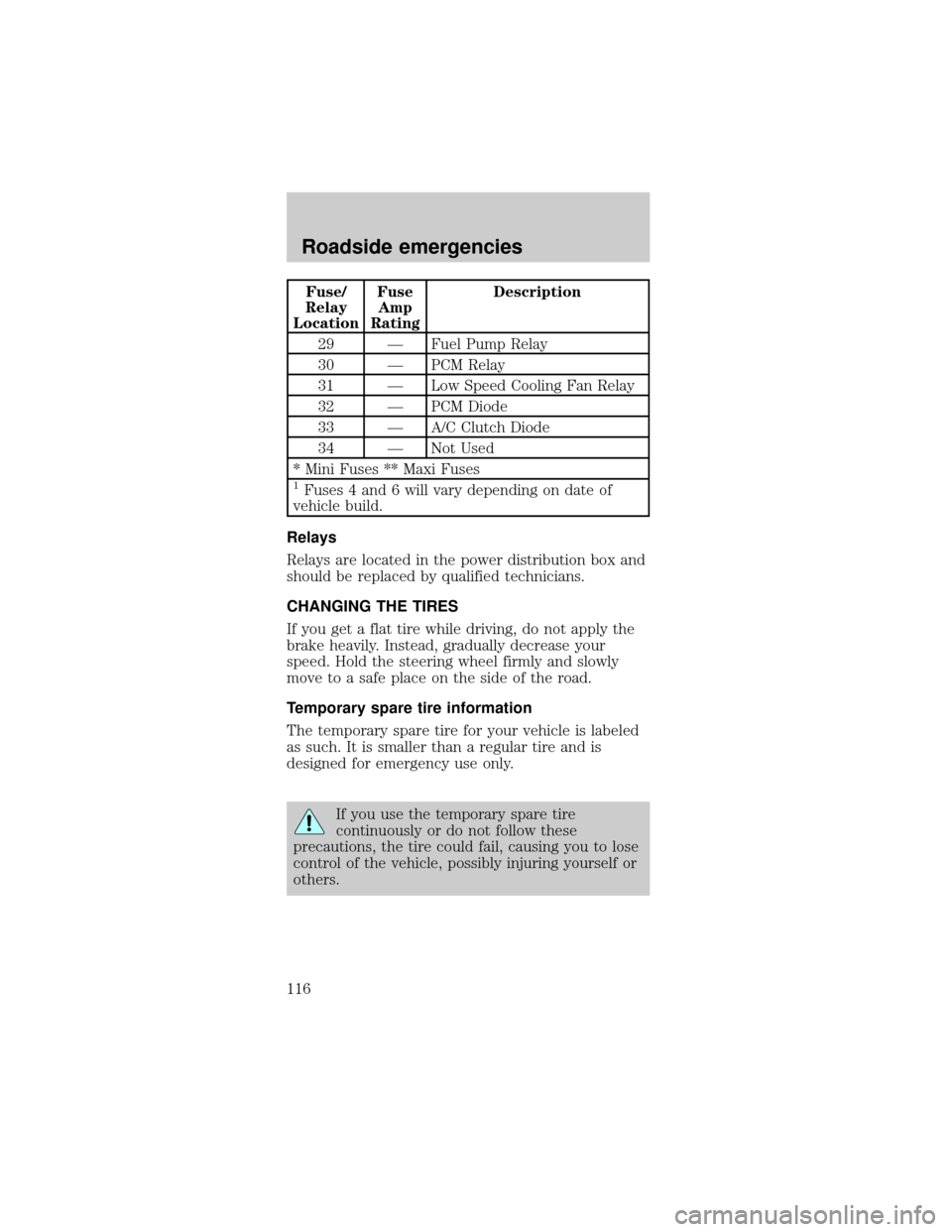
have blown. Blown
fuses are identified by a broken wire within the fuse.
Check the appropriate fuses before replacing any
electrical components.
Always replace a fuse with one that has the
specified amperage rating. Using a fuse with
a higher amperage rating can cause severe wire
damage and could start a fire.
1515
Roadside emergencies
110
Page 115 of 192
Fuse/
Relay
LocationFuse
Amp
RatingDescription
7 40A** Rear Window Defrost Relay
8 30A** Thermactor Air ByPass
Solenoid, EAM Solid State
Relay
9 40A** High Speed Cooling Fan Relay,
Low Speed Cooling Fan Relay
10 20A** Fuel Pump Relay
11 40A** Blower Motor Relay
12 20A** Semi-Active Ride Control
Module
13 40A** Anti-Lock Brake Module
14 Ð Not Used
15 15A* Daytime Running Lamps
(DRL) Module
16 10A* Air Bag Diagnostic Monitor
17 20A* Rear Control Unit, CD Changer
18 30A* Anti-Lock Brake Module
19 15A* Horn Relay, Powertrain
Control Module (PCM)
20 15A* Headlamp Switch, Autolamp
Park Relay
21 Ð Not Used
22 30A* Autolamps Relay,
Multi-Function Switch,
Headlamp Switch
23 Ð Blower Motor Relay
24 Ð Starter Relay
25 Ð A/C Clutch Relay
26 30A* Generator/Voltage Regulator
27 10A* A/C Clutch Relay
28 15A* Heated Oxygen Sensors,
Canister Vent
Roadside emergencies
115
Page 116 of 192
Fuse/
Relay
LocationFuse
Amp
RatingDescription
29 Ð Fuel Pump Relay
30 Ð PCM Relay
31 Ð Low Speed Cooling Fan Relay
32 Ð PCM Diode
33 Ð A/C Clutch Diode
34 Ð Not Used
* Mini Fuses ** Maxi Fuses
1Fuses 4 and 6 will vary depending on date of
vehicle build.
Relays
Relays are located in the power distribution box and
should be replaced by qualified technicians.
CHANGING THE TIRES
If you get a flat tire while driving, do not apply the
brake heavily. Instead, gradually decrease your
speed. Hold the steering wheel firmly and slowly
move to a safe place on the side of the road.
Temporary spare tire information
The temporary spare tire for your vehicle is labeled
as such. It is smaller than a regular tire and is
designed for emergency use only.
If you use the temporary spare tire
continuously or do not follow these
precautions, the tire could fail, causing you to lose
control of the vehicle, possibly injuring yourself or
others.
Roadside emergencies
116
Page 124 of 192
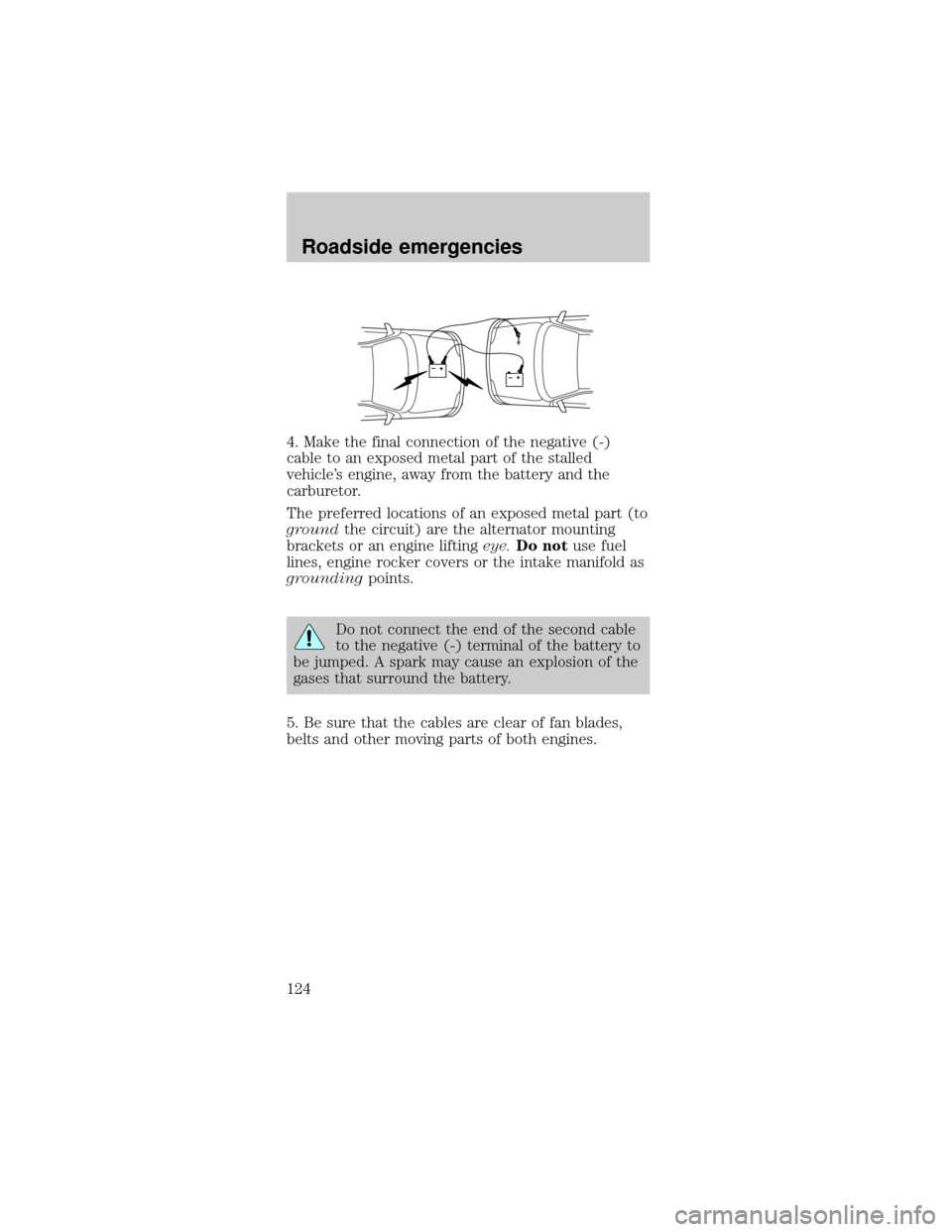
4. Make the final connection of the negative (-)
cable to an exposed metal part of the stalled
vehicle's engine, away from the battery and the
carburetor.
The preferred locations of an exposed metal part (to
groundthe circuit) are the alternator mounting
brackets or an engine liftingeye.Do notuse fuel
lines, engine rocker covers or the intake manifold as
groundingpoints.
Do not connect the end of the second cable
to the negative (-) terminal of the battery to
be jumped. A spark may cause an explosion of the
gases that surround the battery.
5. Be sure that the cables are clear of fan blades,
belts and other moving parts of both engines.
+–+–
Roadside emergencies
124
Page 128 of 192

SERVICE RECOMMENDATIONS
To help you service your vehicle:
²We highlight do-it-yourself items in the engine
compartment for easy location.
²We provide a ªService Guideº which makes
tracking routine service easy.
If your vehicle requires professional service, your
dealership can provide necessary parts and service.
Check your ªWarranty Guideº to find out which parts
and services are covered.
Use only recommended fuels, lubricants, fluids and
service parts conforming to specifications. Motorcraft
parts are designed and built to provide the best
performance in your vehicle.
PRECAUTIONS WHEN SERVICING YOUR
VEHICLE
Be especially careful when inspecting or servicing
your vehicle.
²Do not work on a hot engine.
²When the engine is running, avoid wearing loose
clothing, jewelry or long hair that could get
caught up in moving parts.
²Do not work on a vehicle with the engine running
in an enclosed space, unless you are sure you
have enough ventilation.
²Keep all lit cigarettes, open flames and other lit
material away from the battery and all fuel related
parts.
If you disconnect the battery, the engine must
ªrelearnº its idle conditions before your vehicle will
drive properly, as explained in theBatterysection in
this chapter.
Working with the engine off
1. Set the parking brake, and ensure the gearshift is
securely latched in park.
Maintenance and care
128
Page 137 of 192
WINDSHIELD WASHER FLUID
Checking and adding washer fluid
Check the washer fluid
whenever you stop for
fuel. The reservoir is
highlighted with a
symbol.
If the level is low, add
enough fluid to fill the
reservoir. In very cold
weather, do not fill the
reservoir all the way.
Do not put engine coolant in the container
for the windshield washer fluid.
Checking and adding washer fluid for the
liftgate (if equipped)
The opening for the reservoir is located on the
passenger side under the tail lamp. Refill this
reservoir with the same fluid you use for your
windshield.
ENGINE COOLANT
Check the level of the
engine coolant in the
reservoir. Refer to the
ªService Guideº for
service interval
schedules. Be sure to
read and understand
Precautions when
servicing your vehicle
in this chapter.
Maintenance and care
137
Page 149 of 192
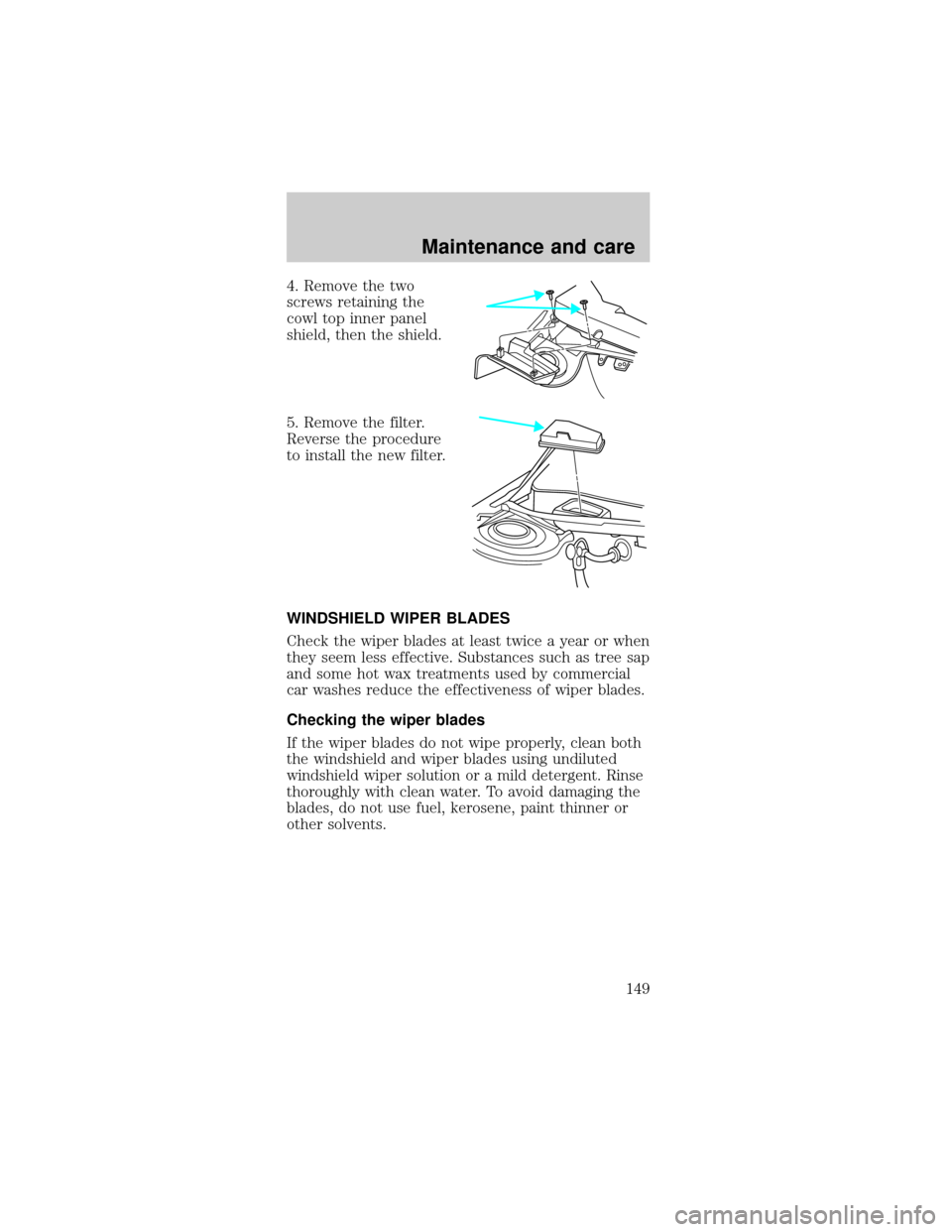
4. Remove the two
screws retaining the
cowl top inner panel
shield, then the shield.
5. Remove the filter.
Reverse the procedure
to install the new filter.
WINDSHIELD WIPER BLADES
Check the wiper blades at least twice a year or when
they seem less effective. Substances such as tree sap
and some hot wax treatments used by commercial
car washes reduce the effectiveness of wiper blades.
Checking the wiper blades
If the wiper blades do not wipe properly, clean both
the windshield and wiper blades using undiluted
windshield wiper solution or a mild detergent. Rinse
thoroughly with clean water. To avoid damaging the
blades, do not use fuel, kerosene, paint thinner or
other solvents.
Maintenance and care
149
Page 154 of 192
Tires that are larger or smaller than your vehicle's
original tires may also affect the accuracy of your
speedometer.
SNOW TIRES AND CHAINS
Snow tires must be the same size and grade
as the tires you currently have on your
vehicle.
The tires on your vehicle have all weather treads to
provide traction in rain and snow. However, in some
climates, you may need to use snow tires and
chains. If you need to use snow tires and chains, it is
recommended that steel wheels are used of the
same size and specifications as those originally
installed.
Follow these guidelines when using snow tires and
chains:
²Use only SAE Class S chains.
²Install chains securely, verifying that the chains do
not touch any wiring, brake lines or fuel lines.
²Drive cautiously. If you hear the chains rub or
bang against your vehicle, stop and re-tighten the
chains. If this does not work, remove the chains
to prevent damage to your vehicle.
²If possible, avoid fully loading your vehicle.
²Do not use tire chains if your vehicle is equipped
with P225/55ZR16 tires.
²Remove the tire chains when they are no longer
needed. Do not use tire chains on dry roads.
²The suspension insulation and bumpers will help
prevent vehicle damage. Do not remove these
components from your vehicle when using snow
tires and chains.
Maintenance and care
154