Page 127 of 192
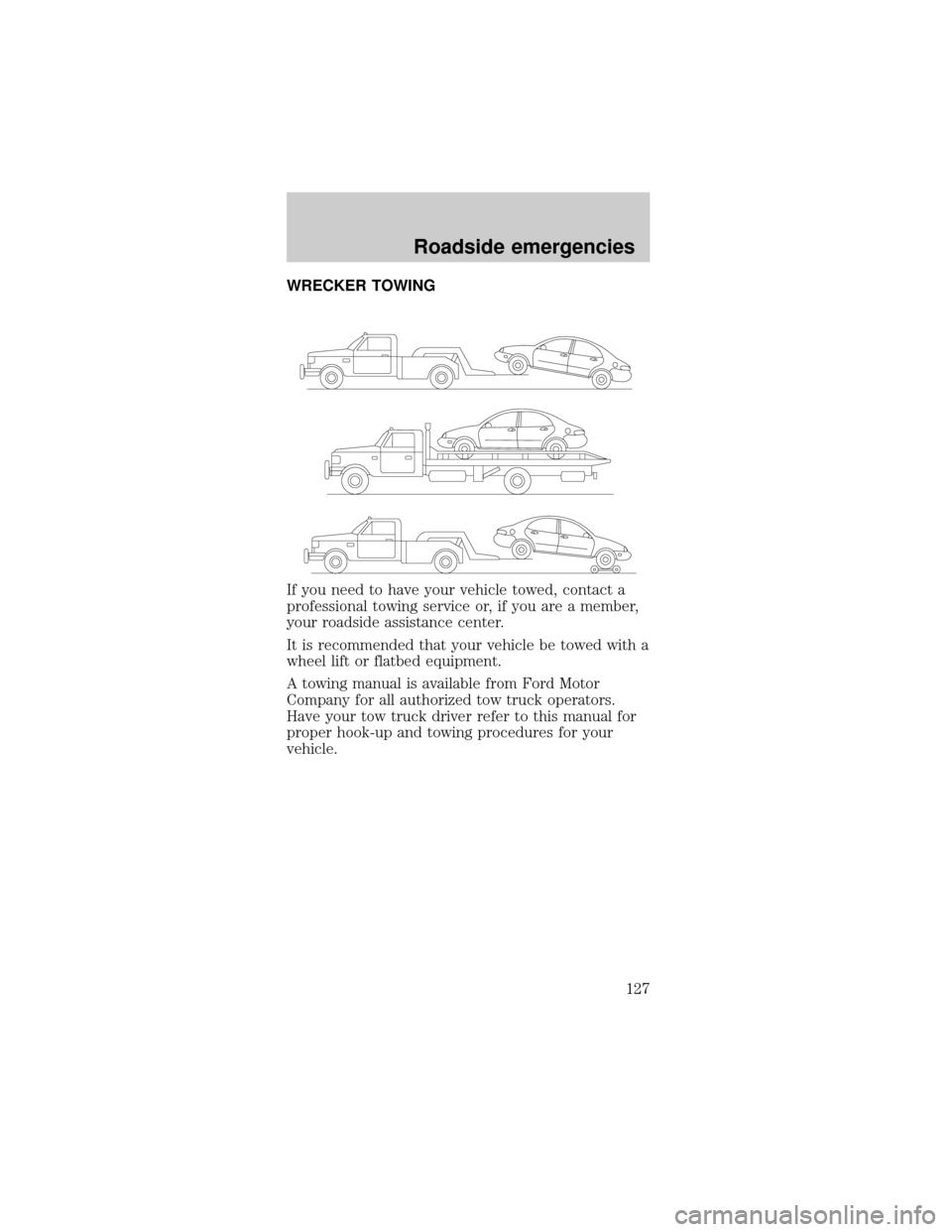
WRECKER TOWING
If you need to have your vehicle towed, contact a
professional towing service or, if you are a member,
your roadside assistance center.
It is recommended that your vehicle be towed with a
wheel lift or flatbed equipment.
A towing manual is available from Ford Motor
Company for all authorized tow truck operators.
Have your tow truck driver refer to this manual for
proper hook-up and towing procedures for your
vehicle.
Roadside emergencies
127
Page 129 of 192
2. Turn off the engine and remove the key.
3. Block the wheels to prevent the vehicle from
moving unexpectedly.
Working with the engine on
1. Set the parking brake and ensure the gearshift is
securely latched in P (Park).
2. Block the wheels to prevent the vehicle from
moving unexpectedly.
Do not start your engine with the air cleaner
removed and do not remove it while the
engine is running.
OPENING THE HOOD
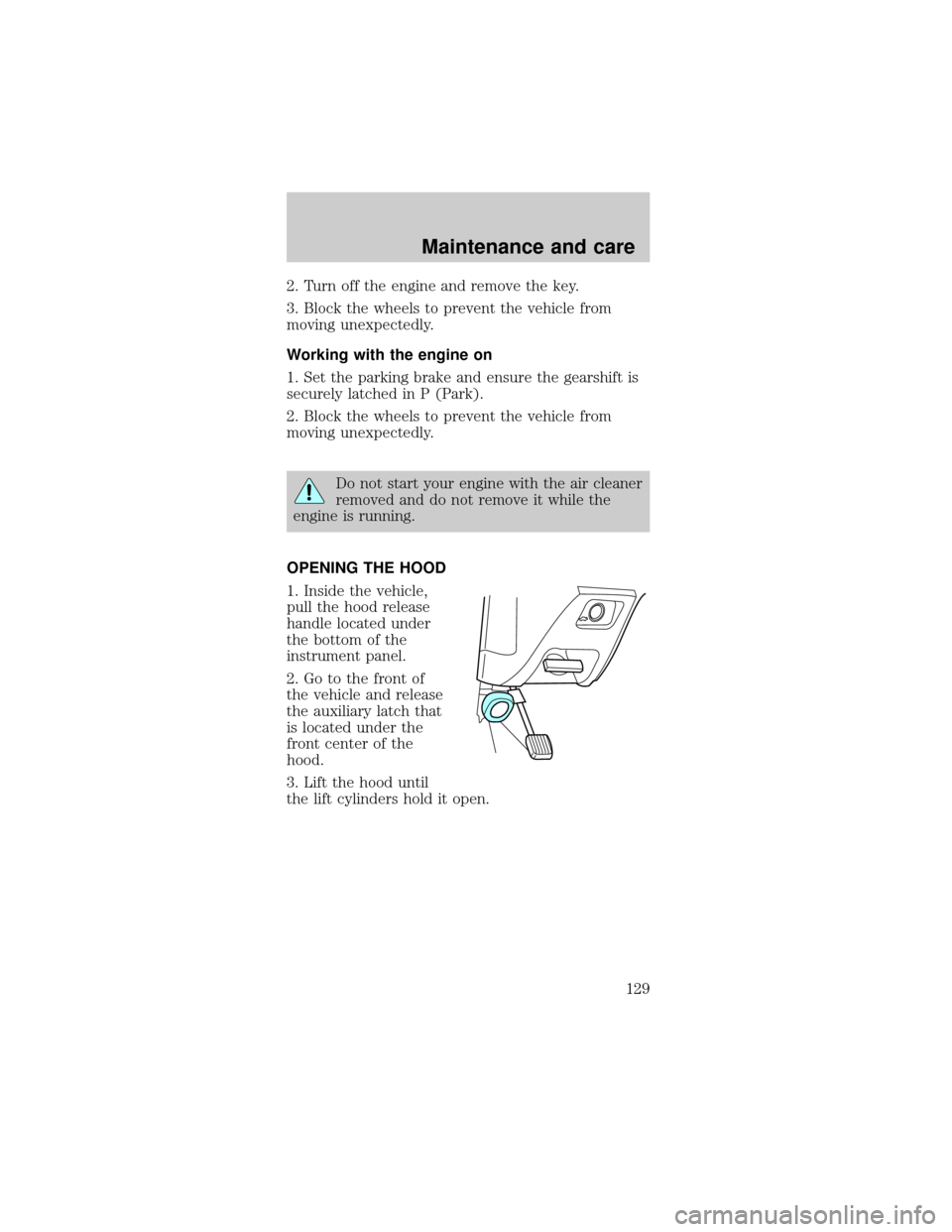
1. Inside the vehicle,
pull the hood release
handle located under
the bottom of the
instrument panel.
2. Go to the front of
the vehicle and release
the auxiliary latch that
is located under the
front center of the
hood.
3. Lift the hood until
the lift cylinders hold it open.
Maintenance and care
129
Page 141 of 192
increase the engine coolant concentration above
60%. Leave a 50/50 mixture of engine coolant and
water in your vehicle year-round in non-extreme
climates.
CHECKING AND ADDING POWER STEERING
FLUID
Check the power
steering fluid. Refer to
the ªService Guideº for
the service interval
schedules. If adding
fluid is necessary, use
only MERCONtAT F.
1. Start the engine and let it run until it reaches
normal operating temperature (the engine coolant
temperature gauge indicator will be near the center
of the normal area between H and C).
2. While the engine idles, turn the steering wheel
left and right several times.
3. Turn the engine off.
Perform steps 4 and 5 following the procedure for
your engine.
3.0L Vulcan engine
4. Check the fluid level
on the dipstick. It
should be between the
arrows in the FULL
HOT range. Do not add
fluid if the level is
within this range.
FULL HOT
Maintenance and care
141
Page 152 of 192
Temperature A B C
The temperature grades are A (the highest), B, and
C, representing the tire's resistance to the
generation of heat and its ability to dissipate heat
when tested under controlled conditions on a
specified indoor laboratory test wheel. Sustained
high temperature can cause the material of the tire
to degenerate and reduce tire life, and excessive
temperature can lead to sudden tire failure. The
grade C corresponds to a level of performance which
all passenger car tires must meet under the Federal
Motor Vehicle Safety Standard No. 109. Grades B
and A represent higher levels of performance on the
laboratory test wheel than the minimum required by
law.
The temperature grade for this tire is
established for a tire that is properly inflated
and not overloaded. Excessive speed,
underinflation, or excessive loading, either
separately or in combination, can cause heat
buildup and possible tire failure.
SERVICING YOUR TIRES
Checking the tire pressure
²Use an accurate tire pressure gauge.
²Check the tire pressure when tires are cold, after
the vehicle has been parked for at least one hour
or has been driven less than 5 km (3 miles).
²Adjust tire pressure to recommended
specifications found on the tire pressure label
inside the glove compartment door.
Maintenance and care
152
Page 154 of 192
Tires that are larger or smaller than your vehicle's
original tires may also affect the accuracy of your
speedometer.
SNOW TIRES AND CHAINS
Snow tires must be the same size and grade
as the tires you currently have on your
vehicle.
The tires on your vehicle have all weather treads to
provide traction in rain and snow. However, in some
climates, you may need to use snow tires and
chains. If you need to use snow tires and chains, it is
recommended that steel wheels are used of the
same size and specifications as those originally
installed.
Follow these guidelines when using snow tires and
chains:
²Use only SAE Class S chains.
²Install chains securely, verifying that the chains do
not touch any wiring, brake lines or fuel lines.
²Drive cautiously. If you hear the chains rub or
bang against your vehicle, stop and re-tighten the
chains. If this does not work, remove the chains
to prevent damage to your vehicle.
²If possible, avoid fully loading your vehicle.
²Do not use tire chains if your vehicle is equipped
with P225/55ZR16 tires.
²Remove the tire chains when they are no longer
needed. Do not use tire chains on dry roads.
²The suspension insulation and bumpers will help
prevent vehicle damage. Do not remove these
components from your vehicle when using snow
tires and chains.
Maintenance and care
154
Page 170 of 192

After washing, apply the brakes several times to dry
them.
Waxing your vehicle
Wax when water stops beading on the surface. This
could be every three or four months, depending on
operating conditions.
Use only carnauba or synthetic-based waxes. Use
cleaning fluid or alcohol with a clean cloth to remove
any bugs and tar before waxing vehicle. Use tar
remover to remove any tar spots.
Avoid getting wax on the windshield. If you have
wax applied at a commercial car wash, it is
recommended that you clean the wiper blades and
windshield as described inCleaning the wiper
blades and windshield.
Repairing paint chips
Minor scratches or paint damage from road debris
may be repaired with touch-up paint, repair foil or
aerosol paint spray from the Ford accessory line.
Observe the application instructions on the
products.
Remove particles such as bird droppings, tree sap,
insect remains, tar spots, road salt and industrial
fallout immediately.
Cleaning the wheels
Wash with the same detergent as the body of your
vehicle. Do not use acid-based or alcohol-based
wheel cleaners, steel wool, fuel or strong detergents.
Never use abrasives that will damage the finish of
special wheel surfaces. Use a tar remover to remove
grease and tar.
Cleaning the engine
Engines are more efficient when they are clean
because grease and dirt buildup keep the engine
warmer than normal. When washing:
Maintenance and care
170
Page 181 of 192
Engine 3.0L V6
Vulcan
engine3.0L V6
Duratec
engine3.4L-32V
V8 SHO
engine
Spark plug
gap1.07-1.17
mm
(0.042-
0.046
inch)1.3-1.4
mm
(0.052-
00.056
inch)1.07-1.17
mm
(0.042-
0.046
inch)
Ignition
systemEDIS EDIS EDIS
Compression
ratio9.3:1 10:1 10:1
VEHICLE DIMENSIONS
Vehicle
dimensionsSedan mm
(in)Wagon mm (in)
(1) Overall
length5 016.5
(197.5)5 069.8 (199.6)
(2) Overall
width1 854.2 (73.0) 1 854.2 (73.0)
(3) Overall
height1 399.5 (55.1) 1 463.0 (57.6)
(4) Wheelbase 2 755.9
(108.5)2 755.9 (108.5)
(5) Track -
Front1 564.6 (61.6) 1 564.6 (61.6)
(5) Track -
Rear1 559.6 (61.4) 1 569.7 (61.8)
Capacities and specifications
181
Page 186 of 192

Air bag supplemental
restraint system ........ 67
and child safety
seats ......................... 69
description .............. 67
disposal .................... 72
indicator light ......... 72
passenger air bag ... 70
Air conditioning
automatic temperature
control
system . 22,23,24,25,27
Anti-theft system ...... 47
arming the system .. 47
Automatic transaxle . 94
driving
with ......... 97,98,99,100
Brakes ........................ 90
anti-lock ................... 90
anti-lock brake
system (ABS)
warning light ........... 91
fluid, checking and
adding .................... 136
shift interlock .......... 94
Break-in period ........... 3
Cargo cover .......... 42,43
Cargo net .............. 41,42
Cellular telephone
(see your Cellular
Phone Guide) ............ 40
Child safety seats
attaching with tether
straps ....................... 79
in rear seat ......... 76,78
tether anchorage
hardware ................. 79
Cleaning your
vehicle ...................... 169
built-in
child seat ....... 80,81,84engine
compartment .. 170,172
exterior lamps ....... 173
plastic parts .......... 172
washing .................. 169
waxing ................... 170
wheels .................... 170
wiper blades .......... 173
Console ...................... 39
Controls
power seat ............... 56
Coolant .................... 140
checking
and adding ............ 138
refill capacities ...... 140
Defrost
rear window ............ 18
Doors
central
unlocking ............ 37,38
Emission control
system ...................... 160
Engine
coolant ................... 137
idle speed control . 144
service
points ....... 130,131,132
starting after a
collision ................. 109
Engine block heater . 88
Engine oil
checking and
adding .................... 134
dipstick .................. 133
specifications . 133,135
Exhaust fumes .......... 88
Floor mats ................. 40
Fuel
choosing the
right fuel ................ 158
detergent in fuel ... 160
Index
186