Page 49 of 192
Disarming the system
You can disarm the system by any of the following
actions:
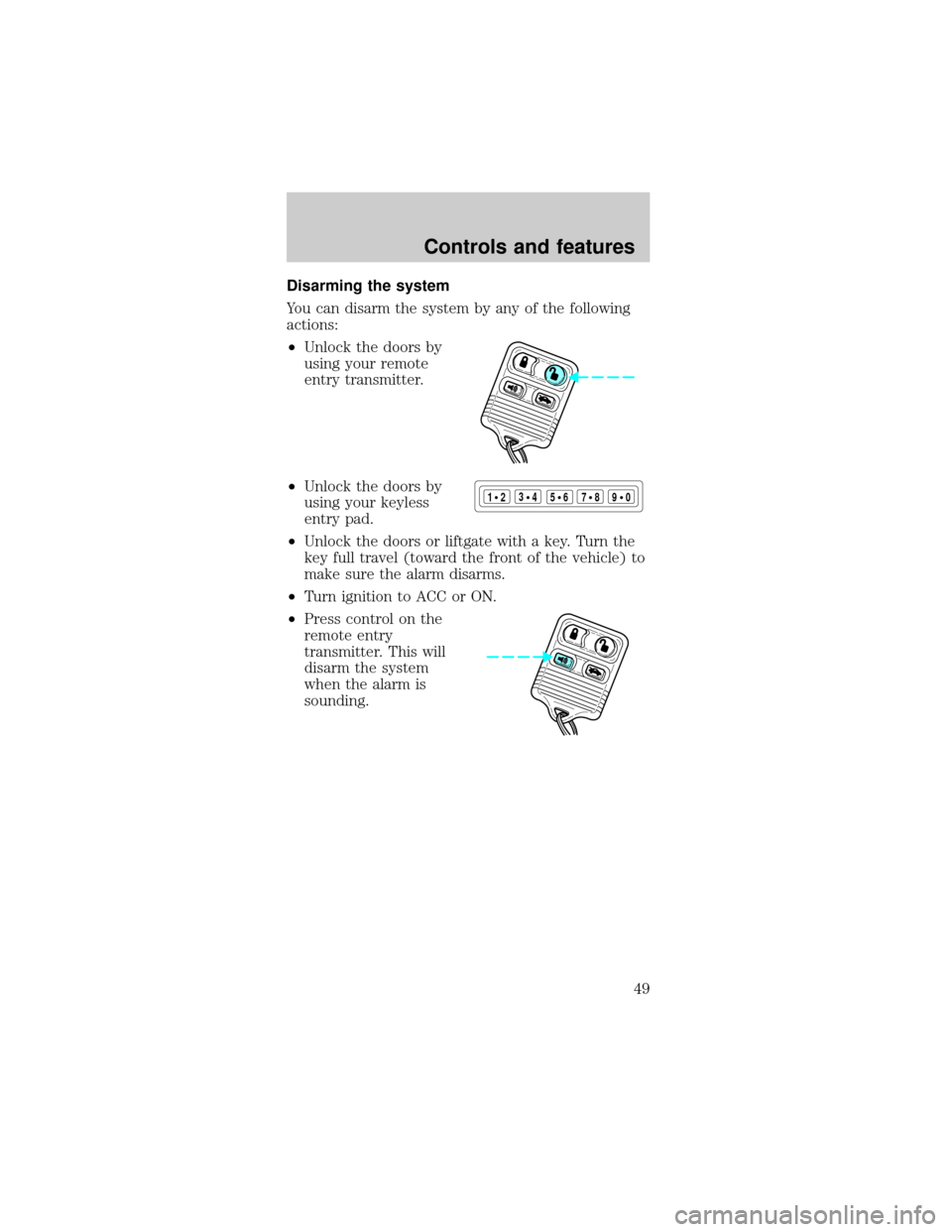
²Unlock the doors by
using your remote
entry transmitter.
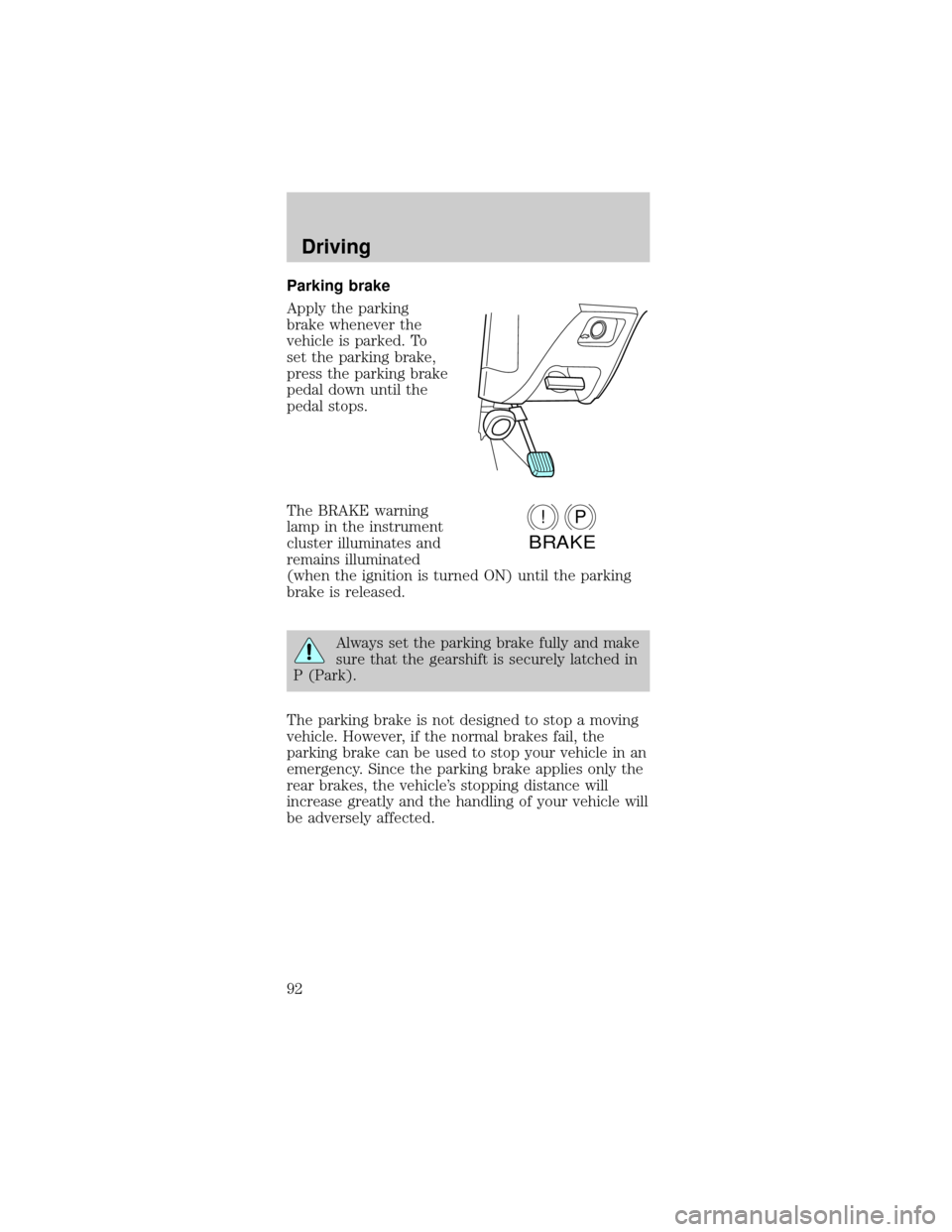
²Unlock the doors by
using your keyless
entry pad.
²Unlock the doors or liftgate with a key. Turn the
key full travel (toward the front of the vehicle) to
make sure the alarm disarms.
²Turn ignition to ACC or ON.
²Press control on the
remote entry
transmitter. This will
disarm the system
when the alarm is
sounding.
123
45678
90
Controls and features
49
Page 52 of 192
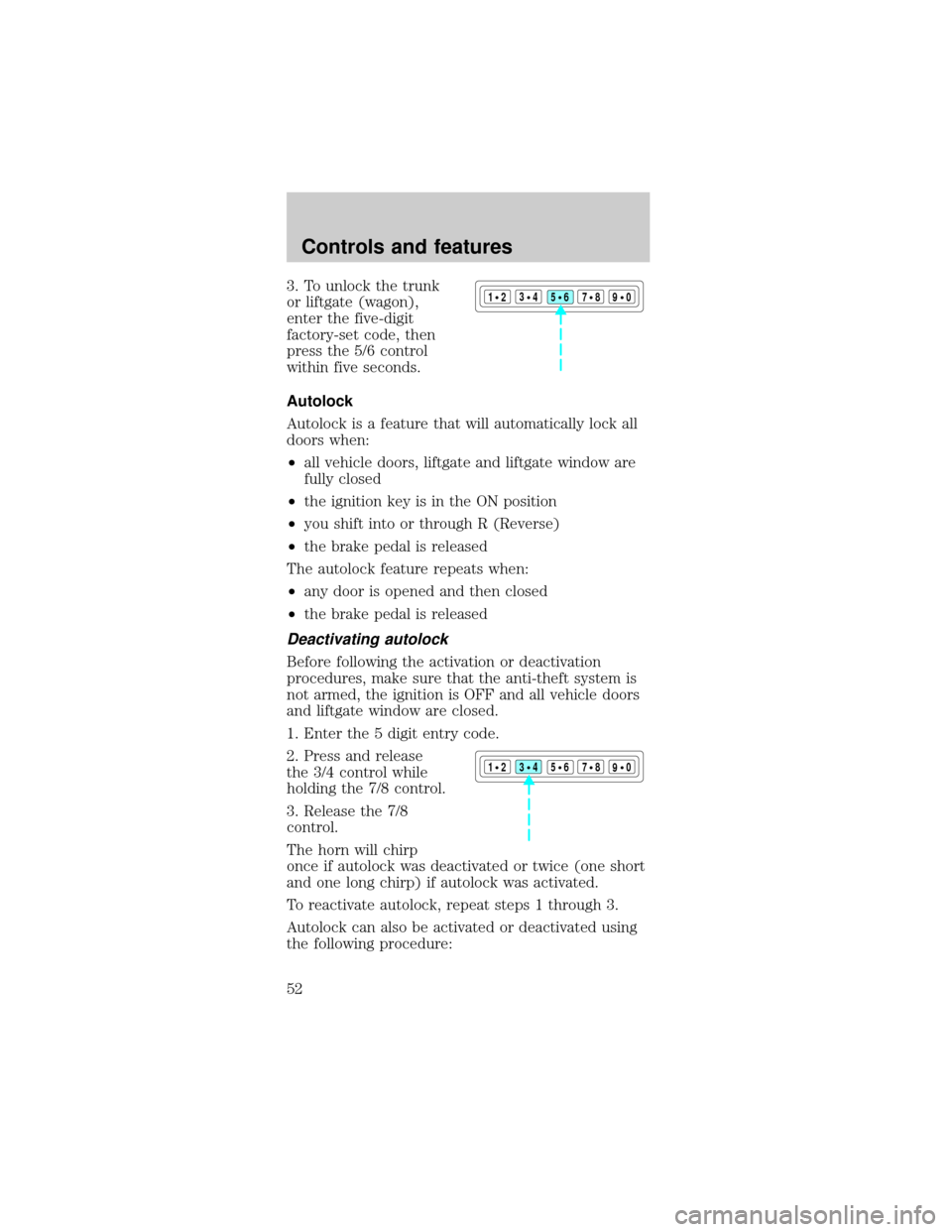
3. To unlock the trunk
or liftgate (wagon),
enter the five-digit
factory-set code, then
press the 5/6 control
within five seconds.
Autolock
Autolock is a feature that will automatically lock all
doors when:
²all vehicle doors, liftgate and liftgate window are
fully closed
²the ignition key is in the ON position
²you shift into or through R (Reverse)
²the brake pedal is released
The autolock feature repeats when:
²any door is opened and then closed
²the brake pedal is released
Deactivating autolock
Before following the activation or deactivation
procedures, make sure that the anti-theft system is
not armed, the ignition is OFF and all vehicle doors
and liftgate window are closed.
1. Enter the 5 digit entry code.
2. Press and release
the 3/4 control while
holding the 7/8 control.
3. Release the 7/8
control.
The horn will chirp
once if autolock was deactivated or twice (one short
and one long chirp) if autolock was activated.
To reactivate autolock, repeat steps 1 through 3.
Autolock can also be activated or deactivated using
the following procedure:
123
45678
90
123
45678
90
Controls and features
52
Page 53 of 192

You must complete steps 1 through 5 within 30
seconds or the procedure will have to be repeated. If
the procedure needs to be repeated, you must wait
30 seconds.
1. Turn the ignition key from OFF to RUN/ACC.
2. Press the power door UNLOCK control three
times.
3. Turn the ignition key from RUN/ACC to OFF.
4. Press the power door UNLOCK control three
times.
5. Turn the ignition key from OFF to RUN/ACC. A
horn chirp indicates the enable/disable feature is
entered.
6. Press the power door UNLOCK control one time.
7. Press the power door LOCK control to toggle the
Autolock/Relock state. You will receive a horn chirp
followed by either a long honk, autolock/relock is
enabled, or no honk, autolock/relock is disabled.
8. Turn ignition to OFF.
If autolock/relock has been changed, the horn will
chirp to confirm procedure is complete.
SECURILOCKYANTI-THEFT SYSTEM
The SecuriLockyanti-theft system provides an
advanced level of vehicle theft protection. Your
vehicle's engine can only be started with the two
special SecuriLockyelectronically coded keys
provided with your vehicle. Each time you start your
vehicle, the SecuriLockykey is read by the
SecuriLockyanti-theft system. If the SecuriLocky
key identification code matches the code stored in
the SecuriLockyanti-theft system, the vehicle's
engine is allowed to start. If the SecuriLockykey
identification code does not match the code stored
in the system or if a SecuriLockykey is not
detected (vehicle theft situation), the vehicle's
engine will not operate.
Controls and features
53
Page 66 of 192

Conditions of operation
If... Then...
The driver's safety belt
is not buckled before
the ignition switch is
turned to the ON
position...The safety belt warning
light illuminates for one
to two minutes and the
warning chime sounds
for four to eight seconds.
The driver's safety belt
is buckled while the
indicator light is
illuminated and the
warning chime is
sounding...The safety belt warning
light and warning chime
turn off.
The driver's safety belt
is buckled before the
ignition switch is turned
to the ON position...The safety belt warning
light and indicator chime
remain off.
Safety belt maintenance
Inspect the safety belt systems periodically to make
sure they work properly and are not damaged.
Inspect the safety belts to make sure there are no
nicks, wears or cuts, replacing if necessary. All
safety belt assemblies, including retractors, buckles,
front seat belt buckle assemblies (slide bar)(if
equipped), shoulder belt height adjusters (if
equipped), child safety seat tether bracket
assemblies (if equipped), and attaching hardware,
should be inspected after a collision. Ford
recommends that all safety belt assemblies used in
vehicles involved in a collision be replaced. However,
if the collision was minor and a qualified technician
finds that the belts do not show damage and
continue to operate properly, they do not need to be
replaced. Safety belt assemblies not in use during a
collision should also be inspected and replaced if
either damage or improper operation is noted.
Seating and safety restraints
66
Page 72 of 192

Determining if the system is operational
The SRS uses a readiness light in the instrument
cluster or a tone to indicate the condition of the
system. Refer to theAir bag readinesssection in
theInstrumentationchapter. Routine maintenance
of the air bag is not required.
A difficulty with the system is indicated by one or
more of the following:
²The readiness light
will either flash or
stay lit.
²The readiness light
will not illuminate immediately after ignition is
turned on.
²A series of five beeps will be heard. The tone
pattern will repeat periodically until the problem
and light are repaired.
If any of these things happen, even intermittently,
have the SRS serviced at your dealership or by a
qualified technician immediately. Unless serviced,
the system may not function properly in the event of
a collision.
Disposal of air bags and air bag equipped
vehicles
For disposal of air bags or air bag equipped vehicles,
see your local dealership or qualified technician. Air
bags MUST BE disposed of by qualified personnel.
SAFETY RESTRAINTS FOR CHILDREN
See the following sections for directions on how to
properly use safety restraints for children. Also see
Air Bag Supplemental Restraint System (SRS)in
this chapter for special instructions about using air
bags.
Seating and safety restraints
72
Page 85 of 192
PREPARING TO START YOUR VEHICLE
Engine starting is controlled by the ignition system.
This system meets all Canadian Interference-Causing
Equipment standard requirements regulating the
impulse electrical field strength of radio noise.
When starting a fuel-injected engine, avoid pressing
the accelerator before or during starting. Only use
the accelerator when you have difficulty starting the
engine. For more information on starting the vehicle,
refer toStarting the enginein this chapter.
Extended idling at high engine speeds can
produce very high temperatures in the
engine and exhaust system, creating the risk of
fire or other damage.
Do not park, idle, or drive your vehicle in
dry grass or other dry ground cover. The
emission system heats up the engine compartment
and exhaust system, which can start a fire.
Do not start your vehicle in a closed garage
or in other enclosed areas. Exhaust fumes
can be toxic. Always open the garage door before
you start the engine. SeeGuarding against
exhaust fumesin this chapter for more
instructions.
Starting
85
Page 91 of 192

an ABS equipped vehicle (on bottom) to a non-ABS
equipped vehicle (on top) during hard braking with
loss of front braking traction.
ABS warning lamp
The
ABSwarning lamp
in the instrument
cluster momentarily
illuminates when the
ignition is turned on and the engine is off. If the
light does not illuminate momentarily at start up,
remains on or continues to flash, the ABS needs to
be serviced. With the ABS light on, the anti-lock
brake system is disabled and normal braking is still
effective unless the brake warning light also remains
illuminated with parking brake released. (If your
brake warning lamp illuminates, have your vehicle
serviced immediately).
Using ABS
²In an emergency or when maximum efficiency
from the ABS is required, apply continuous full
force on the brake. The ABS will be activated
immediately, thus allowing you to retain full
steering control of your vehicle and, providing
there is sufficient space, will enable you to avoid
obstacles and bring the vehicle to a controlled
stop.
²The Anti-Lock system does not decrease the time
necessary to apply the brakes or always reduce
stopping distance. Always leave enough room
between your vehicle and the vehicle in front of
you to stop.
²We recommend that you familiarize yourself with
this braking technique. However, avoid taking any
unnecessary risks.P!
BRAKE
Driving
91
Page 92 of 192
Parking brake
Apply the parking
brake whenever the
vehicle is parked. To
set the parking brake,
press the parking brake
pedal down until the
pedal stops.
The BRAKE warning
lamp in the instrument
cluster illuminates and
remains illuminated
(when the ignition is turned ON) until the parking
brake is released.
Always set the parking brake fully and make
sure that the gearshift is securely latched in
P (Park).
The parking brake is not designed to stop a moving
vehicle. However, if the normal brakes fail, the
parking brake can be used to stop your vehicle in an
emergency. Since the parking brake applies only the
rear brakes, the vehicle's stopping distance will
increase greatly and the handling of your vehicle will
be adversely affected.
P!
BRAKE
Driving
92