Page 187 of 219
control devices and systems may
be adversely affected.
Repair of damage caused by using
a fuel that your vehicle was not
designed for may not be covered
by your warranty.
Octane recommendations
Your vehicle is designed to use
regular unleaded with an (R+M)/2
octane rating of 87. We do not
recommend gasolines labeled as
ªregularº in high altitude areas that
are sold with octane ratings of 86
or even less.
Do not be concerned if your
vehicle sometimes knocks lightly.
However, if it knocks heavily under
most driving conditions on fuel
with the recommended octane, see
your dealer or a qualified service
technician to prevent any engine
damage.
Fuel quality
If you are experiencing starting,
rough idle or hesitation problems
try a different brand of fuel. If the
condition persists, see your dealer
or a qualified service technician.
The American Automobile
Manufacturers Association (AAMA)
issued a gasoline specification to
provide information on high quality
fuels that optimize the
performance of your vehicle. We
recommend the use of gasolines
that meet the AAMA specification
if they are available.
87
Maintenance and care
187
Page 188 of 219
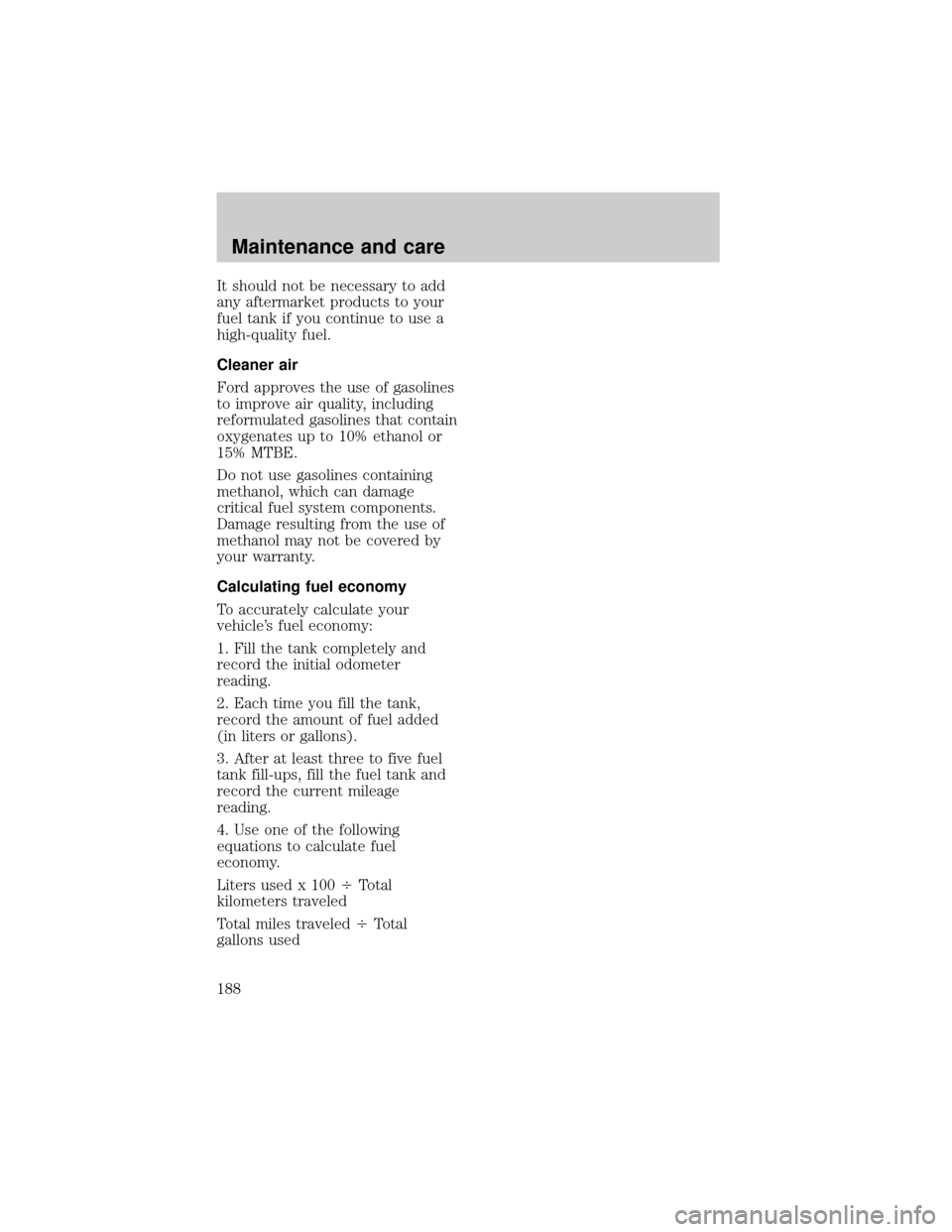
It should not be necessary to add
any aftermarket products to your
fuel tank if you continue to use a
high-quality fuel.
Cleaner air
Ford approves the use of gasolines
to improve air quality, including
reformulated gasolines that contain
oxygenates up to 10% ethanol or
15% MTBE.
Do not use gasolines containing
methanol, which can damage
critical fuel system components.
Damage resulting from the use of
methanol may not be covered by
your warranty.
Calculating fuel economy
To accurately calculate your
vehicle's fuel economy:
1. Fill the tank completely and
record the initial odometer
reading.
2. Each time you fill the tank,
record the amount of fuel added
(in liters or gallons).
3. After at least three to five fuel
tank fill-ups, fill the fuel tank and
record the current mileage
reading.
4. Use one of the following
equations to calculate fuel
economy.
Liters used x 1004Total
kilometers traveled
Total miles traveled4Total
gallons used
Maintenance and care
188
Page 189 of 219
Keep a record for at least one
month. This will provide an
accurate estimate of the vehicle's
fuel economy.
EMISSION CONTROL SYSTEM
Your vehicle is equipped with
various emission control
components and a catalytic
converter which will enable your
vehicle to comply with applicable
exhaust emission standards. To
make sure that the catalytic
converter and other emission
control components continue to
work properly:
²Use only unleaded fuel.
²Avoid running out of fuel.
²Do not turn off the ignition
while your vehicle is moving,
especially at high speeds.
²Have the services listed in your
ªService Guideº performed
according to the specified
schedule.
The Scheduled Maintenance
Services listed in the ªService
Guideº are required because they
are considered essential to the life
and performance of your vehicle
and to its emissions system.
If other than Ford, Motorcraft or
Ford authorized parts are used for
maintenance replacements or for
service of components affecting
emission control such non-Ford
parts should be equivalent to
genuine Ford Motor Company
Maintenance and care
189
Page 199 of 219
antennas, before entering a car
wash.
After washing, apply the brakes
several times to dry them.
Waxing your vehicle
Wax when water stops beading on
the surface. This could be every
three or four months, depending
on operating conditions.
Use only carnauba or
synthetic-based waxes. Remove
any bugs and tar before waxing
vehicle. Use cleaning fluid or
alcohol with a clean cloth to
remove. Use tar remover to
remove any tar spots.
Repairing paint chips
Minor scratches or paint damage
from road debris may be repaired
with touch-up , paint repair foil or
aerosol paint spray from the Ford
accessory line. Observe the
application instructions on the
products.
Remove particles such as bird
droppings, tree sap, insect
remains, tar spots, road salt and
industrial fallout immediately.
Cleaning the wheels
Wash with the same detergent as
the body of your vehicle. Do not
use acid-based wheel cleaners,
steel wool, fuel or strong
detergents. Never use abrasives
that will damage the finish of
special wheel surfaces. Use a tar
remover to remove grease and tar.
Maintenance and care
199
Page 201 of 219
Cleaning plastic exterior parts
Use vinyl cleaner for routine
cleaning. Clean with a tar remover
if necessary. Do not clean plastic
parts with thinners, solvents or
petroleum-based cleaners.
Cleaning the exterior lamps
Wash with the same detergent as
the exterior of your vehicle. Use
glass cleaner or tar remover if
necessary.
To avoid scratching the lamps, do
not use a dry paper towel,
chemical solvents or abrasive
cleaners.
Cleaning the wiper blades
If the wiper blades do not wipe
properly, clean the windshield and
wiper blades with undiluted
windshield wiper solution or a mild
detergent. Rinse thoroughly with
clean water. To avoid damaging the
blades, do not use fuel, kerosene,
paint thinner or other solvents.
Cleaning the instrument panel
Clean with a damp cloth, then dry
with a dry cloth.
Avoid cleaner or polish that
increases the gloss of the upper
portion of the instrument panel.
The dull finish in this area helps
protect the driver from undesirable
windshield reflection.
Cleaning the interior fabric
Remove dust and loose dirt with a
whisk broom or a vacuum cleaner.
Maintenance and care
201
Page 205 of 219
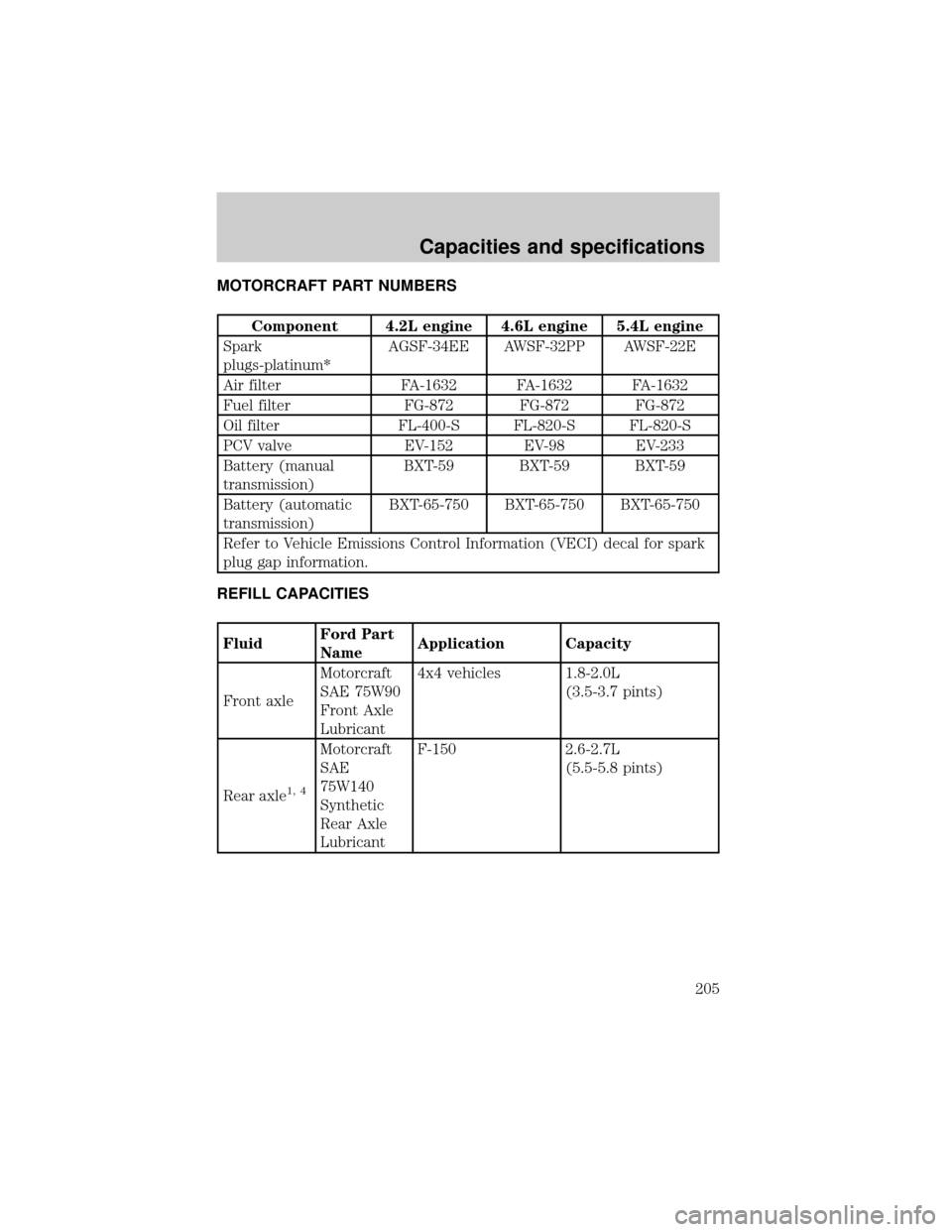
MOTORCRAFT PART NUMBERS
Component 4.2L engine 4.6L engine 5.4L engine
Spark
plugs-platinum*AGSF-34EE AWSF-32PP AWSF-22E
Air filter FA-1632 FA-1632 FA-1632
Fuel filter FG-872 FG-872 FG-872
Oil filter FL-400-S FL-820-S FL-820-S
PCV valve EV-152 EV-98 EV-233
Battery (manual
transmission)BXT-59 BXT-59 BXT-59
Battery (automatic
transmission)BXT-65-750 BXT-65-750 BXT-65-750
Refer to Vehicle Emissions Control Information (VECI) decal for spark
plug gap information.
REFILL CAPACITIES
FluidFord Part
NameApplication Capacity
Front axleMotorcraft
SAE 75W90
Front Axle
Lubricant4x4 vehicles 1.8-2.0L
(3.5-3.7 pints)
Rear axle
1, 4
Motorcraft
SAE
75W140
Synthetic
Rear Axle
LubricantF-150 2.6-2.7L
(5.5-5.8 pints)
Capacities and specifications
205
Page 206 of 219
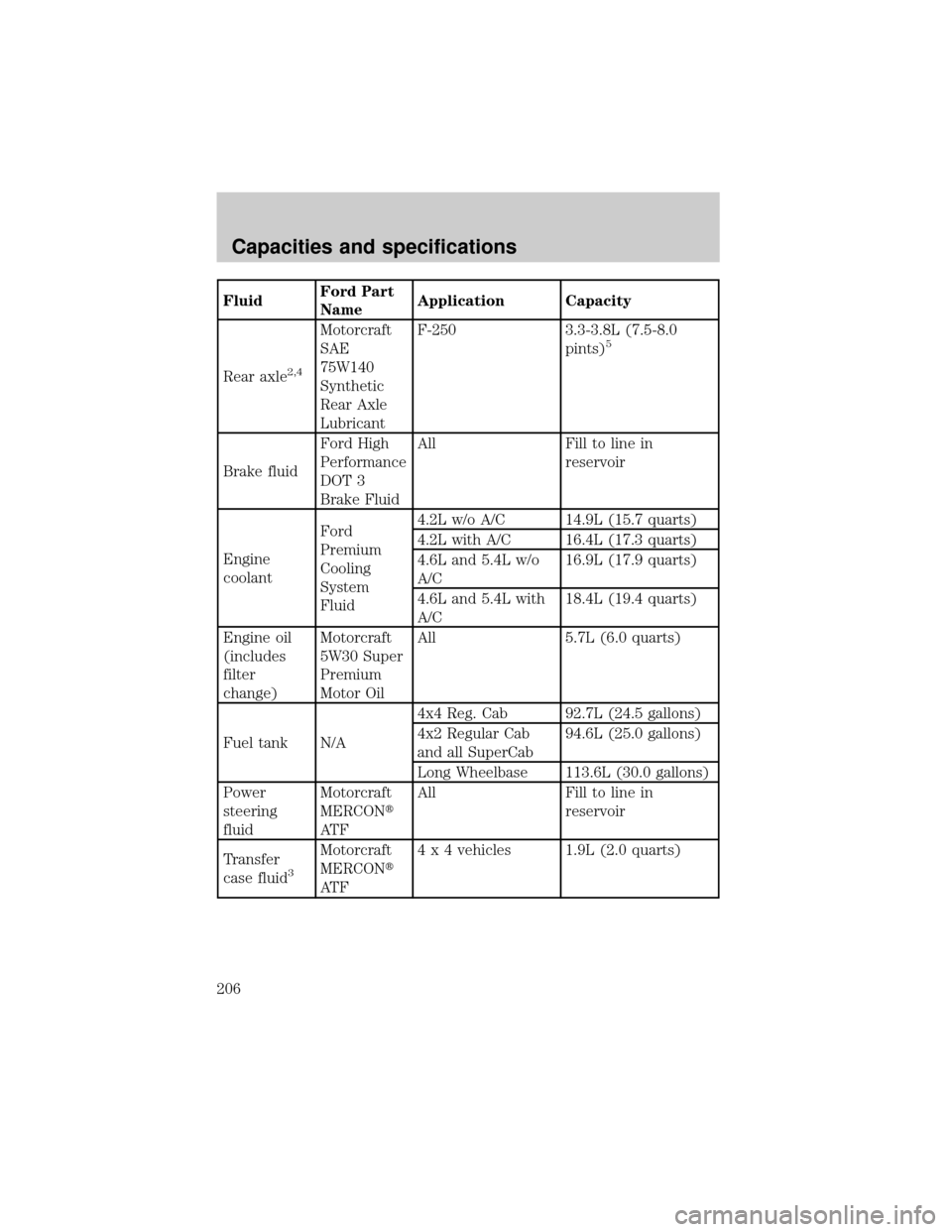
FluidFord Part
NameApplication Capacity
Rear axle
2,4
Motorcraft
SAE
75W140
Synthetic
Rear Axle
LubricantF-250 3.3-3.8L (7.5-8.0
pints)5
Brake fluidFord High
Performance
DOT 3
Brake FluidAll Fill to line in
reservoir
Engine
coolantFord
Premium
Cooling
System
Fluid4.2L w/o A/C 14.9L (15.7 quarts)
4.2L with A/C 16.4L (17.3 quarts)
4.6L and 5.4L w/o
A/C16.9L (17.9 quarts)
4.6L and 5.4L with
A/C18.4L (19.4 quarts)
Engine oil
(includes
filter
change)Motorcraft
5W30 Super
Premium
Motor OilAll 5.7L (6.0 quarts)
Fuel tank N/A4x4 Reg. Cab 92.7L (24.5 gallons)
4x2 Regular Cab
and all SuperCab94.6L (25.0 gallons)
Long Wheelbase 113.6L (30.0 gallons)
Power
steering
fluidMotorcraft
MERCONt
AT FAll Fill to line in
reservoir
Transfer
case fluid
3
Motorcraft
MERCONt
AT F4 x 4 vehicles 1.9L (2.0 quarts)
Capacities and specifications
206
Page 210 of 219
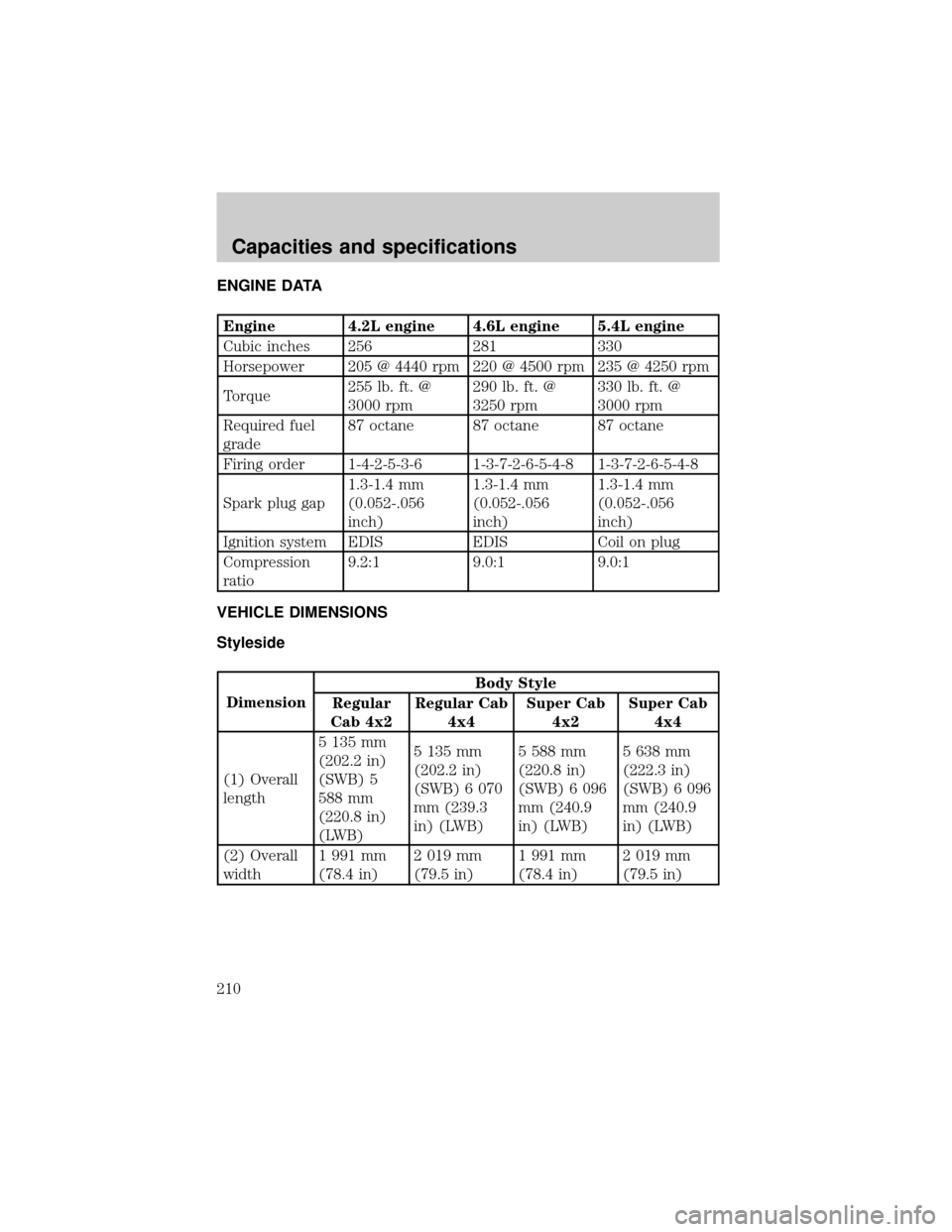
ENGINE DATA
Engine 4.2L engine 4.6L engine 5.4L engine
Cubic inches 256 281 330
Horsepower 205 @ 4440 rpm 220 @ 4500 rpm 235 @ 4250 rpm
Torque255 lb. ft. @
3000 rpm290 lb. ft. @
3250 rpm330 lb. ft. @
3000 rpm
Required fuel
grade87 octane 87 octane 87 octane
Firing order 1-4-2-5-3-6 1-3-7-2-6-5-4-8 1-3-7-2-6-5-4-8
Spark plug gap1.3-1.4 mm
(0.052-.056
inch)1.3-1.4 mm
(0.052-.056
inch)1.3-1.4 mm
(0.052-.056
inch)
Ignition system EDIS EDIS Coil on plug
Compression
ratio9.2:1 9.0:1 9.0:1
VEHICLE DIMENSIONS
Styleside
DimensionBody Style
Regular
Cab 4x2Regular Cab
4x4Super Cab
4x2Super Cab
4x4
(1) Overall
length5 135 mm
(202.2 in)
(SWB) 5
588 mm
(220.8 in)
(LWB)5 135 mm
(202.2 in)
(SWB) 6 070
mm (239.3
in) (LWB)5 588 mm
(220.8 in)
(SWB) 6 096
mm (240.9
in) (LWB)5 638 mm
(222.3 in)
(SWB) 6 096
mm (240.9
in) (LWB)
(2) Overall
width1 991 mm
(78.4 in)2 019 mm
(79.5 in)1 991 mm
(78.4 in)2 019 mm
(79.5 in)
Capacities and specifications
210