Page 112 of 219
TOWING A TRAILER
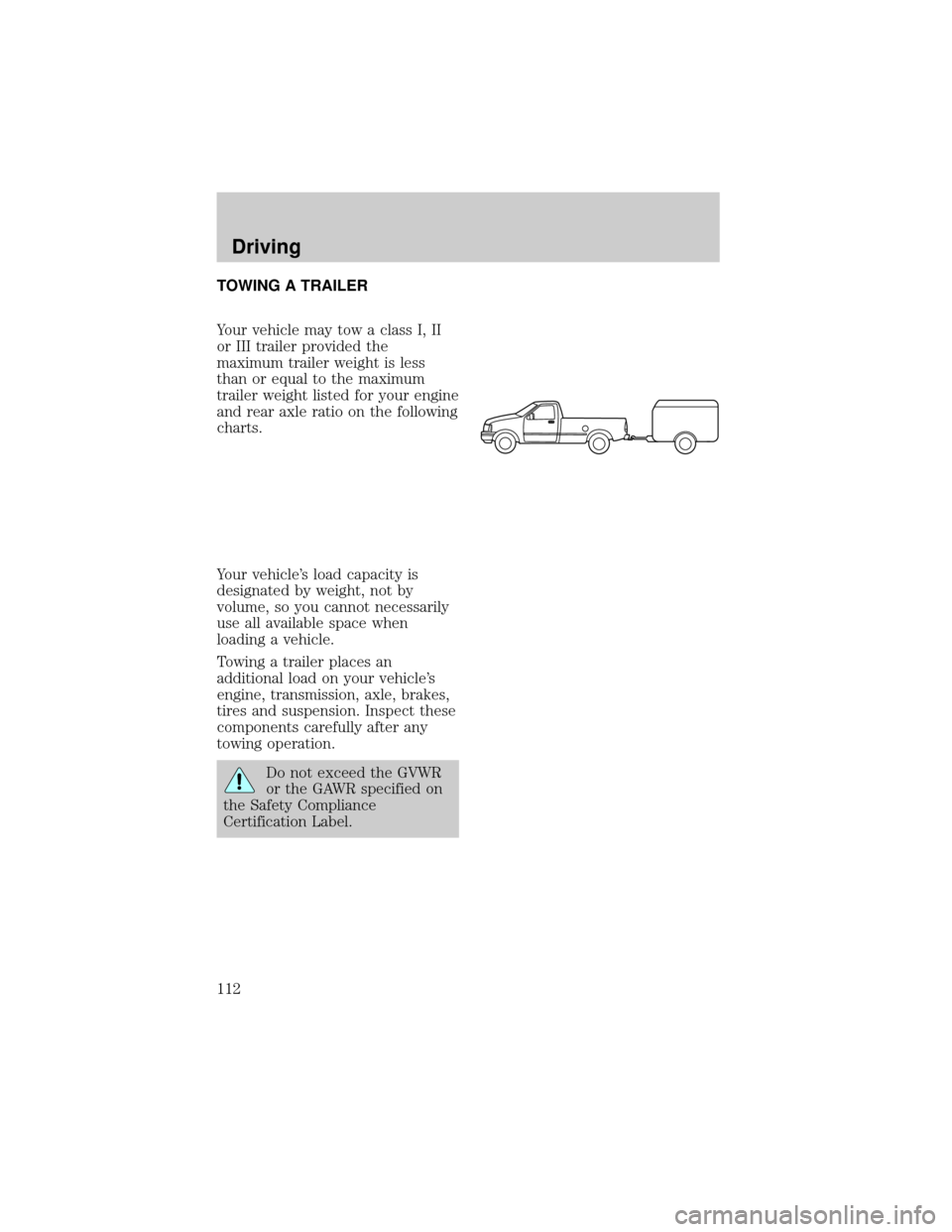
Your vehicle may tow a class I, II
or III trailer provided the
maximum trailer weight is less
than or equal to the maximum
trailer weight listed for your engine
and rear axle ratio on the following
charts.
Your vehicle's load capacity is
designated by weight, not by
volume, so you cannot necessarily
use all available space when
loading a vehicle.
Towing a trailer places an
additional load on your vehicle's
engine, transmission, axle, brakes,
tires and suspension. Inspect these
components carefully after any
towing operation.
Do not exceed the GVWR
or the GAWR specified on
the Safety Compliance
Certification Label.
Driving
112
Page 113 of 219
Towing trailers beyond the
maximum recommended
gross trailer weight could result
in engine damage,
transmission/axle damage,
structural damage, loss of
control, and personal injury.
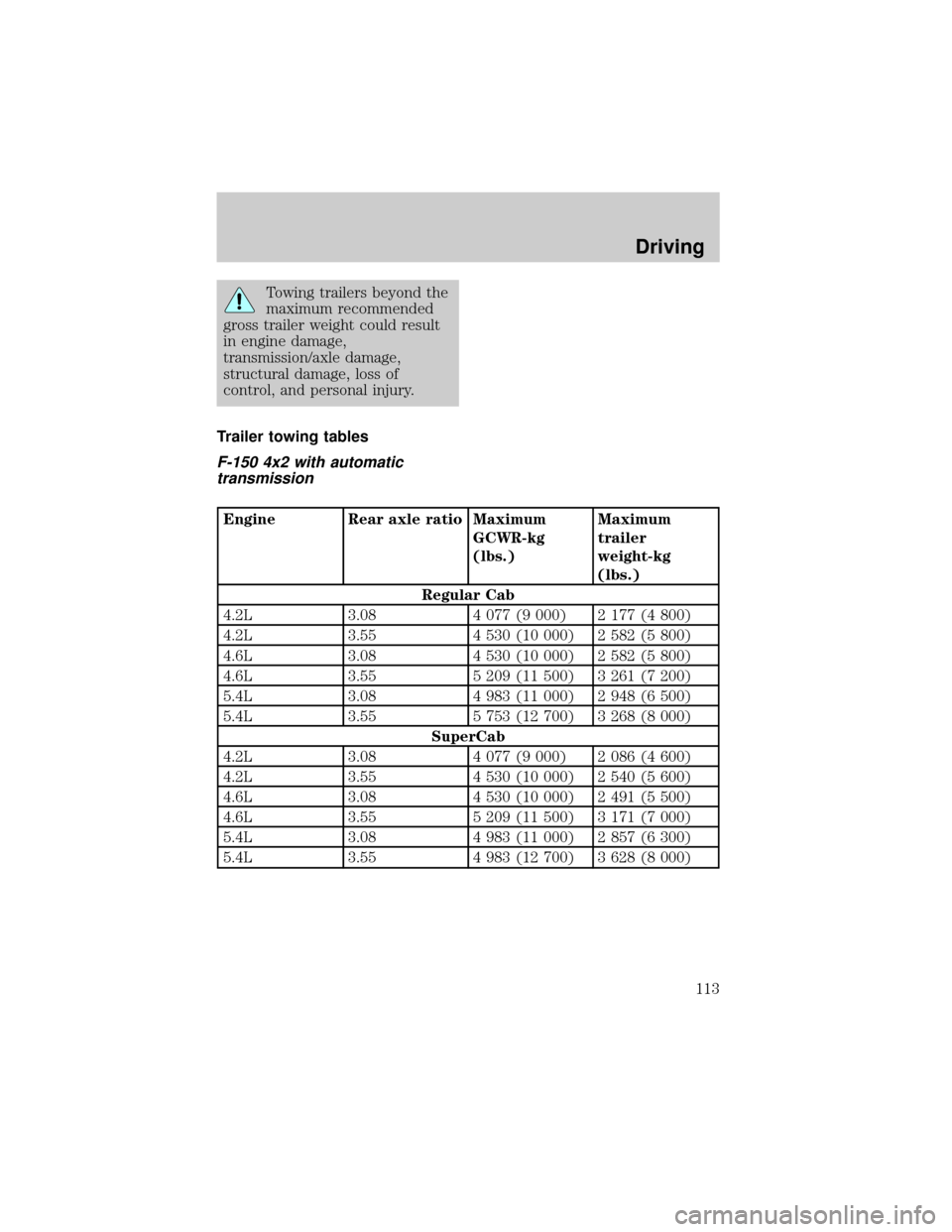
Trailer towing tables
F-150 4x2 with automatic
transmission
Engine Rear axle ratio Maximum
GCWR-kg
(lbs.)Maximum
trailer
weight-kg
(lbs.)
Regular Cab
4.2L 3.08 4 077 (9 000) 2 177 (4 800)
4.2L 3.55 4 530 (10 000) 2 582 (5 800)
4.6L 3.08 4 530 (10 000) 2 582 (5 800)
4.6L 3.55 5 209 (11 500) 3 261 (7 200)
5.4L 3.08 4 983 (11 000) 2 948 (6 500)
5.4L 3.55 5 753 (12 700) 3 268 (8 000)
SuperCab
4.2L 3.08 4 077 (9 000) 2 086 (4 600)
4.2L 3.55 4 530 (10 000) 2 540 (5 600)
4.6L 3.08 4 530 (10 000) 2 491 (5 500)
4.6L 3.55 5 209 (11 500) 3 171 (7 000)
5.4L 3.08 4 983 (11 000) 2 857 (6 300)
5.4L 3.55 4 983 (12 700) 3 628 (8 000)
Driving
113
Page 115 of 219

Engine Rear axle
ratioMaximum
GCWR-kg
(lbs.)Maximum
trailer
weight-kg
(lbs.)Maximum
frontal area
of
trailer-m
(ft)
4.6L 3.55 5 209 (11 500) 2 993 (6 600) 5.52 (60)
5.4L 3.08 4 983 (11 000) 2 721 (6 000) 5.52 (60)
5.4L 3.55 5 753 (12 700) 3 492 (7 700) 5.52 (60)
F-150 4x4 manual transmission
Trailer towing table (F-150 4x4 manual transmission)
Engine Rear axle
ratioMaximum
GCWR-kg
(lbs.)Maximum
trailer
weight-kg
(lbs.)Maximum
frontal area
of
trailer-m
(ft)
Regular Cab F-150
4.2L 3.08 2 944 (6 500) 861 (1 900) 5.52 (60)
4.2L 3.55 3 533 (7 800) 1 451 (3 200) 5.52 (60)
4.6L 3.08 2 944 (6 500) 816 (1 800) 5.52 (60)
4.6L 3.55 3 533 (7 800) 1 406 (3 100) 5.52 (60)
SuperCab F-150
4.6L 3.08 2 944 (6 500) 771 (1 700) 5.52 (60)
4.6L 3.55 3 533 (7 800) 1 360 (3 000) 5.52 (60)
F-250 4x2 automatic
transmission
Engine Rear axle
ratioMaximum
GCWR-kg
(lbs.)Maximum
trailer
weight-kg
(lbs.)Maximum
frontal area
of
trailer-m
(ft)
Regular Cab F-250
4.6L 3.31 4 756 (10 500) 2 630 (5 800) 5.52 (60)
Driving
115
Page 118 of 219
Engine Rear axle
ratioMaximum
GCWR-kg
(lbs.)Maximum
trailer
weight-kg
(lbs.)Maximum
frontal area
of trailer-m
(ft)
SuperCab F-250
4.6L 3.31 3 261 (7 200) 952 (2 100) 5.52 (60)
4.6L 3.73 3 533 (7 800) 1 224 (2 700) 5.52 (60)
Preparing to tow
Use the proper equipment for
towing a trailer, and make sure it
is properly attached to your
vehicle. See your dealer or a
reliable trailer dealer if you require
assistance.
Hitches
Do not use hitches that clamp onto
the vehicle's bumper or attach to
the axle. You must distribute the
load in your trailer so that 10 to
15% of the total weight of the
trailer is on the tongue.
Load equalizing hitch
When hooking up a trailer using a
load equalizing hitch, always use
the following procedure:
1. Park the unloaded vehicle on a
level surface. With the ignition on
and all doors closed, allow the
vehicle to stand for several
minutes so that it can level.
2. Turn the air suspension (if
equipped) control to OFF.
Driving
118
Page 120 of 219

must meet local and Federal
regulations.
Do not connect a trailer's
hydraulic brake system
directly to your vehicle's brake
system. Your vehicle may not
have enough braking power and
your chances of having a
collision greatly increase.
Trailer lamps
Trailer lamps are required on most
towed vehicles. Make sure your
trailer lamps conform to local and
Federal regulations. See your
dealer or trailer rental agency for
proper instructions and equipment
for hooking up trailer lamps.
Using a step bumper
The rear bumper is equipped with
an integral hitch and requires only
a ball with a 25.4 mm (one inch)
shank diameter. The bumper has a
2 270 kg (5 000 lb.) trailer weight
and 227 kg (500 lb.) tongue weight
capability.
If it is necessary to relocate the
trailer hitch ball position, a
frame-mounted trailer hitch must
be installed.
Driving while you tow
Do not drive faster than 88 km/h
(55 mph) when towing a trailer.
Speed control may shut off if you
are towing on long, steep grades.
When towing a trailer:
Driving
120
Page 121 of 219

²Use D (Drive) or a lower gear
when towing up or down steep
hills. This will eliminate
excessive downshifting and
upshifting for optimum fuel
economy and transmission
cooling.
²Anticipate stops and brake
gradually.
Servicing after towing
If you tow a trailer for long
distances, your vehicle will require
more frequent service intervals.
Refer to the Severe Duty Schedule
in your ªService Guideº for more
information.
Trailer towing tips
²Practice turning, stopping and
backing up in an area before
starting on a trip to get the feel
of the vehicle trailer
combination. When turning,
make wider turns so the trailer
wheels will clear curbs and
other obstacles.
²Allow more distance for
stopping with a trailer attached.
²The trailer tongue weight should
be 10±15% of the loaded trailer
weight.
²After you have traveled 80 km
(50 miles), thoroughly check
your hitch, electrical
connections and trailer wheel
lug nuts.
²When stopped in traffic for long
periods of time in hot weather,
place the gearshift in P (Park)
Driving
121
Page 123 of 219
Recreational towing (all wheels
on the ground)
Follow these guidelines for your
specific powertrain combination to
tow your vehicle with all four
wheels on the ground (such as
behind a recreational vehicle).
These guidelines are designed to
ensure that your transmission is
not damaged due to insufficient
lubrication.
2WD (manual and automatic
transmissions)
1. Place transmission in N
(Neutral).
2. Maximum speed is 56 km/h
(35 mph).
3. Maximum distance is 80 km
(50 miles).
If a distance of 80 km (50 miles)
or a speed of 56 km/h (35 mph)
must be exceeded, you must
disconnect the rear driveshaft.
With the rear driveshaft
disconnected, the maximum speed
is 88 km/h (55 mph) and there are
no mileage restrictions.
See your dealer for help with
disconnecting the driveshaft.
4WD ± Lever operated transfer
case (manual and automatic
transmissions)
1. Place transmission in P (Park).
2. Shift the transfer case to N
(Neutral).
Driving
123
Page 126 of 219

must not exceed the front
accessory reserve capacity.
²The total weight of the
snowplow and aftermarket
equipment must not exceed the
Total Accessory Reserve
Capacity.
²The weight of the installed
snowplow and aftermarket
equipment must not load the
vehicle beyond the GAWR
(front/rear) and GVWR listed on
the Safety Compliance
Certification Label.
²The total weight of the
snowplow and aftermarket
equipment must be considered
part of the payload and must
not exceed the Gross Combined
Weight Rating (GCWR) for
towing.
²Federal and most local
regulations require additional
exterior lamps for
snowplow-equipped vehicles.
Consult your dealer for
additional information.
²After installing a snowplow to
the vehicle, ensure the vehicle's
front toe alignment and front
ride height are within
specification (reset if required).
These specifications are located
in the vehicle's Workshop
Manual. Adherence to the toe,
tire pressures and ride height
specification is important for
proper tire wear, ride, handling
and headlight aim. Also,
Driving
126