Page 127 of 210

²Thoroughly prepare your vehicle for towing. Refer toPreparing to
towin this chapter.
²Use extra caution when driving while trailer towing. Refer toDriving
while you towin this chapter.
²Service your vehicle more frequently if you tow a trailer. Refer to the
severe duty schedule in the ``Service Guide''.
²Do not tow a trailer until your vehicle has been driven at least 800 km
(500 miles).
²Refer to the instructions included with towing accessories for the
proper installation and adjustment specifications.
Do not exceed the maximum loads listed on the Safety Compliance
Certification label. For load specification terms found on the label, refer
toVehicle loadingin this chapter. Remember to figure in the tongue
load of your loaded vehicle when figuring the total weight.
Trailer towing table (4x2 manual transmission)
GCWR (Gross Combined Weight Rating)/Trailer weights
EngineRear
axle
ratioMaximum
GCWR-kg
(lbs.)Trailer weight
range-kg (lbs.)
(0-Maximum)Maximum
frontal area of
trailer-m
2(ft2)
2-door
4.0L EFI 3.27 2 721 (6 000) 0-907 (0-2 000) 4.64 (50)
4.0L EFI 3.73 3 175 (7 000) 0-1 424 (0-3 140) 4.64 (50)
4-door
4.0L EFI 3.27 2 721 (6 000) 0-880 (0-1 940) 4.64 (50)
4.0L EFI 3.73 3 175 (7 000) 0-1 325 (0-2 920) 4.64 (50)
Notes:-For high altitude operation, reduce GCW by 2% per 300
meters (1 800 ft) elevation. For definitions of terms used in this table
and instructions on how to calculate your vehicle load, refer toVehicle
loadingin this chapter. Maximum trailer weights shown. The combined
weight of the completed towing vehicle and the loaded trailer must not
exceed the GCWR.
Towing a trailer over 907 kg (2 000 lbs.) requires a weight distributing
hitch.
Driving
127
Page 128 of 210
Trailer towing table (4x4 manual transmission)
GCWR (Gross Combined Weight Rating)/Trailer weights
EngineRear
axle
ratioMaximum
GCWR-kg
(lbs.)Trailer weight
range-kg (lbs.)
(0-Maximum)Maximum
frontal area of
trailer-m
2(ft2)
2-door
4.0L EFI 3.27 2 721 (6 000) 0-871 (0-1 920) 4.64 (50)
4.0L EFI 3.55 2 948 (6 500) 0-1 089 (0-2 420) 4.64 (50)
4.0L EFI 3.73 3 175 (7 000) 0-1 325 (0-2 920) 4.64 (50)
4-door
4.0L EFI 3.55 2 948 (6 500) 0-998 (0-2 200) 4.64 (50)
4.0L EFI 3.73 3 175 (7 000) 0-1 225 (0-2 700) 4.64 (50)
Notes:- For high altitude operation, reduce GCW by 2% per 300
meters (1 800 ft) elevation. For definitions of terms used in this table
and instructions on how to calculate your vehicle load, refer toVehicle
loadingin this chapter. Maximum trailer weights shown. The combined
weight of the completed towing vehicle and the loaded trailer must not
exceed the GCWR.
Towing a trailer over 907 kg (2 000 lbs.) requires a weight distributing
hitch.
Driving
128
Page 129 of 210

Trailer towing table (4x2 automatic transmission)
GCWR (Gross Combined Weight Rating)/Trailer weights
EngineRear
axle
ratioMaximum
GCWR-kg
(lbs.)Trailer Weight
Range-kg (lbs.)
0-MaximumMaximum
frontal area of
trailer-m
2(ft2)
2-door
4.0L
SOHC3.27 3 402 (7 500) 0-1 361 (0-3 000) 4.64 (50)
4.0L
SOHC3.55 3 856 (8 500) 0-2 041 (0-4 500) 4.64 (50)
4.0L EFI 3.73 4 082 (9 000) 0-2 313 (0-5 100) 4.64 (50)
4.0L
SOHC3.73 4 082 (9 000) 0-2 041 (0-4 500) 4.64 (50)
4-door
4.0L
SOHC3.55 4 082 (9 000) 0-2 041 (0-4 500) 4.64 (50)
4.0L EFI 3.73 4 309 (9 500) 0-2 449 (5 400) 4.64 (50)
4.0L
SOHC3.734 535 (10
000)0-2 658 (0-5 860) 4.64 (50)
4.0L
SOHC4.104 535 (10
000)0-2 630 (0-5 800) 4.64 (50)
5.0L 3.734 990 (11
000)0-3 039 (0-6 700) 4.64 (50)
Notes:For high altitude operation, reduce GCW by 2% per 300 meters
(1 000 ft) elevation. For definition of terms and instructions on
calculating your vehicle's load, refer toVehicle loadingin this chapter.
Maximum trailer weights shown. The combined weight of the
completed towing vehicle and the loaded trailer must not exceed the
GCWR.
Towing a trailer over 907 kg (2 000 lbs.) requires a weight distributing
hitch.
Driving
129
Page 130 of 210

Trailer towing table
(4x4 and AWD with automatic transmission)
GCWR (Gross Combined Weight Rating)/Trailer Weights
EngineRear
axle
ratioMaximum
GCWR-kg
(lbs.)Trailer Weight
Range-kg (lbs.)
0-MaximumMaximum
frontal area of
trailer-m
2(ft2)
2-door
4.0L
SOHC3.27 3 402 (7 500) 0-1 524 (0-3 360) 4.64 (50)
4.0L
SOHC3.55 3 856 (8 500) 0-1 978 (0-4 360) 4.64 (50)
4.0L EFI 3.73 4 082 (9 000) 0-2 214 (0-4 880) 4.64 (50)
4.0L
SOHC3.73 4 082 (9 000) 0-2 204 (0-4 860) 4.64 (50)
4.0L EFI 4.10 4 082 (9 000) 0-2 214 (4 880) 4.64 (50)
4.0L
SOHC4.10 4 082 (9 000) 0-2 204 (4 860) 4.64 (50)
4-door
4.0L
SOHC3.55 4 082 (9 000) 0-2 041 (0-4 500) 4.64 (50)
4.0L EFI 3.73 4 309 (9 500) 0-2 341 (0-5 160) 4.64 (50)
4.0L
SOHC3.734 535
(10 000)0-2 558 (0-5 640) 4.64 (50)
4.0L
SOHC4.104 535
(10 000)0-2 558 (0-5 640) 4.64 (50)
5.0L 3.734 990
(11 000)0-2 930 (6 460) 4.64 (50)
Notes:For high altitude operation, reduce GCW by 2% per 300 meters
(1 000 ft) elevation. For definition of terms and instructions on
calculating your vehicle's load, refer toVehicle loadingin this chapter.
Maximum trailer weights shown. The combined weight of the
completed towing vehicle and the loaded trailer must not exceed the
GCWR.
Towing a trailer over 907 kg (2 000 lbs.) requires a weight distributing
hitch.
Driving
130
Page 131 of 210
Do not exceed the GVWR or the GAWR specified on the Safety
Compliance Certification Label.
Towing trailers beyond the maximum recommended gross trailer
weight exceeds the limit of the vehicle and could result in
engine damage, transmission damage, structural damage, loss of
control, and personal injury.
Preparing to tow
Use the proper equipment for towing a trailer, and make sure it is
properly attached to your vehicle. See your dealer or a reliable trailer
dealer if you require assistance.
Hitches
Do not use hitches that clamp onto the vehicle bumper. Use a load
carrying hitch. You must distribute the load in your trailer so that
10 ± 15% of the total weight of the trailer is on the tongue.
Use a frame-mounted weight distributing hitch for trailers over
907 kg (2 000 lb).
Safety chains
Always connect the trailer's safety chains to the vehicle. To connect the
trailer's safety chains, cross the chains under the trailer tongue and allow
slack for turning corners.
If you use a rental trailer, follow the instructions that the rental agency
gives to you.
Trailer brakes
Electric brakes and manual, automatic or surge-type brakes are safe if
installed properly and adjusted to the manufacturer's specifications. The
trailer brakes must meet local and Federal regulations.
Do not connect a trailer's hydraulic brake system directly to your
vehicle's brake system. Your vehicle may not have enough
braking power and your chances of having a collision greatly increase.
Driving
131
Page 133 of 210

²Allow more distance for stopping with a trailer attached.
²The trailer tongue weight should be 10±15% of the loaded trailer
weight.
²After you have traveled 80 km (50 miles), thoroughly check your
hitch, electrical connections and trailer wheel lug nuts.
²When stopped in traffic for long periods of time in hot weather, place
the gearshift in P (Park) (automatic transmissions) or 1 (First)
(manual transmissions) and increase idle speed. This aids engine
cooling and air conditioner efficiency.
²Vehicles with trailers should not be parked on a grade. If you must
park on a grade, place wheel chocks under the trailer's wheels.
Launching or retrieving a boat
When backing down a ramp during boat launching or retrieval,
²Do not allow the static water level to rise above the bottom edge of
the rear bumper and
²Do not allow waves to break higher than 15 cm (six inches) above the
bottom edge of the rear bumper.
Exceeding these limits may allow water to enter critical vehicle
components, adversely affecting driveability, emissions and reliability.
If the rear axle is submerged in water, the rear axle lubricant should be
checked and changed, if necessary. The rear axle is filled with a
synthetic lubricant and does not normally require a lubricant change for
the life of the vehicle. Rear axle lubricant quantities should not need to
be checked unless a leak is suspected.
Recreational towing (all wheels on the ground)
(Neutral tow kit accessory)
On vehicles equipped with a 4.0L engine, an accessory is available that
allows you to tow your vehicle, behind another vehicle, with all the
wheels on the ground. Contact your dealer for more details. Do not tow
your vehicle with all wheels on the ground unless you install the neutral
tow kit as vehicle damage may occur.
LUGGAGE RACK
Maximum load is 45 kg (100 lbs), evenly distributed. If it is not possible
to distribute the load, position it as far rearward as possible. Adjustable
tie down loops must be used to secure the load.
Driving
133
Page 135 of 210
HAZARD LIGHTS CONTROL
Use only in an emergency to warn traffic of vehicle breakdown,
approaching danger, etc. The hazard flashers can be operated when the
ignition is off.
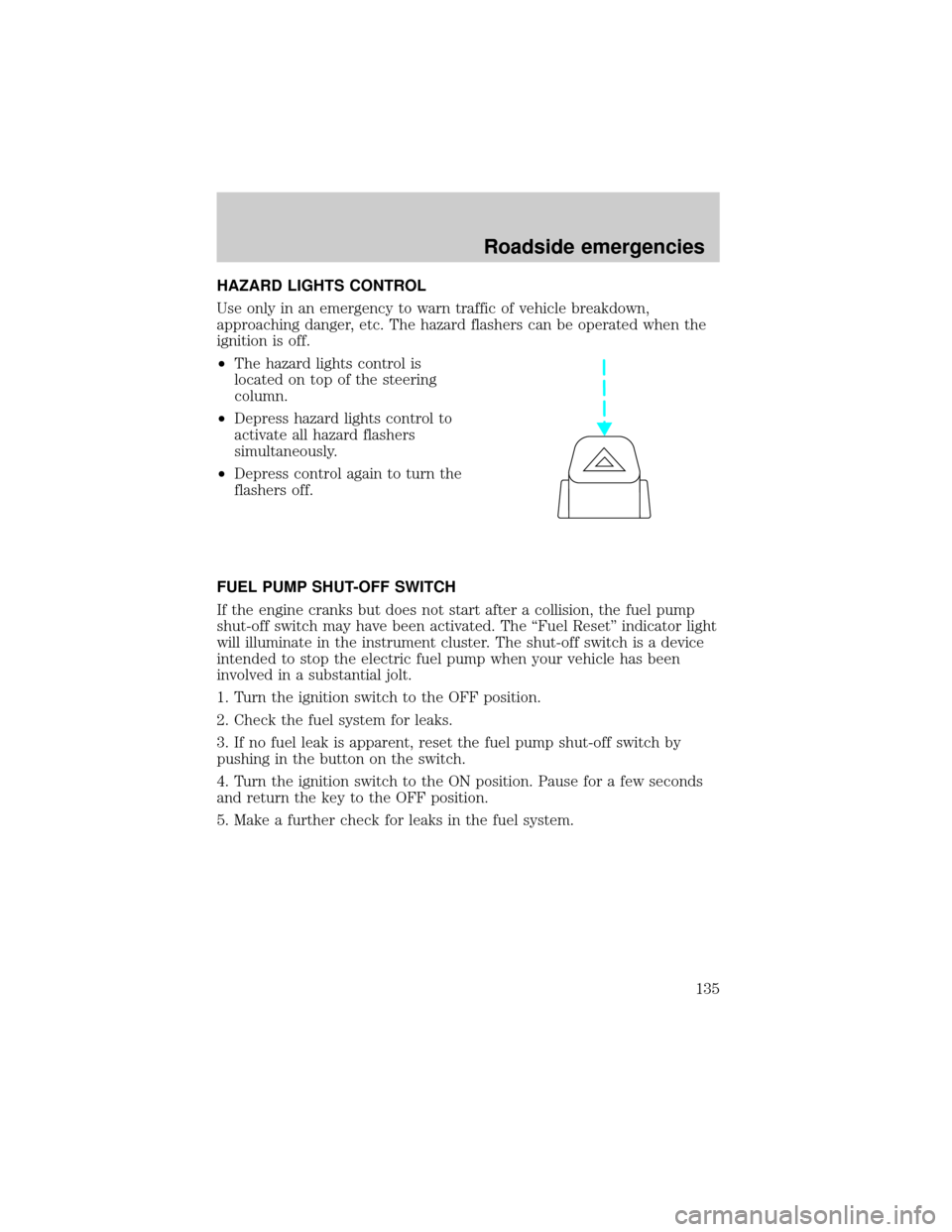
²The hazard lights control is
located on top of the steering
column.
²Depress hazard lights control to
activate all hazard flashers
simultaneously.
²Depress control again to turn the
flashers off.
FUEL PUMP SHUT-OFF SWITCH
If the engine cranks but does not start after a collision, the fuel pump
shut-off switch may have been activated. The ``Fuel Reset'' indicator light
will illuminate in the instrument cluster. The shut-off switch is a device
intended to stop the electric fuel pump when your vehicle has been
involved in a substantial jolt.
1. Turn the ignition switch to the OFF position.
2. Check the fuel system for leaks.
3. If no fuel leak is apparent, reset the fuel pump shut-off switch by
pushing in the button on the switch.
4. Turn the ignition switch to the ON position. Pause for a few seconds
and return the key to the OFF position.
5. Make a further check for leaks in the fuel system.
Roadside emergencies
135
Page 141 of 210
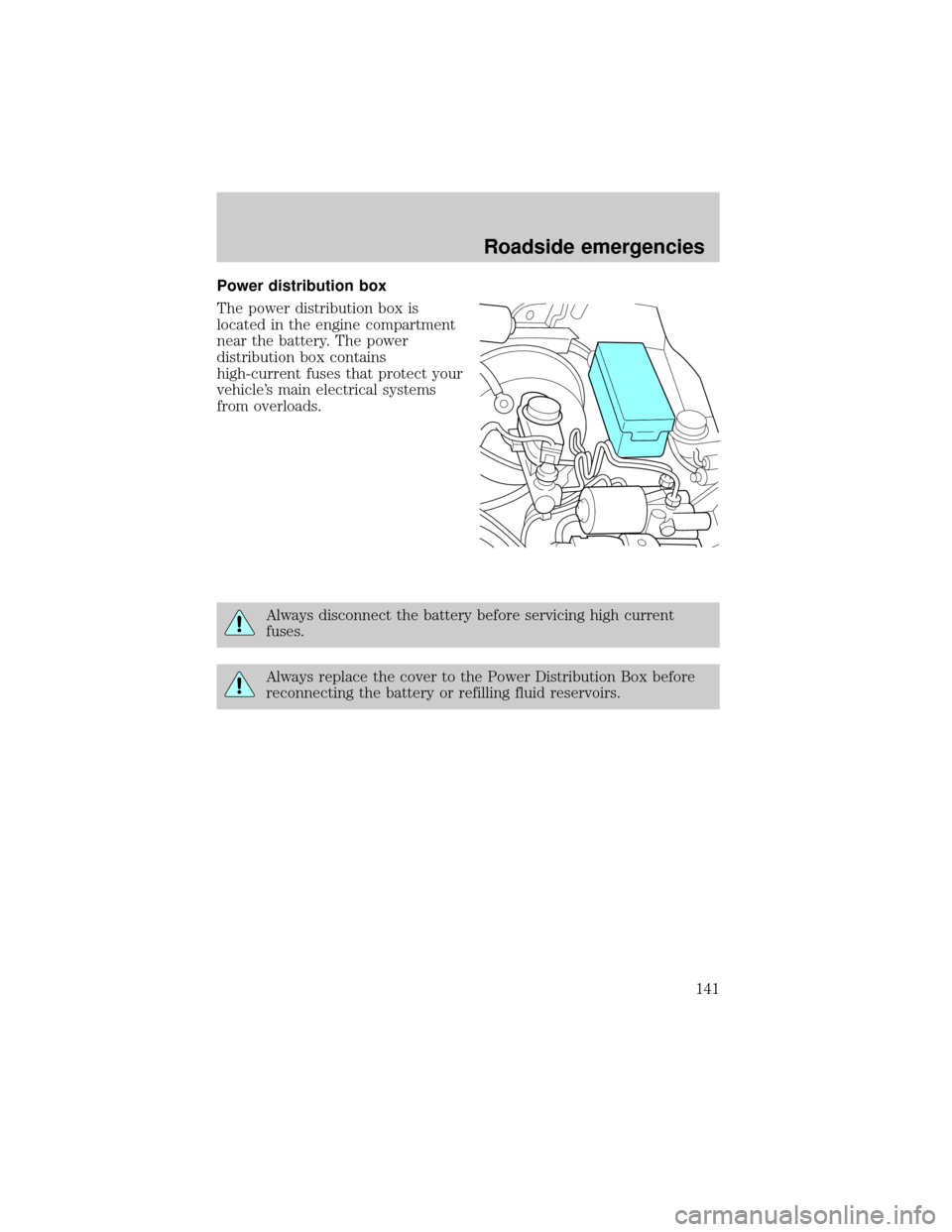
Power distribution box
The power distribution box is
located in the engine compartment
near the battery. The power
distribution box contains
high-current fuses that protect your
vehicle's main electrical systems
from overloads.
Always disconnect the battery before servicing high current
fuses.
Always replace the cover to the Power Distribution Box before
reconnecting the battery or refilling fluid reservoirs.
Roadside emergencies
141