Page 134 of 216
The high-current fuses are coded
as follows.
Fuse/Relay
LocationFuse Amp
RatingDescription
1 20A* Trailer Tow Running Lamp Relay,
Trailer Tow Backup Lamp Relay
2 10A* Air Bag Diagnostic Monitor
3 30A* All Unlock Relay, All Lock Relay,
Driver's Unlock Relay
4 15A* Air Suspension Service Switch
5 20A* Horn Relay
6 30A* Radio, Premium Sound Amplifier,
CD Changer, Rear Integrated
Control Panel, Sub-Woofer Power
(Fuse 3 & Fuse 5)
19 29
18 28EEC
POWER
RELAY
FUEL
PUMP
RELAY
FRONT
WASHER
PUMP HORN
RELAY 17 27
16 26
15 25
14 24
13
11 12
910
78
56
34
1223
22
21
20
W/S/W
RUN/
PARKW/S/W
HI/LO
Roadside emergencies
134
Page 135 of 216
Fuse/Relay
LocationFuse Amp
RatingDescription
7 15A* Main Light Switch, Park Lamp
Relay
8 30A* Main Light Switch, Headlamp
Relay, Multi-Function Switch
9 15A* Daytime Running Lamps (DRL)
Module, Fog Lamp Relay
10 25A* I/P Auxiliary Power Socket
11 25A* Console Auxiliary Power Socket
12 10A* Rear Wiper Up Motor Relay, Rear
Wiper Down Motor Relay
13 30A** Auxiliary A/C Relay
14 60A** 4 Wheel Anti-Lock Brake System
(4WABS) Module
15 50A** Air Suspension Solid State
Compressor Relay
16 40A** Trailer Tow Battery Charge Relay,
Engine Fuse Module (Fuse 2)
17 30A** Shift on the Fly Relay, Transfer
Case Shift relay
18 30A** Power Seat Control Switch
19 20A** Fuel Pump Relay
20 50A** Ignition Switch (B4 & B5)
21 50A** Ignition Switch (B1 & B3)
22 50A** Junction Box Fuse/Relay Panel
Battery Feed
23 40A** I/P Blower Relay
24 30A** PCM Power Relay, Engine Fuse
Module (Fuse 1)
25 30A CB Junction Box Fuse/Relay Panel,
ACC Delay Relay
26 Ð Not Used
Roadside emergencies
135
Page 140 of 216
Removing the jack and tools
1. Locate the access panel on the
interior trim. Lift and rotate the
two panel retaining clips and
remove the panel.
2. Un-snap the wheel lug nut
wrench, instructions and work
gloves from their retaining bracket.
3. Remove the jack by turning the
thumbwheel counterclockwise to
relieve tension against the stowage
bracket.
Removing the spare tire
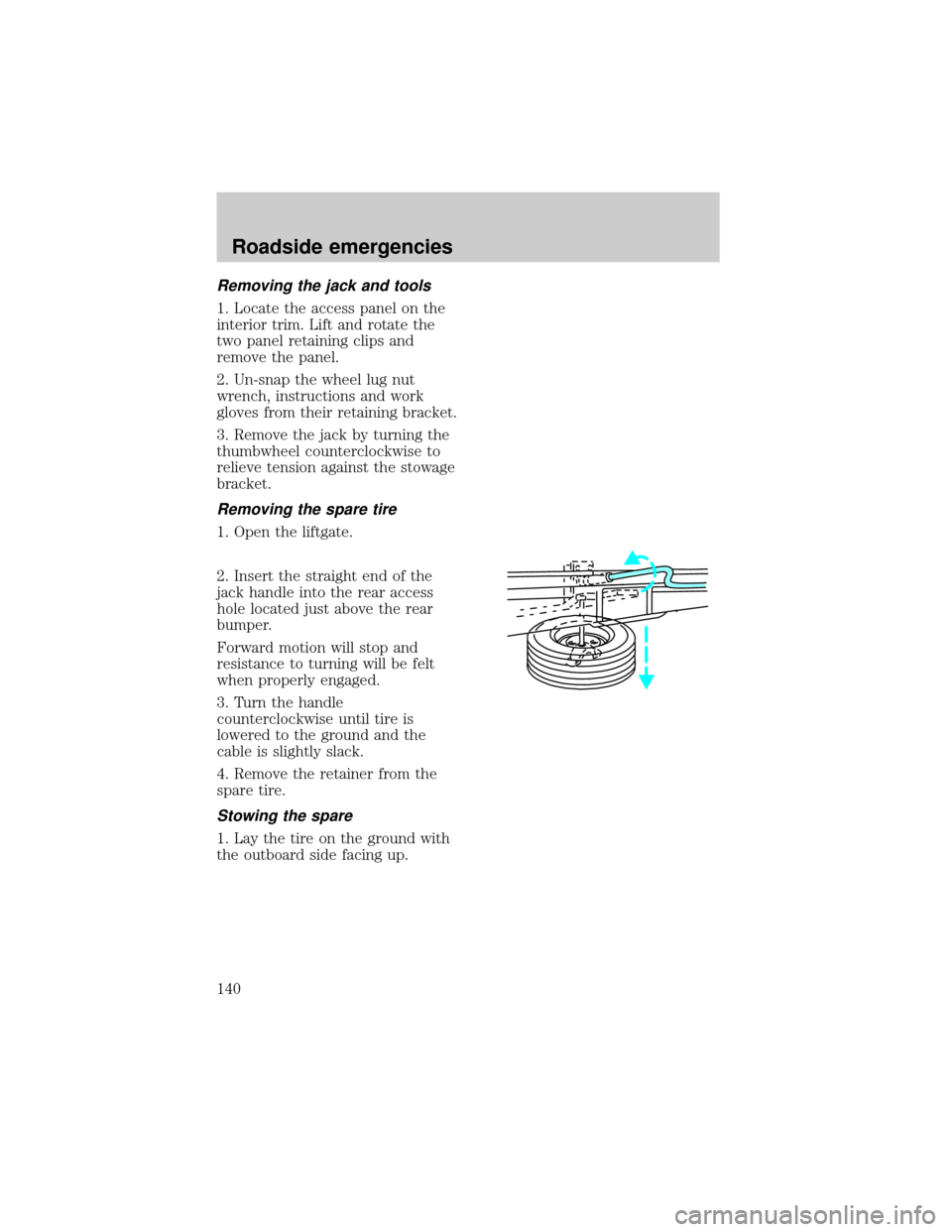
1. Open the liftgate.
2. Insert the straight end of the
jack handle into the rear access
hole located just above the rear
bumper.
Forward motion will stop and
resistance to turning will be felt
when properly engaged.
3. Turn the handle
counterclockwise until tire is
lowered to the ground and the
cable is slightly slack.
4. Remove the retainer from the
spare tire.
Stowing the spare
1. Lay the tire on the ground with
the outboard side facing up.
Roadside emergencies
140
Page 141 of 216
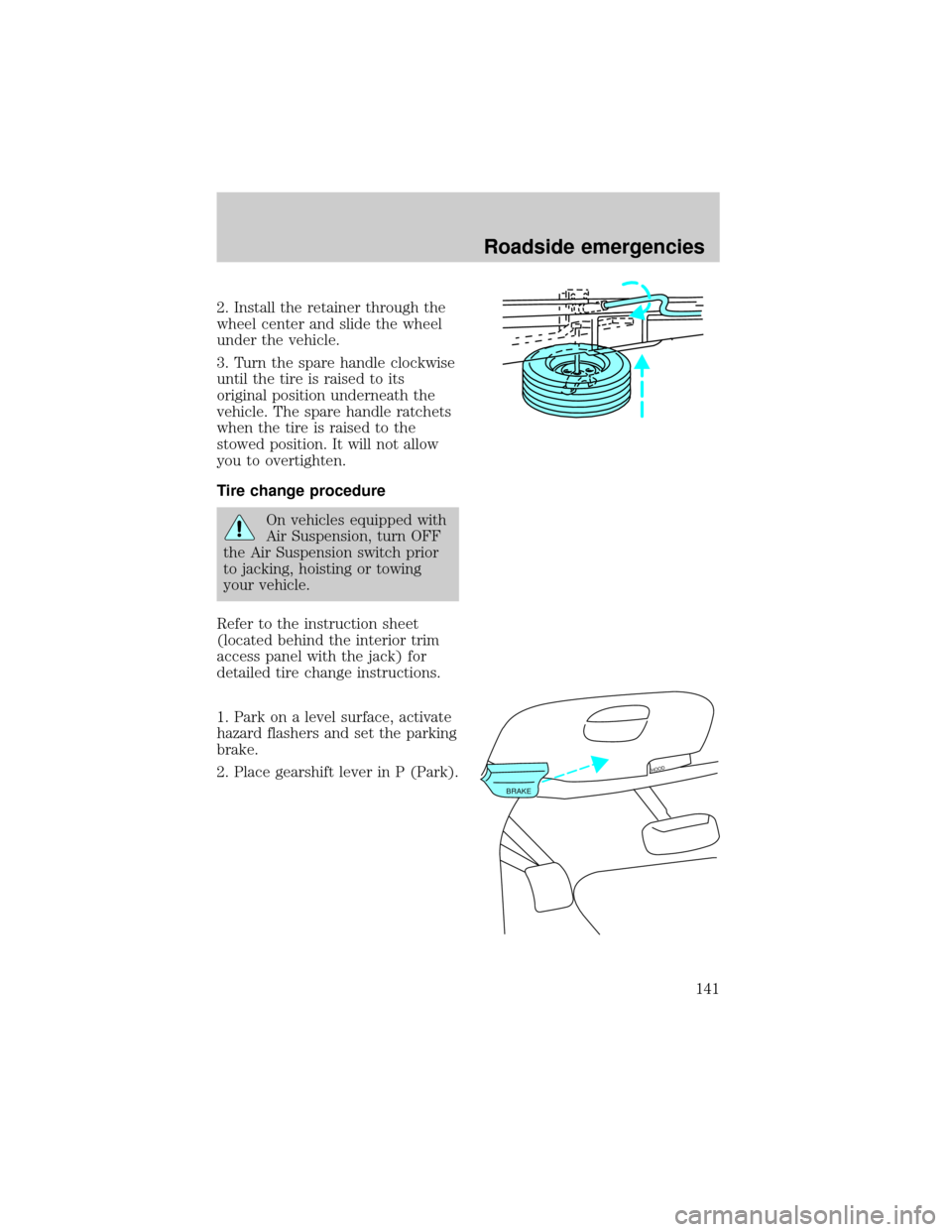
2. Install the retainer through the
wheel center and slide the wheel
under the vehicle.
3. Turn the spare handle clockwise
until the tire is raised to its
original position underneath the
vehicle. The spare handle ratchets
when the tire is raised to the
stowed position. It will not allow
you to overtighten.
Tire change procedure
On vehicles equipped with
Air Suspension, turn OFF
the Air Suspension switch prior
to jacking, hoisting or towing
your vehicle.
Refer to the instruction sheet
(located behind the interior trim
access panel with the jack) for
detailed tire change instructions.
1. Park on a level surface, activate
hazard flashers and set the parking
brake.
2. Place gearshift lever in P (Park).
BRAKE
HOOD
Roadside emergencies
141
Page 142 of 216
3. Block the diagonally opposite
wheel.
4. Obtain the spare tire and jack
from their storage locations.
5. Use the tip of the lug wrench to
remove any wheel trim.
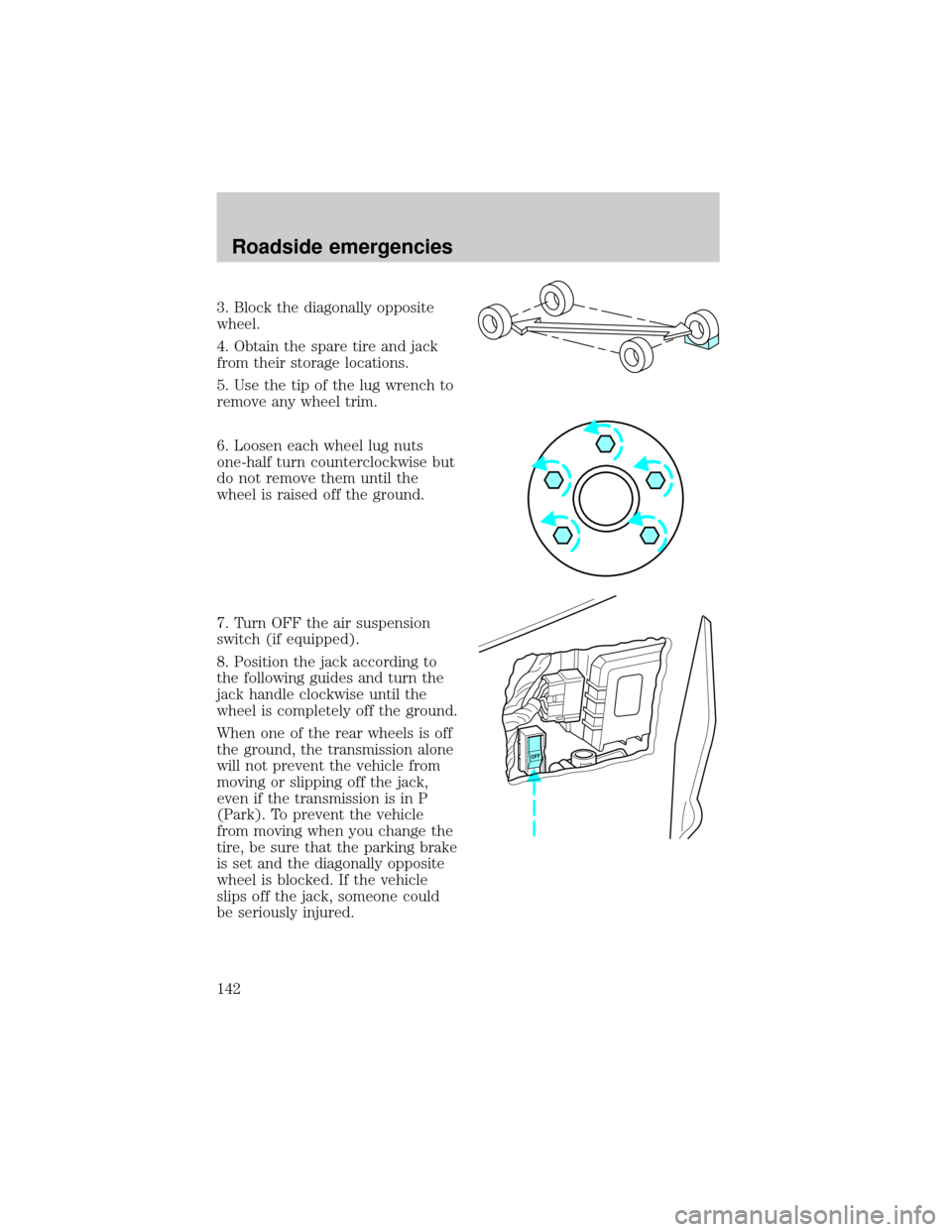
6. Loosen each wheel lug nuts
one-half turn counterclockwise but
do not remove them until the
wheel is raised off the ground.
7. Turn OFF the air suspension
switch (if equipped).
8. Position the jack according to
the following guides and turn the
jack handle clockwise until the
wheel is completely off the ground.
When one of the rear wheels is off
the ground, the transmission alone
will not prevent the vehicle from
moving or slipping off the jack,
even if the transmission is in P
(Park). To prevent the vehicle
from moving when you change the
tire, be sure that the parking brake
is set and the diagonally opposite
wheel is blocked. If the vehicle
slips off the jack, someone could
be seriously injured.
OFF
Roadside emergencies
142
Page 144 of 216
²Never use the front or rear
differential as a jacking
point.
9. Remove the lug nuts with the
lug wrench.
10. Replace the flat tire with the
spare tire, making sure the valve
stem is facing outward. Reinstall
the lug nuts until the wheel is snug
against the hub. Do not fully
tighten the lug nuts until the
wheel has been lowered.
11. Lower the wheel by turning the
jack handle counterclockwise.
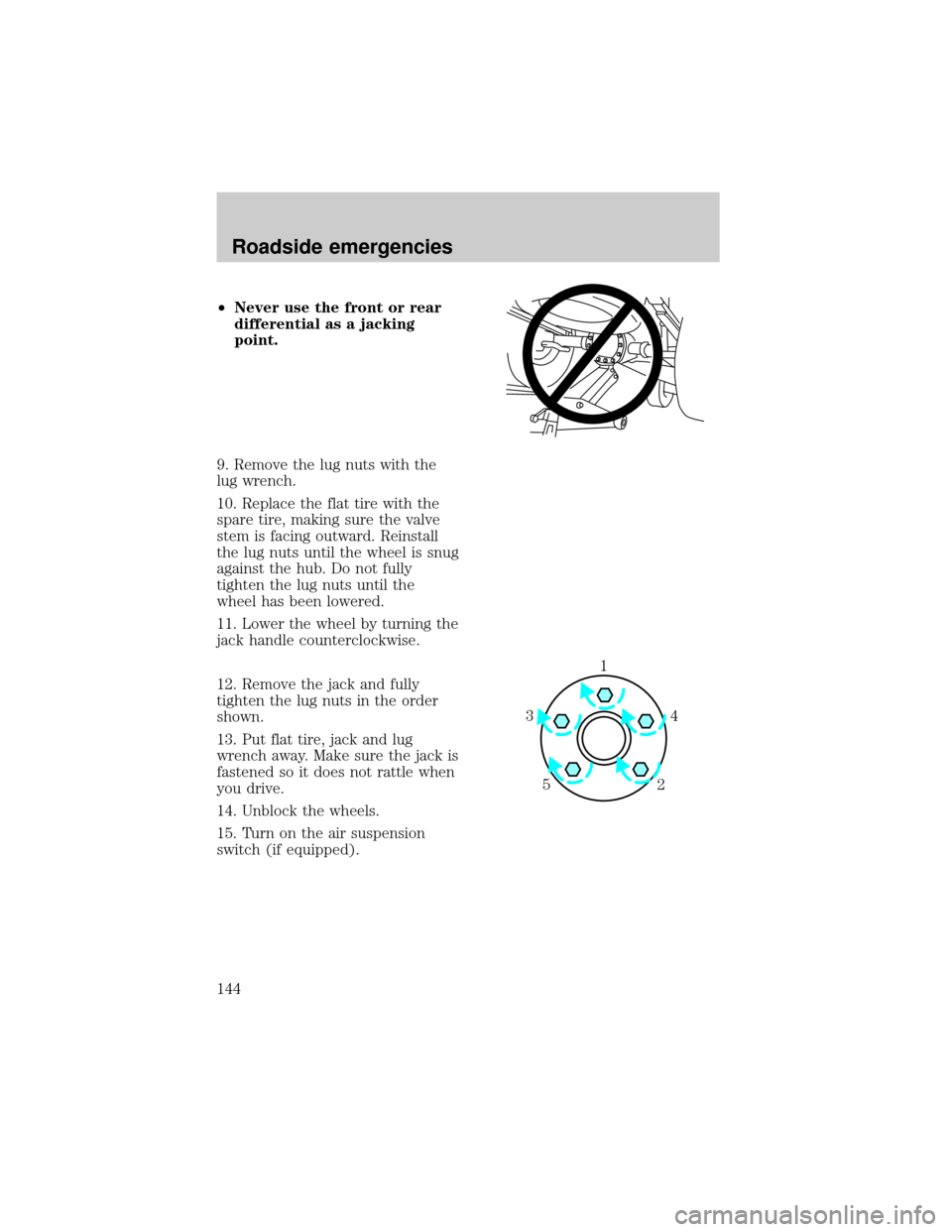
12. Remove the jack and fully
tighten the lug nuts in the order
shown.
13. Put flat tire, jack and lug
wrench away. Make sure the jack is
fastened so it does not rattle when
you drive.
14. Unblock the wheels.
15. Turn on the air suspension
switch (if equipped).
1
4 3
52
Roadside emergencies
144
Page 151 of 216
²Keep all lit cigarettes, open
flames and other lit material
away from the battery and all
fuel related parts.
If you disconnect the battery, the
engine must ªrelearnº its idle
conditions before your vehicle will
drive properly, as explained in
Batteryin this chapter.
Working with the engine off
1. Set the parking brake and
ensure the gearshift is securely
latched in P (Park).
2. Turn off the engine and remove
the key.
3. Block the wheels to prevent the
vehicle from moving unexpectedly.
Working with the engine on.
1. Set the parking brake and
ensure the gearshift is securely
latched in P (Park).
2. Block the wheels to prevent the
vehicle from moving unexpectedly.
Do not start your engine
with the air cleaner
removed and do not remove it
while the engine is running.
Maintenance and care
151
Page 160 of 216
Never remove the coolant
recovery cap while the
engine is running or hot.
If you must remove the coolant
recovery cap, follow these steps to
avoid personal injury:
1. Before you remove the cap, turn
the engine off and let it cool.
2. When the engine is cool, wrap a
thick cloth around the cap. Slowly
turn cap counterclockwise to the
first stop.
3. Step back while the pressure
releases.
4. When you are sure that all the
pressure has been released, use
the cloth to press the cap down,
turn it counterclockwise and
remove it.
Use Ford Premium Cooling System
Fluid E2FZ-19549±AA (in Canada,
Motorcraft CXC-8±B) or an
equivalent premium engine coolant
that meets Ford specification
ESE-M97B44±A. Ford Premium
Engine Coolant is an optimized
formula that will protect all metals
and rubber elastomers used in
Ford cooling systems for four years
or 80,000 km (50,000 miles).
Do not use alcohol or methanol
antifreeze or any engine coolants
mixed with alcohol or methanol
antifreeze. Do not use
supplemental coolant additives in
your vehicle. These additives may
harm your engine cooling system.
The use of an improper coolant
Maintenance and care
160