Page 98 of 216

BRAKES
Your brakes are self-adjusting.
Refer to the ªService Guideº for
scheduled maintenance.
Occasional brake noise is normal
and often does not indicate a
performance concern with the
vehicle's brake system. In normal
operation, automotive brake
systems may emit occasional or
intermittent squeal or groan noises
when the brakes are applied. Such
noises are usually heard during the
first few brake applications in the
morning; however, they may be
heard at any time while braking
and can be aggravated by
environmental conditions such as
cold, heat, moisture, road dust, salt
or mud. If a ªmetal-to-metal,º
ªcontinuous grindingº or
ªcontinuous squealº sound is
present while braking, the brake
linings may be worn-out and
should be inspected by a qualified
service technician.
Anti-lock brake system (ABS)
On vehicles equipped with an
anti-lock braking system (ABS), a
noise from the hydraulic pump
motor and pulsation in the pedal
may be observed during ABS
braking events. Pedal pulsation
coupled with noise while braking
under panic conditions or on loose
gravel, bumps, wet or snowy roads
is normal and indicates proper
functioning of the vehicle's
anti-lock brake system. If the
vehicle has continuous vibration or
Driving
98
Page 99 of 216
shudder while braking, felt mainly
in the steering wheel, the vehicle
most likely needs service.
The ABS operates by detecting the
onset of wheel lock up during
brake applications and
compensating for this tendency.
The front wheels are prevented
from locking even when the brakes
are firmly applied. The
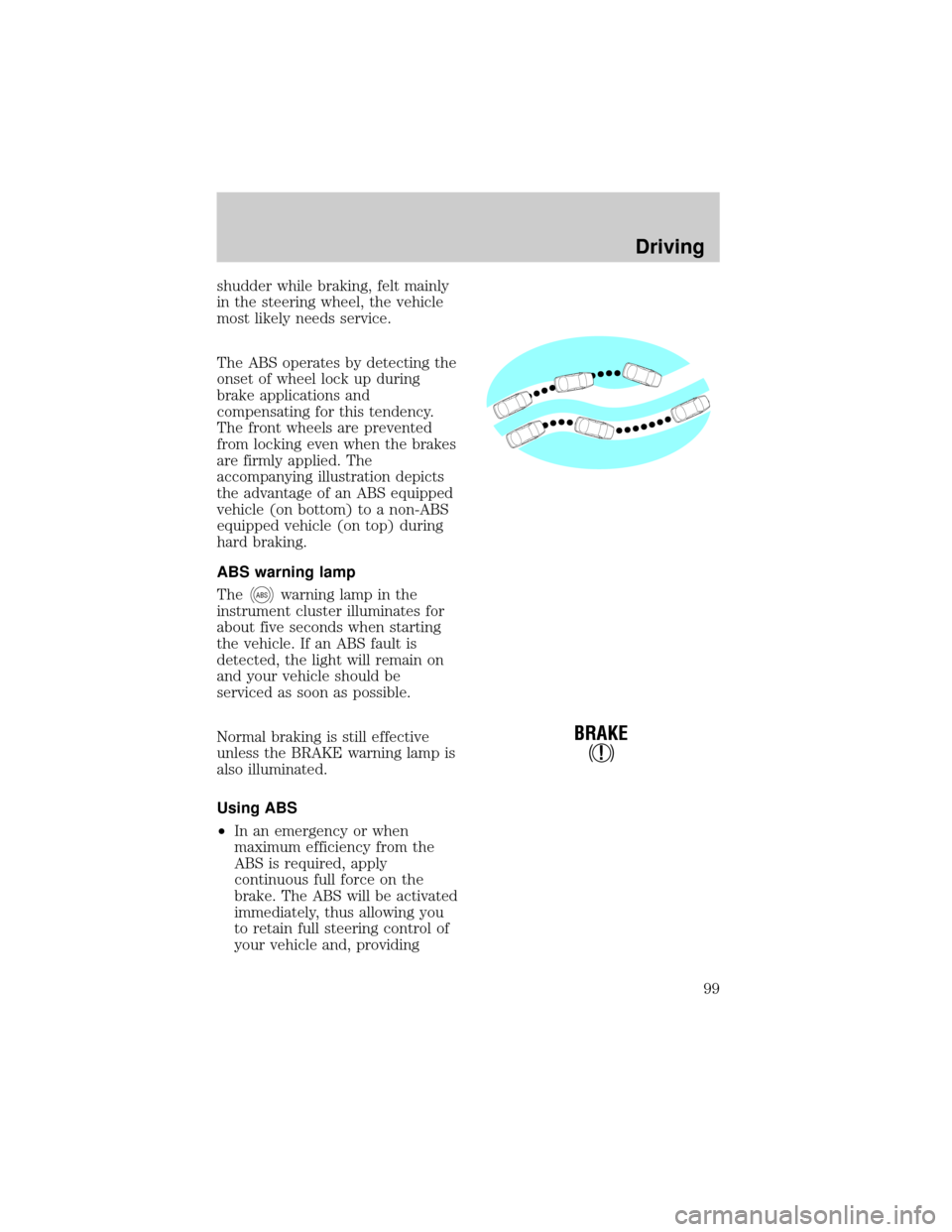
accompanying illustration depicts
the advantage of an ABS equipped
vehicle (on bottom) to a non-ABS
equipped vehicle (on top) during
hard braking.
ABS warning lamp
The
ABSwarning lamp in the
instrument cluster illuminates for
about five seconds when starting
the vehicle. If an ABS fault is
detected, the light will remain on
and your vehicle should be
serviced as soon as possible.
Normal braking is still effective
unless the BRAKE warning lamp is
also illuminated.
Using ABS
²In an emergency or when
maximum efficiency from the
ABS is required, apply
continuous full force on the
brake. The ABS will be activated
immediately, thus allowing you
to retain full steering control of
your vehicle and, providing
!
BRAKE
Driving
99
Page 104 of 216

TRANSMISSION OPERATION
Automatic transmission
operation
Brake-shift interlock
This vehicle is equipped with a
brake-shift interlock feature that
prevents the gearshift from being
moved from P (Park) unless the
brake pedal is depressed.
If you cannot move the gearshift
out of P (Park) with the brake
pedal depressed:
1. Apply the parking brake, turn
ignition key to LOCK, then remove
the key.
2. Insert the key and turn it to
OFF. Apply the brake pedal and
shift to N (Neutral).
3. Start the vehicle.
If it is necessary to use the above
procedure to move the gearshift, it
is possible that a fuse has blown
and the vehicle's brakelamps may
not be operating properly. Refer to
Fuses and relaysin theRoadside
emergencieschapter.
Do not drive your vehicle
until you verify that the
brakelamps are working.
If your vehicle gets stuck in mud
or snow it may be rocked out by
shifting from forward and reverse
gears in a steady pattern. Press
lightly on the accelerator in each
gear.
Driving
104
Page 108 of 216
gear, and will shift to 1 (Low) after
vehicle decelerates to the proper
speed.
CONTROL-TRAC AUTOMATIC
FOUR-WHEEL DRIVE SYSTEM
(IF EQUIPPED)
Your 4x4 features a heavy-duty
Control-Trac system, including a
computer-operated transfer case.
Coupled with a
center-disconnected front axle, this
unique system is interactive with
the road, continually monitoring
and adjusting torque delivery to
the front and rear wheels to
optimize vehicle control.
Positions of the Control-Trac
system
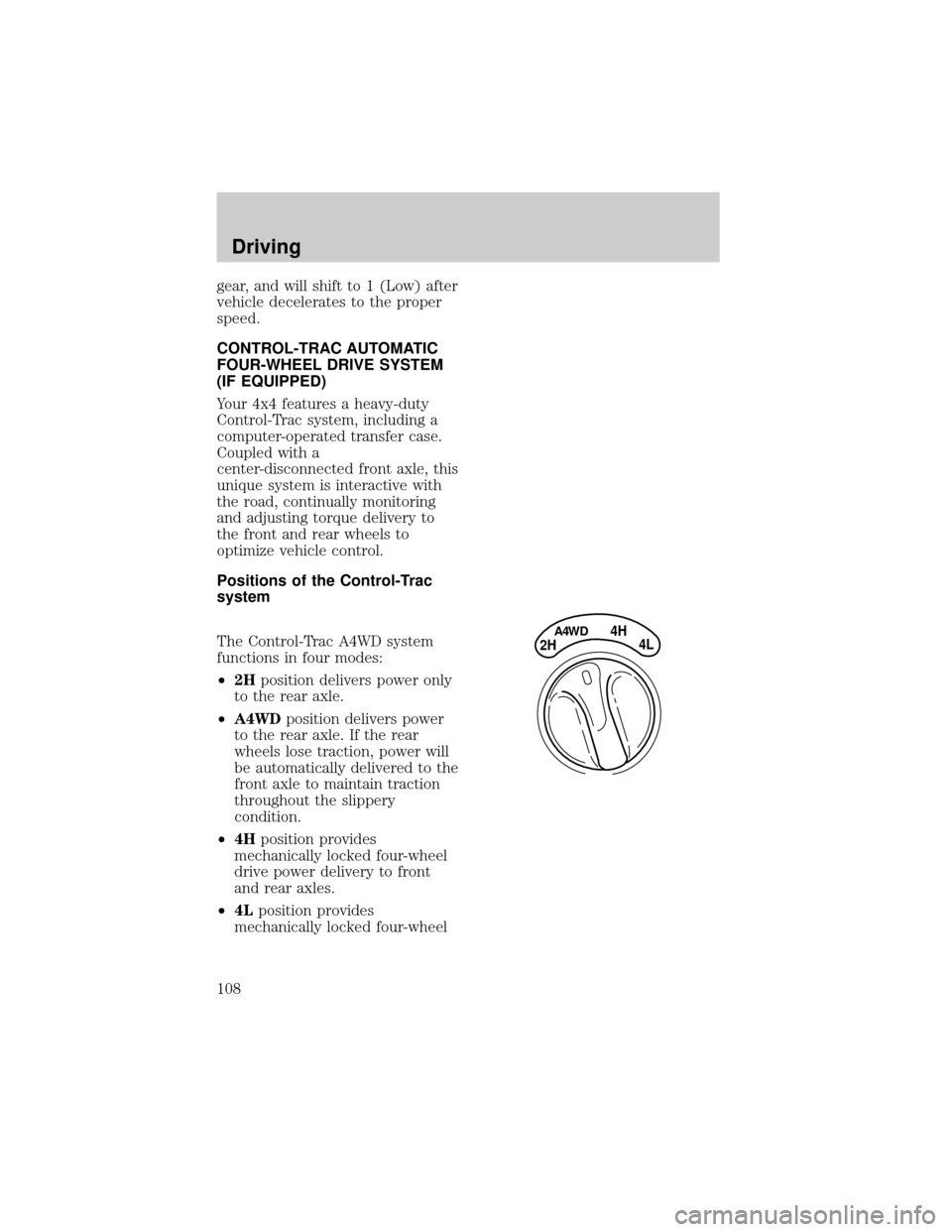
The Control-Trac A4WD system
functions in four modes:
²2Hposition delivers power only
to the rear axle.
²A4WDposition delivers power
to the rear axle. If the rear
wheels lose traction, power will
be automatically delivered to the
front axle to maintain traction
throughout the slippery
condition.
²4Hposition provides
mechanically locked four-wheel
drive power delivery to front
and rear axles.
²4Lposition provides
mechanically locked four-wheel
4H
2HA4WD4L
Driving
108
Page 114 of 216

ACCEL button (to resume speeds
over 50 km/h (30 mph).
Automatic transmission may shift
frequently while driving up steep
grades. Eliminate frequent shifting
by shifting out of
(Overdrive)
into D (Drive).
Driving on snow and ice
A 4WD vehicle has advantages
over 2WD vehicles in snow and ice
but can skid like any other vehicle.
Avoid sudden applications of
power and quick changes of
direction on snow and ice. Apply
the accelerator slowly and steadily
when starting from a full stop.
When braking, apply the brakes as
you normally would. In order to
allow the anti-lock brake system
(ABS) to operate properly, keep
steady pressure on the brake
pedal.
Allow more stopping distance and
drive slower than usual. Consider
using one of the lower gears.
DRIVING THROUGH WATER
Do not drive quickly through
standing water, especially if the
depth is unknown. Traction or
brake capability may be limited
and if the ignition system gets wet,
your engine may stall. Water may
also enter your engine's air intake
and severely damage your engine.
If driving through deep or standing
water is unavoidable, proceed very
slowly. Never drive through water
that is higher than the bottom of
Driving
114
Page 126 of 216
LUGGAGE RACK
Load luggage at the front crossbar
and adjust the rear crossbar as
necessary.
²Do not exceed 90.7 kg (200 lb)
of luggage if the weight is
placed directly on the crossbars.
²Do not exceed 68 kg (150 lb) if
the weight is resting directly on
the roof.
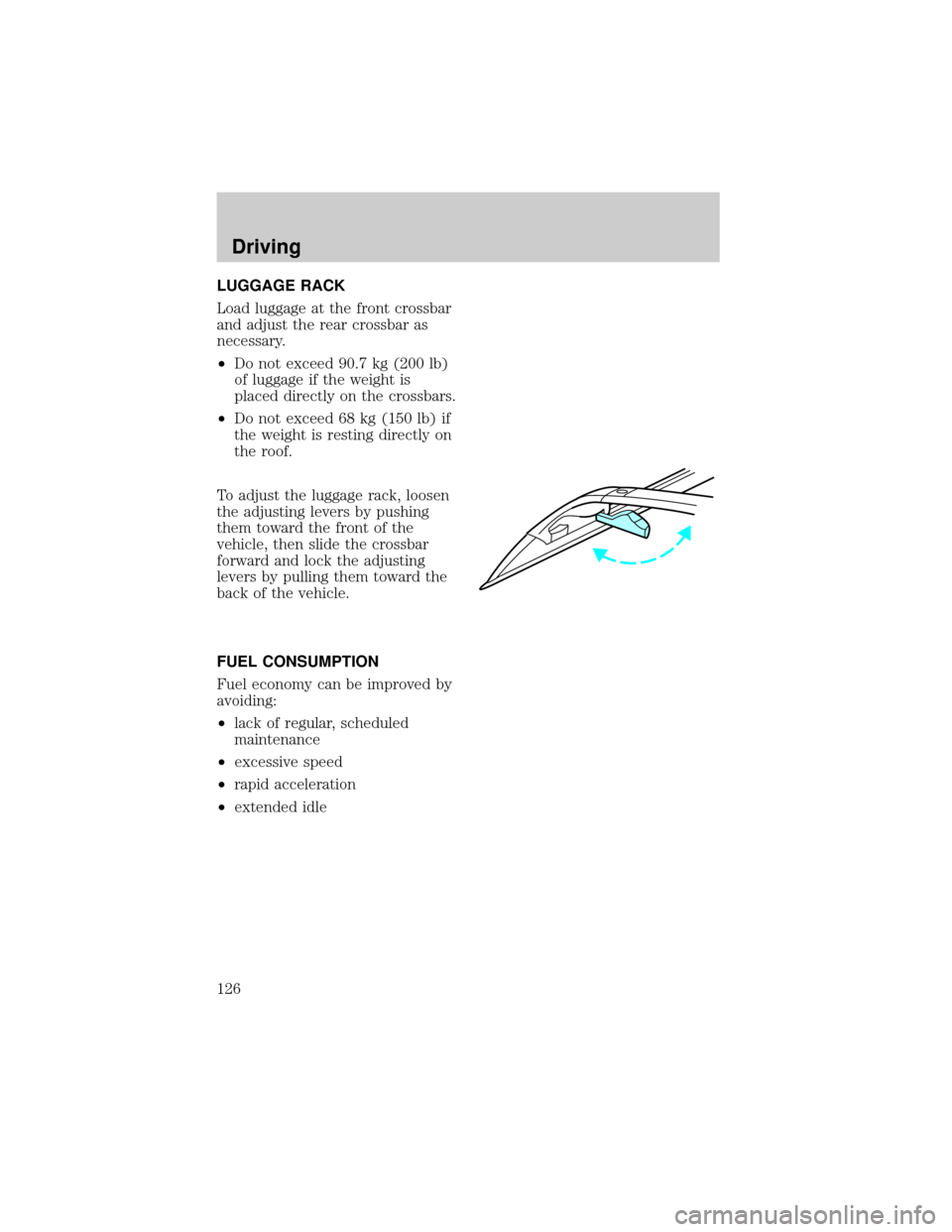
To adjust the luggage rack, loosen
the adjusting levers by pushing
them toward the front of the
vehicle, then slide the crossbar
forward and lock the adjusting
levers by pulling them toward the
back of the vehicle.
FUEL CONSUMPTION
Fuel economy can be improved by
avoiding:
²lack of regular, scheduled
maintenance
²excessive speed
²rapid acceleration
²extended idle
Driving
126
Page 131 of 216
Fuse/Relay
LocationFuse Amp
RatingDescription
5 15A Digital Transmission Range (DTR)
Sensor, Daytime Running Lamps
(DRL) Module, Speed Control
Servo/Amplifier Assembly,
Heater-A/C Control Assembly,
Blend Door Actuator, Electronic
Variable Orifice (EVO) Module
6 5A Shift Lock Actuator, Generic
Electronic Module (GEM), 4
Wheel Air Suspension (4WAS)
Module, Compass Sensor, Steering
Wheel Rotation Sensor, Heated
Grid Relay, Overhead Trip
Computer (OTC) Module
7 5A Auxiliary A/C Relay, Console
Blower Motor
8 5A Radio, Main Light Switch, Remote
Anti-Theft Personality (RAP)
Module
9 Ð Not Used
10 Ð Not Used
11 30A Washer Pump Relay, Wiper
Run/Park Relay, Wiper Hi/Lo
Relay, Windshield Wiper Motor,
Rear Wiper Pump Relay
12 5A Data Link Connector (DLC)
13 15A Brake On/Off (BOO) Switch,
Brake Pressure Switch
14 15A Battery Saver Relay, Interior
Lamp Relay
15 5A Generic Electronic Module
(GEM), Passive Anti-Theft System
(PATS) Module
Roadside emergencies
131
Page 132 of 216

Fuse/Relay
LocationFuse Amp
RatingDescription
16 20A Instrument Cluster (W/O DRL),
Daytime Running Lamps (DRL)
Module, Hi-Beam Headlamps
(Power supplied through
Multi-Function Switch)
17 10A Heated Backlight Switch, Left
Power/Heated Signal Mirror, Right
Power/Heated Signal Mirror
18 5A Main Light Switch, Generic
Electronic Module (GEM),
Instrument Illumination (Power
supplied through Main Light
Switch)
19 10A Instrument Cluster, Air Bag
Diagnostic Monitor
20 5A 4 Wheel Air Suspension (4WAS),
Generic Electronic Module (GEM)
21 15A Digital Transmission Range (DTR)
Sensor, Junction Box Fuse/Relay
Panel (Fuse 20)
22 10A Air Bag Diagnostic Monitor
23 10A Trailer Tow Battery Charge Relay,
4X4 Center Axle Disconnect
solenoid, 4X2 Center Axle
Disconnect Solenoid, Function
Selector Switch, Rear Integrated
Control Panel, Recirculation
Vacuum Solenoid, Auxiliary A/C
Mode Acturator, Auxiliary A/C
Control Module
24 10A Function Selector Switch
25 5A 4 Wheel Anti-Lock Brake System
(4WABS) Module, 4WABS Relay
Roadside emergencies
132