Page 89 of 216
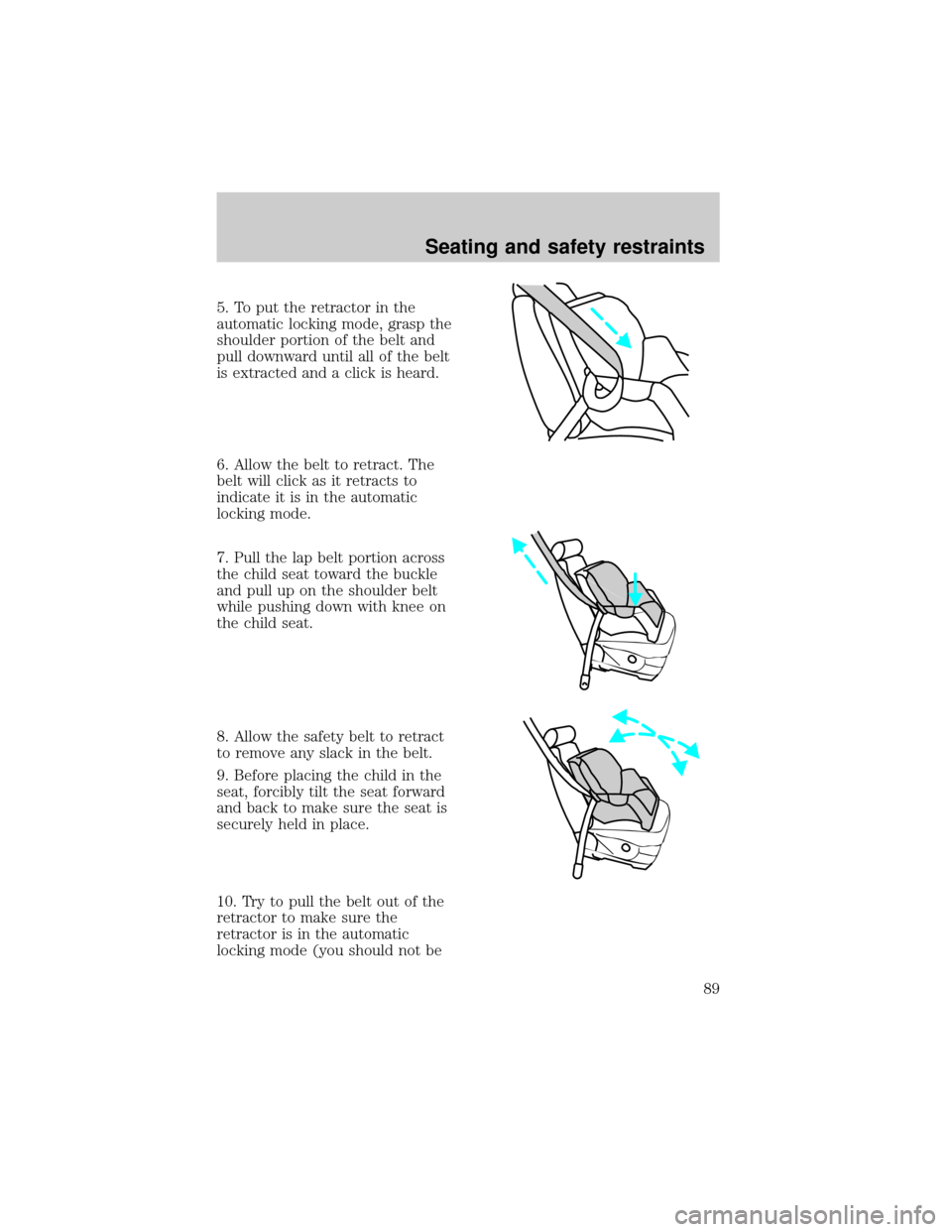
5. To put the retractor in the
automatic locking mode, grasp the
shoulder portion of the belt and
pull downward until all of the belt
is extracted and a click is heard.
6. Allow the belt to retract. The
belt will click as it retracts to
indicate it is in the automatic
locking mode.
7. Pull the lap belt portion across
the child seat toward the buckle
and pull up on the shoulder belt
while pushing down with knee on
the child seat.
8. Allow the safety belt to retract
to remove any slack in the belt.
9. Before placing the child in the
seat, forcibly tilt the seat forward
and back to make sure the seat is
securely held in place.
10. Try to pull the belt out of the
retractor to make sure the
retractor is in the automatic
locking mode (you should not be
Seating and safety restraints
89
Page 90 of 216

able to pull more belt out). If the
retractor is not locked, unbuckle
the belt and repeat steps two
through nine.
Check to make sure the child seat
is properly secured before each
use.
Attaching safety seats with
tether straps
Some manufacturers make safety
seats that include a tether strap
that goes over the back of the
vehicle seat and attaches to an
anchoring point. Other
manufacturers offer the tether
strap as an accessory. Contact the
manufacturer of your child safety
seat for information about ordering
a tether strap.
Tether anchorage hardware
A tethered seat can be installed in
the front seat. Put the tether strap
over the seatback and attach it to
an anchor bracket.
An anchor bracket can be installed
on the rear edge of the front seat
cushion.
The provision (attaching hole) is
provided in the rear edge of the
front passenger seat cushion
frame. The anchor bracket must be
installed using the instructions
provided with the kit.
Tether anchorage hardware kits
(part number 613D74) including
instructions, may be obtained at no
charge from any Ford or
Lincoln-Mercury dealer.
Seating and safety restraints
90
Page 93 of 216
Do not start your vehicle
in a closed garage or in
other enclosed areas. Exhaust
fumes can be toxic. Always open
the garage door before you start
the engine. SeeGuarding
against exhaust fumesin this
chapter for more instructions.
If you smell exhaust fumes
inside your vehicle, have
your dealer inspect your vehicle
immediately. Do not drive if you
smell exhaust fumes.
Important safety precautions
A computer system controls the
engine's idle revolutions per
minute (RPM). When the engine
starts, the idle RPM runs faster to
warm the engine. If the engine idle
speed does not slow down
automatically, have the vehicle
checked. Do not allow the vehicle
to idle for more than ten minutes.
Before starting the vehicle:
1. Make sure all vehicle occupants
have buckled their safety belts. For
more information on safety belts
and their proper usage, refer to
theSeating and safety restraints
chapter.
2. Make sure the headlamps and
vehicle accessories are off.
Starting
93
Page 95 of 216
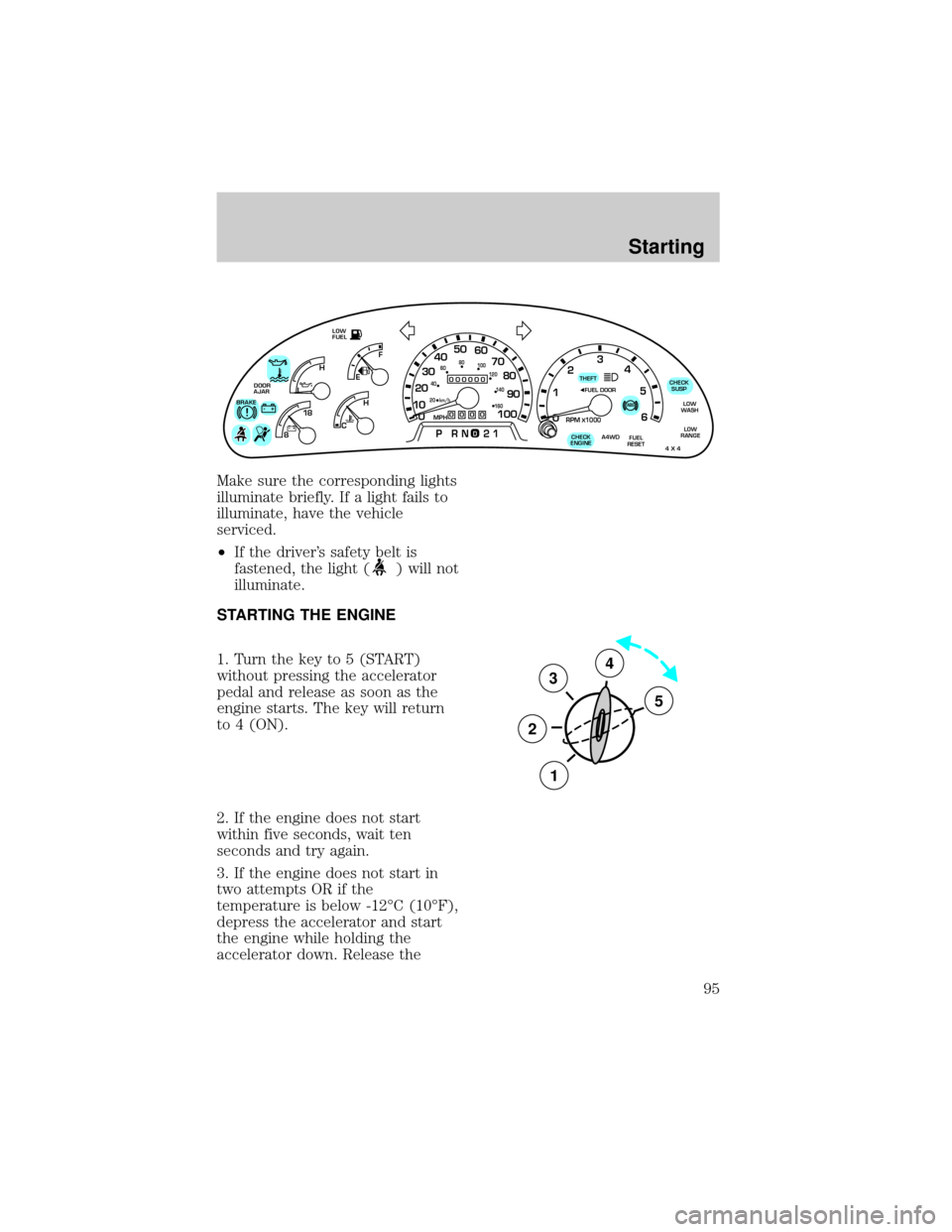
Make sure the corresponding lights
illuminate briefly. If a light fails to
illuminate, have the vehicle
serviced.
²If the driver's safety belt is
fastened, the light (
) will not
illuminate.
STARTING THE ENGINE
1. Turn the key to 5 (START)
without pressing the accelerator
pedal and release as soon as the
engine starts. The key will return
to 4 (ON).
2. If the engine does not start
within five seconds, wait ten
seconds and try again.
3. If the engine does not start in
two attempts OR if the
temperature is below -12ÉC (10ÉF),
depress the accelerator and start
the engine while holding the
accelerator down. Release the
LOW
FUEL
DOOR
AJAR
BRAKE
FUEL
RESET CHECK
ENGINELOW
RANGE
4 X 4
!ABS+ -
THEFTLEF
H0
0000
RPM1000X
00000
MPH
20km/h 406080
100
120
140
160
0
0 123
5
6 4
PRN 21
1020304050
60
70
80
90
100
8C 18
H
D
CHECK
SUSP
LOW
WASH
A4WDFUEL DOOR
3
2
1
5
4
Starting
95
Page 148 of 216
WRECKER TOWING
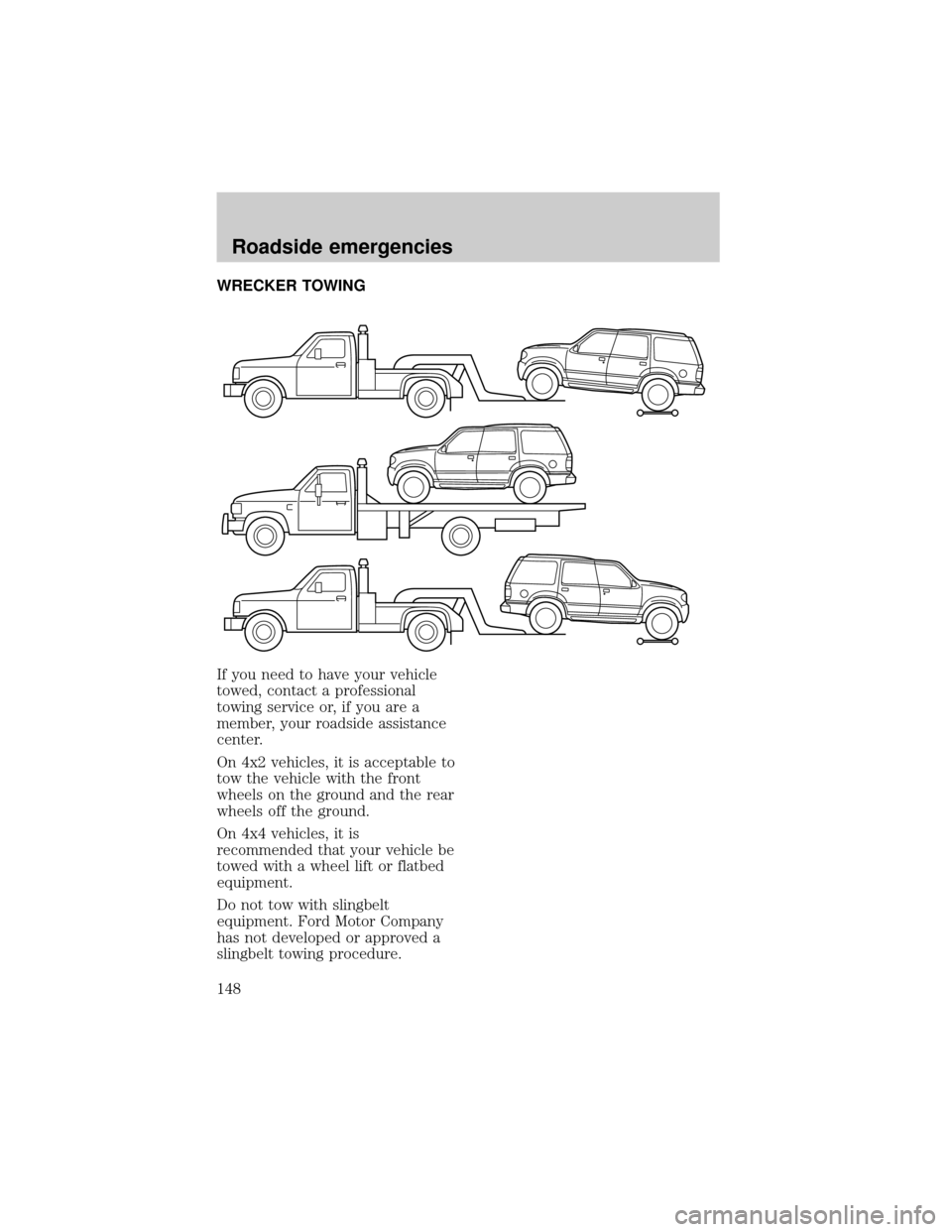
If you need to have your vehicle
towed, contact a professional
towing service or, if you are a
member, your roadside assistance
center.
On 4x2 vehicles, it is acceptable to
tow the vehicle with the front
wheels on the ground and the rear
wheels off the ground.
On 4x4 vehicles, it is
recommended that your vehicle be
towed with a wheel lift or flatbed
equipment.
Do not tow with slingbelt
equipment. Ford Motor Company
has not developed or approved a
slingbelt towing procedure.
Roadside emergencies
148
Page 197 of 216

To avoid scratching the lamps, do
not use a dry paper towel,
chemical solvents or abrasive
cleaners.
Cleaning the wiper blades
If the wiper blades do not wipe
properly, clean the windshield and
wiper blades with undiluted
windshield wiper solution or a mild
detergent. Rinse thoroughly with
clean water. To avoid damaging the
blades, do not use fuel, kerosene,
paint thinner or other solvents.
Cleaning the instrument panel
Clean with a damp cloth, then dry
with a dry cloth.
Avoid cleaner or polish that
increases the gloss of the upper
portion of the instrument panel.
The dull finish in this area helps
protect the driver from undesirable
windshield reflection.
Cleaning the interior fabric
Remove dust and loose dirt with a
whisk broom or a vacuum cleaner.
Remove fresh spots immediately.
Follow the directions that come
with the cleaner.
Cleaning and maintaining the
safety belts
Clean the safety belts with a mild
soap solution recommended for
cleaning upholstery or carpets. Do
not bleach or dye the belts,
because these actions may weaken
the belt webbing.
Maintenance and care
197
Page 198 of 216

Check the safety belt system
periodically to make sure there are
no nicks, wear or cuts. If your
vehicle has been involved in an
accident, refer to theSafety belt
maintenancesection in the
Seating and safety restraints
chapter.
Cleaning leather seats
For routine cleaning, wipe the
surface with a soft, damp cloth.
For more thorough cleaning, wipe
the surface with a leather and
vinyl cleaner or a mild soap.
The type of scrubbing pad is
very critical because the
common 3M ªScotch Briteº
green pad is too aggressive and
will damage the leather surface
²Spray a small amount of the
leather cleaner on the pad and
rub the area to be cleaned with
the pad using a circular motion.
Only clean 1/4 of the area at a
time. For heavily soiled areas,
spray the cleaner directly onto
the leather (two squirts should
be adequate) and rub with the
pad. Repeat if necessary.
²Use a soft, damp cloth to
remove the loosened dirt and
foam.
²Dry with a soft cloth.
Do not use household cleaners,
glass cleaner, alcohol solutions
or cleaner intended for vinyl,
rubber or plastics. These
Maintenance and care
198
Page 208 of 216

Aiming headlamps ....................193
Air bag supplemental restraint
system ..........................................78
and child safety seats ..............80
description ................................79
disposal ......................................83
indicator light ...........................82
passenger air bag .....................81
Air cleaner filter .......................170
Air conditioning
auxiliary heater and air
conditioner ................................29
manual heating and air
conditioning system ..23,24,26,28
Air suspension
description ..............................102
warning light .............................11
Ambulance packages ....................3
Anti-lock brake system (ABS)
description ................................99
Battery .......................................168
voltage gauge ............................16
Brake fluid
checking and adding ..............157
Brakes ..........................................98
anti-lock .....................................98
anti-lock brake system (ABS)
warning light .............................99
fluid, checking and adding ....157
Brake-shift interlock .................104
Break-in period .............................2
Bulbs, replacing ........................186
headlamps ...............................187
rear lamps ........................191,192
Changing a tire .........................138
Child safety seats ........................86
Childproof locks ..........................50
Chime
headlamps on ............................13
Cleaning your vehicle ...............194
engine compartment ..............195
fabric ........................................197instrument panel ....................197
plastic parts ............................196
safety belts ..............................197
tail lamps .................................196
washing ....................................194
waxing .....................................194
wheels ......................................195
Compass, electronic ....................42
calibration .................................44
set zone adjustment .................43
Control trac 4WD system .........108
Controls ..................................51,52
Daytime running light system ...20
Defrost
rear window ..............................22
Driving under special
conditions ..................................111
high water ...............................112
slippery roads ..................113,114
Electronic sound system ............52
Emission control system ..........183
Engine ........................................204
check engine temperature
warning, message center .......152
service points ..........................152
Engine block heater ...................96
Engine coolant
checking and adding .......158,159
disposal ....................................161
refill capacities ........................161
Engine oil ...........................153,155
changing oil and oil filter .......156
checking and adding .......153,155
Exhaust fumes ............................96
Fail safe cooling ........................162
Floor mats ...................................53
Foglamps ...................................190
Four-Wheel Drive vehicles
control trac ........................23,108
indicator light ...........................11
special driving
instructions ......................109,110
Index
208