Page 126 of 191
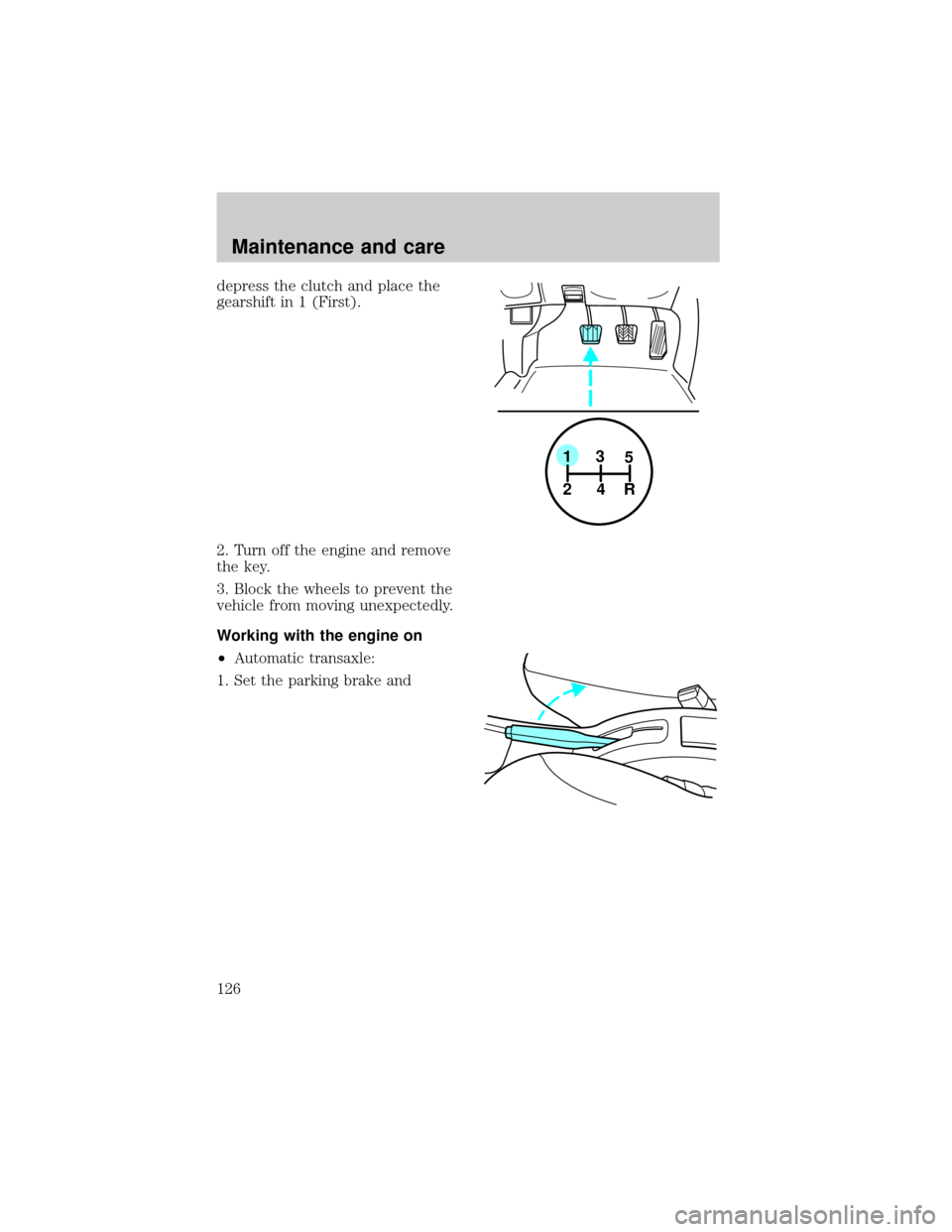
depress the clutch and place the
gearshift in 1 (First).
2. Turn off the engine and remove
the key.
3. Block the wheels to prevent the
vehicle from moving unexpectedly.
Working with the engine on
²Automatic transaxle:
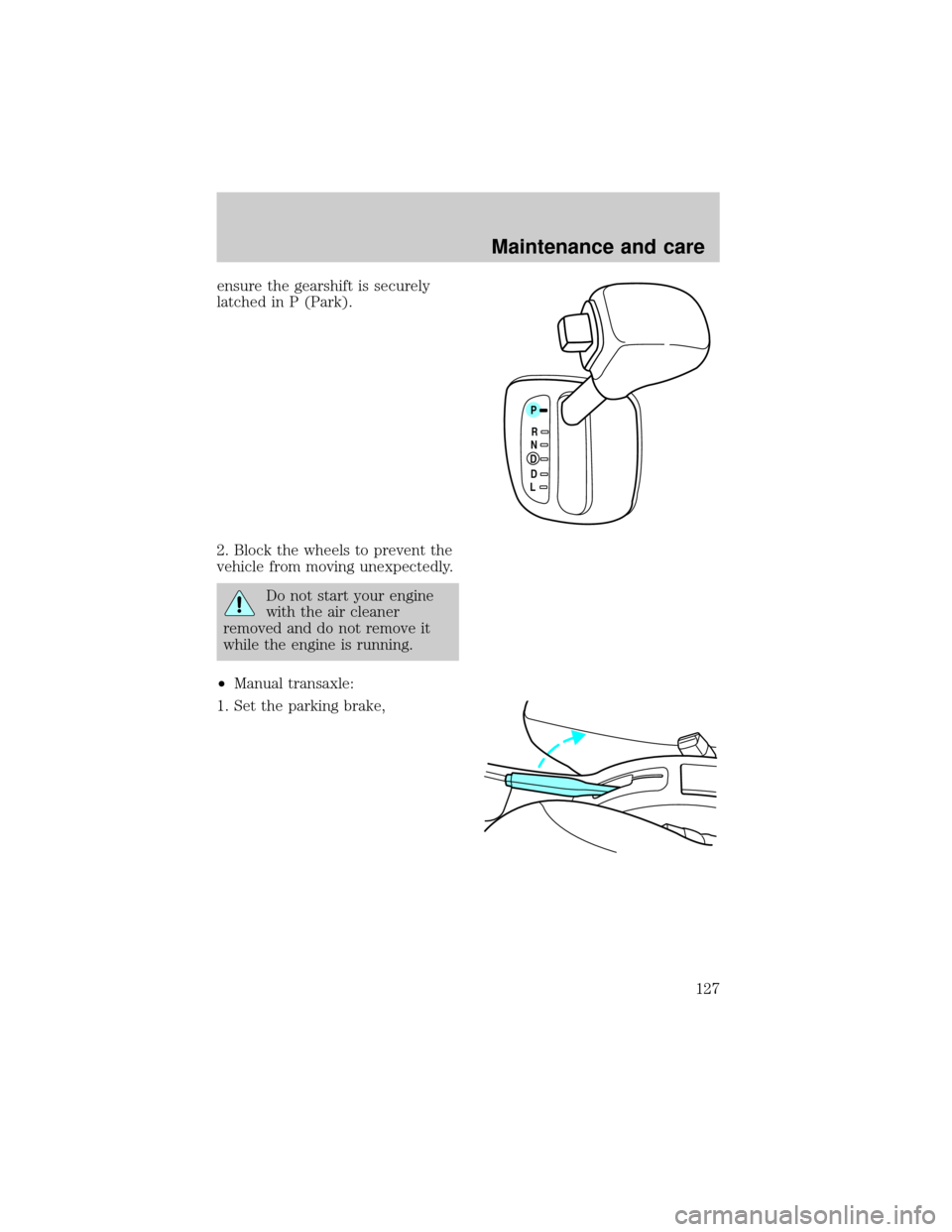
1. Set the parking brake and
1
24R3
5
Maintenance and care
126
Page 127 of 191
ensure the gearshift is securely
latched in P (Park).
2. Block the wheels to prevent the
vehicle from moving unexpectedly.
Do not start your engine
with the air cleaner
removed and do not remove it
while the engine is running.
²Manual transaxle:
1. Set the parking brake,
P
RNDDL
Maintenance and care
127
Page 128 of 191
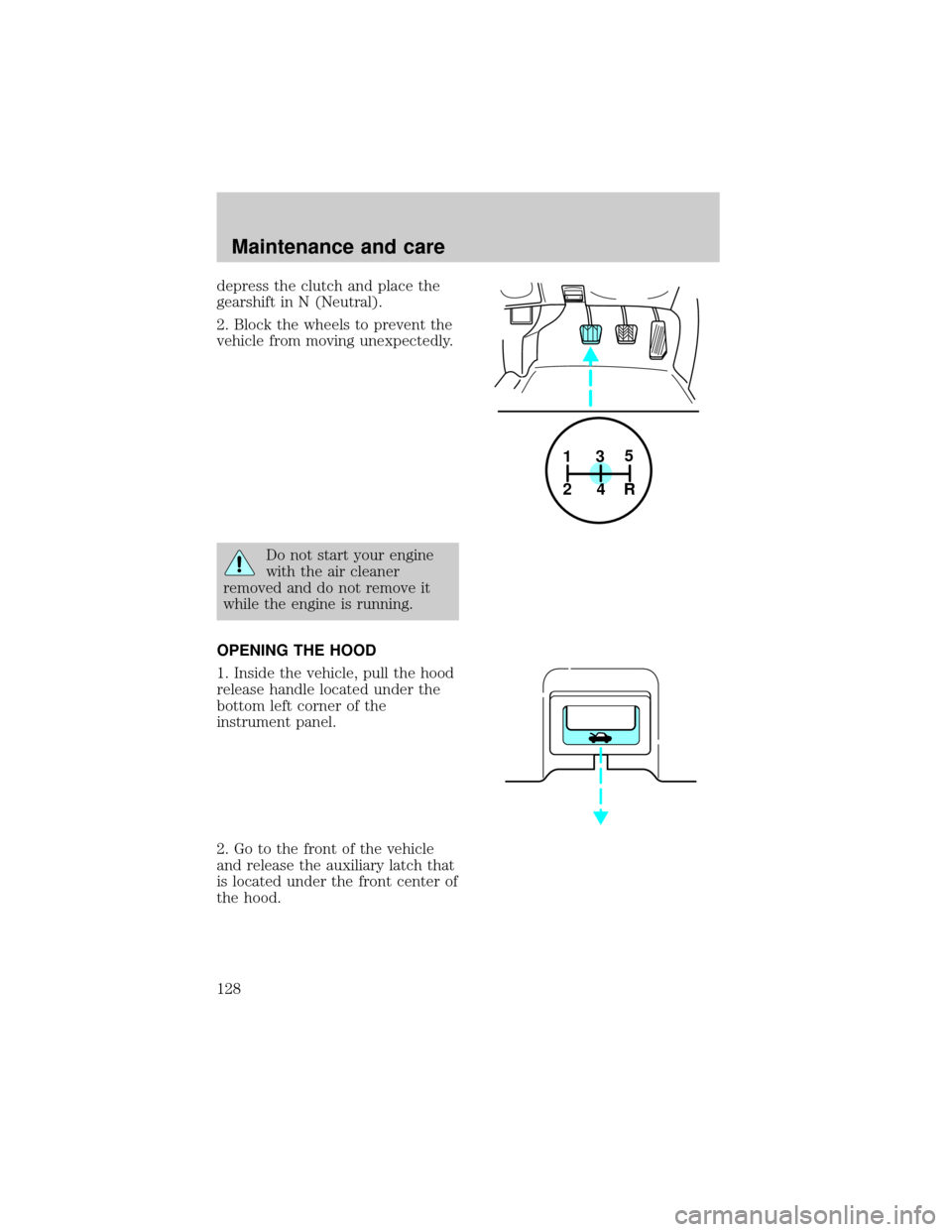
depress the clutch and place the
gearshift in N (Neutral).
2. Block the wheels to prevent the
vehicle from moving unexpectedly.
Do not start your engine
with the air cleaner
removed and do not remove it
while the engine is running.
OPENING THE HOOD
1. Inside the vehicle, pull the hood
release handle located under the
bottom left corner of the
instrument panel.
2. Go to the front of the vehicle
and release the auxiliary latch that
is located under the front center of
the hood.
1
24R35
Maintenance and care
128
Page 143 of 191
center of the NORMAL band).
2. While the engine idles, turn the
steering wheel left and right
several times.
3. Turn the engine off.
4. Check the fluid level in the
reservoir. It should be between the
MIN and MAX lines. Do not add
fluid if the level is in this range.
5. If the fluid is low, add fluid in
small amounts, continuously
checking the level until it reaches
the range between the MIN and
MAX lines. Be sure to put the cap
back on the reservoir.
TRANSMISSION FLUID
Checking and adding automatic
transmission fluid
Follow the scheduled service
intervals outlined in the ªService
Guide.º
Before adding any fluid, make sure
the correct type is used. The type
of fluid used is normally indicated
on the dipstick and/or dipstick
handle and also in theLubricant
specificationssection in the
Capacities and specifications
chapter.
Do not drive the vehicle if the fluid
level is below the hole at the
bottom of the dipstick and outside
temperatures are above 10ÉC
(50ÉF).
Your transaxle does not use up
fluid. However, it is recommended
that you check the transmission
Maintenance and care
143
Page 151 of 191
The traction grade
assigned to this tire is
based on braking (straight
ahead) traction tests and does
not include cornering (turning)
traction.
Temperature A B C
The temperature grades are A (the
highest), B, and C, representing
the tire's resistance to the
generation of heat and its ability to
dissipate heat when tested under
controlled conditions on a
specified indoor laboratory test
wheel. Sustained high temperature
can cause the material of the tire
to degenerate and reduce tire life,
and excessive temperature can
lead to sudden tire failure. The
grade C corresponds to a level of
performance which all passenger
car tires must meet under the
Federal Motor Vehicle Safety
Standard No. 109. Grades B and A
represent higher levels of
performance on the laboratory test
wheel than the minimum required
by law.
The temperature grade for
this tire is established for a
tire that is properly inflated and
not overloaded. Excessive speed,
underinflation, or excessive
loading, either separately or in
combination, can cause heat
buildup and possible tire failure.
Maintenance and care
151
Page 154 of 191
SNOW TIRES AND CHAINS
Snow tires must be the
same size and grade as the
tires you currently have on your
vehicle.
The tires on your vehicle have all
weather treads to provide traction
in rain and snow. However, in some
climates, you may need to use
snow tires and chains. If you need
to use snow tires and chains, you
must install steel wheels of the
same size and specifications as
those originally installed.
Follow these guidelines when using
snow tires and chains:
²Use only SAE Class S chains.
²Install chains securely, verifying
that the chains do not touch any
wiring, brake lines or fuel lines.
²Drive cautiously. If you hear the
chains rub or bang against your
vehicle, stop and re-tighten the
chains. If this does not work,
remove the chains to prevent
damage to your vehicle.
²If possible, avoid fully loading
your vehicle.
²Do not use tire chains on
aluminum wheels. Chains may
chip the wheels.
²Do not use tire chains with
38 cm (15 inch) wheel/tire
options. Using chains on this
size tire may cause damage to
steering, suspension and/or body
components.
Maintenance and care
154
Page 176 of 191

Use only carnauba or
synthetic-based waxes. Remove
any bugs and tar before waxing
vehicle. Use cleaning fluid or
alcohol with a clean cloth to
remove. Use tar remover to
remove any tar spots.
Repairing paint chips
Minor scratches or paint damage
from road debris may be repaired
with touch-up, paint repair foil or
aerosol paint spray from the Ford
accessory line. Observe the
application instructions on the
products.
Remove particles such as bird
droppings, tree sap, insect
remains, tar spots, road salt and
industrial fallout immediately.
Cleaning the wheels
Wash with the same detergent as
the body of your vehicle. Do not
use acid-based wheel cleaners,
steel wool, fuel or strong
detergents. Never use abrasives
that will damage the finish of
special wheel surfaces. Use a tar
remover to remove grease and tar.
Cleaning the engine
Engines are more efficient when
they are clean because grease and
dirt buildup keep the engine
warmer than normal. When
washing:
²Take care when using a power
washer to clean the engine. The
Maintenance and care
176
Page 183 of 191
Engine 2.0L-2V engine 2.0L-4V Zetec engine
Compression ratio 9.2:1 9.6:1
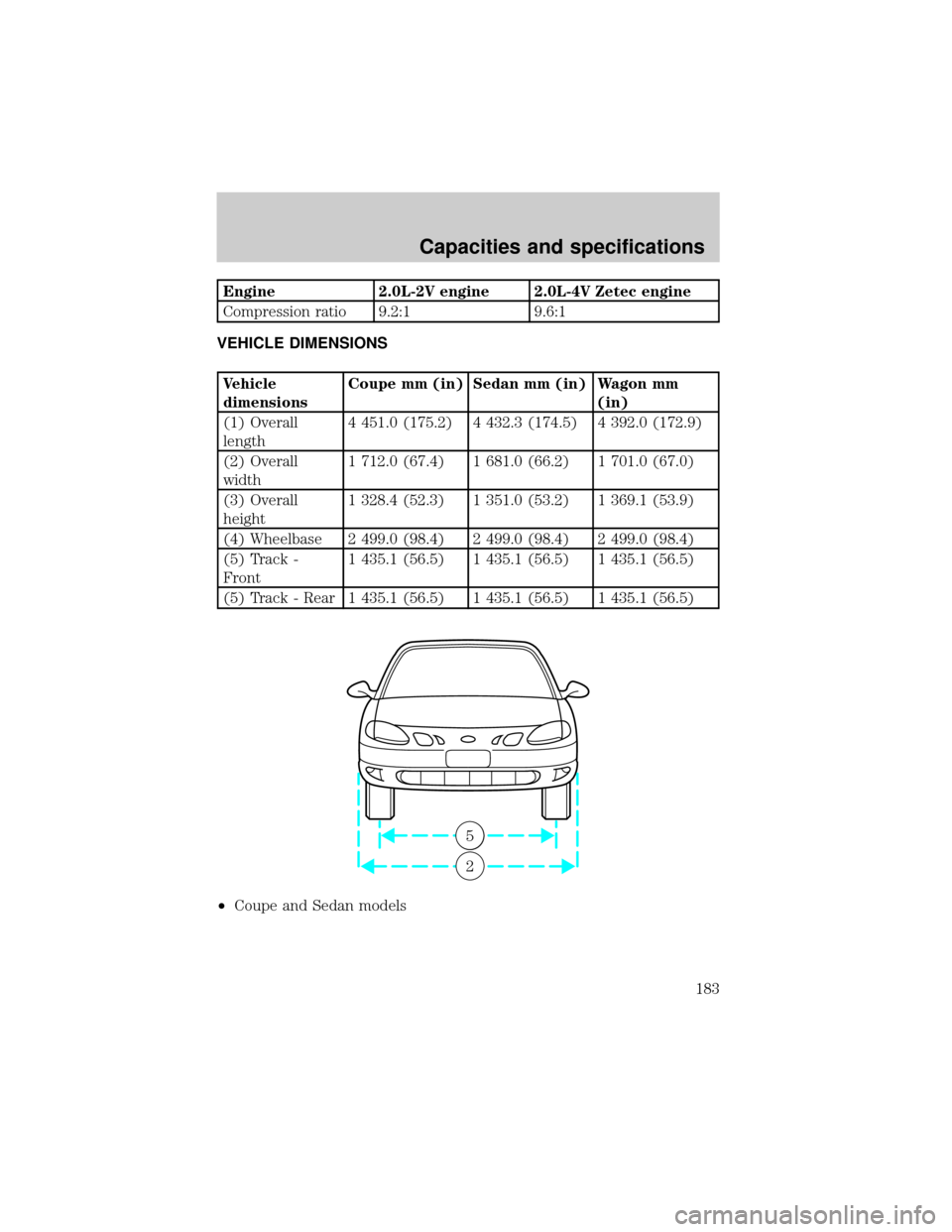
VEHICLE DIMENSIONS
Vehicle
dimensionsCoupe mm (in) Sedan mm (in) Wagon mm
(in)
(1) Overall
length4 451.0 (175.2) 4 432.3 (174.5) 4 392.0 (172.9)
(2) Overall
width1 712.0 (67.4) 1 681.0 (66.2) 1 701.0 (67.0)
(3) Overall
height1 328.4 (52.3) 1 351.0 (53.2) 1 369.1 (53.9)
(4) Wheelbase 2 499.0 (98.4) 2 499.0 (98.4) 2 499.0 (98.4)
(5) Track -
Front1 435.1 (56.5) 1 435.1 (56.5) 1 435.1 (56.5)
(5) Track - Rear 1 435.1 (56.5) 1 435.1 (56.5) 1 435.1 (56.5)
²Coupe and Sedan models
2
55
Capacities and specifications
183