1998 FORD CROWN VICTORIA service
[x] Cancel search: servicePage 133 of 160
Octane recommendations
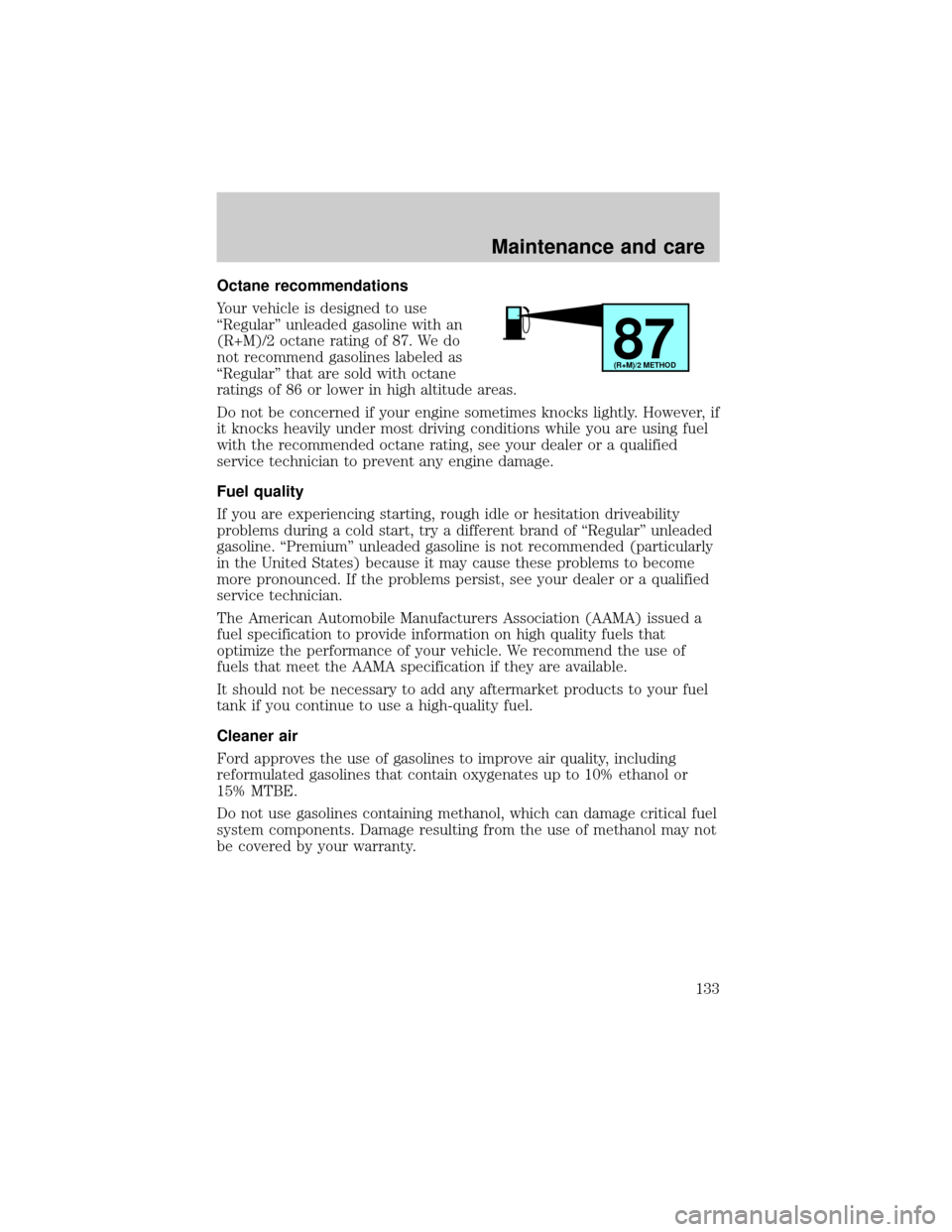
Your vehicle is designed to use
ªRegularº unleaded gasoline with an
(R+M)/2 octane rating of 87. We do
not recommend gasolines labeled as
ªRegularº that are sold with octane
ratings of 86 or lower in high altitude areas.
Do not be concerned if your engine sometimes knocks lightly. However, if
it knocks heavily under most driving conditions while you are using fuel
with the recommended octane rating, see your dealer or a qualified
service technician to prevent any engine damage.
Fuel quality
If you are experiencing starting, rough idle or hesitation driveability
problems during a cold start, try a different brand of ªRegularº unleaded
gasoline. ªPremiumº unleaded gasoline is not recommended (particularly
in the United States) because it may cause these problems to become
more pronounced. If the problems persist, see your dealer or a qualified
service technician.
The American Automobile Manufacturers Association (AAMA) issued a
fuel specification to provide information on high quality fuels that
optimize the performance of your vehicle. We recommend the use of
fuels that meet the AAMA specification if they are available.
It should not be necessary to add any aftermarket products to your fuel
tank if you continue to use a high-quality fuel.
Cleaner air
Ford approves the use of gasolines to improve air quality, including
reformulated gasolines that contain oxygenates up to 10% ethanol or
15% MTBE.
Do not use gasolines containing methanol, which can damage critical fuel
system components. Damage resulting from the use of methanol may not
be covered by your warranty.
87(R+M)/2 METHOD
Maintenance and care
133
Page 134 of 160
Running out of fuel
Avoid running out fuel because this situation may have an adverse affect
on powertrain components.
If you have run out of fuel:
²You may need to crank the engine several times before the system
starts to pump fuel from the tank to the engine.
²Your ªCheck Engineº light may come on. For more information on the
ªCheck Engineº light, refer to theInstrumentationchapter.
Calculating fuel economy
To accurately calculate your vehicle's fuel economy:
1. Fill the tank completely and record the initial odometer reading.
2. Each time you fill the tank, record the amount of fuel added (in liters
or gallons).
3. After at least three to five fuel tank fill-ups, fill the fuel tank and
record the current mileage reading.
4. Use one of the following equations to calculate fuel economy.
Liters used x 1004Total kilometers traveled
Total miles traveled4Total gallons used
Keep a record for at least one month. This will provide an accurate
estimate of the vehicle's fuel economy.
EMISSION CONTROL SYSTEM
Your vehicle is equipped with various emission control components and a
catalytic converter which will enable your vehicle to comply with
applicable exhaust emission standards. To make sure that the catalytic
converter and other emission control components continue to work
properly:
²Use only unleaded fuel.
²Avoid running out of fuel.
²Do not turn off the ignition while your vehicle is moving, especially at
high speeds.
²Have the items listed in your ªService Guideº performed according to
the specified schedule.
Maintenance and care
134
Page 135 of 160
The scheduled maintenance items listed in the ªService Guideº are
essential to the life and performance of your vehicle and to its emissions
system.
If other than Ford, Motorcraft or Ford-authorized parts are used for
maintenance replacements or for service of components affecting
emission control, such non-Ford parts should be equivalent to genuine
Ford Motor Company parts in performance and durability.
Do not park, idle, or drive your vehicle in dry grass or other dry
ground cover. The emission system heats up the engine
compartment and exhaust system, which can start a fire.
Lumination of the charging system warning light, ªCheck Engineº light or
the temperature warning light, fluid leaks, strange odors, smoke or loss
of oil pressure, could indicate that the emission control system is not
working properly.
If you smell exhaust fumes of any kind inside your vehicle, have
the dealer inspect and fix your vehicle immediately. Do not drive
if you smell exhaust fumes. These fumes are harmful and could kill
you.
Do not make any unauthorized changes to your vehicle or engine. By
law, vehicle owners and anyone who manufactures, repairs, items, sells,
leases, trades vehicles, or supervises a fleet of vehicles are not permitted
to intentionally remove an emission control device or prevent it from
working. Information about your vehicle's emission system is on the
Vehicle Emission Control Information Decal located on or near the
engine. This decal identifies engine displacement and gives some tune up
specifications.
Please consult your ªWarranty Guideº for complete emission warranty
information.
Readiness for inspection/maintenance (I/M) testing
In some localities, it may be a legal requirement to pass an I/M test of
the on-board diagnostic (OBD-II) system. If your ªCheck Engine/Service
Engine Soonº light is on, refer to the description in theWarning Lights
and Chimessection of theInstrumentationchapter. Your vehicle may
not pass the I/M test with the ªCheck Engine/Service Engine Soonº light
on.
Maintenance and care
135
Page 136 of 160
If the vehicle's powertrain system or its battery has just been serviced,
the OBD-II system is reset to a ªnot ready for I/M testº condition. To
ready the OBD-II system for I/M testing, a minimum of 30 minutes of city
and highway driving is necessary as described below:
²First, at least 10 minutes of driving on an expressway or highway.
²Next, at least 20 minutes driving in stop-and-go, city-type traffic with
at least four idle periods.
Allow the vehicle to sit for at least eight hours without starting the
engine. Then, start the engine and complete the above driving cycle. The
engine must warm up to its normal operating temperature. Once started,
do not turn off the engine until the above driving cycle is complete.
EXTERIOR BULBS
Replacing exterior bulbs
Check the operation of the following lamps frequently:
²Headlamps
²Tail lamps
²Brakelamps
²High-mount brakelamp
²Turn signals
²Backup lamps
²License plate lamp
Do not remove lamp bulbs unless they will be replaced immediately. If a
bulb is removed for an extended period of time, contaminants may enter
the lamp housings and affect performance.
Replacing headlamp bulbs
Handle a halogen headlamp bulb carefully and keep out of
children's reach. Grasp the bulb only by its plastic base and do
not touch the glass. The oil from your hand could cause the bulb to
break the next time the headlamps are operated.
To remove the headlamp bulb:
1. Make sure headlamp switch is in OFF position, then open the hood.
Maintenance and care
136
Page 138 of 160
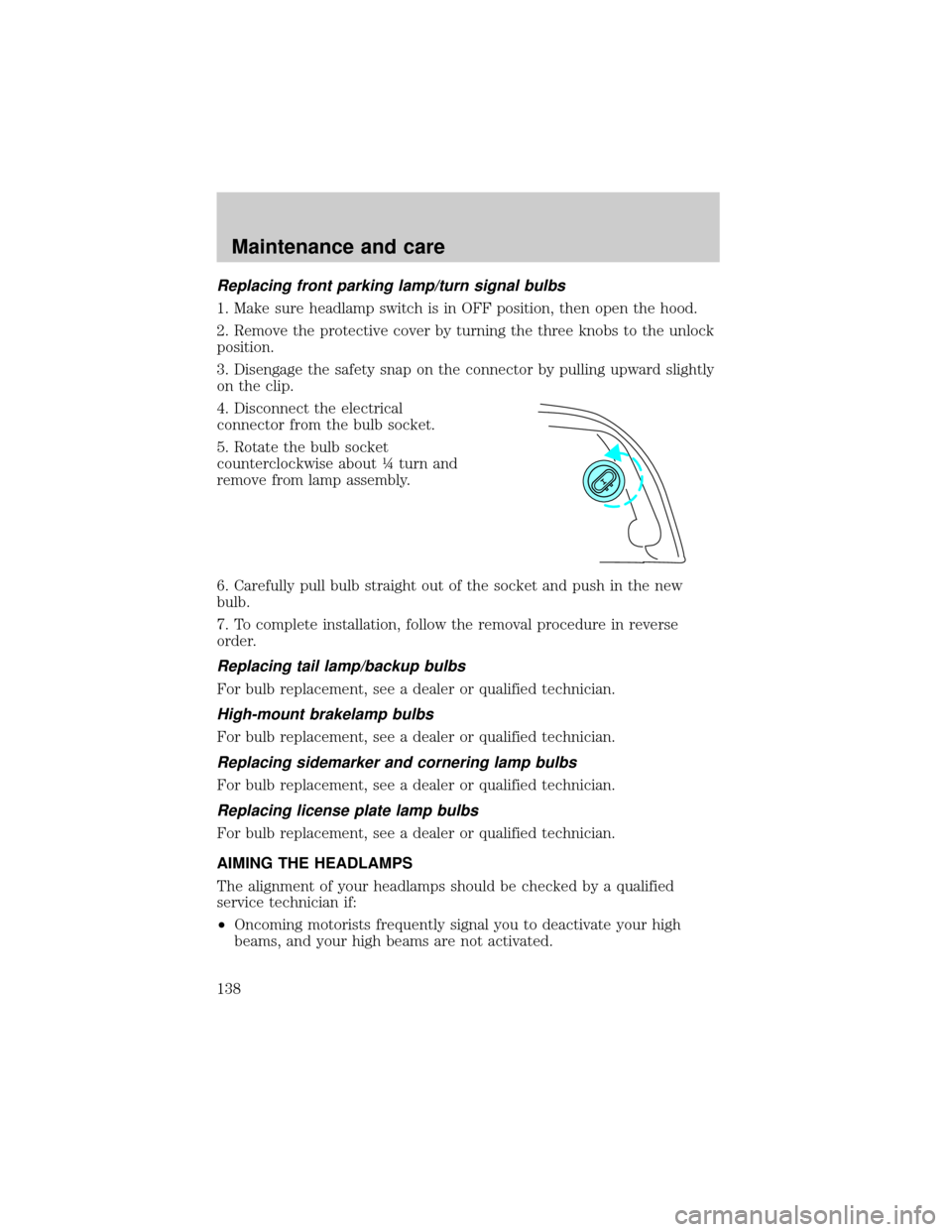
Replacing front parking lamp/turn signal bulbs
1. Make sure headlamp switch is in OFF position, then open the hood.
2. Remove the protective cover by turning the three knobs to the unlock
position.
3. Disengage the safety snap on the connector by pulling upward slightly
on the clip.
4. Disconnect the electrical
connector from the bulb socket.
5. Rotate the bulb socket
counterclockwise about ò turn and
remove from lamp assembly.
6. Carefully pull bulb straight out of the socket and push in the new
bulb.
7. To complete installation, follow the removal procedure in reverse
order.
Replacing tail lamp/backup bulbs
For bulb replacement, see a dealer or qualified technician.
High-mount brakelamp bulbs
For bulb replacement, see a dealer or qualified technician.
Replacing sidemarker and cornering lamp bulbs
For bulb replacement, see a dealer or qualified technician.
Replacing license plate lamp bulbs
For bulb replacement, see a dealer or qualified technician.
AIMING THE HEADLAMPS
The alignment of your headlamps should be checked by a qualified
service technician if:
²Oncoming motorists frequently signal you to deactivate your high
beams, and your high beams are not activated.
Maintenance and care
138
Page 145 of 160
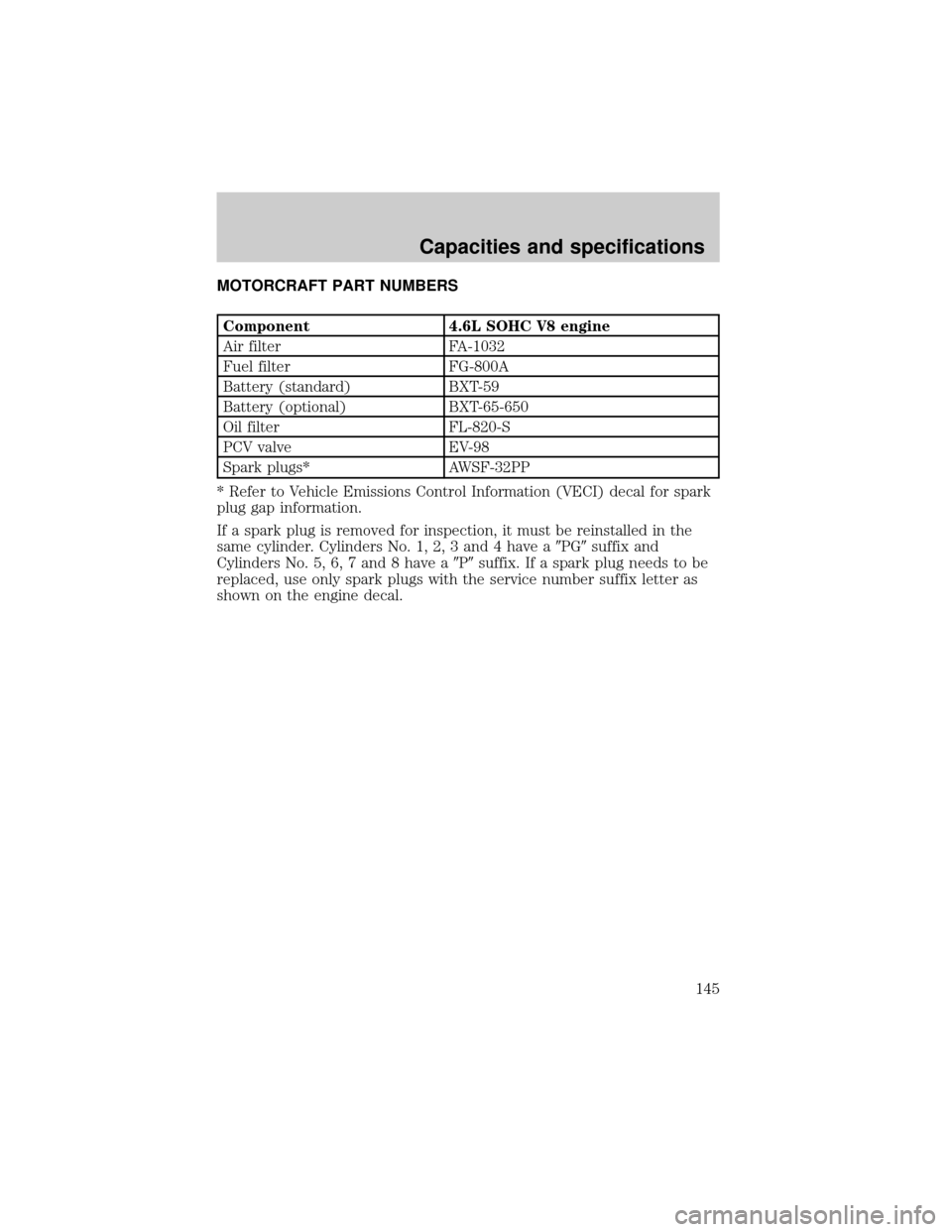
MOTORCRAFT PART NUMBERS
Component 4.6L SOHC V8 engine
Air filter FA-1032
Fuel filter FG-800A
Battery (standard) BXT-59
Battery (optional) BXT-65-650
Oil filter FL-820-S
PCV valve EV-98
Spark plugs* AWSF-32PP
* Refer to Vehicle Emissions Control Information (VECI) decal for spark
plug gap information.
If a spark plug is removed for inspection, it must be reinstalled in the
same cylinder. Cylinders No. 1, 2, 3 and 4 have a9PG9suffix and
Cylinders No. 5, 6, 7 and 8 have a9P9suffix. If a spark plug needs to be
replaced, use only spark plugs with the service number suffix letter as
shown on the engine decal.
Capacities and specifications
145
Page 146 of 160

REFILL CAPACITIES
Fluid Ford Part Name Capacity
Engine oil (includes
filter change)Motorcraft 5W30 Super
Premium Motor Oil4.7L (5.0 quarts)
Brake fluid High Performance DOT 3
Motor Vehicle Brake FluidFill to line on
reservoir
Power steering fluid Motorcraft MERCONtATF Fill to line on
reservoir
Transmission fluid Motorcraft MERCONtV
AT F13.1L (13.9 quarts)
Engine coolant
115.0L (15.8 quarts)
Fuel tank N/A 71.9L (19.0 gallons)
Rear axle fluid
2Motorcraft SAE 80W90
Rear Axle Lubricant1.8-1.9L (3.75-4.0
pints)
Windshield washer
fluidUltra-Clear Windshield
Washer ConcentrateFill to line on
reservoir
1If your engine coolant is green in color, use Ford Premium Cooling
System Fluid. If your coolant is orange in color, use Ford Extended Life
Engine Coolant. Refer toLubricant Specifications.
2Add 118 ml (4 oz.) of additive friction modifier C8AZ-19B546±A, Ford
specification EST-M2C118±A for complete refill of Traction-Lok axles.
Service refill capacities are determined by filling the rear axle 6 mm to
14 mm (1/4 inch to 9/16 inch) below the bottom of the filler hole.
Rear axles are considered lubricated for life when the vehicle is used for
normal service. See your ªService Guideº for Severe Duty requirements.
Capacities and specifications
146
Page 152 of 160

Aiming headlamps ....................138
Air bag supplemental restraint
system ..........................................68
and child safety seats ..............69
description ................................68
disposal ......................................72
indicator light ...........................71
passenger air bag .....................70
Air conditioning
manual heating and air
conditioning system ............25,26
Air suspension
description ................................87
Anti-lock brake system
(ABS)description
Battery .......................................124
voltage gauge ............................16
Brake fluid
checking and adding ..............114
Brakes ..........................................83
anti-lock .....................................83
anti-lock brake system (ABS)
warning light .............................84
fluid, checking and adding ....114
traction control .........................85
Brake-shift interlock ...................88
Break-in period .............................2
Bulbs, replacing ........................136
headlamps ...............................136
specifications ..........................139
Changing a tire .........................101
Child safety seats ........................73
Childproof locks ..........................48
Chime
headlamps on ............................12
Cleaning your vehicle ...............140
engine compartment .......141,142
exterior ....................................143
headlamps ...............................142
plastic parts ............................142
washing ....................................140
waxing .....................................140wheels ......................................141
windows ..................................144
wiper blades ............................142
Climate control system
automatic temperature
control ...................27,28,29,30,32
Clock ............................................33
Compass, electronic ....................43
calibration .................................45
set zone adjustment .................44
Coolant (see Engine coolant)
temperature gauge ...................15
Defrost
rear window ..............................24
Emission control system ..........134
Engine
service points ..........................111
Engine block heater ...................81
Engine coolant
checking and adding ..............116
disposal ....................................117
refill capacities ........................118
Engine oil ...........................112,113
changing oil and oil filter .......114
checking and adding .......112,113
Exhaust fumes ............................82
Floor mats ...................................48
Fuel
calculating fuel economy .......134
improving fuel economy ..........94
octane rating ...........................133
quality ......................................133
running out of fuel .................134
safety information relating to
automotive fuels .....................131
Fuel pump shut-off switch .........95
Fuse panels
instrument panel ......................97
power distribution box .............99
Fuses .......................................96,97
Gauges, Mechanical ....................12
fuel gauge ..................................12
Index
152