1998 FORD CROWN VICTORIA hood release
[x] Cancel search: hood releasePage 84 of 160
ABS warning lamp
The
ABSwarning lamp in the instrument cluster illuminates for about
five seconds when starting the vehicle. If an ABS fault is detected, the
light will remain on, the ABS system is disabled with normal braking still
effective, and your vehicle should be serviced as soon as possible.
Normal braking is still effective
unless the BRAKE warning lamp is
also illuminated.
Using ABS
²In an emergency or when maximum efficiency from the ABS is
required, apply continuous full force on the brake. The ABS will be
activated immediately, thus allowing you to retain full steering control
of your vehicle and, providing there is sufficient space, will enable you
to avoid obstacles and bring the vehicle to a controlled stop.
²The Anti-Lock system does not decrease the time necessary to apply
the brakes or always reduce stopping distance. Always leave enough
room between your vehicle and the vehicle in front of you to stop.
²We recommend that you familiarize yourself with this braking
technique. However, avoid taking any unnecessary risks.
Parking brake with auto-release
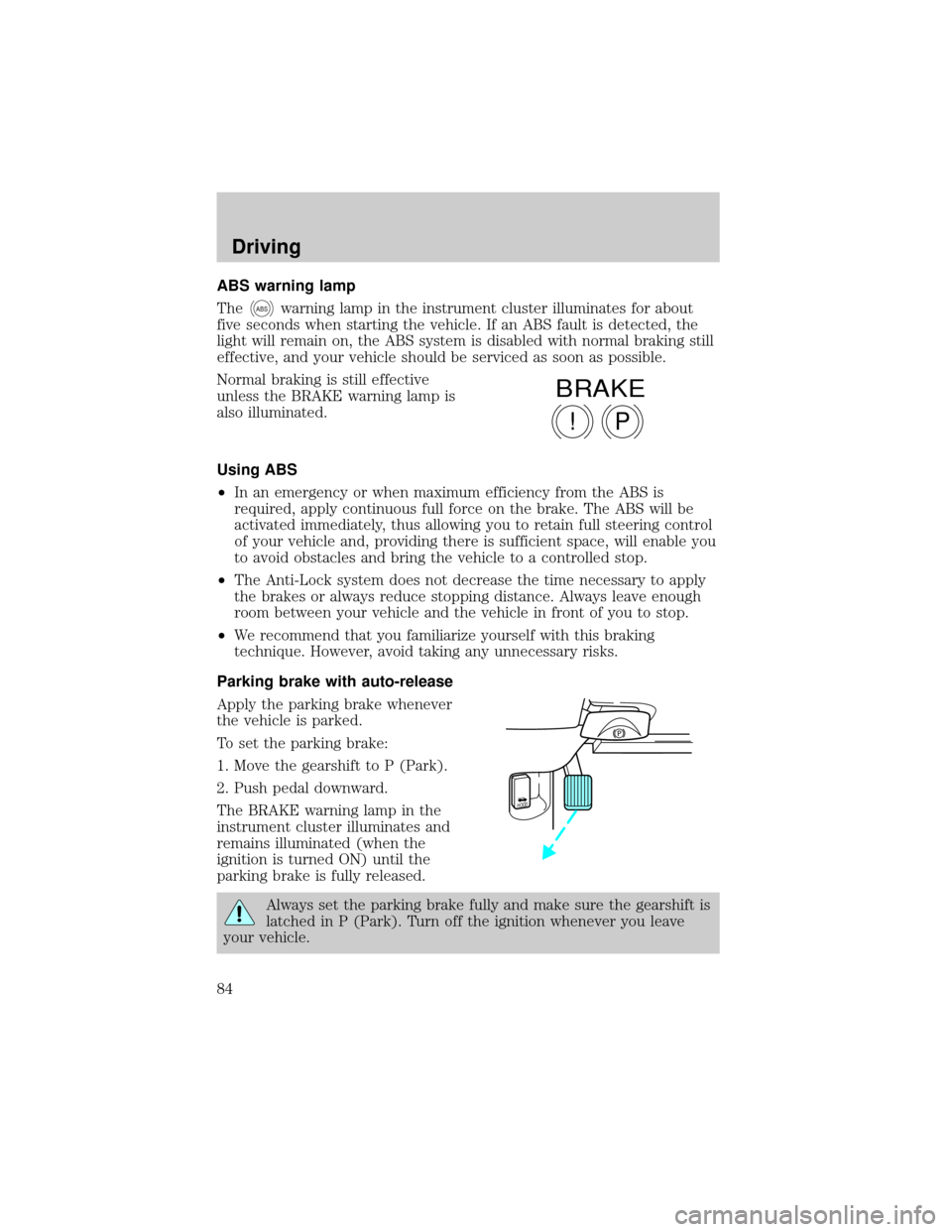
Apply the parking brake whenever
the vehicle is parked.
To set the parking brake:
1. Move the gearshift to P (Park).
2. Push pedal downward.
The BRAKE warning lamp in the
instrument cluster illuminates and
remains illuminated (when the
ignition is turned ON) until the
parking brake is fully released.
Always set the parking brake fully and make sure the gearshift is
latched in P (Park). Turn off the ignition whenever you leave
your vehicle.
P!
BRAKE
HOOD
Driving
84
Page 85 of 160
The parking brake is not designed to stop a moving vehicle. However, if
the normal brakes fail, the parking brake can be used to stop your
vehicle in an emergency. Since the parking brake applies only the rear
brakes, the vehicle's stopping distance will increase greatly and the
handling of your vehicle will be adversely affected.
Your vehicle has an automatic parking brake release. To release the
parking brake:
1. Turn the ignition to the RUN position.
2. Press the brake pedal.
3. Move the gearshift from the P (Park) position to one of the forward
gears (the parking brake will not release automatically when you shift
into reverse). The brake pedal must remain pressed while the gearshift is
moved.
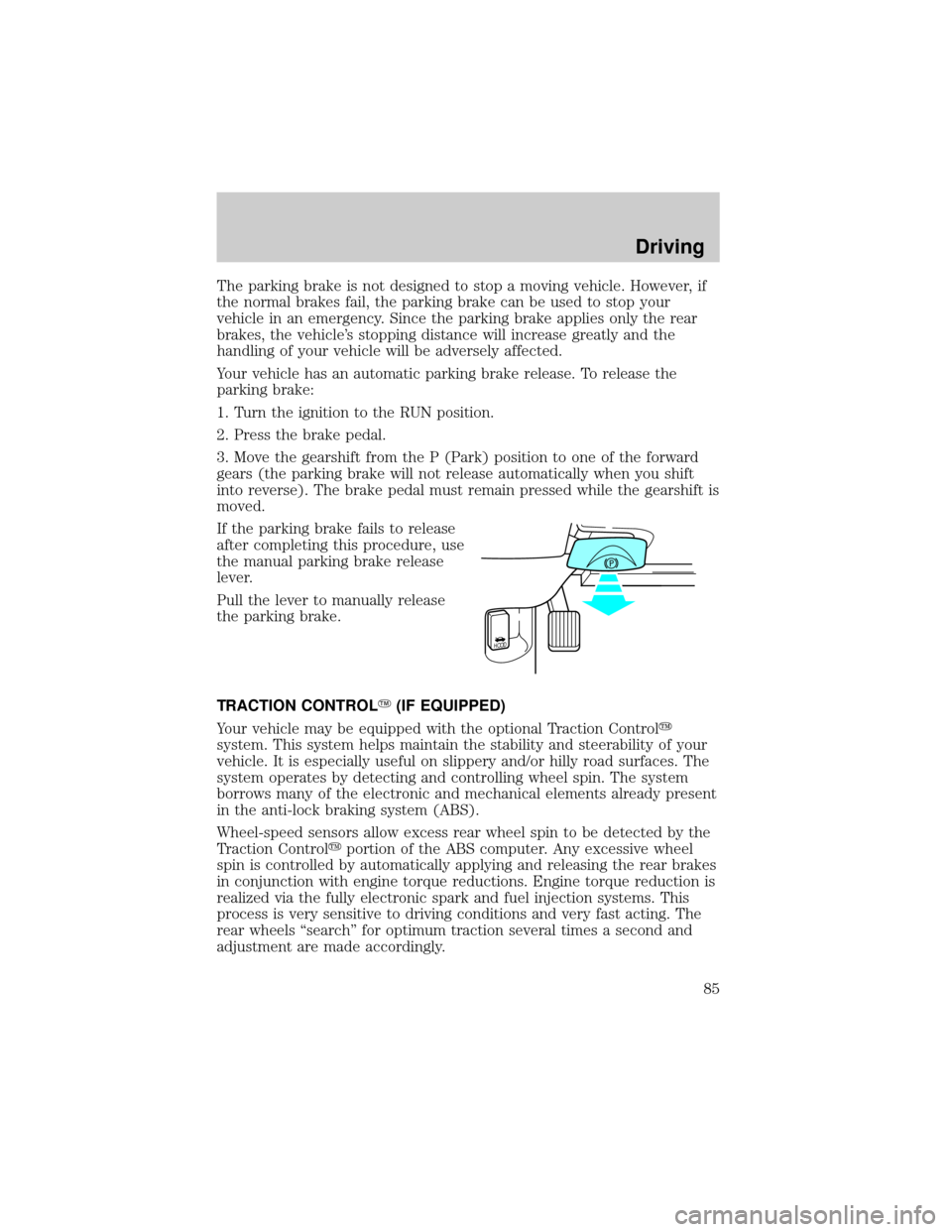
If the parking brake fails to release
after completing this procedure, use
the manual parking brake release
lever.
Pull the lever to manually release
the parking brake.
TRACTION CONTROLY(IF EQUIPPED)
Your vehicle may be equipped with the optional Traction Controly
system. This system helps maintain the stability and steerability of your
vehicle. It is especially useful on slippery and/or hilly road surfaces. The
system operates by detecting and controlling wheel spin. The system
borrows many of the electronic and mechanical elements already present
in the anti-lock braking system (ABS).
Wheel-speed sensors allow excess rear wheel spin to be detected by the
Traction Controlyportion of the ABS computer. Any excessive wheel
spin is controlled by automatically applying and releasing the rear brakes
in conjunction with engine torque reductions. Engine torque reduction is
realized via the fully electronic spark and fuel injection systems. This
process is very sensitive to driving conditions and very fast acting. The
rear wheels ªsearchº for optimum traction several times a second and
adjustment are made accordingly.
HOOD
Driving
85
Page 110 of 160
Working with the engine on
1. Set the parking brake and ensure the gearshift is securely latched in
P (Park).
2. Block the wheels to prevent the vehicle from moving unexpectedly.
Do not start your engine with the air cleaner removed and do
not remove it while the engine is running.
OPENING THE HOOD
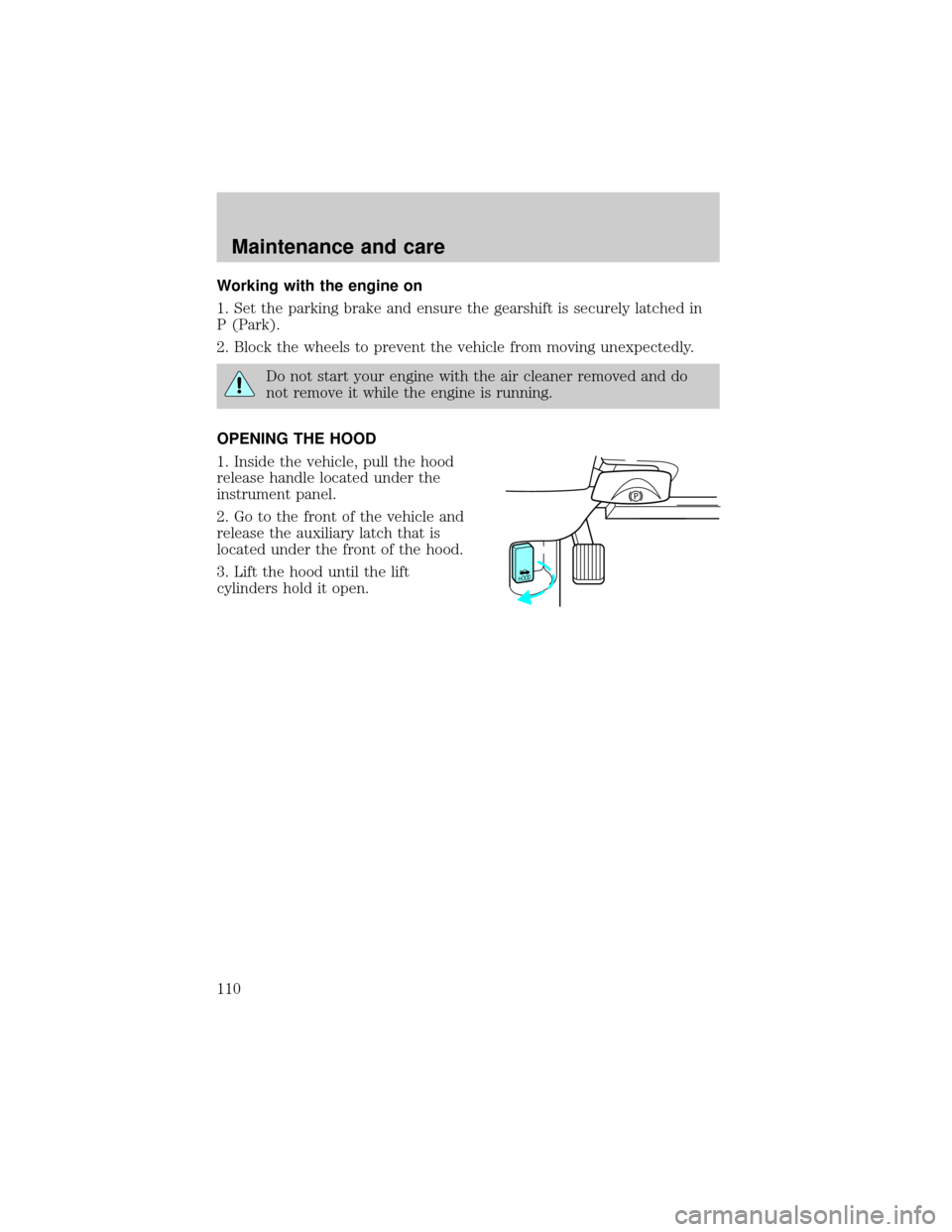
1. Inside the vehicle, pull the hood
release handle located under the
instrument panel.
2. Go to the front of the vehicle and
release the auxiliary latch that is
located under the front of the hood.
3. Lift the hood until the lift
cylinders hold it open.
HOOD
Maintenance and care
110
Page 153 of 160

Hazard flashers ...........................95
Headlamps ...................................23
autolamp system .......................24
daytime running lights .............24
flashing ......................................23
high beam .................................23
Heating ........................................25
High beams
indicator light .............................9
Hood
release lever ............................110
Ignition
positions of the ignition ...........35
Instrument panel
cleaning ...................................143
lighting up panel and interior .23
Keyless entry system
autolock .....................................50
keypad .......................................55
programming entry code ....56,57
Keys
key in ignition chime ...............11
Lamps
headlamps ...............................136
high-mount brakelamp ...........138
interior lamps .........................139
parking lamps .........................138
tail lamps .................................138
License plate lamps ..................138
Lights, warning and indicator
air bag ..........................................8
air suspension ...........................10
anti-lock brakes (ABS) .........9,22
brake .......................................8,22
charging system ..........................9
check engine ...............................7
fuel reset .....................................6
low coolant ................................10
oil pressure ...............................10
overdrive off ..............................11
safety belt ...................................8
turn signal indicator ...................9Lubricant specifications ...........147
Message center ...........................17
reset button .........................17,18
select button .............................18
Mirrors
automatic dimming rearview
mirror ........................................42
side view mirrors (power) .......47
Motorcraft parts ........................145
Odometer .....................................14
Panic alarm feature, remote
entry system ................................51
Parking brake ..............................84
Power door locks ........................47
Power steering
fluid, checking and adding ....121
Radio ............................................33
Refill capacities for fluids ........146
Relays ...................................96,101
Remote entry system .................48
illuminated entry ......................51
locking/unlocking doors ...........49
replacement/additional
transmitters ...............................53
replacing the batteries .............52
Reporting safety defects ..........151
Safety restraints
center front lap belt .................65
cleaning the safety belts ........143
extension assembly ..................66
for children ...............................72
warning light and
chime ...............................11,66,67
Safety seats for children
attaching with tether straps ....77
in rear seat ................................77
tether anchorage hardware .....77
Seat belts (see Safety
restraints) ....................................61
Seats ............................................58
adjusting the seat, manual ..58,59
adjusting the seat, power ...59,61
Index
153
Page 160 of 160

Recommended fuel Unleaded fuel only - 87 octane
Fuel tank capacity 71.9L (19.0 gallons)
Engine oil capacity
(includes filter change)4.7L (5.0 quarts). Use Motorcraft 5W30
Super Premium Motor Oil, Ford Specification
WSS-M2C153-G.
Automatic transmission
fluid capacity13.1L (13.9 quarts). Use Motorcraft
MERCONtV ATF.
Tire pressure and size Refer to Tire Pressure Label located on the
front face of the rear passenger door jamb.
Hood release Pull handle under the left side of the
instrument panel.
Coolant capacity
115.0L (15.8 quarts)
Power steering fluid
capacityFill to line on reservoir. Use Motorcraft
MERCONtAT F.
1If your engine coolant is green in color, use Ford Premium Cooling
System Fluid. If your engine coolant is orange in color, use Ford
Extended Life Engine Coolant. Refer toLubricant Specifications.
Ensure correct automatic transmission fluid is used for a specific
application. Check the container to verify the fluid is MERCONtand/or
MERCONtV approved. Some fluids have been approved as meeting both
MERCONtand MERCONtV requirements and will be labeled as such.
Fluids labeled as meeting only MERCONtor only MERCONtV
requirements must not be used interchangeably. DO NOT mix MERCONt
and MERCONtV. Transmission fluid requirements are indicated on the
dipstick or on the dipstick handle. Refer to your ªService Guideº to
determine the correct service interval.
Filling station information
160