Page 97 of 200
Driving
97 22
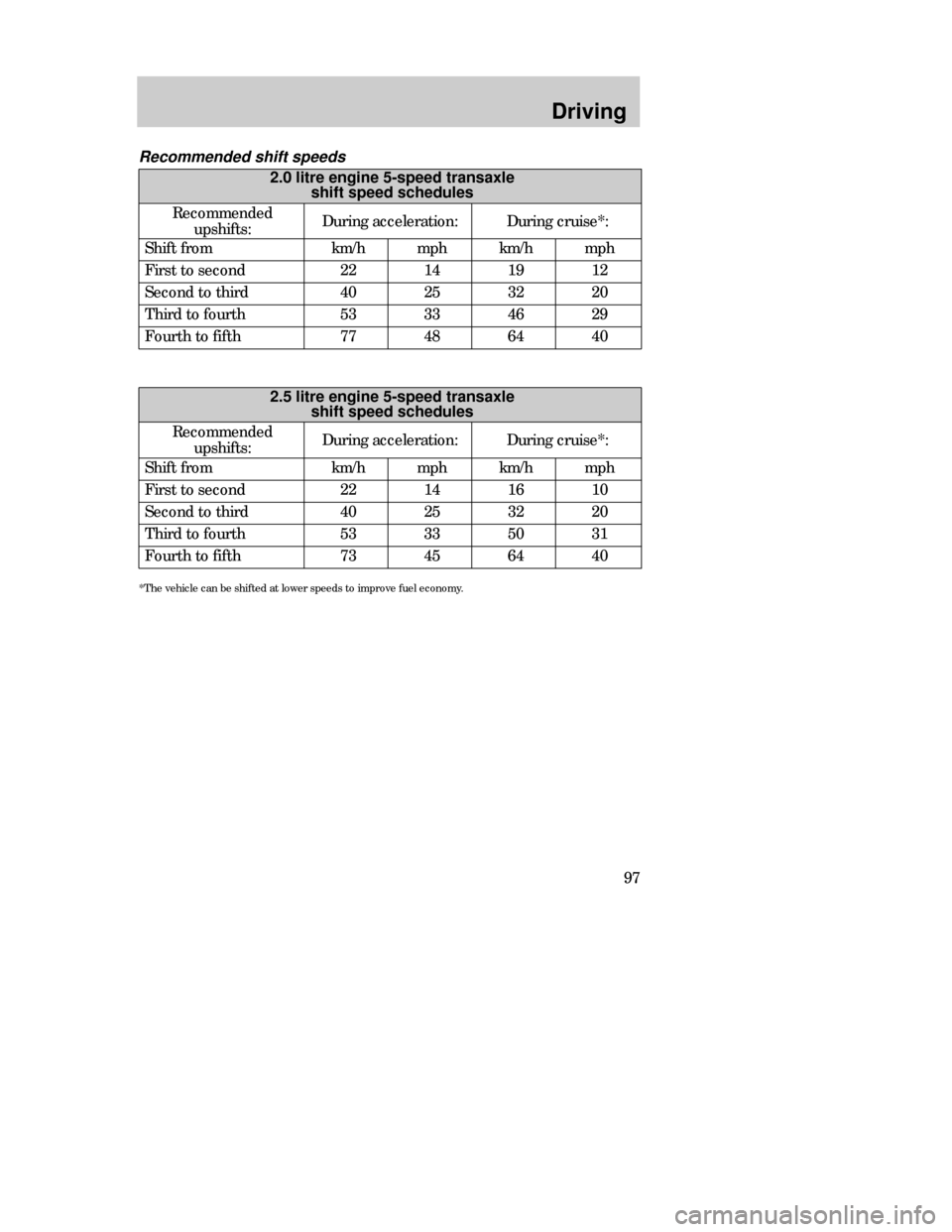
Recommended shift speeds
2.0 litre engine 5-speed transaxle
shift speed schedules
Recommended
upshifts:
Shift fromkm/hmph
14
25
33
48
40
53
77mph
12
20
29
40
km/h
19
32
64 First to second
Second to third
Third to fourth
Fourth to fifthDuring acceleration:During cruise*:
46
2.5 litre engine 5-speed transaxle
shift speed schedules
km/h
mphkm/hmph
10
20
31
40 16
32
50
64
14
25
33
4522
40
53
73
Shift from
First to second
Second to third
Third to fourth
Fourth to fifth
Recommended
upshifts:During acceleration:During cruise*:
*The vehicle can be shifted at lower speeds to improve fuel economy.
CDW IVB1-10Driving en C 5/15/97 8:52 PM Page 97
Page 101 of 200
Driving
101 Payload = GVWRminus Base
curb weight
To obtain the correct weight for
your vehicle, try taking your
vehicle to a shipping company or
an inspection station for trucks.
Do not use replacement tires with
lower weight capacities than the
originals because they might lower
the vehicle’s GVWR and GAWR.
(Replacement tires with a higher
weight limit than the originals do
not increase the GVWR and GAWR
limitations.)
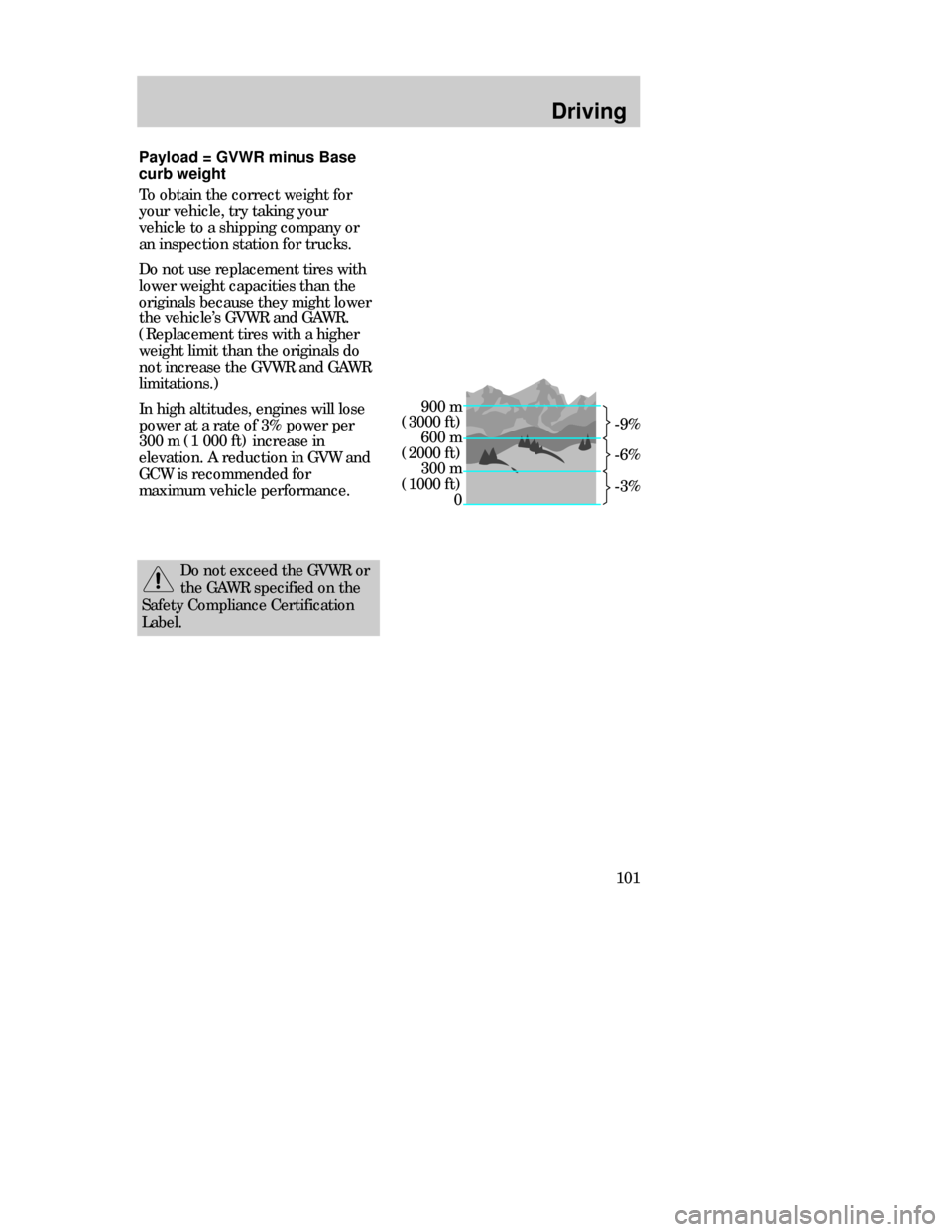
In high altitudes, engines will lose
power at a rate of 3% power per
300 m (1000 ft) increase in
elevation. A reduction in GVW and
GCW is recommended for
maximum vehicle performance.
-9%
-6%
-3% 900 m
(3000 ft)
600 m
(2000 ft)
300 m
(1000 ft)
0
Do not exceed the GVWR or
the GAWR specified on the
Safety Compliance Certification
Label.
CDW IVB1-10Driving en C 5/15/97 8:52 PM Page 101
Page 103 of 200
Driving
103 TRAILER TOWING
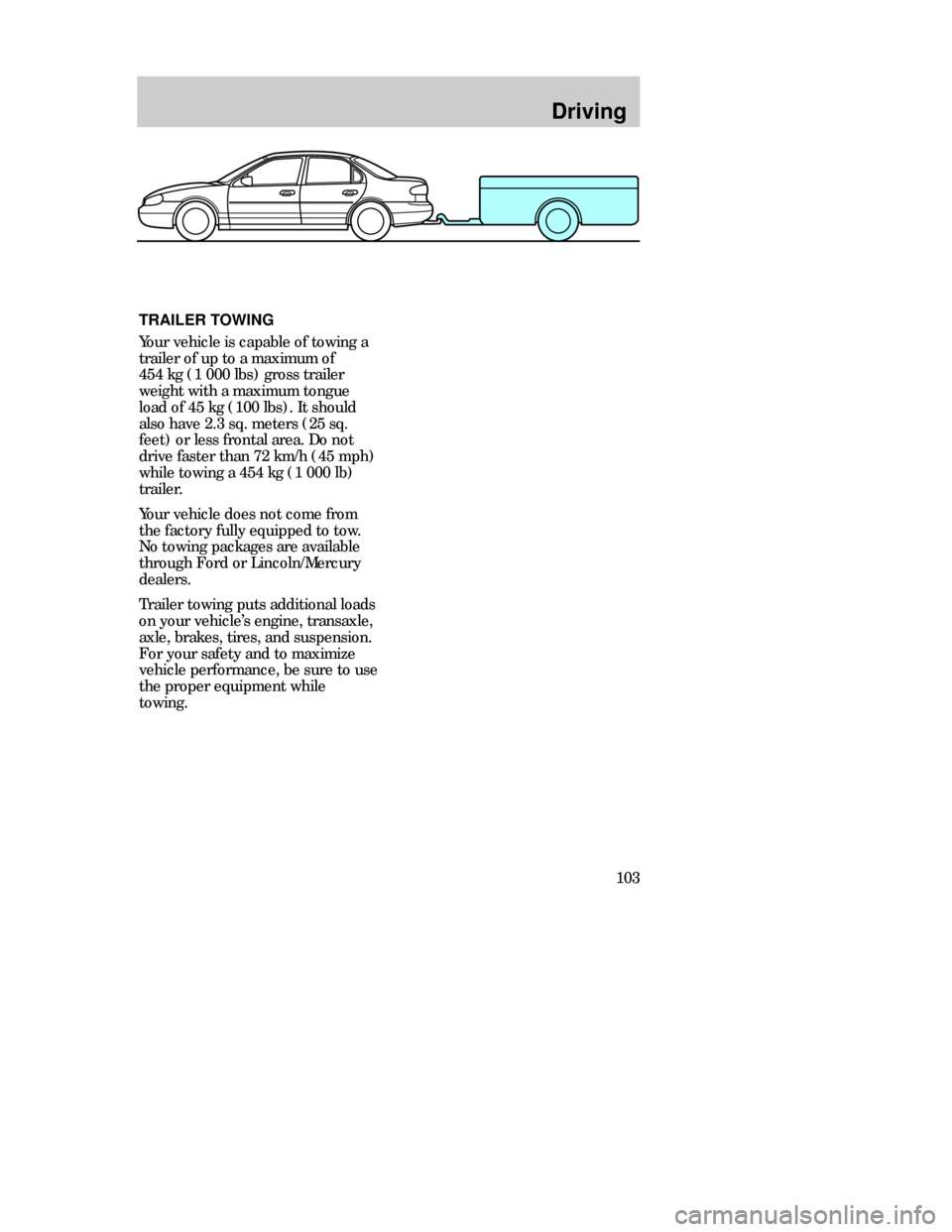
Your vehicle is capable of towing a
trailer of up to a maximum of
454kg (1000 lbs) gross trailer
weight with a maximum tongue
load of 45kg (100 lbs). It should
also have 2.3sq. meters (25sq.
feet) or less frontal area. Do not
drive faster than 72km/h (45mph)
while towing a 454kg (1000lb)
trailer.
Your vehicle does not come from
the factory fully equipped to tow.
No towing packages are available
through Ford or Lincoln/Mercury
dealers.
Trailer towing puts additional loads
on your vehicle’s engine, transaxle,
axle, brakes, tires, and suspension.
For your safety and to maximize
vehicle performance, be sure to use
the proper equipment while
towing.
CDW IVB1-10Driving en C 5/15/97 8:52 PM Page 103
Page 105 of 200
Driving
105 Preparing to tow
Use the proper equipment for
towing a trailer and make sure that
it is properly attached to your
vehicle. See your dealer or a
reliable trailer retailer if you
require assistance.
Auxiliary coolers are recommended
for the power steering system and
automatic transaxle system if you
are planning on:
•Traveling farther than 80 km
(50miles).
•Towing in hilly terrain.
•Towing frequently.
Towing trailers beyond the
maximum recommended
gross trailer weight exceeds the
limit of the vehicle and could
result in engine damage, transaxle
damage, structural damage, loss of
control, and personal injury.
Do not exceed the maximum loads
listed on the Safety Compliance
Certification Label. For load
specification terms found on the
label, refer to Loading your
vehiclein this chapter. Remember
to figure in the tongue load of your
loaded vehicle when figuring the
total weight.
CDW IVB1-10Driving en C 5/15/97 8:52 PM Page 105
Page 108 of 200
Driving
108Driving while towing a trailer
Do not drive faster than 72km/h
(45mph) while towing a 454 kg
(1000lb) trailer. Do not drive
faster than 72km/h (45mph) with
any weight trailer while towing in
hilly terrain or on hot days.
Speed control (if equipped) may
not work properly while towing on
long, steep grades.
If driving with an automatic
transaxle:
•Use D (Drive) or a low gear
rather than D (Overdrive) while
towing up or down steep inclines.
•Anticipate stops and brake
gradually.
If driving with a manual transaxle:
•Select a gear that avoids jerking
or excessive engine speed.
•Avoid driving excessively in first
or second gear. If you need to
drive excessively in first or
second gear, the trailer may be
too big or too heavily loaded for
the vehicle drivetrain.
•Shift to a lower gear while towing
up or down steep hills.
•Anticipate stops and brake
gradually.
CDW IVB1-10Driving en C 5/15/97 8:52 PM Page 108
Page 109 of 200
Driving
109 FUELCONSUMPTION
Fuel economy can be improved by
avoiding:
•lack of regular, scheduled
maintenance,
•excessive speed,
•rapid acceleration,
•driving with the brake pedal
depressed,
•sudden stops,
•extended engine idling,
•use of speed control in hilly
terrain,
•extended use of the air
conditioner, defroster, rear
window defroster and other
accessories,
•underinflated tires,
•heavy loads,
•aftermarked add-ons such as
bike, ski or luggage racks, bug
deflectors, etc.
CDW IVB1-10Driving en C 5/15/97 8:52 PM Page 109
Page 110 of 200
110
FUELPUMPSHUT-OFF SWITCH
If the engine cranks, but does not
start or does not start after a
collision, the fuel pump shut-off
switch may have been activated.
The shut-off switch is a device
intended to stop the electric fuel
pump when your vehicle has been
involved in a substantial jolt.
Once the shut-off switch is
activated, you must reset the
switch by hand before you can start
your vehicle. The switch is located
on the side panel in front of the
driver’s side door.
Roadside emergencies
HAZARD FLASHER CONTROL
Use only in an emergency to warn
traffic of vehicle breakdown or
approaching danger. Depress to
activate. Depress again to switch
off. The hazard lights can be
operated when the ignition is off.
CDW IVC1-6Roads en C 5/15/97 8:53 PM Page 110
Page 111 of 200
Roadside emergencies
111
If your engine cranks but does not
start after a collision or substantial
jolt:
1. Turn the ignition key to the off
position.
2. Check under the vehicle for
leaking fuel.
3. If you do not see or smell fuel,
push the red reset button down. If
the button is already set, you may
have a different mechanical
problem.
4. Turn the ignition key to the on
position for a few seconds, then
turn it to the off position.
5. Check under the vehicle again
for leaking fuel. If you see or smell
fuel, do not start your vehicle
again. If you do not see or smell
fuel, you can try to start your
vehicle again.
If you see or smell fuel, do
not reset the switch or try to
start your vehicle. Have all the
passengers get out of the vehicle
and call the local fire department
or a towing service.
CDW IVC1-6Roads en C 5/15/97 8:53 PM Page 111