1998 DODGE RAM 1500 Washer pump
[x] Cancel search: Washer pumpPage 1916 of 2627

OIL PUMP
DESCRIPTION
The oil pump (Fig. 109) is located in the pump
housing inside the bell housing of the transmission
case. The oil pump consists of an inner and outer
gear, a housing, and a reaction shaft support.
OPERATION
As the torque converter rotates, the converter hub
rotates the inner and outer gears. As the gears
rotate, the clearance between the gear teeth
increases in the crescent area, and creates a suction
at the inlet side of the pump. This suction draws
fluid through the pump inlet from the oil pan. As the
clearance between the gear teeth in the crescent area
decreases, it forces pressurized fluid into the pump
outlet and to the valve body.
Fig. 109 Oil Pump Assembly
1 - OIL SEAL 7 - BOLTS (6)
2 - VENT BAFFLE 8 - #1 THRUST WASHER (SELECTIVE)
3 - OIL PUMP BODY 9 - INNER GEAR
4 - GASKET 10 - OUTER GEAR
5 - REACTION SHAFT SUPPORT 11 - ªOº RING
6 - SEAL RINGS 12 - TORQUE CONVERTER SEAL RING
DRAUTOMATIC TRANSMISSION - 48RE 21 - 213
Page 1917 of 2627
DISASSEMBLY
(1) Mark position of support in oil pump body for
assembly alignment reference. Use scriber or paint to
make alignment marks.
(2) Place pump body on two wood blocks.
(3) Remove reaction shaft support bolts and sepa-
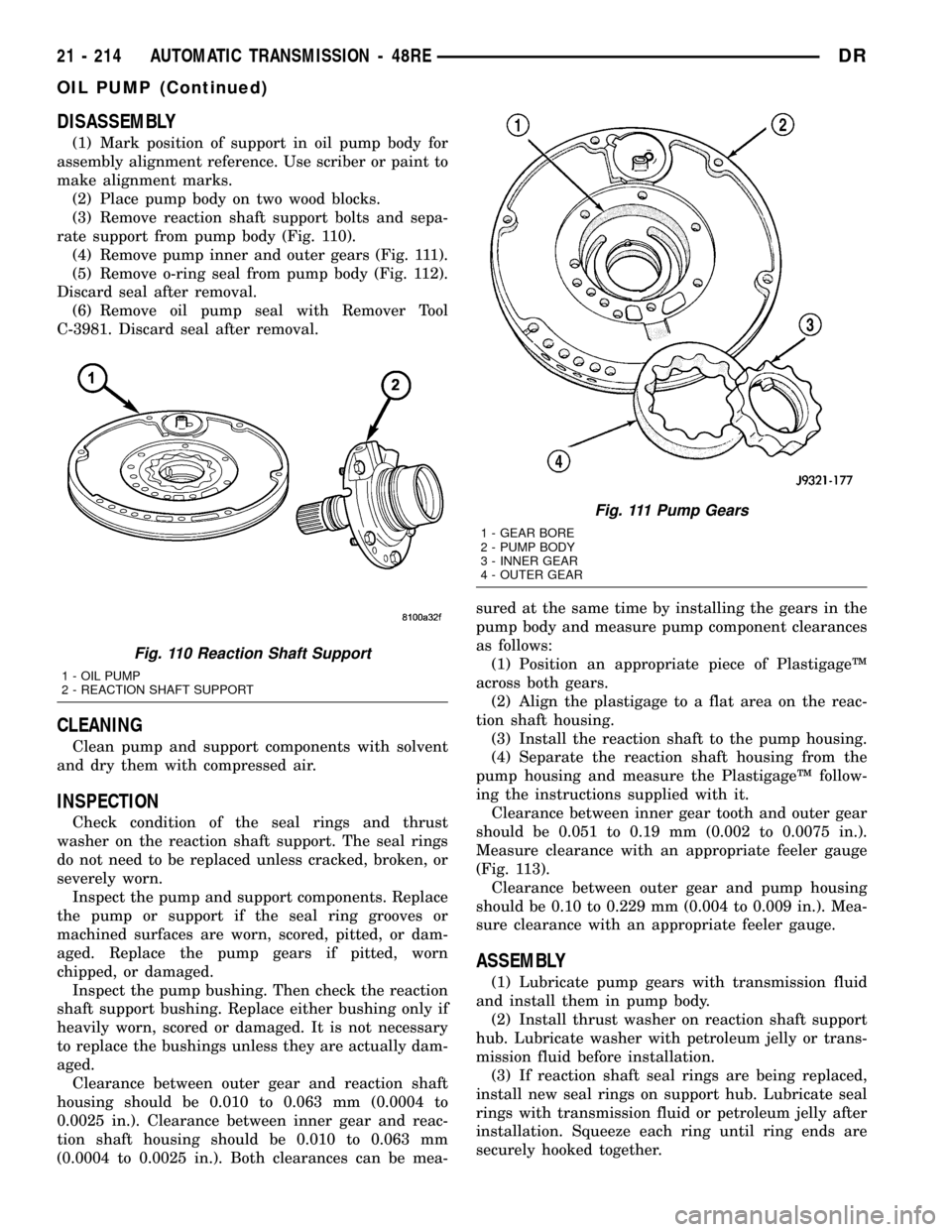
rate support from pump body (Fig. 110).
(4) Remove pump inner and outer gears (Fig. 111).
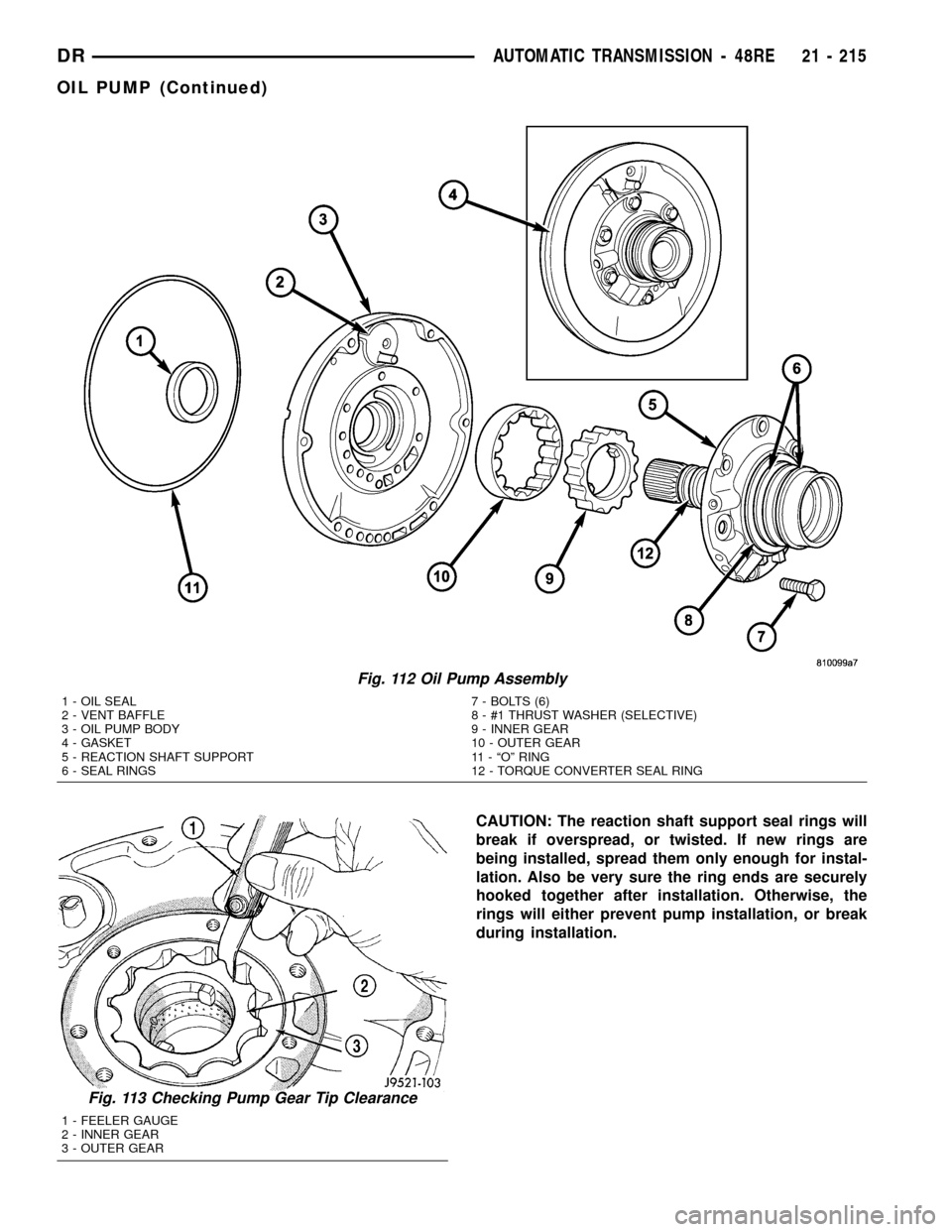
(5) Remove o-ring seal from pump body (Fig. 112).
Discard seal after removal.
(6) Remove oil pump seal with Remover Tool
C-3981. Discard seal after removal.
CLEANING
Clean pump and support components with solvent
and dry them with compressed air.
INSPECTION
Check condition of the seal rings and thrust
washer on the reaction shaft support. The seal rings
do not need to be replaced unless cracked, broken, or
severely worn.
Inspect the pump and support components. Replace
the pump or support if the seal ring grooves or
machined surfaces are worn, scored, pitted, or dam-
aged. Replace the pump gears if pitted, worn
chipped, or damaged.
Inspect the pump bushing. Then check the reaction
shaft support bushing. Replace either bushing only if
heavily worn, scored or damaged. It is not necessary
to replace the bushings unless they are actually dam-
aged.
Clearance between outer gear and reaction shaft
housing should be 0.010 to 0.063 mm (0.0004 to
0.0025 in.). Clearance between inner gear and reac-
tion shaft housing should be 0.010 to 0.063 mm
(0.0004 to 0.0025 in.). Both clearances can be mea-sured at the same time by installing the gears in the
pump body and measure pump component clearances
as follows:
(1) Position an appropriate piece of PlastigageŸ
across both gears.
(2) Align the plastigage to a flat area on the reac-
tion shaft housing.
(3) Install the reaction shaft to the pump housing.
(4) Separate the reaction shaft housing from the
pump housing and measure the PlastigageŸ follow-
ing the instructions supplied with it.
Clearance between inner gear tooth and outer gear
should be 0.051 to 0.19 mm (0.002 to 0.0075 in.).
Measure clearance with an appropriate feeler gauge
(Fig. 113).
Clearance between outer gear and pump housing
should be 0.10 to 0.229 mm (0.004 to 0.009 in.). Mea-
sure clearance with an appropriate feeler gauge.
ASSEMBLY
(1) Lubricate pump gears with transmission fluid
and install them in pump body.
(2) Install thrust washer on reaction shaft support
hub. Lubricate washer with petroleum jelly or trans-
mission fluid before installation.
(3) If reaction shaft seal rings are being replaced,
install new seal rings on support hub. Lubricate seal
rings with transmission fluid or petroleum jelly after
installation. Squeeze each ring until ring ends are
securely hooked together.
Fig. 110 Reaction Shaft Support
1 - OIL PUMP
2 - REACTION SHAFT SUPPORT
Fig. 111 Pump Gears
1 - GEAR BORE
2 - PUMP BODY
3 - INNER GEAR
4 - OUTER GEAR
21 - 214 AUTOMATIC TRANSMISSION - 48REDR
OIL PUMP (Continued)
Page 1918 of 2627
CAUTION: The reaction shaft support seal rings will
break if overspread, or twisted. If new rings are
being installed, spread them only enough for instal-
lation. Also be very sure the ring ends are securely
hooked together after installation. Otherwise, the
rings will either prevent pump installation, or break
during installation.
Fig. 112 Oil Pump Assembly
1 - OIL SEAL 7 - BOLTS (6)
2 - VENT BAFFLE 8 - #1 THRUST WASHER (SELECTIVE)
3 - OIL PUMP BODY 9 - INNER GEAR
4 - GASKET 10 - OUTER GEAR
5 - REACTION SHAFT SUPPORT 11 - ªOº RING
6 - SEAL RINGS 12 - TORQUE CONVERTER SEAL RING
Fig. 113 Checking Pump Gear Tip Clearance
1 - FEELER GAUGE
2 - INNER GEAR
3 - OUTER GEAR
DRAUTOMATIC TRANSMISSION - 48RE 21 - 215
OIL PUMP (Continued)
Page 1951 of 2627

OPERATION
To apply the clutch, pressure is applied between
the clutch retainer and piston. The fluid pressure is
provided by the oil pump, transferred through the
control valves and passageways, and enters the
clutch through the hub of the reaction shaft support.
With pressure applied between the clutch retainer
and piston, the piston moves away from the clutch
retainer and compresses the clutch pack. This action
applies the clutch pack, allowing torque to flow
through the input shaft into the driving discs, and
into the clutch plates and pressure plate that are
lugged to the clutch retainer. The waved spring is
used to cushion the application of the clutch pack.
The snap-ring is selective and used to adjust clutch
pack clearance.
When pressure is released from the piston, the
spring returns the piston to its fully released position
and disengages the clutch. The release spring also
helps to cushion the application of the clutch assem-
bly. When the clutch is in the process of being
released by the release spring, fluid flows through a
vent and one-way ball-check-valve located in the pis-
ton. The check-valve is needed to eliminate the pos-
sibility of plate drag caused by centrifugal force
acting on the residual fluid trapped in the clutch pis-
ton retainer.
DISASSEMBLY
(1) Remove fiber thrust washer from forward side
of clutch retainer.
(2) Remove input shaft front and rear seal rings.
(3) Remove selective clutch pack snap-ring (Fig.
214).
(4) Remove the reaction plate, clutch discs, steel
plates, pressure plate, wave spring, spacer ring, and
piston spring (Fig. 214).
(5) Remove clutch piston with rotating motion.
(6) Remove and discard piston seals.
(7) Remove input shaft retaining ring. It may be
necessary to press the input shaft in slightly to
relieve tension on the retaining ring
(8) Press input shaft out of retainer with shop
press and suitable size press tool. Use a suitably
sized press tool to support the retainer as close to the
input shaft as possible.
CLEANING
Clean the clutch components with solvent and dry
them with compressed air. Do not use rags or shop
towels to dry any of the clutch parts. Lint from such
materials will adhere to component surfaces and
could restrict or block fluid passages after assembly.
INSPECTION
Replace the clutch discs if warped, worn, scored,
burned/charred, the lugs are damaged, or if the fac-
ing is flaking off. Replace the top and bottom pres-
sure plates if scored, warped, or cracked. Be sure the
driving lugs on the pressure and clutch plates are
also in good condition. The lugs must not be bent,
cracked or damaged in any way.
Replace the piston spring and wave spring if either
part is distorted, warped or broken.
Check the lug grooves in the clutch retainer. The
clutch and pressure plates should slide freely in the
slots. Replace the retainer if the grooves are worn or
damaged. Also check action of the check balls in the
retainer and piston. Each check ball must move
freely and not stick.
Replace the retainer bushing if worn, scored, or
doubt exists about bushing condition.
Inspect the piston and retainer seal surfaces for
nicks or scratches. Minor scratches can be removed
with crocus cloth. However, replace the piston and/or
retainer if the seal surfaces are seriously scored.
Check condition of the fiber thrust washer and
metal output shaft thrust washer. Replace either
washer if worn or damaged.
Check condition of the seal rings on the input shaft
and clutch retainer hub. Replace the seal rings only
if worn, distorted, or damaged. The input shaft front
seal ring is teflon with chamfered ends. The rear ring
is metal with interlocking ends.
Check the input shaft for wear, or damage. Replace
the shaft if worn, scored or damaged in any way.
21 - 248 AUTOMATIC TRANSMISSION - 48REDR
REAR CLUTCH (Continued)
Page 1961 of 2627
STATOR
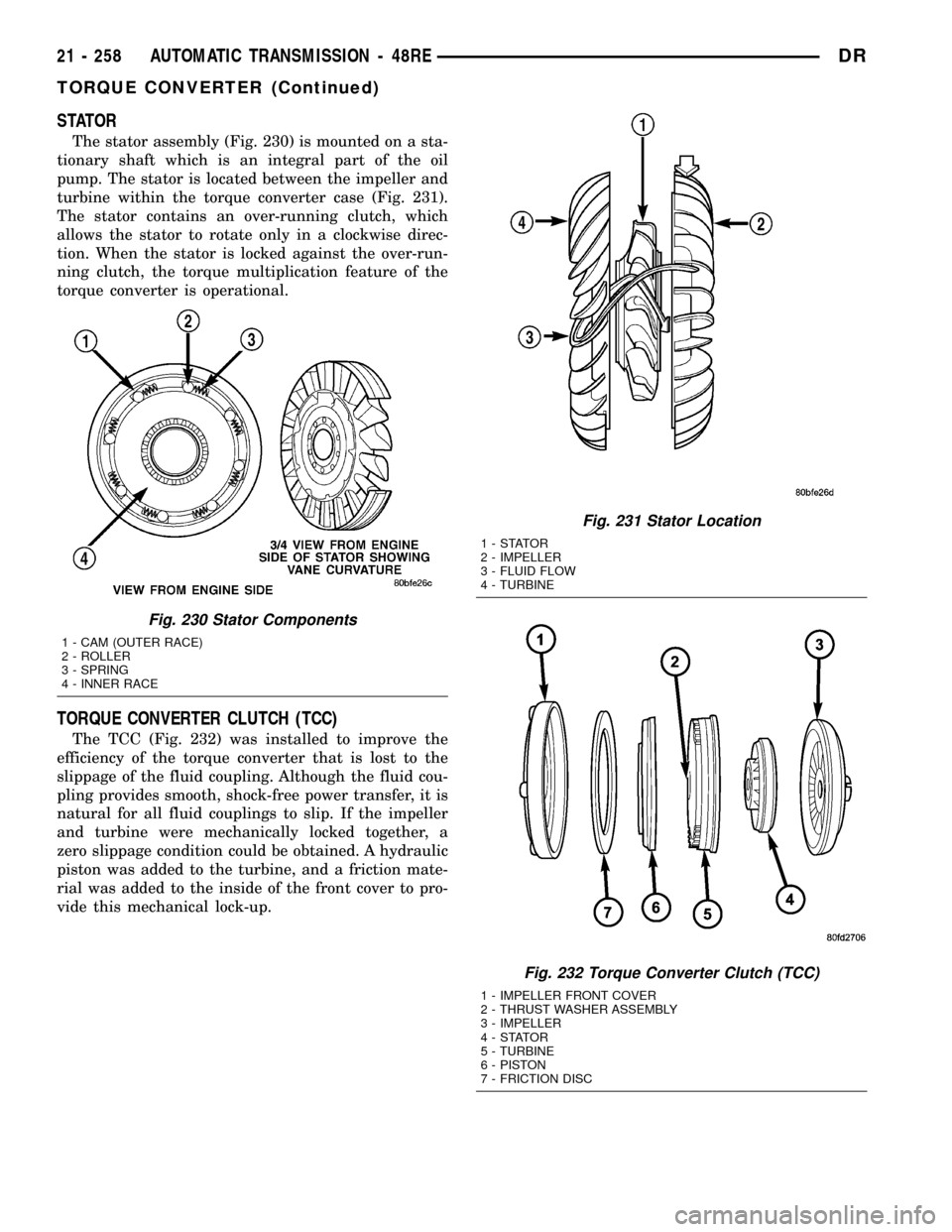
The stator assembly (Fig. 230) is mounted on a sta-
tionary shaft which is an integral part of the oil
pump. The stator is located between the impeller and
turbine within the torque converter case (Fig. 231).
The stator contains an over-running clutch, which
allows the stator to rotate only in a clockwise direc-
tion. When the stator is locked against the over-run-
ning clutch, the torque multiplication feature of the
torque converter is operational.
TORQUE CONVERTER CLUTCH (TCC)
The TCC (Fig. 232) was installed to improve the
efficiency of the torque converter that is lost to the
slippage of the fluid coupling. Although the fluid cou-
pling provides smooth, shock-free power transfer, it is
natural for all fluid couplings to slip. If the impeller
and turbine were mechanically locked together, a
zero slippage condition could be obtained. A hydraulic
piston was added to the turbine, and a friction mate-
rial was added to the inside of the front cover to pro-
vide this mechanical lock-up.
Fig. 230 Stator Components
1 - CAM (OUTER RACE)
2 - ROLLER
3 - SPRING
4 - INNER RACE
Fig. 231 Stator Location
1-STATOR
2 - IMPELLER
3 - FLUID FLOW
4 - TURBINE
Fig. 232 Torque Converter Clutch (TCC)
1 - IMPELLER FRONT COVER
2 - THRUST WASHER ASSEMBLY
3 - IMPELLER
4-STATOR
5 - TURBINE
6 - PISTON
7 - FRICTION DISC
21 - 258 AUTOMATIC TRANSMISSION - 48REDR
TORQUE CONVERTER (Continued)
Page 2093 of 2627
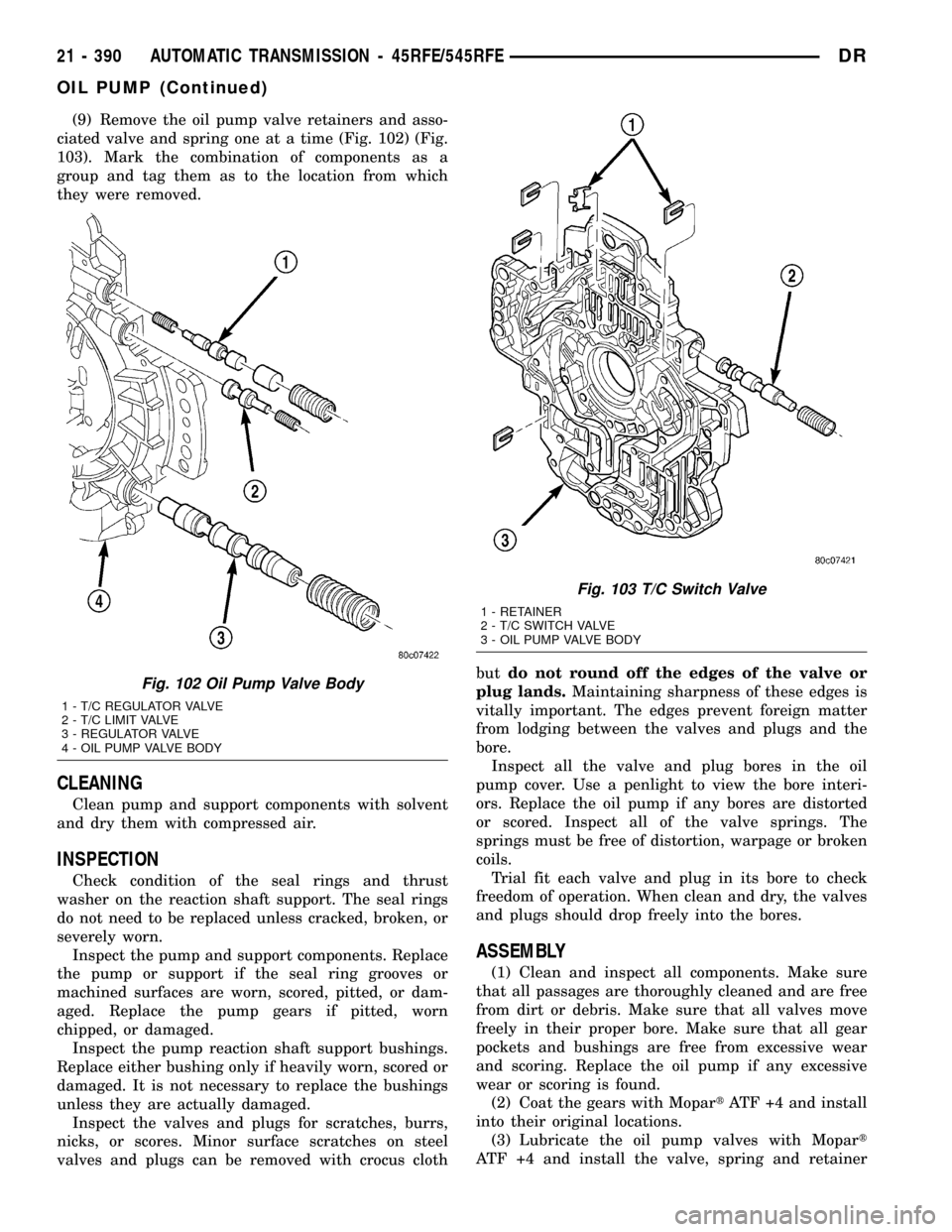
(9) Remove the oil pump valve retainers and asso-
ciated valve and spring one at a time (Fig. 102) (Fig.
103). Mark the combination of components as a
group and tag them as to the location from which
they were removed.
CLEANING
Clean pump and support components with solvent
and dry them with compressed air.
INSPECTION
Check condition of the seal rings and thrust
washer on the reaction shaft support. The seal rings
do not need to be replaced unless cracked, broken, or
severely worn.
Inspect the pump and support components. Replace
the pump or support if the seal ring grooves or
machined surfaces are worn, scored, pitted, or dam-
aged. Replace the pump gears if pitted, worn
chipped, or damaged.
Inspect the pump reaction shaft support bushings.
Replace either bushing only if heavily worn, scored or
damaged. It is not necessary to replace the bushings
unless they are actually damaged.
Inspect the valves and plugs for scratches, burrs,
nicks, or scores. Minor surface scratches on steel
valves and plugs can be removed with crocus clothbutdo not round off the edges of the valve or
plug lands.Maintaining sharpness of these edges is
vitally important. The edges prevent foreign matter
from lodging between the valves and plugs and the
bore.
Inspect all the valve and plug bores in the oil
pump cover. Use a penlight to view the bore interi-
ors. Replace the oil pump if any bores are distorted
or scored. Inspect all of the valve springs. The
springs must be free of distortion, warpage or broken
coils.
Trial fit each valve and plug in its bore to check
freedom of operation. When clean and dry, the valves
and plugs should drop freely into the bores.
ASSEMBLY
(1) Clean and inspect all components. Make sure
that all passages are thoroughly cleaned and are free
from dirt or debris. Make sure that all valves move
freely in their proper bore. Make sure that all gear
pockets and bushings are free from excessive wear
and scoring. Replace the oil pump if any excessive
wear or scoring is found.
(2) Coat the gears with MopartATF +4 and install
into their original locations.
(3) Lubricate the oil pump valves with Mopart
ATF +4 and install the valve, spring and retainer
Fig. 102 Oil Pump Valve Body
1 - T/C REGULATOR VALVE
2 - T/C LIMIT VALVE
3 - REGULATOR VALVE
4 - OIL PUMP VALVE BODY
Fig. 103 T/C Switch Valve
1 - RETAINER
2 - T/C SWITCH VALVE
3 - OIL PUMP VALVE BODY
21 - 390 AUTOMATIC TRANSMISSION - 45RFE/545RFEDR
OIL PUMP (Continued)
Page 2105 of 2627
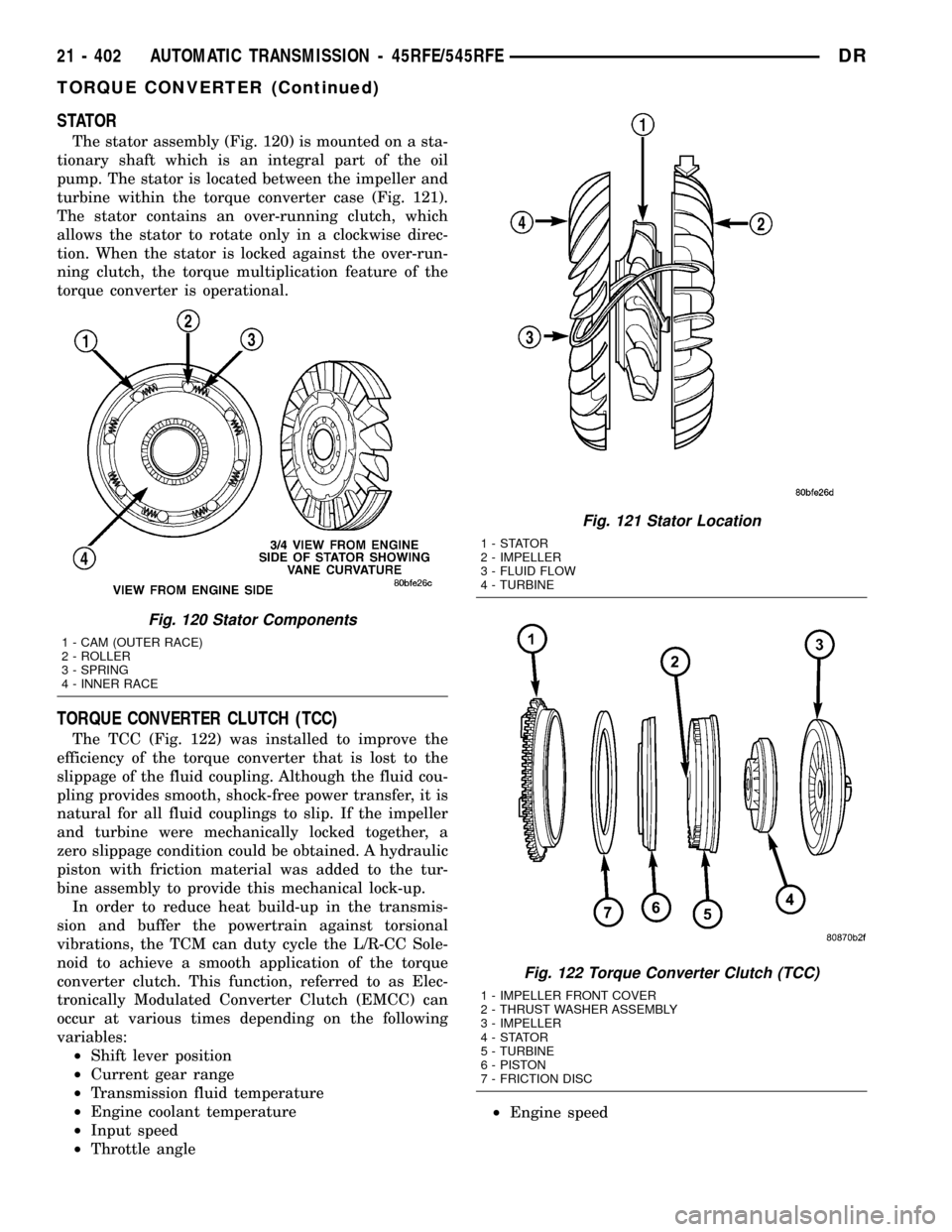
STATOR
The stator assembly (Fig. 120) is mounted on a sta-
tionary shaft which is an integral part of the oil
pump. The stator is located between the impeller and
turbine within the torque converter case (Fig. 121).
The stator contains an over-running clutch, which
allows the stator to rotate only in a clockwise direc-
tion. When the stator is locked against the over-run-
ning clutch, the torque multiplication feature of the
torque converter is operational.
TORQUE CONVERTER CLUTCH (TCC)
The TCC (Fig. 122) was installed to improve the
efficiency of the torque converter that is lost to the
slippage of the fluid coupling. Although the fluid cou-
pling provides smooth, shock-free power transfer, it is
natural for all fluid couplings to slip. If the impeller
and turbine were mechanically locked together, a
zero slippage condition could be obtained. A hydraulic
piston with friction material was added to the tur-
bine assembly to provide this mechanical lock-up.
In order to reduce heat build-up in the transmis-
sion and buffer the powertrain against torsional
vibrations, the TCM can duty cycle the L/R-CC Sole-
noid to achieve a smooth application of the torque
converter clutch. This function, referred to as Elec-
tronically Modulated Converter Clutch (EMCC) can
occur at various times depending on the following
variables:
²Shift lever position
²Current gear range
²Transmission fluid temperature
²Engine coolant temperature
²Input speed
²Throttle angle²Engine speed
Fig. 120 Stator Components
1 - CAM (OUTER RACE)
2 - ROLLER
3 - SPRING
4 - INNER RACE
Fig. 121 Stator Location
1-STATOR
2 - IMPELLER
3 - FLUID FLOW
4 - TURBINE
Fig. 122 Torque Converter Clutch (TCC)
1 - IMPELLER FRONT COVER
2 - THRUST WASHER ASSEMBLY
3 - IMPELLER
4-STATOR
5 - TURBINE
6 - PISTON
7 - FRICTION DISC
21 - 402 AUTOMATIC TRANSMISSION - 45RFE/545RFEDR
TORQUE CONVERTER (Continued)
Page 2600 of 2627

FIRING ORDER / CABLE ROUTING, 5.7L
V-8 ENGINE..........................8I-4
FIRING ORDER, 3.7L V-6 - ENGINE........8I-4
FIRING ORDER, 4.7L V-8 - ENGINE........8I-4
FIRING ORDER, DIESEL - FUEL
INJECTOR..........................14-48
FITTING - DESCRIPTION, QUICK
CONNECT............................14-8
FITTING - STANDARD PROCEDURE,
CONNECTING ROD BEARING...........9-129
FITTING - STANDARD PROCEDURE,
CRANKSHAFT MAIN BEARING.....9-134,9-207
FITTING - STANDARD PROCEDURE,
PISTON...................9-139,9-211,9-51
FITTING - STANDARD PROCEDURE,
PISTON RING.........9-142,9-213,9-284,9-53
FITTING, STANDARD PROCEDURE -
CONNECTING ROD BEARING............9-49
FITTING, STANDARD PROCEDURE -
MAIN BEARING.......................9-44
FITTINGS - STANDARD PROCEDURE,
HANDLING TUBING...................24-45
FITTINGS - STANDARD PROCEDURE,
QUICK-CONNECT......................14-8
FLAG - INSTALLATION, SIDE VIEW
MIRROR...........................23-27
FLAG - REMOVAL, SIDE VIEW MIRROR . . . 23-27
FLARING - STANDARD PROCEDURE,
DOUBLE INVERTED....................5-10
FLARING - STANDARD PROCEDURE, ISO . . . 5-11
FLEX PLATE - INSTALLATION . . 9-138,9-210,9-48
FLEX PLATE - REMOVAL.......9-138,9-210,9-48
FLOOR - INSTALLATION, LOAD..........23-72
FLOOR - REMOVAL, LOAD.............23-71
FLOOR CONSOLE - INSTALLATION.......23-67
FLOOR CONSOLE - REMOVAL...........23-67
FLOOR DISTRIBUTION DUCT -
INSTALLATION.......................24-34
FLOOR DISTRIBUTION DUCT - REMOVAL . 24-33
FLOOR MATS - INSTALLATION, CARPETS . 23-65
FLOOR MATS - REMOVAL, CARPETS.....23-65
FLOOR SHIFT BOOT - INSTALLATION,
4WD ..............................23-62
FLOOR SHIFT BOOT - REMOVAL, 4WD....23-62
FLOOR SUPPORT CYLINDER -
INSTALLATION, LOAD.................23-72
FLOOR SUPPORT CYLINDER -
REMOVAL, LOAD.....................23-72
FLOW - 5.9L DIESEL - DESCRIPTION,
COOLING SYSTEM.....................7-3
FLOW - DIAGNOSIS AND TESTING,
RADIATOR COOLANT..............7-54,7-56
FLOW 3.7L/4.7L/5.7L ENGINE -
DESCRIPTION, COOLING SYSTEM.........7-1
FLOW AND PRESSURE - DIAGNOSIS
AND TESTING, POWER STEERING........19-4
FLUID - DESCRIPTION................19-43
FLUID - DESCRIPTION, AUTOMATIC
TRANSMISSION.......................0-4
FLUID - DESCRIPTION, POWER
STEERING............................0-3
FLUID - DIAGNOSIS AND TESTING,
CAUSES OF BURNT............21-201,21-366
FLUID - OPERATION, AUTOMATIC
TRANSMISSION.......................0-5
FLUID AND FILTER REPLACEMENT -
STANDARD PROCEDURE........21-203,21-367
FLUID CAPACITIES, SPECIFICATIONS.......0-5
FLUID CONTAMINATION - DIAGNOSIS
AND TESTING................21-202,21-366
FLUID CONTAMINATION - DIAGNOSIS
AND TESTING, BRAKE..................5-23
FLUID COOLER - INSTALLATION.........19-43
FLUID COOLER - REMOVAL............19-43
FLUID DRAIN AND REFILL - STANDARD
PROCEDURE.....21-441,21-476,21-507,21-537,
21-571
FLUID INDICATOR - DESCRIPTION,
WASHER
...........................8J-44
FLUID INDICATOR - OPERATION,
WASHER
...........................8J-44
FLUID LEAK - DIAGNOSIS AND TESTING,
CONVERTER HOUSING
.........21-144,21-318
FLUID LEVEL - DIAGNOSIS AND
TESTING, EFFECTS OF INCORRECT
.....21-201,
21-366
FLUID LEVEL - STANDARD PROCEDURE,
BRAKE
..............................5-23FLUID LEVEL CHECK - STANDARD
PROCEDURE.................21-202,21-366
FLUID LEVEL CHECKING - STANDARD
PROCEDURE, POWER STEERING........19-43
FLUID LEVEL SWITCH - DESCRIPTION,
WASHER............................8R-9
FLUID LEVEL SWITCH - INSTALLATION,
WASHER...........................8R-11
FLUID LEVEL SWITCH - OPERATION,
WASHER............................8R-9
FLUID LEVEL SWITCH - REMOVAL,
WASHER...........................8R-10
FLUID RESERVOIR - INSTALLATION.......5-24
FLUID RESERVOIR - REMOVAL..........5-23
FLUID, SPECIFICATIONS - BRAKE.........5-23
FLUSH - SPECIFICATIONS, GAP.........23-95
FLUSHING - STANDARD PROCEDURE,
COOLING SYSTEM CLEANING/
REVERSE............................7-17
FLUSHING POWER STEERING SYSTEM -
STANDARD PROCEDURE...............19-40
FLYWHEEL - ASSEMBLY................6-11
FLYWHEEL - DIAGNOSIS AND TESTING....6-10
FLYWHEEL - DISASSEMBLY.............6-11
FLYWHEEL - INSTALLATION.............6-11
FLYWHEEL - REMOVAL.................6-11
FOG LAMP - INSTALLATION............8L-12
FOG LAMP - REMOVAL................8L-12
FOG LAMP RELAY - DESCRIPTION.......8L-12
FOG LAMP RELAY - INSTALLATION........8L-13
FOG LAMP RELAY - OPERATION.........8L-13
FOG LAMP RELAY - REMOVAL..........8L-13
FOOTMANS LOOP BRACKETS -
INSTALLATION, SEAT BACK REAR.......23-85
FOOTMANS LOOP BRACKETS -
REMOVAL, SEAT BACK REAR...........23-85
FORM-IN-PLACE GASKETS AND
SEALERS - STANDARD PROCEDURE . . 9-239,9-9,
9-94
FRAME - INSTALLATION, GRILLE........23-40
FRAME - REAR - INSTALLATION, SEAT
CUSHION...........................23-85
FRAME - REAR - REMOVAL, SEAT
CUSHION...........................23-85
FRAME - REMOVAL, GRILLE............23-40
FRAME DIMENSIONS - SPECIFICATIONS . . 13-16
FRAME H-SECTION REPLACEMENT -
STANDARD PROCEDURE, REAR.........13-13
FRAME RAIL TIP REPLACEMENT -
STANDARD PROCEDURE, LIGHT DUTY
FRONT..............................13-4
FREE MODULE - INSTALLATION, HANDS . . . 8T-2
FREE MODULE - REMOVAL, HANDS.......8T-2
FRONT - INSTALLATION....5-16,5-21,5-22,5-34
FRONT - INSTALLATION...............22-14
FRONT - INSTALLATION, CRANKSHAFT
OIL SEAL.............9-136,9-208,9-275,9-46
FRONT - INSTALLATION, PROPELLER
SHAFT - HD...........................3-7
FRONT - INSTALLATION, PROPELLER
SHAFT- LD............................3-7
FRONT - INSTALLATION, SEAT..........23-81
FRONT - INSTALLATION, SEAT BACK
CUSHION / COVER...................23-82
FRONT - INSTALLATION, SEAT CUSHION
/ COVER............................23-83
FRONT - REMOVAL........5-13,5-17,5-21,5-33
FRONT - REMOVAL, CRANKSHAFT OIL
SEAL................9-135,9-208,9-275,9-46
FRONT - REMOVAL, PROPELLER SHAFT
- HD ................................3-7
FRONT - REMOVAL, PROPELLER SHAFT-
LD ..................................3-6
FRONT - REMOVAL, SEAT..............23-81
FRONT - REMOVAL, SEAT BACK
CUSHION / COVER...................23-82
FRONT - REMOVAL, SEAT CUSHION /
COVER.............................23-83
FRONT AIR DAM - INSTALLATION........13-2
FRONT AIR DAM - REMOVAL............13-2
FRONT AXLE - 9 1/4 AA -
ADJUSTMENTS
.......................3-59
FRONT AXLE - 9 1/4 AA - DIAGNOSIS
AND TESTING
........................3-54
FRONT AXLE - 9 1/4 AA - INSTALLATION
. . . 3-58
FRONT AXLE - 9 1/4 AA - REMOVAL
......3-57
FRONT AXLE - 9 1/4 AA - SPECIAL
TOOLS
..............................3-64FRONT AXLE - 9 1/4 AA -
SPECIFICATIONS......................3-63
FRONT AXLE - C205F - ADJUSTMENTS....3-32
FRONT AXLE - C205F - DIAGNOSIS AND
TESTING............................3-27
FRONT AXLE - C205F - INSTALLATION.....3-31
FRONT AXLE - C205F - REMOVAL........3-31
FRONT AXLE - C205F - SPECIAL TOOLS . . . 3-40
FRONT AXLE - C205F - SPECIFICATIONS . . . 3-39
FRONT BEARING - INSTALLATION,
OUTPUT SHAFT.....................21-216
FRONT BEARING - REMOVAL, OUTPUT
SHAFT............................21-216
FRONT BRAKE HOSE - INSTALLATION.....5-13
FRONT BUMPER - INSTALLATION.........13-2
FRONT BUMPER - REMOVAL............13-2
FRONT CENTER SEAT BELT -
INSTALLATION......................8O-31
FRONT CENTER SEAT BELT - REMOVAL . . 8O-30
FRONT CENTER SEAT BELT &
RETRACTOR - INSTALLATION...........8O-29
FRONT CENTER SEAT BELT &
RETRACTOR - REMOVAL..............8O-29
FRONT CLUTCH - ASSEMBLY..........21-207
FRONT CLUTCH - DESCRIPTION........21-205
FRONT CLUTCH - DISASSEMBLY.......21-205
FRONT CLUTCH - INSPECTION.........21-206
FRONT CLUTCH - OPERATION.........21-205
FRONT CONTROL MODULE -
DESCRIPTION.....................8W-97-5
FRONT CONTROL MODULE -
DESCRIPTION........................8E-5
FRONT CONTROL MODULE - DIAGNOSIS
AND TESTING.....................8W-97-5
FRONT CONTROL MODULE - DIAGNOSIS
AND TESTING........................8E-5
FRONT CONTROL MODULE -
INSTALLATION....................8W-97-6
FRONT CONTROL MODULE -
INSTALLATION........................8E-5
FRONT CONTROL MODULE - OPERATION . 8W-97-5
FRONT CONTROL MODULE - OPERATION . . 8E-5
FRONT CONTROL MODULE - REMOVAL . 8W-97-6
FRONT CONTROL MODULE - REMOVAL....8E-5
FRONT CROSSMEMBER - INSTALLATION . . 13-22
FRONT CROSSMEMBER - REMOVAL.....13-22
FRONT DOOR GLASS RUN
WEATHERSTRIP - INSTALLATION........23-92
FRONT DOOR GLASS RUN
WEATHERSTRIP - REMOVAL............23-92
FRONT DOOR INNER BELT MOLDING -
INSTALLATION.......................23-93
FRONT DOOR INNER BELT MOLDING -
REMOVAL..........................23-93
FRONT DOOR OUTER BELT MOLDING -
INSTALLATION.......................23-93
FRONT DOOR OUTER BELT MOLDING -
REMOVAL..........................23-92
FRONT FASCIA - INSTALLATION..........13-3
FRONT FASCIA - REMOVAL..............13-2
FRONT FENDER - INSTALLATION........23-39
FRONT FENDER - REMOVAL............23-39
FRONT FRAME RAIL TIP REPLACEMENT
- STANDARD PROCEDURE, LIGHT
DUTY...............................13-4
FRONT HOSE - REMOVAL...............5-12
FRONT MOUNT - INSTALLATION . . . 9-147,9-218,
9-287,9-59
FRONT MOUNT - REMOVAL . . 9-146,9-217,9-286,
9-58
FRONT OUTBOARD SEAT BELT BUCKLE -
INSTALLATION......................8O-38
FRONT OUTBOARD SEAT BELT BUCKLE -
REMOVAL..........................8O-37
FRONT OUTPUT SHAFT SEAL -
INSTALLATION . . . 21-442,21-477,21-508,21-538,
21-572
FRONT OUTPUT SHAFT SEAL -
REMOVAL . 21-441,21-477,21-507,21-537,21-572
FRONT PARKING BRAKE CABLE -
INSTALLATION........................5-38
FRONT PARKING BRAKE CABLE -
REMOVAL
...........................5-36
FRONT SEAL - INSTALLATION, OIL
PUMP
............................21-391
FRONT SEAL - REMOVAL, OIL PUMP
....21-391
FRONT SERVO - ASSEMBLY
...........21-209
FRONT SERVO - CLEANING
...........21-209
DRINDEX 13
Description Group-Page Description Group-Page Description Group-Page