1998 DODGE RAM 1500 blower
[x] Cancel search: blowerPage 1050 of 2627

8W-80 CONNECTOR PIN-OUTS
Component Page
4WD Switch (Manual Transfer Case)..... 8W-80-5
A/C Compressor Clutch (Diesel)......... 8W-80-5
A/C Compressor Clutch (Gas)........... 8W-80-5
A/C Heater Control C1................ 8W-80-5
A/C Heater Control C2................ 8W-80-6
A/C Pressure Transducer (Diesel)........ 8W-80-6
A/C Pressure Transducer (NGC)......... 8W-80-6
Accelerator Pedal Position Sensor (5.7L) . . 8W-80-6
Accelerator Pedal Position Sensor
(Diesel M/T)...................... 8W-80-7
Accelerator Pedel Position Sensor
(Diesel A/T)....................... 8W-80-7
Adjustable Pedal Motor (Except Memory) . 8W-80-7
Adjustable Pedal Switch (Except Memory) . 8W-80-8
Airbag Control Module C1............. 8W-80-8
Airbag Control Module C2............. 8W-80-9
Airbag-Left Curtain.................. 8W-80-9
Airbag-Passenger On/Off Switch....... 8W-80-10
Airbag-Passenger Squib.............. 8W-80-10
Airbag-Right Curtain................ 8W-80-10
Ambient Temperature Sensor.......... 8W-80-10
Amplifier Audio C1 (Premium)......... 8W-80-11
Amplifier Audio C2 (Premium)......... 8W-80-11
Ashtray Lamp...................... 8W-80-11
Automatic Day/Night Mirror C1 (Except
Base).......................... 8W-80-12
Automatic Day/Night Mirror C2
(Telematics)..................... 8W-80-12
Back-Up Lamp Switch............... 8W-80-12
Battery Temperature Sensor........... 8W-80-12
Blend Door Actuator (Single Zone)...... 8W-80-13
Blower Motor...................... 8W-80-13
Blower Motor Resistor Block.......... 8W-80-13
Brake Fluid Level Switch............. 8W-80-13
Brake Lamp Switch................. 8W-80-13
Brake Transmission Shift Interlock
Solenoid........................ 8W-80-14
C102 (NGC)....................... 8W-80-14
C103............................. 8W-80-14
C106 (5.7L A/T).................... 8W-80-14
C106 (5.7L A/T).................... 8W-80-15
C107 (5.7L)........................ 8W-80-15
C107 (5.7L)........................ 8W-80-16
C108 (Diesel)...................... 8W-80-16
C108 (Diesel)...................... 8W-80-16
C109 (Diesel)...................... 8W-80-17
C109 (Diesel)...................... 8W-80-17
C110 (Diesel)...................... 8W-80-17
C110 (Diesel)...................... 8W-80-18
C112 (Diesel M/T)................... 8W-80-18
C112 (Diesel M/T)................... 8W-80-18
C112 (Diesel A/T)................... 8W-80-18Component Page
C112 (Diesel A/T)................... 8W-80-19
C130 (Diesel)...................... 8W-80-19
C131 (4.7L Electronic Transfer Case).... 8W-80-20
C131 (4.7L Electronic Transfer Case).... 8W-80-20
C131 (5.7L/Diesel).................. 8W-80-20
C131 (5.7L/Diesel).................. 8W-80-21
C131 (3.7L/4.7L Except Electronic
Transfer Case)................... 8W-80-21
C131 (3.7L/4.7L Except Electronic
Transfer Case)................... 8W-80-22
C200............................. 8W-80-22
C200............................. 8W-80-23
C201............................. 8W-80-23
C201............................. 8W-80-23
C202............................. 8W-80-24
C202............................. 8W-80-24
C206............................. 8W-80-24
C206............................. 8W-80-24
C207............................. 8W-80-24
C207............................. 8W-80-25
C216............................. 8W-80-25
C216............................. 8W-80-25
C217............................. 8W-80-26
C217............................. 8W-80-26
C218............................. 8W-80-26
C218............................. 8W-80-27
C219............................. 8W-80-27
C219............................. 8W-80-29
C220............................. 8W-80-30
C220............................. 8W-80-31
C250 (Hands Free).................. 8W-80-31
C250 (Hands Free).................. 8W-80-32
C301............................. 8W-80-32
C301............................. 8W-80-32
C301............................. 8W-80-33
C302............................. 8W-80-33
C302 (SLT)........................ 8W-80-34
C304............................. 8W-80-34
C304............................. 8W-80-34
C305 (SLT)........................ 8W-80-35
C305 (SLT)........................ 8W-80-35
C306............................. 8W-80-36
C306............................. 8W-80-36
C308............................. 8W-80-36
C308............................. 8W-80-37
C309............................. 8W-80-37
C309............................. 8W-80-37
C311 ............................. 8W-80-38
C311 ............................. 8W-80-38
C313............................. 8W-80-38
C313............................. 8W-80-39
C315............................. 8W-80-39
DR8W-80 CONNECTOR PIN-OUTS 8W - 80 - 1
Page 1055 of 2627
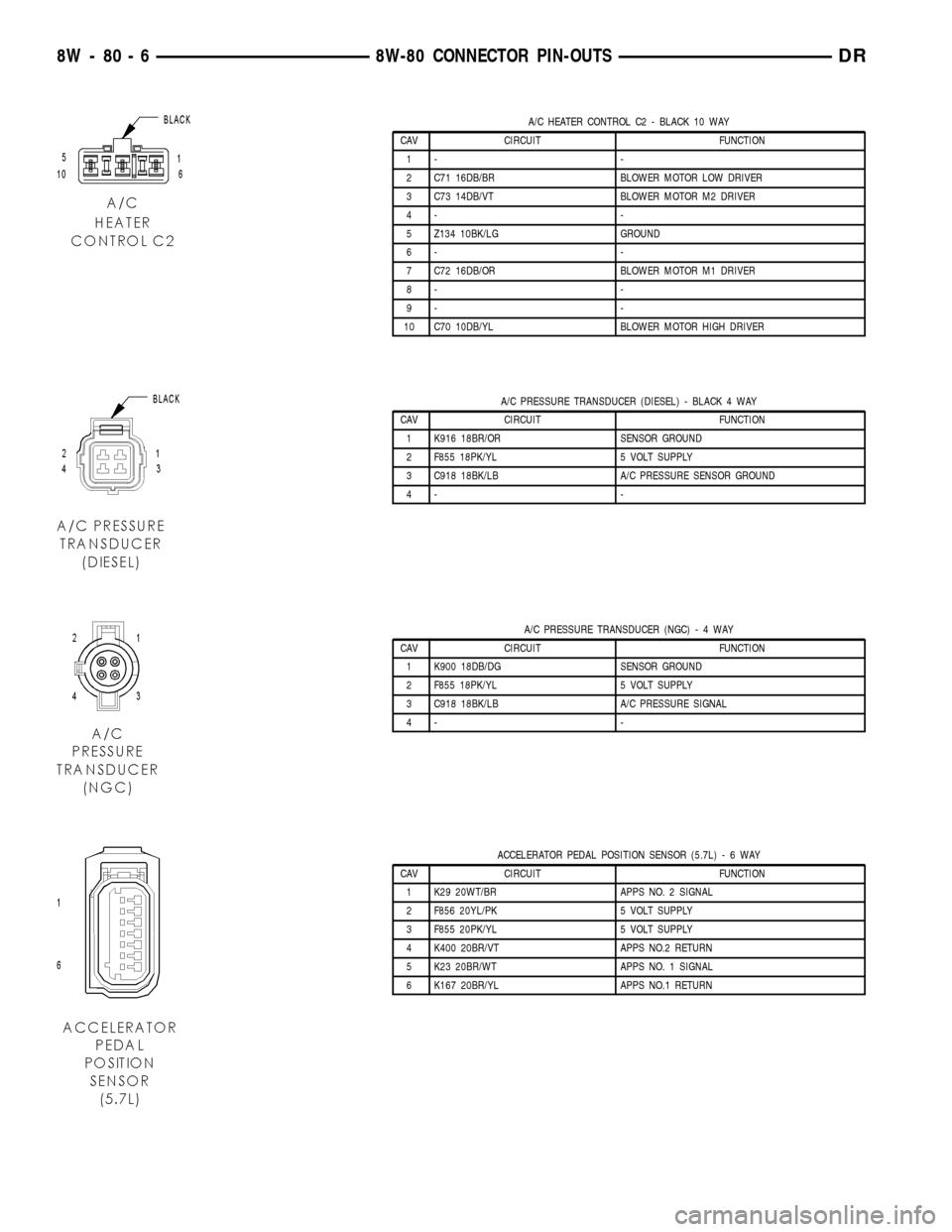
A/C HEATER CONTROL C2 - BLACK 10 WAY
CAV CIRCUIT FUNCTION
1- -
2 C71 16DB/BR BLOWER MOTOR LOW DRIVER
3 C73 14DB/VT BLOWER MOTOR M2 DRIVER
4- -
5 Z134 10BK/LG GROUND
6- -
7 C72 16DB/OR BLOWER MOTOR M1 DRIVER
8- -
9- -
10 C70 10DB/YL BLOWER MOTOR HIGH DRIVER
A/C PRESSURE TRANSDUCER (DIESEL) - BLACK 4 WAY
CAV CIRCUIT FUNCTION
1 K916 18BR/OR SENSOR GROUND
2 F855 18PK/YL 5 VOLT SUPPLY
3 C918 18BK/LB A/C PRESSURE SENSOR GROUND
4- -
A/C PRESSURE TRANSDUCER (NGC)-4WAY
CAV CIRCUIT FUNCTION
1 K900 18DB/DG SENSOR GROUND
2 F855 18PK/YL 5 VOLT SUPPLY
3 C918 18BK/LB A/C PRESSURE SIGNAL
4- -
ACCELERATOR PEDAL POSITION SENSOR (5.7L)-6WAY
CAV CIRCUIT FUNCTION
1 K29 20WT/BR APPS NO. 2 SIGNAL
2 F856 20YL/PK 5 VOLT SUPPLY
3 F855 20PK/YL 5 VOLT SUPPLY
4 K400 20BR/VT APPS NO.2 RETURN
5 K23 20BR/WT APPS NO. 1 SIGNAL
6 K167 20BR/YL APPS NO.1 RETURN
8W - 80 - 6 8W-80 CONNECTOR PIN-OUTSDR
Page 1062 of 2627
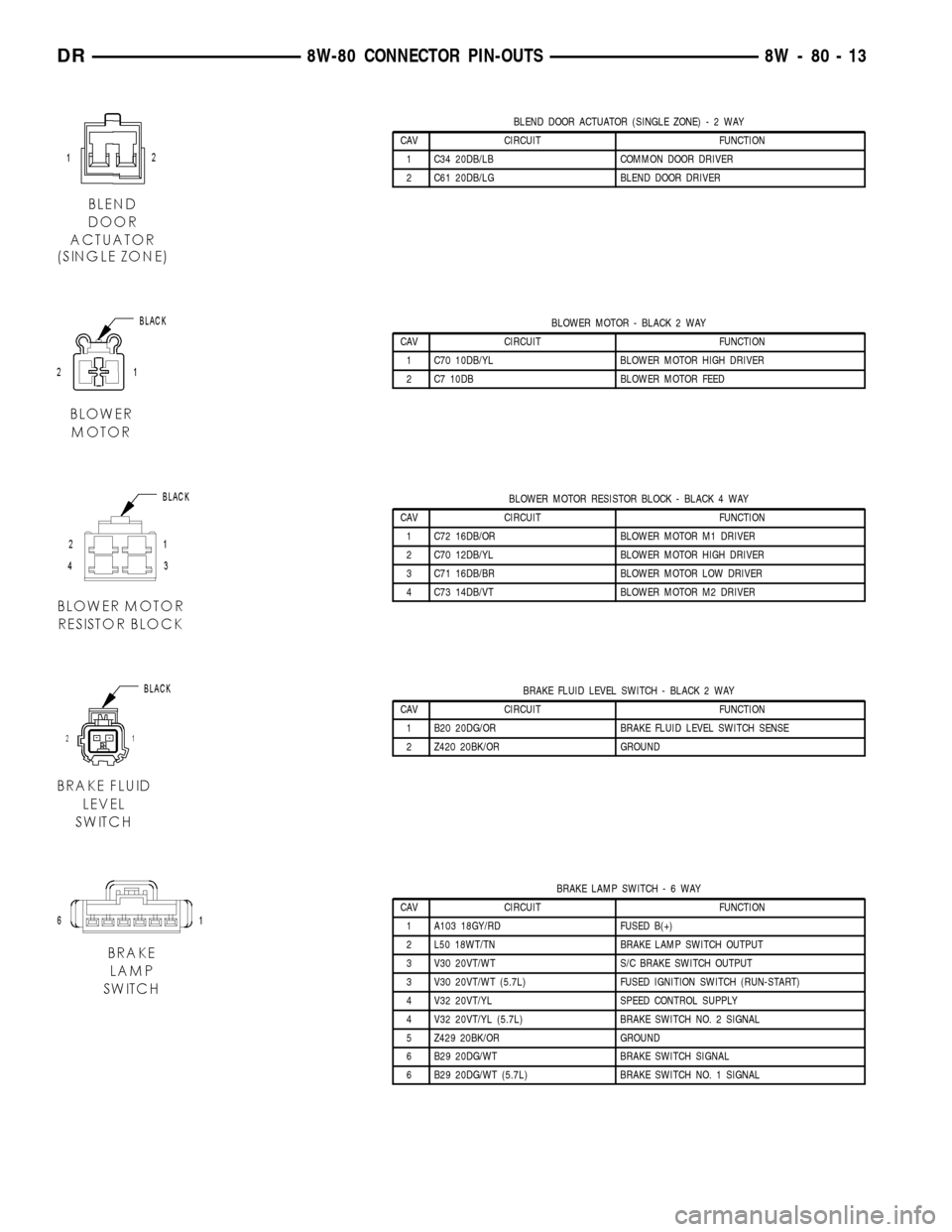
BLEND DOOR ACTUATOR (SINGLE ZONE)-2WAY
CAV CIRCUIT FUNCTION
1 C34 20DB/LB COMMON DOOR DRIVER
2 C61 20DB/LG BLEND DOOR DRIVER
BLOWER MOTOR - BLACK 2 WAY
CAV CIRCUIT FUNCTION
1 C70 10DB/YL BLOWER MOTOR HIGH DRIVER
2 C7 10DB BLOWER MOTOR FEED
BLOWER MOTOR RESISTOR BLOCK - BLACK 4 WAY
CAV CIRCUIT FUNCTION
1 C72 16DB/OR BLOWER MOTOR M1 DRIVER
2 C70 12DB/YL BLOWER MOTOR HIGH DRIVER
3 C71 16DB/BR BLOWER MOTOR LOW DRIVER
4 C73 14DB/VT BLOWER MOTOR M2 DRIVER
BRAKE FLUID LEVEL SWITCH - BLACK 2 WAY
CAV CIRCUIT FUNCTION
1 B20 20DG/OR BRAKE FLUID LEVEL SWITCH SENSE
2 Z420 20BK/OR GROUND
BRAKE LAMP SWITCH-6WAY
CAV CIRCUIT FUNCTION
1 A103 18GY/RD FUSED B(+)
2 L50 18WT/TN BRAKE LAMP SWITCH OUTPUT
3 V30 20VT/WT S/C BRAKE SWITCH OUTPUT
3 V30 20VT/WT (5.7L) FUSED IGNITION SWITCH (RUN-START)
4 V32 20VT/YL SPEED CONTROL SUPPLY
4 V32 20VT/YL (5.7L) BRAKE SWITCH NO. 2 SIGNAL
5 Z429 20BK/OR GROUND
6 B29 20DG/WT BRAKE SWITCH SIGNAL
6 B29 20DG/WT (5.7L) BRAKE SWITCH NO. 1 SIGNAL
DR8W-80 CONNECTOR PIN-OUTS 8W - 80 - 13
Page 1119 of 2627
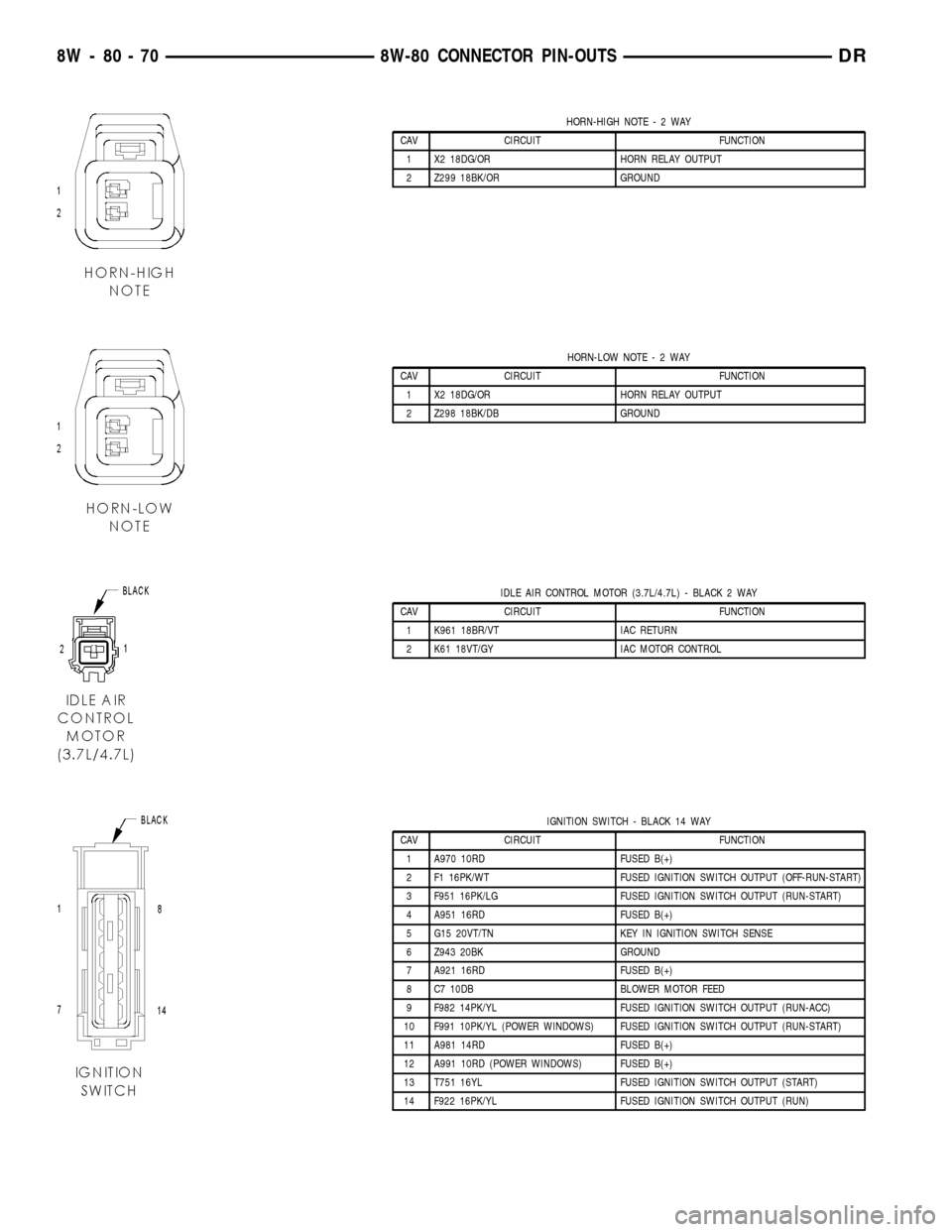
HORN-HIGH NOTE-2WAY
CAV CIRCUIT FUNCTION
1 X2 18DG/OR HORN RELAY OUTPUT
2 Z299 18BK/OR GROUND
HORN-LOW NOTE-2WAY
CAV CIRCUIT FUNCTION
1 X2 18DG/OR HORN RELAY OUTPUT
2 Z298 18BK/DB GROUND
IDLE AIR CONTROL MOTOR (3.7L/4.7L) - BLACK 2 WAY
CAV CIRCUIT FUNCTION
1 K961 18BR/VT IAC RETURN
2 K61 18VT/GY IAC MOTOR CONTROL
IGNITION SWITCH - BLACK 14 WAY
CAV CIRCUIT FUNCTION
1 A970 10RD FUSED B(+)
2 F1 16PK/WT FUSED IGNITION SWITCH OUTPUT (OFF-RUN-START)
3 F951 16PK/LG FUSED IGNITION SWITCH OUTPUT (RUN-START)
4 A951 16RD FUSED B(+)
5 G15 20VT/TN KEY IN IGNITION SWITCH SENSE
6 Z943 20BK GROUND
7 A921 16RD FUSED B(+)
8 C7 10DB BLOWER MOTOR FEED
9 F982 14PK/YL FUSED IGNITION SWITCH OUTPUT (RUN-ACC)
10 F991 10PK/YL (POWER WINDOWS) FUSED IGNITION SWITCH OUTPUT (RUN-START)
11 A981 14RD FUSED B(+)
12 A991 10RD (POWER WINDOWS) FUSED B(+)
13 T751 16YL FUSED IGNITION SWITCH OUTPUT (START)
14 F922 16PK/YL FUSED IGNITION SWITCH OUTPUT (RUN)
8W - 80 - 70 8W-80 CONNECTOR PIN-OUTSDR
Page 1155 of 2627
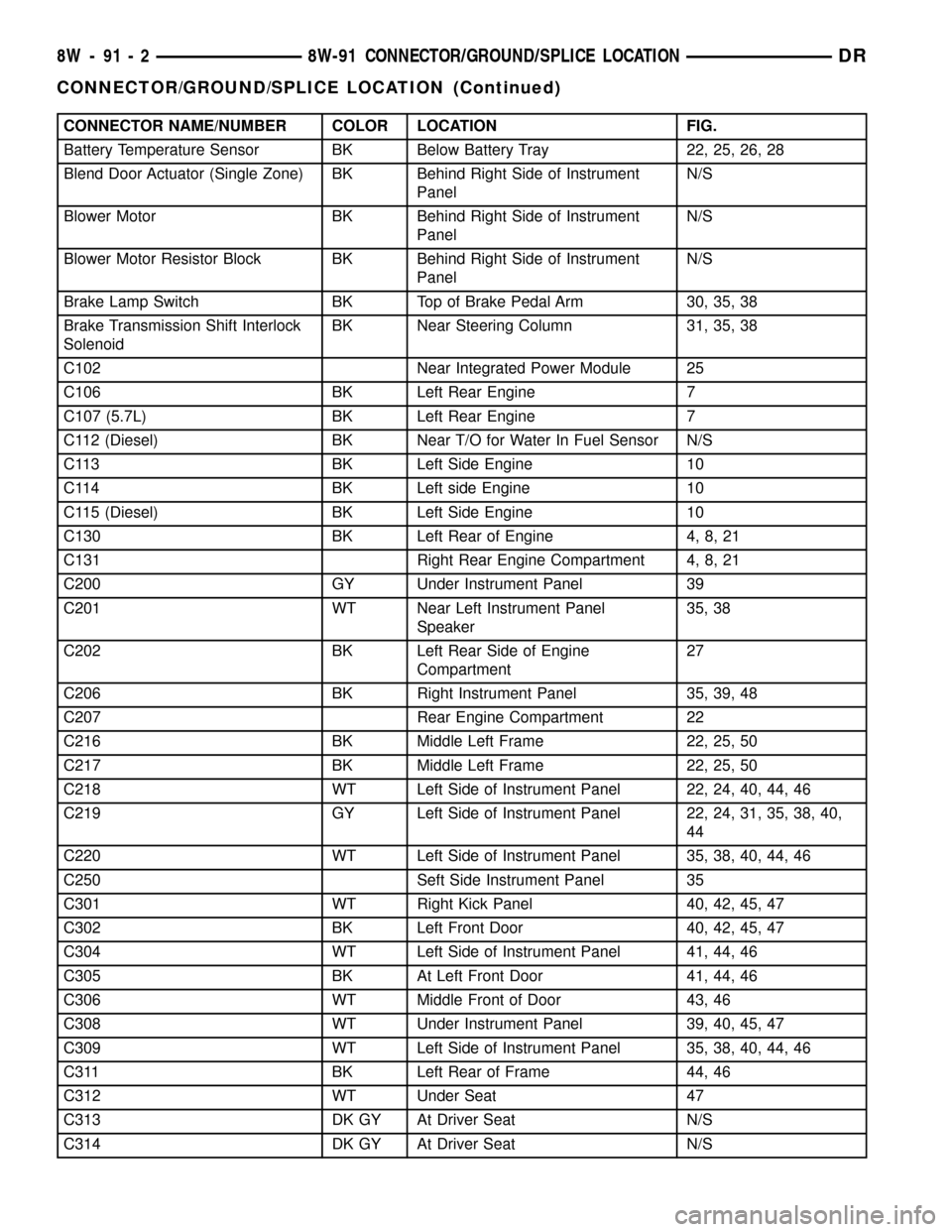
CONNECTOR NAME/NUMBER COLOR LOCATION FIG.
Battery Temperature Sensor BK Below Battery Tray 22, 25, 26, 28
Blend Door Actuator (Single Zone) BK Behind Right Side of Instrument
PanelN/S
Blower Motor BK Behind Right Side of Instrument
PanelN/S
Blower Motor Resistor Block BK Behind Right Side of Instrument
PanelN/S
Brake Lamp Switch BK Top of Brake Pedal Arm 30, 35, 38
Brake Transmission Shift Interlock
SolenoidBK Near Steering Column 31, 35, 38
C102 Near Integrated Power Module 25
C106 BK Left Rear Engine 7
C107 (5.7L) BK Left Rear Engine 7
C112 (Diesel) BK Near T/O for Water In Fuel Sensor N/S
C113 BK Left Side Engine 10
C114 BK Left side Engine 10
C115 (Diesel) BK Left Side Engine 10
C130 BK Left Rear of Engine 4, 8, 21
C131 Right Rear Engine Compartment 4, 8, 21
C200 GY Under Instrument Panel 39
C201 WT Near Left Instrument Panel
Speaker35, 38
C202 BK Left Rear Side of Engine
Compartment27
C206 BK Right Instrument Panel 35, 39, 48
C207 Rear Engine Compartment 22
C216 BK Middle Left Frame 22, 25, 50
C217 BK Middle Left Frame 22, 25, 50
C218 WT Left Side of Instrument Panel 22, 24, 40, 44, 46
C219 GY Left Side of Instrument Panel 22, 24, 31, 35, 38, 40,
44
C220 WT Left Side of Instrument Panel 35, 38, 40, 44, 46
C250 Seft Side Instrument Panel 35
C301 WT Right Kick Panel 40, 42, 45, 47
C302 BK Left Front Door 40, 42, 45, 47
C304 WT Left Side of Instrument Panel 41, 44, 46
C305 BK At Left Front Door 41, 44, 46
C306 WT Middle Front of Door 43, 46
C308 WT Under Instrument Panel 39, 40, 45, 47
C309 WT Left Side of Instrument Panel 35, 38, 40, 44, 46
C311 BK Left Rear of Frame 44, 46
C312 WT Under Seat 47
C313 DK GY At Driver Seat N/S
C314 DK GY At Driver Seat N/S
8W - 91 - 2 8W-91 CONNECTOR/GROUND/SPLICE LOCATIONDR
CONNECTOR/GROUND/SPLICE LOCATION (Continued)
Page 2297 of 2627

VISUAL INSPECTION BEFORE WATER LEAK TESTS
Verify that floor and body plugs are in place, body
drains are clear, and body components are properly
aligned and sealed. If component alignment or seal-
ing is necessary, refer to the appropriate section of
this group for proper procedures.
WATER LEAK TESTS
WARNING: DO NOT USE ELECTRIC SHOP LIGHTS
OR TOOLS IN WATER TEST AREA. PERSONAL
INJURY CAN RESULT.
When the conditions causing a water leak have
been determined, simulate the conditions as closely
as possible.
²If a leak occurs with the vehicle parked in a
steady light rain, flood the leak area with an open-
ended garden hose.
²If a leak occurs while driving at highway speeds
in a steady rain, test the leak area with a reasonable
velocity stream or fan spray of water. Direct the
spray in a direction comparable to actual conditions.
²If a leak occurs when the vehicle is parked on an
incline, hoist the end or side of the vehicle to simu-
late this condition. This method can be used when
the leak occurs when the vehicle accelerates, stops or
turns. If the leak occurs on acceleration, hoist the
front of the vehicle. If the leak occurs when braking,
hoist the back of the vehicle. If the leak occurs on left
turns, hoist the left side of the vehicle. If the leak
occurs on right turns, hoist the right side of the vehi-
cle. For hoisting recommendations (Refer to LUBRI-
CATION & MAINTENANCE/HOISTING -
STANDARD PROCEDURE).
WATER LEAK DETECTION
To detect a water leak point-of-entry, do a water
test and watch for water tracks or droplets forming
on the inside of the vehicle. If necessary, remove inte-
rior trim covers or panels to gain visual access to the
leak area. If the hose cannot be positioned without
being held, have someone help do the water test.
Some water leaks must be tested for a considerable
length of time to become apparent. When a leak
appears, find the highest point of the water track or
drop. The highest point usually will show the point of
entry. After leak point has been found, repair the
leak and water test to verify that the leak has
stopped.
Locating the entry point of water that is leaking
into a cavity between panels can be difficult. The
trapped water may splash or run from the cavity,
often at a distance from the entry point. Most water
leaks of this type become apparent after accelerating,
stopping, turning, or when on an incline.MIRROR INSPECTION METHOD
When a leak point area is visually obstructed, use
a suitable mirror to gain visual access. A mirror can
also be used to deflect light to a limited-access area
to assist in locating a leak point.
BRIGHT LIGHT LEAK TEST METHOD
Some water leaks in the luggage compartment can
be detected without water testing. Position the vehi-
cle in a brightly lit area. From inside the darkened
luggage compartment inspect around seals and body
seams. If necessary, have a helper direct a drop light
over the suspected leak areas around the luggage
compartment. If light is visible through a normally
sealed location, water could enter through the open-
ing.
PRESSURIZED LEAK TEST METHOD
When a water leak into the passenger compart-
ment cannot be detected by water testing, pressurize
the passenger compartment and soap test exterior of
the vehicle. To pressurize the passenger compart-
ment, close all doors and windows, start engine, and
set heater control to high blower in HEAT position. If
engine can not be started, connect a charger to the
battery to ensure adequate voltage to the blower.
With interior pressurized, apply dish detergent solu-
tion to suspected leak area on the exterior of the
vehicle. Apply detergent solution with spray device or
soft bristle brush. If soap bubbles occur at a body
seam, joint, seal or gasket, the leak entry point could
be at that location.
DIAGNOSIS AND TESTING - WIND NOISE
Wind noise is the result of most air leaks. Air leaks
can be caused by poor sealing, improper body compo-
nent alignment, body seam porosity, or missing plugs
in the engine compartment or door hinge pillar areas.
All body sealing points should be airtight in normal
driving conditions. Moving sealing surfaces will not
always seal airtight under all conditions. At times,
side glass or door seals will allow wind noise to be
noticed in the passenger compartment during high
cross winds. Over compensating on door or glass
adjustments to stop wind noise that occurs under
severe conditions can cause premature seal wear and
excessive closing or latching effort. After a repair pro-
cedure has been performed, test vehicle to verify
noise has stopped before returning vehicle to use.
VISUAL INSPECTION BEFORE TESTS
Verify that floor and body plugs are in place and
body components are aligned and sealed. If compo-
nent alignment or sealing is necessary, refer to the
appropriate section of this group for proper proce-
dures.
23 - 2 BODYDR
BODY (Continued)
Page 2488 of 2627

HEATING & AIR CONDITIONING
TABLE OF CONTENTS
page page
HEATING & AIR CONDITIONING
DESCRIPTION
DESCRIPTION - ENGINE COOLING
SYSTEM REQUIREMENTS...............1
DESCRIPTION - HEATER AND AIR
CONDITIONER........................1
OPERATION - HEATER AND AIR
CONDITIONER........................1
DIAGNOSIS AND TESTING
DIAGNOSIS AND TESTING - A/C
PERFORMANCE.......................3DIAGNOSIS AND TESTING - HEATER
PERFORMANCE TEST..................6
SPECIFICATIONS - A/C SYSTEM............7
CONTROLS.............................9
DISTRIBUTION..........................26
PLUMBING.............................41
HEATING & AIR
CONDITIONING
DESCRIPTION
DESCRIPTION - ENGINE COOLING SYSTEM
REQUIREMENTS
To maintain the performance level of the heating,
ventilation and air conditioning (HVAC) system, the
engine cooling system must be properly maintained.
The use of a bug screen is not recommended. Any
obstructions in front of the radiator or A/C condenser
will reduce the performance of the A/C and engine
cooling systems.
The engine cooling system includes the radiator,
thermostat, radiator hoses and the engine coolant
pump. Refer to Cooling for more information before
opening or attempting any service to the engine cool-
ing system.
DESCRIPTION - HEATER AND AIR
CONDITIONER
A manually controlled single zone type heating-air
conditioning system or a manually controlled dual
zone type heating-air conditioning system is available
on this model.
All vehicles are equipped with a common heater,
ventilation and air conditioning (HVAC) housing (Fig.
1). The system combines air conditioning, heating,
and ventilating capabilities in a single unit housing
mounted within the passenger compartment under
the instrument panel. The HVAC housing includes:
²Blower motor
²Blower motor resistor block²Heater core
²Evaporator coil
²Blend door and actuator
²Defrost door and actuator
²Mode door and actuator
²Recirculation door and actuator
Based upon the system and mode selected, condi-
tioned air can exit the HVAC housing through one or
a combination of the three main housing outlets:
defrost, panel or floor. The defrost outlet is located on
the top of the housing, the panel outlet is located on
the face of the housing and the floor outlet is located
on the bottom of the housing. Once the conditioned
air exits the unit housing, it is further directed
through molded plastic ducts to the various outlets in
the vehicle interior. These outlets and their locations
are as follows:
²Defroster Outlet- A single large defroster out-
let is located in the center of the instrument panel
top cover, near the base of the windshield.
²Side Window Demister Outlets- There are
two side window demister outlets, one is located at
each outboard end of the instrument panel top cover,
near the belt line at the A-pillars.
²Panel Outlets- There are four panel outlets in
the instrument panel, one located near each outboard
end of the instrument panel facing the rear of the
vehicle and two located near the top of the instru-
ment panel center bezel.
²Front Floor Outlets- There are two front floor
outlets, one located above each side of the floor panel
center tunnel near the dash panel.
OPERATION - HEATER AND AIR CONDITIONER
The heating and air conditioning systems pulls
outside (ambient) air through the cowl opening at the
base of the windshield, then into the plenum cham-
DRHEATING & AIR CONDITIONING 24 - 1
Page 2489 of 2627

ber above the heating, ventilation and air condition-
ing (HVAC) housing. On models equipped with air
conditioning, the air passes through the evaporator
coil. Air flow can be directed either through or
around the heater core. This is done by adjusting the
blend door with the temperature control knob on the
A/C-heater control located the instrument panel. The
air flow can then be directed from the panel, floor
and defrost outlets in various combinations using the
mode control knob located on the A/C-heater control.
Air flow velocity can be adjusted with the blower
speed selector located on the A/C-heater control.
NOTE: It is important to keep the air intake opening
clear of debris. Leaf particles and other debris that
is small enough to pass through the cowl opening
screen can accumulate within the HVAC housing.
The closed, warm, damp and dark environment cre-
ated within the housing is ideal for the growth of
certain molds, mildews and other fungi. Any accu-mulation of decaying plant matter provides an addi-
tional food source for fungal spores, which enter
the housing with the fresh intake-air. Excess debris,
as well as objectionable odors created by decaying
plant matter and growing fungi can be discharged
into the passenger compartment during heater-A/C
operation if the air intake opening is not kept clear
of debris.
The heater and air conditioning systems are blend-
air type systems. In a blend-air system, a blend door
controls the amount of unconditioned air (or cooled
air from the evaporator on models with air condition-
ing) that is allowed to flow through, or around, the
heater core. A temperature control knob determines
the discharge air temperature by actuating an elec-
tric motor, which operates the blend door. This allows
an almost immediate control of the output air tem-
perature of the system.
On all models, the outside air intake can be shut
off by selecting the Recirculation Mode with the
mode control knob. This will operate a electric actu-
ated recirculation air door that closes off the outside
fresh air intake and recirculates the air that is
already inside the vehicle.
The air conditioning compressor can be engaged in
any mode by pressing the snowflake, A/C on/off but-
ton. It can also be engaged by placing the mode con-
trol in the mix to defrost positions. This will remove
heat and humidity from the air before it is directed
through or around the heater core. The mode control
knob on the A/C-heater control is used to also direct
the conditioned air to the selected system outlets.
The mode control switch uses an electric motor to
control the mode doors.
The defroster outlet receives airflow from the
HVAC housing through the molded plastic defroster
duct, which connects to the HVAC housing defroster
outlet. The airflow from the defroster outlets is
directed by fixed vanes in the defroster outlet grilles
and cannot be adjusted. The defroster outlet grilles
are integral to the instrument panel top cover.
The side window demister outlets receive airflow
from the HVAC housing through the molded plastic
defroster duct and two molded plastic demister ducts.
The airflow from the side window demister outlets is
directed by fixed vanes in the demister outlet grilles
and cannot be adjusted. The side window demister
outlet grilles are integral to the instrument panel.
The demisters direct air from the HVAC housing
through the outlets located on the top corners of the
instrument panel. The demisters operate when the
mode control knob is positioned in the floor-defrost
and defrost-only settings. Some air may be noticeable
from the demister outlets when the mode control is
in the bi-level to floor positions.
Fig. 1 HVAC Housing - Dual Zone Shown, Single
Zone Typical
1 - NUT
2 - PASSENGER BLEND DOOR ACTUATOR
3 - NUT
4 - INLET BAFFLE
5 - RECIRCULATION DOOR ACTUATOR
6 - RECIRCULATION DOOR
7 - DRIVER SIDE BLEND DOOR ACTUATOR
8 - HVAC HOUSING
9 - BOLT
10 - DEFROSTER DOOR ACTUATOR
11 - MODE DOOR ACTUATOR
24 - 2 HEATING & AIR CONDITIONINGDR
HEATING & AIR CONDITIONING (Continued)