1998 DODGE RAM 1500 5.9l
[x] Cancel search: 5.9lPage 1641 of 2627

is the primary engine speed indicator for the engine
after the engine is running.
REMOVAL
The Camshaft Position Sensor (CMP) on the 5.9L
diesel engine is located below the fuel injection
pump. It is bolted to the back of the timing gear
housing (Fig. 9).
(1) Disconnect electrical connector at CMP sensor
(Fig. 9).
(2) Remove sensor mounting bolt.
(3) Carefully twist sensor from timing gear hous-
ing.
(4) Check condition of sensor o-ring.
INSTALLATION
(1) Clean out machined hole in back of timing gear
housing (cover).
(2) Apply a small amount of engine oil to sensor
o-ring.
(3) Install sensor into timing gear housing (cover)
with a slight rocking action. Do not twist sensor into
position as damage to o-ring may result.
CAUTION: Before tightening sensor mounting bolt,
be sure sensor is completely flush to back of timingchain housing (cover). If sensor is not flush, dam-
age to sensor mounting tang may result.
(4) Install mounting bolt and tighten. Refer to
Torque Specifications.
(5) Connect electrical connector to sensor.
CRANKSHAFT POSITION
SENSOR
DESCRIPTION
The Crankshaft Position Sensor (CKP) on the die-
sel engine is attached at the front / left side of the
engine next to the engine harmonic balancer (crank-
shaft damper).
OPERATION
The Crankshaft Position Sensor (CKP) is the pri-
mary engine speed indicator for the engine after the
engine is running (Fig. 10). The CKP contains a hall
effect device. A rotating, notched target wheel (tone-
wheel) for the CKP is located on the engine harmonic
balancer (Fig. 11). This hall effect device detects
notches located on the tonewheel. As the tonewheel
rotates, the notches pass the tip of the CKP.
Fig. 8 5.9L DIESEL CMP
1 - CMP
2 - FUEL INJECTION PUMP (BOTTOM)
3 - ELECTRONIC CONTROL MODULE (ECM)
4 - ECM ELEC. CONNECTOR
5 - CMP ELEC. CONNECTOR
6 - CMP MOUNTING BOLT
7 - BACK OF TIMING GEAR HOUSING
Fig. 9 5.9L DIESEL CMP
1 - CMP
2 - FUEL INJECTION PUMP (BOTTOM)
3 - ELECTRONIC CONTROL MODULE (ECM)
4 - ECM ELEC. CONNECTOR
5 - CMP ELEC. CONNECTOR
6 - CMP MOUNTING BOLT
7 - BACK OF TIMING GEAR HOUSING
14 - 72 FUEL INJECTION - DIESELDR
CAMSHAFT POSITION SENSOR (Continued)
Page 1642 of 2627

When the leading edge of the tonewheel notch
passes the tip of the CKP, the following occurs: The
interruption of magnetic field causes the voltage to
switch high resulting in a signal of approximately 5
volts.
When the trailing edge of the tonewheel notch
passes the tip of the CKP, the following occurs: The
change of the magnetic field causes the signal voltage
to switch low to 0 volts.
The Camshaft Position Sensor (CMP) also provides
a signal to the Engine Control Module (ECM) at all
times when the engine is running. The ECM uses
this CMP information primarily on engine start-up.
Once the engine is running, the ECM uses the CMP
as a backup sensor for engine speed.
REMOVAL
(1) Raise and support vehicle
(2) Disconnect electrical connector at CKP sensor
(Fig. 12).
(3) Remove 1 sensor mounting bolt.
(4) Remove CKP sensor.
INSTALLATION
(1) Position and install CKP sensor to engine.
(2) Install 1 sensor mounting bolt and tighten to 9
N´m (80 in. lbs.) torque.(3) Install electrical connector to CKP sensor (Fig.
12).
Fig. 10 5.9L DIESEL CKP
1 - ENGINE HARMONIC BALANCER
2 - FRONT OF TIMING GEAR COVER
3 - CKP MOUNTING BOLT
4 - ELEC. CONNECTOR
5 - CKP SENSOR
6 - NOTCHES
Fig. 11 CKP NOTCHED TONEWHEEL
1 - ENGINE HARMONIC BALANCER
2 - NOTCHED TONEWHEEL
3 - FRONT OF CRANKSHAFT
Fig. 12 5.9L DIESEL CKP
1 - ENGINE HARMONIC BALANCER
2 - FRONT OF TIMING GEAR COVER
3 - CKP MOUNTING BOLT
4 - ELEC. CONNECTOR
5 - CKP SENSOR
6 - NOTCHES
DRFUEL INJECTION - DIESEL 14 - 73
CRANKSHAFT POSITION SENSOR (Continued)
Page 1648 of 2627

(8) Connect battery cables to both batteries.
(9) Start engine and check for leaks.
INLET AIR TEMPERATURE
SENSOR/PRESSURE SENSOR
DESCRIPTION
The combination, dual function Inlet Air Tempera-
ture/Pressure Sensor is located on the air cleaner (fil-
ter) cover.
OPERATION
The Inlet Air Temperature/Pressure Sensor is a
combination dual-function sensor. The sensor element
extends into the intake air stream at the top of the
air filter housing. Ambient air temperature as well as
barometric pressure is monitored by this sensor. The
Engine Control Module (ECM) monitors signals from
this sensor.
REMOVAL
The Inlet Air Temperature/Pressure Sensor is
located on the air cleaner cover (Fig. 23).
(1) Disconnect electrical connector at sensor (Fig.
24).
(2) Remove two Torx-type mounting screws.
(3) Remove sensor from air cleaner cover.
(4) Check condition of sensor o-ring (Fig. 25).
INSTALLATION
(1) Check condition of sensor o-ring.
(2) Position sensor into top of air cleaner cover
with a slight twisting action.
(3) Install 2 mounting screws.
(4) Install electrical connector.
Fig. 22 FUEL INJECTOR RAIL
1 - FUEL RAIL MOUNTING BOLTS (3)
2 - INSULATED CLAMPS
3 - FUEL INJECTOR RAIL
Fig. 23 IAT/PRESSURE SENSOR LOCATION - 5.9L
DIESEL
1 - CLIPS
2 - FILTER COVER
3 - FILTER MINDERŸ
4 - INLET AIR TEMPERATURE/ PRESSURE SENSOR
5 - FILTER HOUSING
DRFUEL INJECTION - DIESEL 14 - 79
FUEL INJECTOR RAIL (Continued)
Page 1695 of 2627

OPERATION
Hydraulic pressure is provided for the power steer-
ing gear by the belt driven power steering pump (Fig.
1). The power steering pumps are constant flow rate
and displacement, vane-type pumps.
DIAGNOSIS AND TESTING - PUMP LEAKAGE
The pump is serviced as an assembly and should
not be disassembled. The plastic pump reservoir and
the reservoir o-rings can be replaced.
Check for leaks in the following areas:
²Pump shaft seal behind the pulley
²Pump to reservoir O-ring
²Reservoir cap
²Pressure and return lines
²Flow control valve fitting
STANDARD PROCEDURE
STANDARD PROCEDURE - POWER STEERING
PUMP - INITIAL OPERATION
WARNING: THE FLUID LEVEL SHOULD BE
CHECKED WITH ENGINE OFF TO PREVENT INJURY
FROM MOVING COMPONENTS.
CAUTION: MOPARTATF+4 is to be used in the
power steering system. No other power steering or
automatic transmission fluid is to be used in the
system. Damage may result to the power steeringpump and system if any other fluid is used, and do
not overfill.
Wipe filler cap clean, then check the fluid level.
The dipstick should indicateCOLDwhen the fluid is
at normal temperature.
(1) Turn steering wheel all the way to the left
(2) Fill the pump fluid reservoir to the proper level
and let the fluid settle for at least two (2) minutes.
(3) Raise the front wheels off the ground.
(4) Slowly turn the steering wheel lock-to-lock 20
times with the engine off while checking the fluid
level.
NOTE: For vehicles with long return lines or oil
coolers turn wheel 40 times.
(5) Start the engine. With the engine idling main-
tain the fluid level.
(6) Lower the front wheels and let the engine idle
for two minutes.
(7) Turn the steering wheel in both direction and
verify power assist and quiet operation of the pump.
If the fluid is extremely foamy or milky looking,
allow the vehicle to stand a few minutes and repeat
the procedure.
CAUTION: Do not run a vehicle with foamy fluid for
an extended period. This may cause pump damage.
STANDARD PROCEDURE - FLUSHING POWER
STEERING SYSTEM
Flushing is required when the power steering/hy-
draulic booster system fluid has become contami-
nated. Contaminated fluid in the steering/booster
system can cause seal deterioration and affect steer-
ing gear/booster spool valve operation.
(1) Raise the front end of the vehicle off the
ground until the wheels are free to turn.
(2) Remove the return line from the pump.
NOTE: If vehicle is equipped with a hydraulic
booster remove both return lines from the pump.
(3) Plug the return line port/ports at the pump.
(4) Position the return line/lines into a large con-
tainer to catch the fluid.
(5) While an assistant is filling the pump reservoir
start the engine.
(6) With the engine running at idle turn the wheel
back and forth.
NOTE: Do not contact or hold the wheel against the
steering stops.
(7) Run a quart of fluid through the system then
stop the engine and install the return line/lines.
Fig. 1 POWER STEERING PUMP
1 - 3.7L & 4.7L (6 GROOVE)
PHENOLIC (PLASTIC TYPE) PULLEY
1 - 5.7L,5.9L & 8.0L (7 GROOVE)
PHENOLIC (PLASTIC TYPE) PULLEY
1 - 5.9L DIESEL (8 GROOVE)
STEEL PULLEY
2 - PUMP ASSEMBLY
3 - RESERVOIR
4 - CAP
19 - 40 PUMPDR
PUMP (Continued)
Page 1701 of 2627

(4) Remove the support and lower the vehicle.
(5) Reconnect the return hose at the reservoir.
(6) Refill the power steering system,(Refer to 19 -
STEERING/PUMP - STANDARD PROCEDURE).
POWER STEERING PRESSURE
SWITCH
DESCRIPTION
A pressure sensing switch is used in the power
steering system. It is mounted on the high-pressure
steering hose (Fig. 9). This switch will be used with
both 3.7L and 5.7L engines. There is no pressure
switch used for the 4.7L or the 5.9L pump.
OPERATION
The switch is used on the 3.7L V-6 & 5.7L V-8
engines.
The power steering pressure switch provides an
input to the Powertrain Control Module (PCM). This
input is provided during periods of high steering
pump load and low engine rpm; such as during park-
ing maneuvers. The PCM increases the idle speed
through the Idle Air Control (IAC) motor. This is
done to prevent the engine from stalling under the
increased load.
When steering pump pressure exceeds 3275 kPa
690 kPa (475 psi 100 psi), the Normally Closed
(NC) switch will open and the PCM will increase the
engine idle speed. This will prevent the engine from
stalling.
When pump pressure drops to approximately 1379
kPa (200 psi), the switch circuit will re-close and
engine idle speed will return to its previous setting.
REMOVAL - 3.7L & 5.7L
The power steering pressure switch is installed in
the power steering high-pressure hose (Fig. 9).
(1) Disconnect electrical connector from power
steering pressure switch.(2) Place a small container or shop towel beneath
switch to collect any excess fluid.
(3) Remove switch. Use back-up wrench on power
steering line to prevent line bending.
INSTALLATION - 3.7L & 5.7L
This switch is used only with the 3.7L V±6 and the
5.7L V-8 engines.
(1) Install power steering switch into power steer-
ing line.
(2) Tighten to 8±11 N´m (70±100 in. lbs.) torque.
(3) Connect electrical connector to switch.
(4) Check power steering fluid and add as neces-
sary.
(5) Start engine and again check power steering
fluid. Add fluid if necessary.
Fig. 9 PRESSURE SWITCH
1 - POWER STEERING PULLEY
2 - POWER STEERING PUMP HOUSING
3 - POWER STEERING FLUID RESERVOIR
4 - RETURN HOSE
5 - HIGH PRESSURE HOSE WITH PRESSURE SWITCH
19 - 46 PUMPDR
HOSES - LINK/COIL (Continued)
Page 2494 of 2627
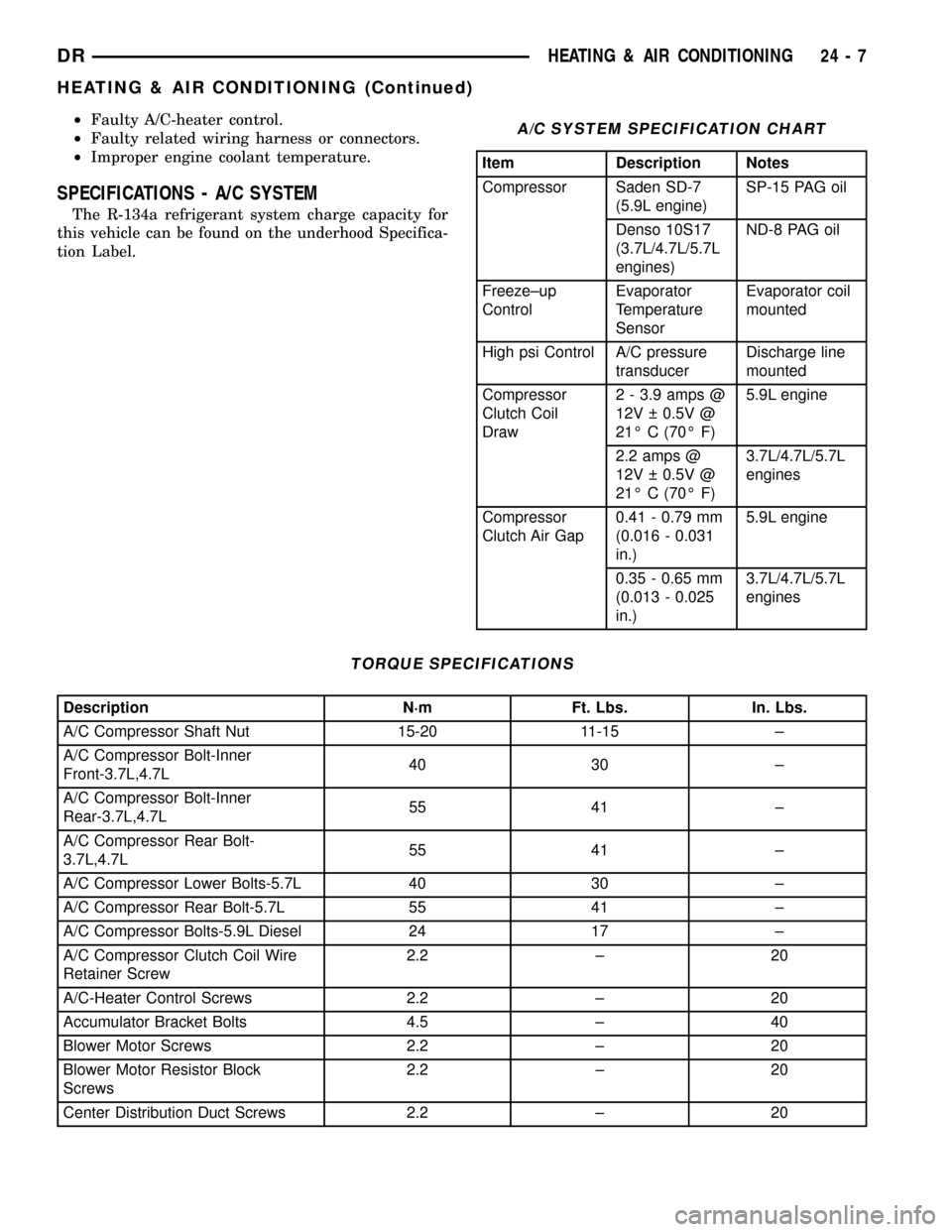
²Faulty A/C-heater control.
²Faulty related wiring harness or connectors.
²Improper engine coolant temperature.
SPECIFICATIONS - A/C SYSTEM
The R-134a refrigerant system charge capacity for
this vehicle can be found on the underhood Specifica-
tion Label.
A/C SYSTEM SPECIFICATION CHART
Item Description Notes
Compressor Saden SD-7
(5.9L engine)SP-15 PAG oil
Denso 10S17
(3.7L/4.7L/5.7L
engines)ND-8 PAG oil
Freeze±up
ControlEvaporator
Temperature
SensorEvaporator coil
mounted
High psi Control A/C pressure
transducerDischarge line
mounted
Compressor
Clutch Coil
Draw2 - 3.9 amps @
12V 0.5V @
21É C (70É F)5.9L engine
2.2 amps @
12V 0.5V @
21É C (70É F)3.7L/4.7L/5.7L
engines
Compressor
Clutch Air Gap0.41 - 0.79 mm
(0.016 - 0.031
in.)5.9L engine
0.35 - 0.65 mm
(0.013 - 0.025
in.)3.7L/4.7L/5.7L
engines
TORQUE SPECIFICATIONS
Description N´m Ft. Lbs. In. Lbs.
A/C Compressor Shaft Nut 15-20 11-15 ±
A/C Compressor Bolt-Inner
Front-3.7L,4.7L40 30 ±
A/C Compressor Bolt-Inner
Rear-3.7L,4.7L55 41 ±
A/C Compressor Rear Bolt-
3.7L,4.7L55 41 ±
A/C Compressor Lower Bolts-5.7L 40 30 ±
A/C Compressor Rear Bolt-5.7L 55 41 ±
A/C Compressor Bolts-5.9L Diesel 24 17 ±
A/C Compressor Clutch Coil Wire
Retainer Screw2.2 ± 20
A/C-Heater Control Screws 2.2 ± 20
Accumulator Bracket Bolts 4.5 ± 40
Blower Motor Screws 2.2 ± 20
Blower Motor Resistor Block
Screws2.2 ± 20
Center Distribution Duct Screws 2.2 ± 20
DRHEATING & AIR CONDITIONING 24 - 7
HEATING & AIR CONDITIONING (Continued)
Page 2495 of 2627
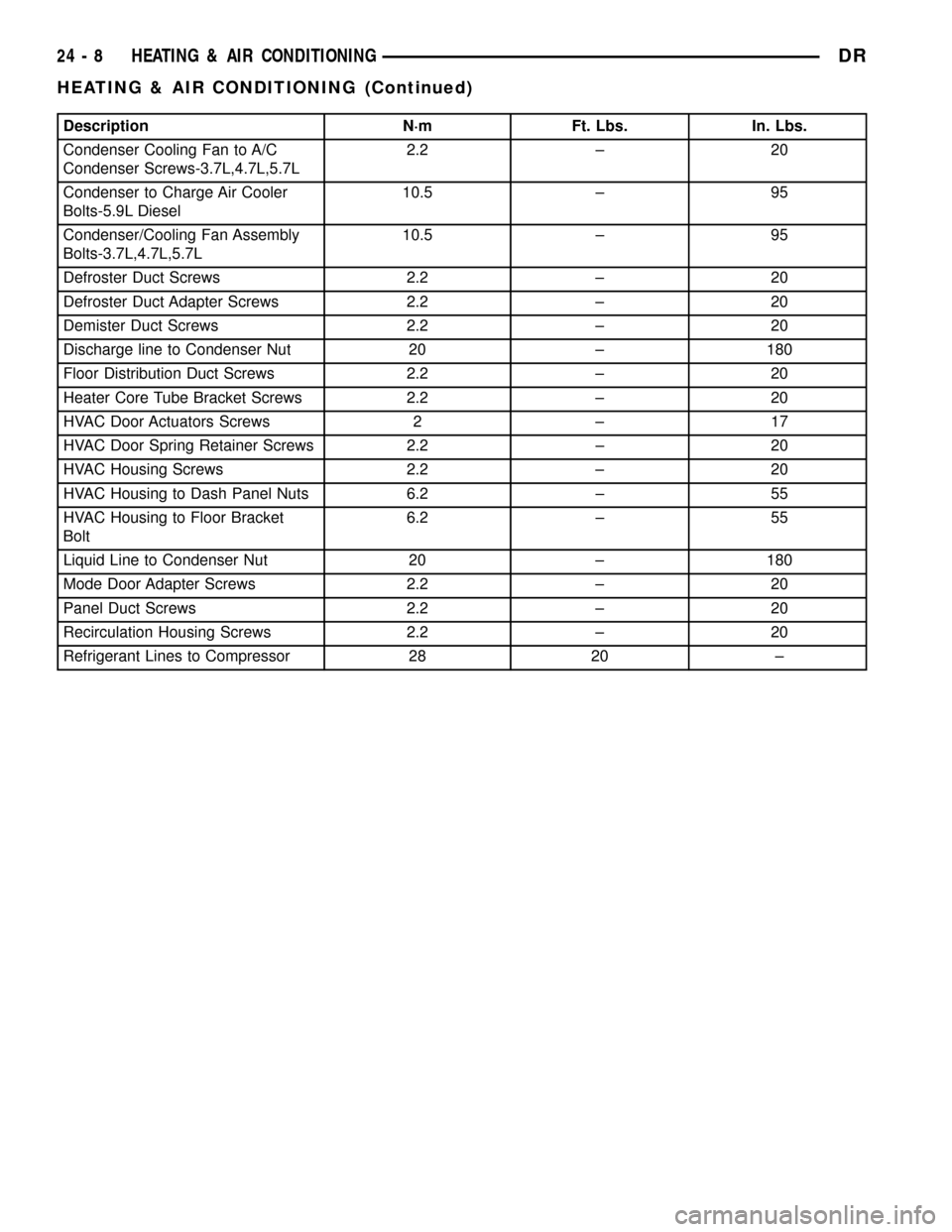
Description N´m Ft. Lbs. In. Lbs.
Condenser Cooling Fan to A/C
Condenser Screws-3.7L,4.7L,5.7L2.2 ± 20
Condenser to Charge Air Cooler
Bolts-5.9L Diesel10.5 ± 95
Condenser/Cooling Fan Assembly
Bolts-3.7L,4.7L,5.7L10.5 ± 95
Defroster Duct Screws 2.2 ± 20
Defroster Duct Adapter Screws 2.2 ± 20
Demister Duct Screws 2.2 ± 20
Discharge line to Condenser Nut 20 ± 180
Floor Distribution Duct Screws 2.2 ± 20
Heater Core Tube Bracket Screws 2.2 ± 20
HVAC Door Actuators Screws 2 ± 17
HVAC Door Spring Retainer Screws 2.2 ± 20
HVAC Housing Screws 2.2 ± 20
HVAC Housing to Dash Panel Nuts 6.2 ± 55
HVAC Housing to Floor Bracket
Bolt6.2 ± 55
Liquid Line to Condenser Nut 20 ± 180
Mode Door Adapter Screws 2.2 ± 20
Panel Duct Screws 2.2 ± 20
Recirculation Housing Screws 2.2 ± 20
Refrigerant Lines to Compressor 28 20 ±
24 - 8 HEATING & AIR CONDITIONINGDR
HEATING & AIR CONDITIONING (Continued)
Page 2528 of 2627

PLUMBING
TABLE OF CONTENTS
page page
PLUMBING
DESCRIPTION - REFRIGERANT LINE.......42
OPERATION- REFRIGERANT LINES........42
WARNING
ENGINE COOLING SYSTEM.............42
A/C SYSTEM.........................43
CAUTION
A/C SYSTEM.........................43
DIAGNOSIS AND TESTING - REFRIGERANT
SYSTEM LEAKS......................44
STANDARD PROCEDURE
STANDARD PROCEDURE - HANDLING
TUBING AND FITTINGS.................45
STANDARD PROCEDURE - DIODE
REPLACEMENT.......................45
STANDARD PROCEDURE - REFRIGERANT
SYSTEM SERVICE EQUIPMENT..........46
STANDARD PROCEDURE - REFRIGERANT
RECOVERY..........................47
STANDARD PROCEDURE - REFRIGERANT
SYSTEM EVACUATE...................47
STANDARD PROCEDURE - REFRIGERANT
SYSTEM CHARGE.....................47
A/C COMPRESSOR
DESCRIPTION
DESCRIPTION - A/C COMPRESSOR.......48
DESCRIPTION - HIGH PRESSURE RELIEF
VALVE..............................48
OPERATION
OPERATION - A/C COMPRESSOR........48
OPERATION - HIGH PRESSURE RELIEF
VALVE..............................48
DIAGNOSIS AND TESTING - A/C
COMPRESSOR.......................49
REMOVAL.............................49
INSTALLATION.........................51
A/C CONDENSER
DESCRIPTION.........................52
OPERATION...........................52
REMOVAL
REMOVAL - 3.7, 4.7 AND 5.7L ENGINES....52
REMOVAL - 5.9L DIESEL ENGINE.........53
INSTALLATION
INSTALLATION - 3.7, 4.7 AND 5.7L ENGINES . 53
INSTALLATION - 5.9L DIESEL ENGINE.....54
A/C CONDENSER FAN
REMOVAL - 3.7, 4.7 and 5.7L ENGINES......55
INSTALLATION - 3.7, 4.7 and 5.7L ENGINES . . . 55A/C DISCHARGE LINE
DESCRIPTION.........................56
REMOVAL
REMOVAL - 5.9L DIESEL ENGINE.........56
REMOVAL - 3.7L/4.7L AND 5.7L HEMI
ENGINE.............................57
INSTALLATION
INSTALLATION - 5.9L DIESEL ENGINE.....58
INSTALLATION - 3.7L/4.7L AND 5.7L HEMI
ENGINE.............................59
A/C EVAPORATOR
DESCRIPTION.........................59
OPERATION...........................59
REMOVAL.............................60
INSTALLATION.........................60
A/C ORIFICE TUBE
DESCRIPTION.........................60
OPERATION...........................60
DIAGNOSIS AND TESTING - A/C ORIFICE
TUBE...............................61
ACCUMULATOR
DESCRIPTION.........................61
OPERATION...........................61
REMOVAL.............................61
INSTALLATION.........................62
HEATER CORE
DESCRIPTION.........................63
OPERATION...........................63
REMOVAL.............................63
INSTALLATION.........................63
HEATER INLET HOSE
REMOVAL.............................64
INSTALLATION.........................64
HEATER RETURN HOSE
REMOVAL.............................64
INSTALLATION.........................65
LIQUID LINE
DESCRIPTION.........................65
REMOVAL.............................65
INSTALLATION.........................66
REFRIGERANT
DESCRIPTION.........................67
OPERATION...........................67
REFRIGERANT LINE COUPLER
DESCRIPTION.........................67
OPERATION...........................67
REMOVAL.............................68
INSTALLATION.........................68
DRPLUMBING 24 - 41