1998 CHEVROLET VENTURE reset
[x] Cancel search: resetPage 249 of 474
Care of Your Cassette Tape Player
A tape player that is not cleaned regularly can cause
reduced sound quality, ruined cassettes or a damaged
mechanism. Cassette tapes should be stored in their
cases away from contaminants, direct sunlight and
extreme heat.
If they aren’t, they may not operate
properly or may cause failure of the tape player.
Your tape player should be cleaned regularly after every
50 hours of use. Your radio may display CLN to indicate
that you have used your tape player for
50 hours without
resetting the tape clean timer.
If this message appears on
the display, your cassette tape player needs to be cleaned. It will still play tapes, but you should clean it as\
soon as possible to prevent damage to your tapes and
player.
If you notice a reduction in sound quality, try a
known good cassette to see if it is the tape or the tape
player at fault.
If this other cassette has no improvement
in sound quality, clean the tape player.
The recommended cleaning method for your cassette
tape player
is the use of a scrubbing action,
non-abrasive cleaning cassette with pads which scrub
the tape head as the hubs of the cleaner cassette
turn.
The recommended cleaning cassette is available through
your dealership
(GM Part No. 12344789).
When using a scrubbing action, non-abrasive cleaning
cassette, it is normal for the cassette to eject because
your unit is equipped
with a cut tape detection feature
and a cleaning cassette may appear as a broken tape. To
prevent the cleaning cassette from being ejected,
use the
following steps.
If your vehicle is equipped with the
AM-FM Stereo with
Cassette Tape Player:
1. Turn the ignition to RUN or ACCESSORY.
2. Turn the radio on.
3. Insert the scrubbing action cleaning cassette.
4. Within five seconds, press and hold the REV and
FWD buttons at the same time for three seconds. The
tape symbol on the display will flash, showing that
the cut tape detection feature is no longer active.
5. Eject the cleaning cassette after the manufacturer’s
recommended cleaning time.
3-30
ProCarManuals.com
Page 250 of 474
If your vehicle is equipped with the AM-FM Stereo with
Cassette Tape Player and Automatic Tone Control:
1. Turn the ignition to RUN or ACCESSORY.
2. Turn the radio off.
3. Press and hold the TAPE AUX button for five
seconds. The tape symbol on the display will flash
for two seconds.
4. Insert the scrubbing action cleaning cassette.
5. Eject the cleaning cassette after the manufacturer’s
recommended cleaning time.
When the cleaning cassette has been ejected, the cut tape detection feature is active again.
You may also choose a non-scrubbing action, wet-type
cleaner which uses a cassette with a fabric belt to clean
the tape head. This type of cleaning cassette will not
eject on its own.
A non-scrubbing action cleaner may
not clean as thoroughly as the scrubbing type cleaner.
The use of
a non-scrubbing action, dry-type cleaning
cassette is not recommended. After you clean the player, press and hold EJECT
for
five seconds to reset the CLN indicator. The radio will
display
--- to show the indicator was reset.
Cassettes are subject to wear and the sound quality may degrade over time. Always make sure
the cassette
tape is
in good condition before you have your tape
player serviced.
Care of Your Compact Discs
Handle discs carefully. Store them in their original cases
or other protective cases and away from direct sunlight
and dust. If the surface of a disc is soiled, dampen a
clean, soft cloth
in a mild, neutral detergent solution and
clean
it, wiping from the center to the edge.
Be sure never to touch the signal surface when handling
discs. Pick up discs by grasping the outer edges or the
edge of the hole and the outer edge.
3-31
ProCarManuals.com
Page 359 of 474
Thermostat
Engine coolant temperature is controlled by a thermostat
in the engine coolant system. The thermostat stops the
flow
of coolant through the radiator until the coolant
reaches a preset temperature.
You
can be burned if you spill coolant on hot
engine parts, Coolant contains ethylene glycol,
and
it will burn if the engine parts are hot
enough. Don't spill coolant on
a hot engine.
Radiator I ressure Cap
NOTICE:
Your radiator cap is a 15 psi (105 kPa)
pressure-type cap and must be tightly installed to
prevent coolant
loss and possible engine damage
from overheating. Be sure the arrows on the cap
line up with the overflow tube on the radiator
filler neck.
When you replace your radiator pressure cap,
a GM cap
is recommended. When you replace your thermostat, a
GM thermostat
is recommended.
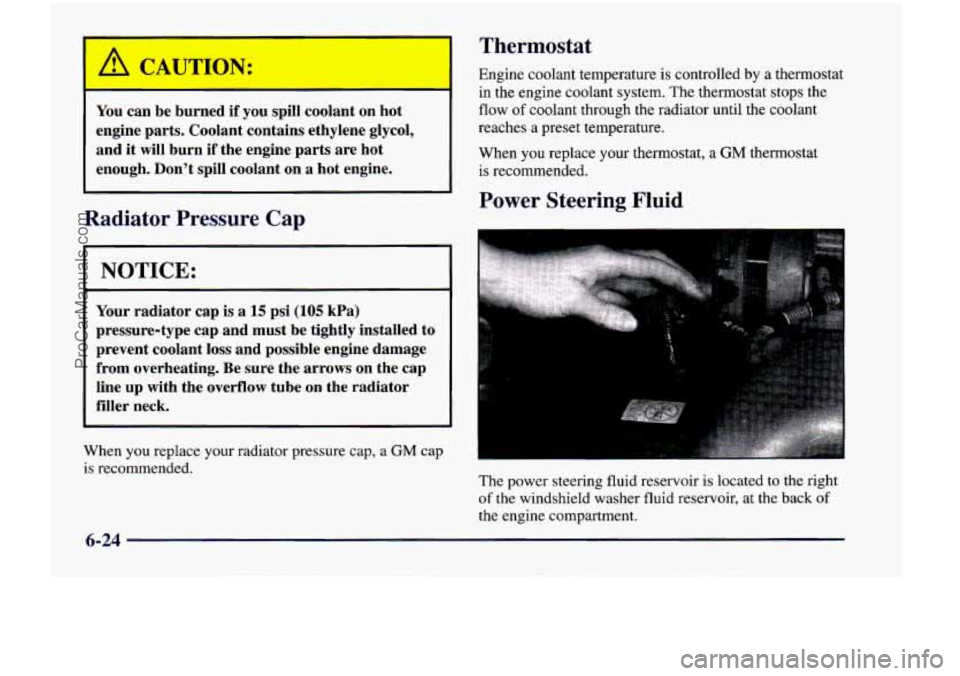
Power
Steering Fluid
'l'kv Gower steering fluid reservoir is located to the right
of the windshield washer fluid reservoir, at the back of
the engine compartment.
ProCarManuals.com
Page 381 of 474
IT T ~1 Alignment and Tire Balance
me wheels on your vehicle were aligned and balanced
carefully at the factory
to give you the longest tire life
and best overall performance.
Scheduled wheel alignment and wheel balancing are
not needed. However, if you notice unusual tire wear
or your vehicle pulling one way or the other, the
alignment may need to be reset. If you notice your
vehicle vibrating when driving on a smooth road, your
wheels may need to be rebalanced.
Wheel Replacement
Replace any wheel that is bent, cracked, or badly rusted
or corroded. If wheel nuts keep coming loose, the wheel,
wheel bolts and wheel nuts should be replaced.
If the
wheel leaks air, replace it (except some aluminum
wheels, which can sometimes be repaired). See your
dealer if any
of these conditions exist.
Your dealer will know the kind of wheel you need. Each
new wheel should have the same load-carrying
capacity, diameter, width, offset and be mounted the
same way as the one it replaces.
If you need to replace any of your wheels, wheel bolts
or wheel nuts, replace them only with new
GM original
equipment parts. This way, you will be sure to have the
right wheel, wheel bolts and wheel nuts for your
Chevrolet model.
I
Using the wrong replacement wheels, wheel
bolts or wheel nuts on your vehicle can be
dangerous. It could affect the braking and
handling of your vehicle, make your tires lose
air and make you lose control. You could have a
collision in which you or others could be injured.
Always use the correct wheel, wheel bolts and
wheel nuts for replacement.
6-46
ProCarManuals.com
Page 466 of 474
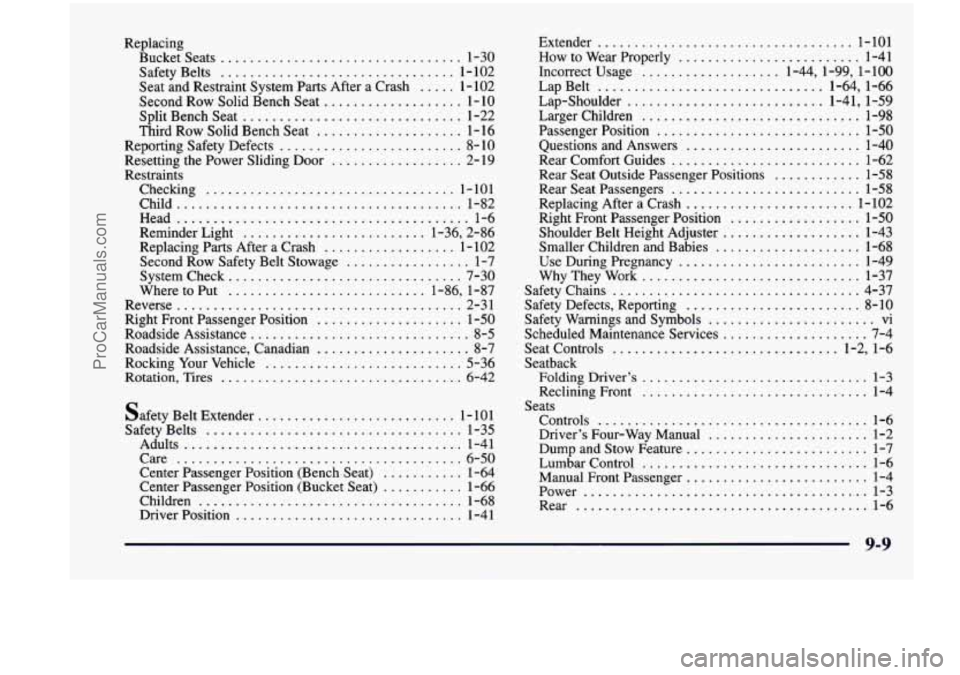
Replacing Bucketseats
................................. 1-30
Safety Belts
................................ 1-102
Seat and Restraint System Parts After a Crash
..... 1-102
Second Row Solid Bench Seat
................... 1 . 10
Split Bench Seat
.............................. 1-22
Third Row Solid Bench Seat
.................... 1- 16
Reporting Safety Defects ......................... 8- 10
Restraints
Resetting the Power Sliding Door
.................. 2- 19
Checking
.................................. 1-101
Child
....................................... 1-82
Head
........................................ 1-6
Reminder Light
......................... 1.36. 2.86
Replacing Parts After a Crash
.................. 1-102
Second Row Safety Belt Stowage
................. 1-7
Systemcheck
................................ 7-30
Where to Put
........................... 1.86. 1-87
Reverse
....................................... 2-31
Right Front Passenger Position
.................... 1-50
Roadside Assistance
.............................. 8-5
Roadside Assistance. Canadian ..................... 8-7
Rocking Your Vehicle
........................... 5-36
Rotation. Tires
................................. 6-42
Safety Belt Extender
........................... 1-101
Safety Belts
................................... 1-35
Adults
...................................... 1-41
Care
....................................... 6-50
Center Passenger Position (Bench Seat) ........... 1-64
Center Passenger Position (Bucket Seat)
........... 1-66
Children
.................................... 1-68
Driver Position
............................... 1-4 1 Extender
................................... 1-101
How to Wear Properly ......................... 1-41
Incorrect Usage
................... 1.44. 1.99. 1-100
Lap Belt
............................... 1.64. 1.66
Lap-Shoulder
........................... 1.41. 1.59
Larger Children
.............................. 1-98
Passenger Position
............................ 1-50
Questions and Answers
........................ 1-40
Rear Comfort Guides
.......................... 1-62
Rear Seat Outside Passenger Positions
............ 1-58
Replacing After a Crash
....................... 1 . 102
Right Front Passenger Position
.................. 1-50
Shoulder Belt Height Adjuster
................... 1-43
Smaller Children and Babies
.................... 1-68
Use During Pregnancy
......................... 1-49
WhyTheyWork
.............................. 1-37
SafetyChains
.................................. 4-37
Safety Defects. Reporting
........................ 8-10
Safety Warnings and Symbols
....................... vi
Scheduled Maintenance Services
.................... 7-4
Seat Controls
............................... 1.2. 1.6
Seatback Folding Driver’s
............................... 1-3
Reclining Front ............................... 1-4
Controls
..................................... 1-6
Driver’s Four-Way Manual
...................... 1-2
Dump and Stow Feature
......................... 1-7
Lumbar Control
............................... 1-6
Manual Front Passenger
......................... 1-4
Power
....................................... 1-3
Rear
........................................ 1-6
Rear Seat Passengers
.......................... 1-58
Seats
..... ...
ProCarManuals.com