Page 86 of 474
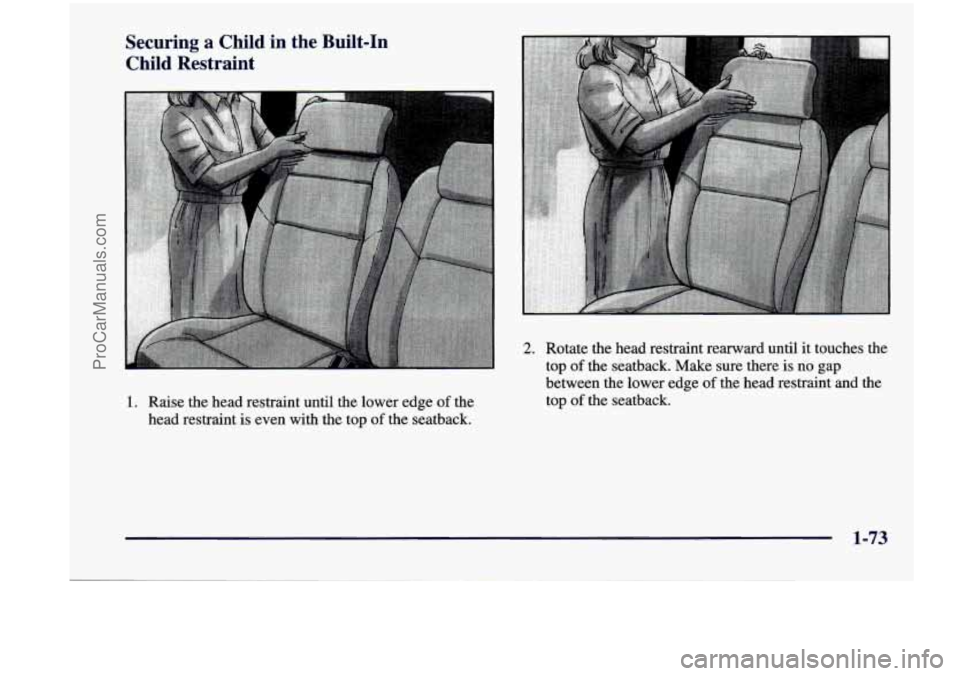
Securing a Child in the Built-In Child Restraint
1. Raise the head restraint until the lower edge of the
head restraint is even with the top
of the seatback.
2. Rotate the head restraint rearward until it touches the
top
of the seatback. Make sure there is no gap
between the lower edge
of the head restraint and the
top
of the seatback.
1-73
ProCarManuals.com
Page 88 of 474
A CAUTION:
Using the vehicle’s regular safety belts on a child
seated
on the child restraint cushion can cause
serious injury to the child in a sudden stop or
crash.
If a child is the proper size for the built-in
child restraint, secure the child using the child
restraint’s harness. But children who are too
~ large for the built-in child restraint should sit on
the vehicle’s regular seat and use the vehicle’s
adult safety belts.
WARNING! FAILURE TO FOLLOW THE
MANUFACTURER’S INSTRUCTIONS ON
THE
USE OF THIS CHILD RESTRAINT SYSTEM
CAN RESULT IN YOUR CHILD STRIKING THE
VEHICLE’S INTERIOR DURING A SUDDEN
STOP OR CRASH. SNUGLY ADJUST THE
BELTS PROVIDED WITH THIS CHILD
RESTRAINT AROUND YOUR CHILD.
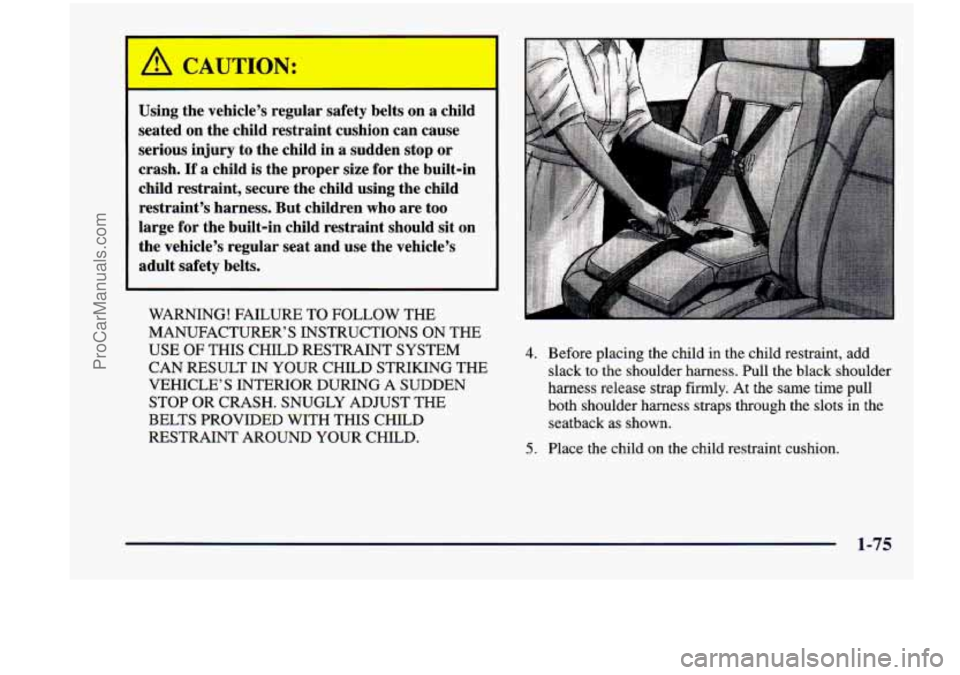
4. Before placing the child in the child restraint, add slack to the shoulder harness. Pull the black shoulder
harness release strap firmly.
At the same time pull
both shoulder harness straps through the slots in the seatback as shown.
5. Place the child on the child restraint cushion.
1-75
ProCarManuals.com
Page 92 of 474
Removing the Child from the Built-In
Child Restraint
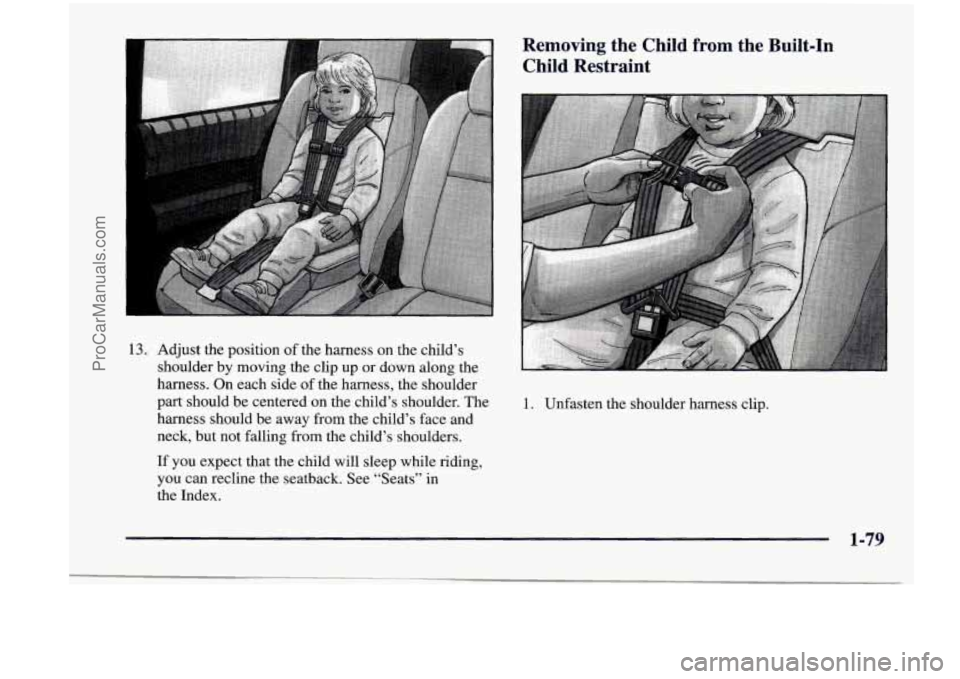
13. Adjust the position of the harness on the child’s
shoulder by moving the clip up
or down along the
harness. On each side of the harness, the shoulder
part should be centered on the child’s shoulder. The
harness should be away from the child’s face and
neck, but not falling from the child’s shoulders.
If you expect that the child will sleep while riding,
you can recline the seatback. See “Seats” in
the Index.
1. Unfasten the shoulder harness clip.
1-79
ProCarManuals.com
Page 94 of 474
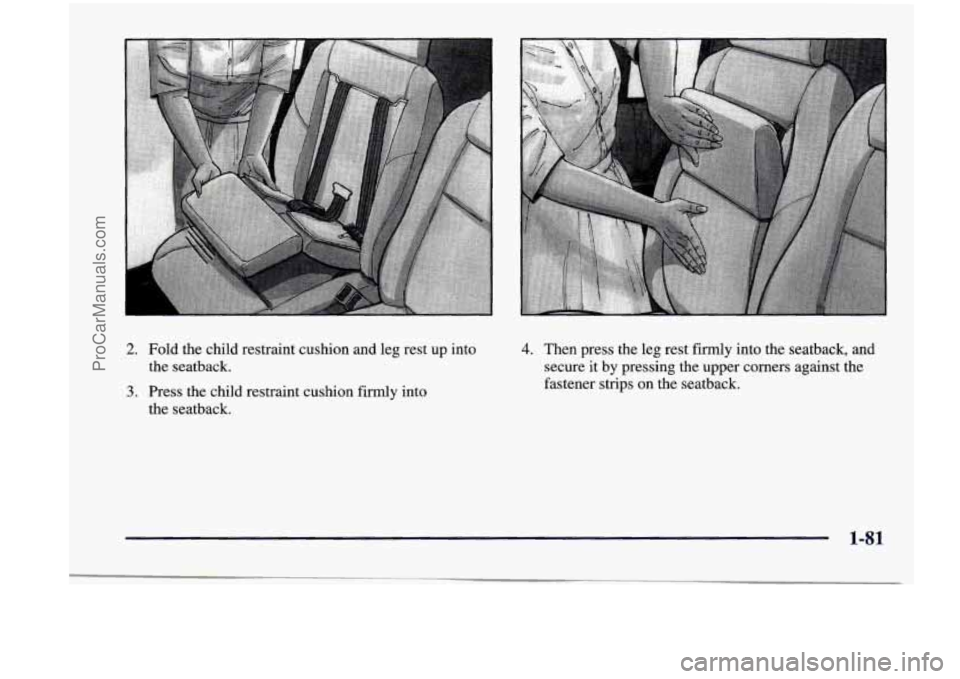
2. Fold the child restraint cushion and leg rest up into
the seatback.
3. Press the child restraint cushion firmly into
the seatback.
4. Then press the leg rest firmly into the seatback, and
secure it
by pressing the upper corners against the
fastener strips on the seatback.
1-81
ProCarManuals.com
Page 95 of 474
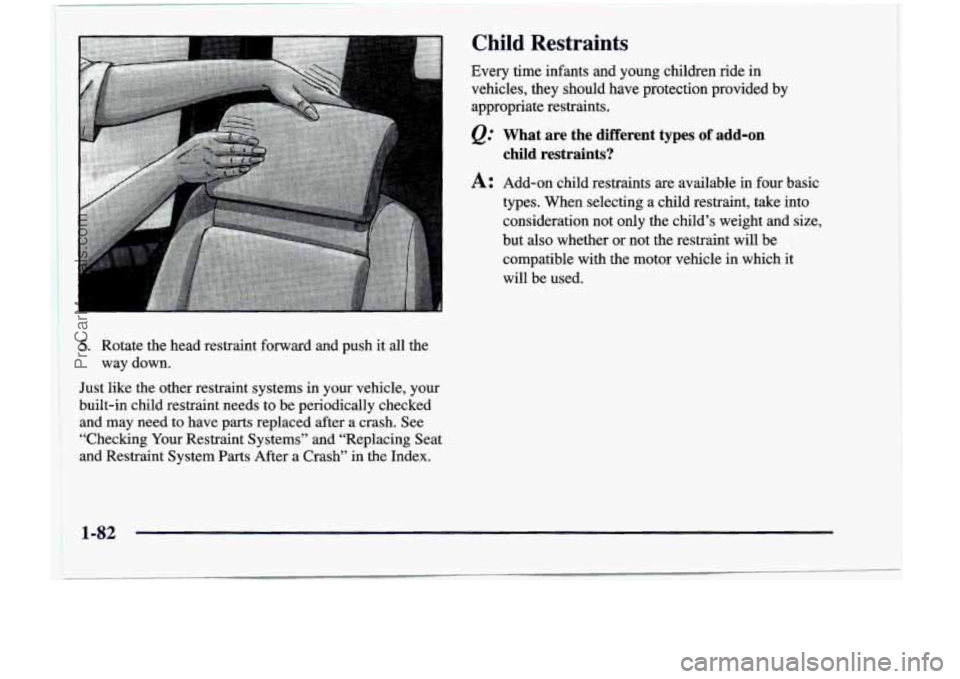
5. Rotate the head restraint forward and push it all the
way down.
Child Restraints
Every time infants and young children ride in
vehicles, they should have protection provided by
appropriate restraints.
&= What are the different types of add-on
A: Add-on child restraints are available in four basic
types. When selecting a child restraint, take into
consideration not only the child’s weight and size,
but also whether
or not the restraint will be
compatible with the motor vehicle in which it
will be used.
child restraints?
Just like the other restraint systems in your vehicle, your
built-in child restraint needs to be periodically checked
and may need
to have parts replaced after a crash. See
“Checking Your Restraint Systems” and “Replacing Seat
and Restraint System
Parts After a Crash” in the Index.
1
ProCarManuals.com
Page 96 of 474
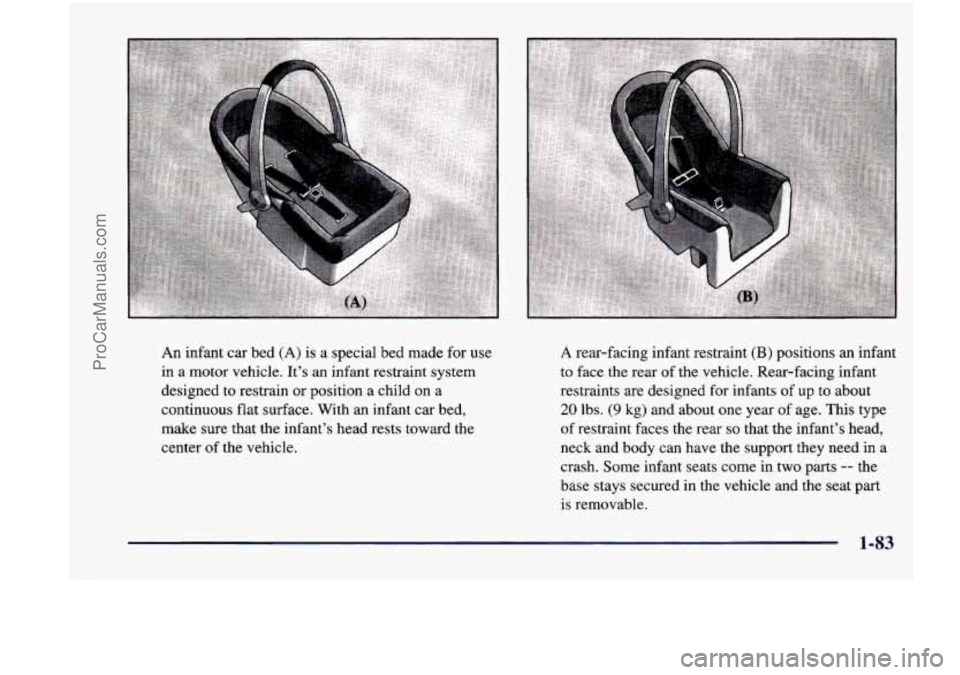
An infant car bed (A) is a special bed made for use
in
a motor vehicle. It’s an infant restraint system
designed
to restrain or position a child on a
continuous flat surface. With an infant car bed,
make sure that the infant’s head rests toward the
center of the vehicle.
A rear-facing infant restraint (B) positions an infant
to face the rear
of the vehicle. Rear-facing infant
restraints are designed for infants of up to about
20 lbs. (9 kg) and about one year of age. This type
of restraint faces the rear so that the infant’s head,
neck and body can have the support they need in a
crash. Some infant seats come in two parts
-- the
base stays secured in the vehicle and the seat part
is removable.
1-83
ProCarManuals.com
Page 98 of 474
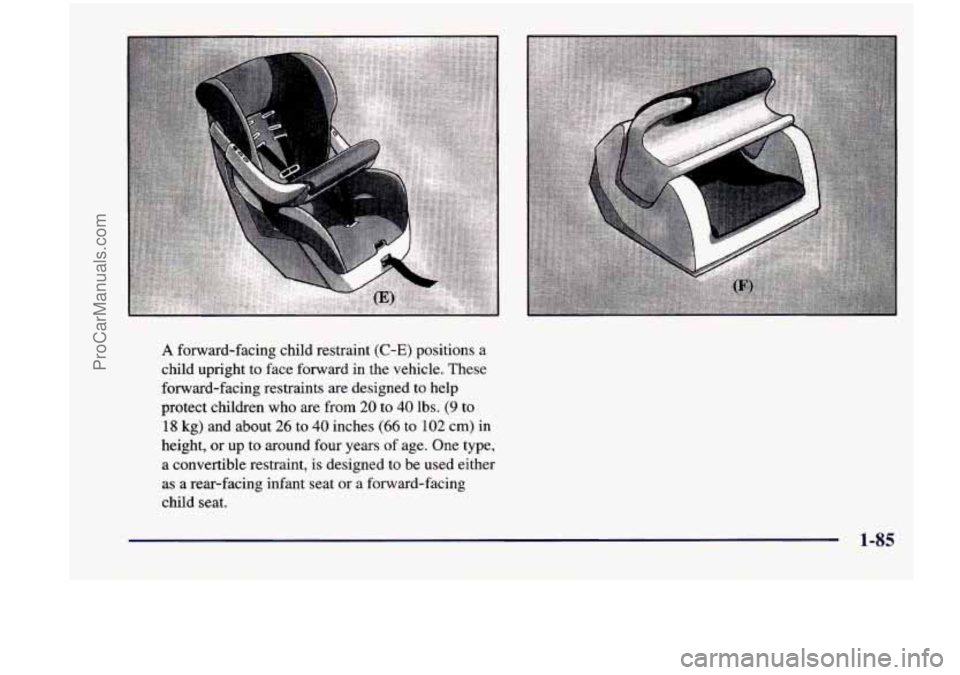
A forward-facing child restraint (C-E) positions a
child upright to face forward in the vehicle. These
forward-facing restraints are designed to help
protect children
who are from 20 to 40 lbs. (9 to
18 kg) and about 26 to 40 inches (66 to 102 cm) in
height, or up to around four years of age. One type,
a convertible restraint, is designed to be used either
as
a rear-facing infant seat or a forward-facing
child seat.
1-85
ProCarManuals.com
Page 99 of 474
When choosing a child restraint, be sure the child
restraint is designed to be used in
a vehicle. If it is, it
will have a label saying that it meets Federal Motor
Vehicle Safety Standards.
Then follow the instructions for the restraint.
You may
find these instructions on the restraint itself or in a
booklet,
or both. These restraints use the belt system in
your vehicle, but
the child also has to be secured within
the restraint to help reduce the chance of personal injury.
The instructions that come with the infant or child
restraint will show you how to do that. Both the owner's
manual and the child restraint instructions are important,
so if either one of these is not available, obtain a
replacement copy from the manufacturer.
Where to Put the Restraint (Except Cargo Vans)
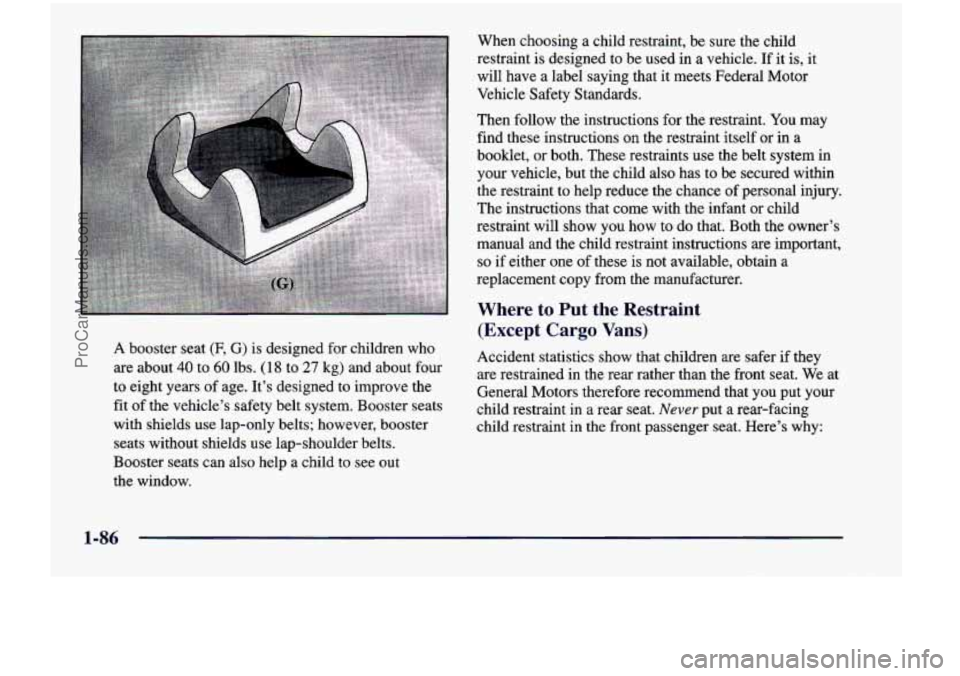
A booster seat (F, G, is designed for who Accident statistics show that children me safer if they
are about 40 to 6o lbs* (18 to 27 kg) and about four are restrained in the rear rather than the front seat. We at
to eight years of age. It's designed to improve the
General Motors therefore recommend that you put your
with shields use lap-only belts; however, booster child restraint
in the front passenger seat. Here's why:
seats without shields use lap-shoulder belts.
Booster seats
can also help a child to see out
the window.
fit
Of the
vehicle's safety belt system. Booster seats child restraint in a rear seat. Never put a rear-facing
1-86
ProCarManuals.com