Page 30 of 364
Downloaded from www.Manualslib.com manuals search engine @ What’s wrong with this?
A: The shoulder belt is too loose. It won’t give nearly
as much protection this way.
You can be seriously hurt if you ihoulc 0 belt is
too loose. In a crash, you would move forward
too much, which could increase injury. The
shoulder belt should fit against your body.
Page 31 of 364
Downloaded from www.Manualslib.com manuals search engine What's wrong with this?
1 I I I I I I I
A: The belt is buckled in the wrong place.
You can be seriously injured if your belt is
buckled in the wrong place like this. In a
crash, the belt would
go up over your abdomen.
The belt forces would be there, not at the
pelvic bones. This could cause serious internal
injuries. Always buckle your belt into the buckle
nearest you.
1-17
Page 32 of 364
Downloaded from www.Manualslib.com manuals search engine &: What's wrong with this?
A: The shoulder belt is worn under the arm. It should
be worn over the shoulder at all times.
A CAUTION:
--
You can be seriously injured if you wear the
shoulder belt under your arm. In
a crash, your
body would move too far forward, which would
increase the chance of head and neck injury.
Also, the belt would apply too much force to the
ribs, which aren't as strong as shoulder bones.
You could also severely injure internal organs
like your liver
or spleen.
1-18
Page 33 of 364
Downloaded from www.Manualslib.com manuals search engine &: What’s wrong with this?
L
A: The belt is twisted across the body.
You can be seriously injured by a twisted belt. In
a crash, you wouldn’t have the full width of the
belt to spread impact forces.
If a belt is twisted,
make it straight
so it can work properly, or ask
your dealer to
fix it.
1-19
Page 34 of 364
Downloaded from www.Manualslib.com manuals search engine To unlatch the belt, just push the button on the buckle.
The belt should go back out of the way.
Before you close the door, be sure the belt is
out of the
way.
If you slam the door on it, you can damage both the
belt and your vehicle.
Safety Belt Use During Pregnancy
Safety belts work for everyone, including pregnant
women. Like all occupants, they are more likely to be
seriously injured if they don't wear safety belts.
A pregnant woman should wear a lap-shoulder belt, and
the lap portion should be worn
as low as possible, below
the rounding, throughout the pregnancy.
1-20
Page 35 of 364
Downloaded from www.Manualslib.com manuals search engine The best way to protect the fetus is to protect the
mother. When a safety belt is worn properly, it’s more
likely that the fetus won’t be hurt
in a crash. For
pregnant women, as for anyone, the key to making
safety belts effective is wearing them properly.
Right Front Passenger Positi(- -I
To learn how to wear the right front passenger’s
safety belt properly, see “Driver Position” earlier in
this section.
The right front passenger’s safety belt works the same
way as the driver’s safety belt
-- except for one thing. If
you ever pull the shoulder portion of the belt out all the
way,
you will engage the child restraint locking feature.
If this happens, just let the belt
go back all the way and
start again.
Air Bag Systems
This part explains the frontal and side impact air
bag systems.
Your vehicle has air bags
-- a “Next Generation”
reduced-force frontal air bag for
the driver and another
“Next Generation” reduced-force frontal air bag for the
right front passenger. Reduced-force frontal air bags are designed
to help reduce the risk of injury from the force
of an inflating frontal air bag. But even these air bags
must inflate
very quickly if they are to do their job and
comply with federal regulations. Your vehicle may also
have side impact air bags
-- a side impact air bag for the
driver and another side impact air bag for the right
front passenger.
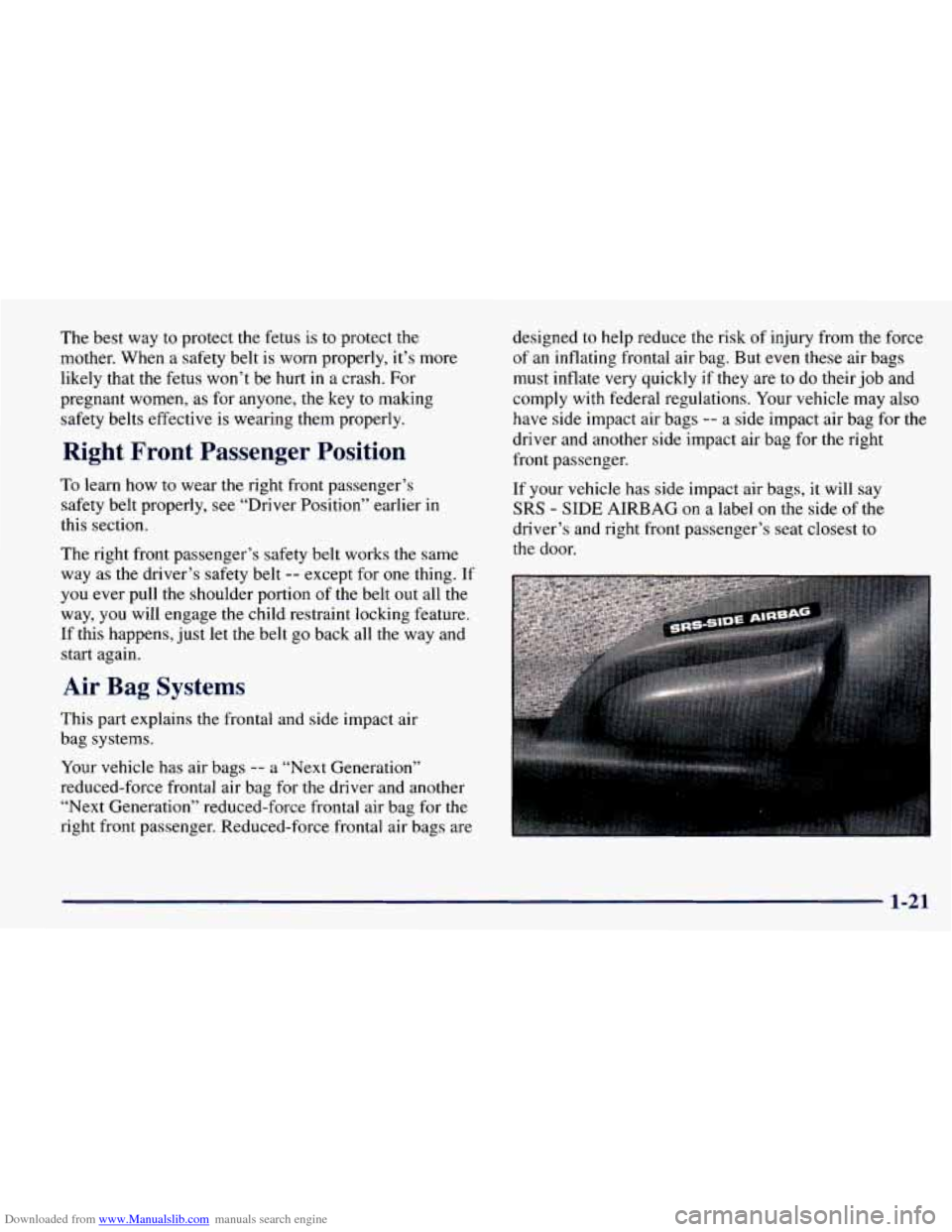
If your vehicle has side impact air bags, it will say
SRS
- SIDE AIRBAG on a label on the side of the
driver’s and right front passenger’s seat closest to
the door.
1-21
Page 36 of 364

Downloaded from www.Manualslib.com manuals search engine Here are the most important things to know about the air
bag systems:
You can be severely injured or killed in a crash if
you aren’t wearing your safety belt
-- even if you
have
air bags. Wearing your safety belt during a
crash helps reduce your chance of hitting things
inside the vehicle or being ejected from it. Air
bags
are “supplemental restraints’’ to the safety
belts. All air bags
-- even reduced-force air
bags
-- are designed to work with safety belts but
don’t replace them.
CAUTION: (Continued) Reduced-force
frontal air bags
for the driver and
right front passenger are designed to work only
in moderate to severe crashes where the front
of
your vehicle hits something. They aren’t designed
to inflate at all in rollover, rear, side or low-speed
frontal crashes. And, for unrestrained occupants,
reduced-force frontal air bags may provide less
protection in frontal crashes than more forceful
air bags have provided in the past. The side
impact air bags
for the driver and right front
passenger are designed to inflate only in
moderate to severe crashes where something hits
the side
of your vehicle. They aren’t designed to
inflate in frontal, in rollover or in rear crashes.
Everyone in your vehicle should wear a safety
belt properly
-- whether or not there’s an air bag
for that person.
1-22
Page 37 of 364

Downloaded from www.Manualslib.com manuals search engine A CAUTION:
Both frontal and side impact air bags inflate with
great force, faster than the blink of an eye.
If you’re
too close to an inflating
air bag, it could seriously
injure you.
This is true even with reduced-force
frontal
air bags. Safety belts help keep you in position
for
air bag idation before and during a crash.
Always
wear your safety belt, even with
reduced-force frontal
air bags. The driver should sit
as far back as possible while still maintaining control
of the vehicle. Front occupants should not lean on or
sleep against the door.
’ A CAU-ION:
Children who are up against, or very close to, an
air bag when it inflates can be seriously injured or
killed. This is true even though your vehicle
has
reduced-force frontal air bags. Air bags plus
CAUTION: (Continued)
I
lap-shoulder belts offer the best protection for
adults but not for young children and infants.
Neither the vehicle’s safety belt system nor its air
bag system is designed for them. Young children
and infants need the protection that a child
restraint system can provide. Always secure
children properly in your vehicle. To read how,
see the part of this manual called “Children” and
see the caution labels on the sunvisors and the
right front passenger’s safety belt.
AIR
BAG
There is an air bag
readiness light on
the instrument
panel, which shows
AIR BAG.
The system checks the air bag electrical system for
malfunctions.
The lights tell you if there is an electrical
problem. See “Air Bag Readiness Light” in the Index
for more information.
1-23


