1998 CHEVROLET PRIZM air condition
[x] Cancel search: air conditionPage 280 of 364

Downloaded from www.Manualslib.com manuals search engine Headlamps Wiring Fuses and Circuit Breakers
The
headlamp wiring is protected by a circuit breaker.
An electrical overload will cause the lamps to go on and
off, or in some cases to remain
off. If this happens, have
your headlamp wiring checked right away.
Windshield Wipers Fuses
The windshield wiper motor is protected by a circuit
breaker and a fuse. If the motor overheats due to heavy
snow, etc., the wiper will stop until the motor cools. If
the overload is caused by some electrical problem, and
not snow, etc., be sure to get it fixed.
Power Windows and Other Power Options
Circuit breakers protect the power windows and other
power accessories. When the current load is too heavy,
the circuit breaker opens and closes, protecting the
circuit until the problem is fixed or goes away. The wiring circuits in your vehicle are protected from
short circuits by fuses, circuit breakers and fusible
thermal links in
the wiring itself. This greatly reduces
the chance of fires caused by electrical problems.
Look at the silver-colored band inside the fuse. If the
band is broken or melted, replace the fuse. Be sure you
replace
a bad fuse with a new one of the correct size.
If you ever have a problem on the road and don’t
have a
spare fuse, you can borrow one. Just pick some feature
of your vehicle that you can get along without -- like the
radio or air conditioner
-- and use its fuse, if it is of the
value you need. Replace it as soon as you can.
Before replacing
a fuse, turn every electrical switch off.
6-54
Page 283 of 364
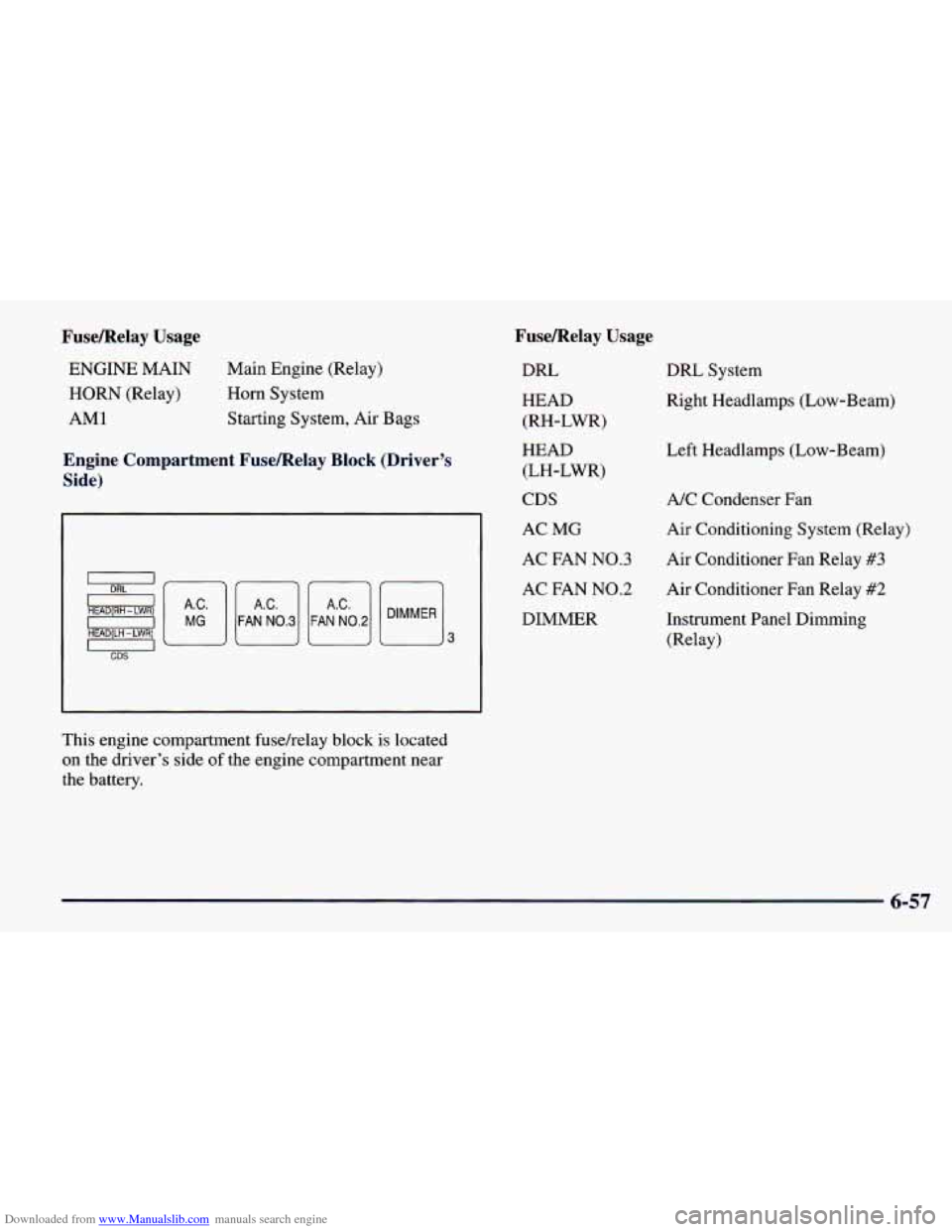
Downloaded from www.Manualslib.com manuals search engine Fusemelay Usage
ENGINE MAIN
HORN (Relay)
AM1 Main Engine (Relay)
Horn System
Starting System, Air Bags
Engine Compartment Fusemelay Block (Driver’s
Side)
-
e5 HEAD(RH - LWR)
0
0
HEAD(LH -LWR)
CDS Elm FAN N0.3 FAN N0.2 El3
DIMMER
This engine compartment fusehelay block is located
on the driver’s side of the engine compartment near
the battery.
Fusemelay Usage
DRL
HEAD
(RH-LWR)
HEAD (LH-LWR)
CDS
AC
MG
AC FAN N0.3
AC FAN
N0.2
DIMMER DRL System
Right Headlamps (Low-Beam)
Left Headlamps (Low-Beam)
A/C Condenser Fan
Air Conditioning System (Relay)
Air Conditioner Fan Relay
#3
Air Conditioner Fan Relay #2
Instrument Panel Dimming
(Relay)
6-57
Page 284 of 364
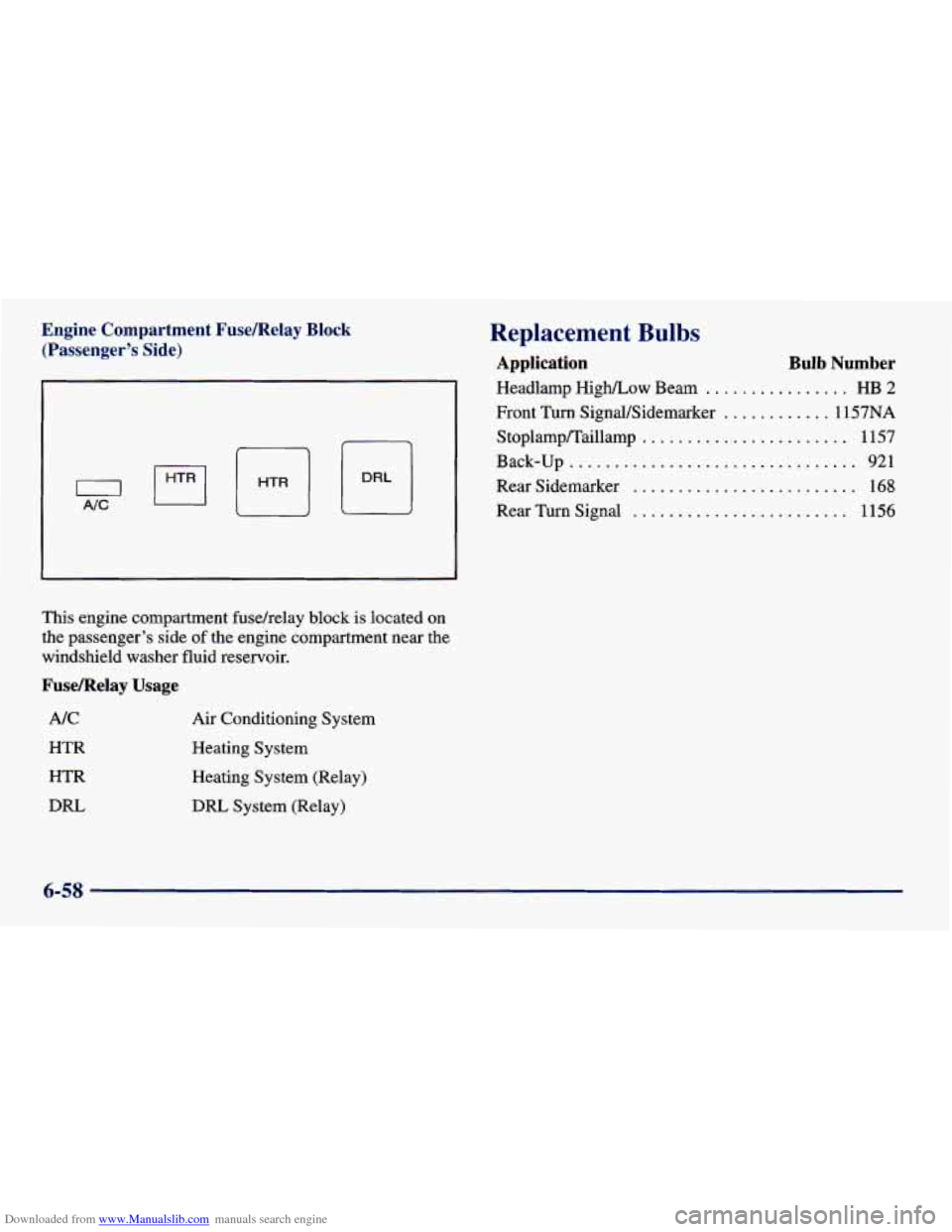
Downloaded from www.Manualslib.com manuals search engine Engine Compartment Fusemelay Block (Passenger's Side)
n
This engine compartment fusehelay block is located on
the passenger's side
of the engine compartment near the
windshield washer fluid reservoir.
Fusemelay Usage
NC
HTR
HTR
DRL Air Conditioning System
Heating System
Heating System (Relay)
DRL System (Relay)
Replacement Bulbs
Headlamp High/Low Beam ................ HB 2
Front Turn SignaVSidemarker ............ 1157NA
Application Bulb Number
Stoplamp/"aillamp ....................... 1157
Back-up
................................ 921
Rear Sidemarker ......................... 168
Rear Turn Signal
........................ 1156
6-58
Page 285 of 364

Downloaded from www.Manualslib.com manuals search engine Capacities and Specifications
Engine
Type .................................... L4
Compression Ratio ...................... 10.0: 1
Firing Order
.......................... 1-3-4-2
Fuel Delivery
........... Multi-Port Fuel Injection
Piston Displacement
.............. 109 CID (1.8L)
Valve Arrangement
........ Double Overhead Cam
Thermostat Temperature
........... 167°F (76°C)
Wheel Nuts
Wheel Nut Torque ........... 100 lb-ft (140 Nem)
Capacities (Approximate)
The following approximate capacities are given in
English and metric conversions.
Air Conditioning
.............. See the refrigerant
information label under the hood.
Automatic Transmission
3-Speed
.................. 2.6 quarts (2.5 L) **
4-Speed .................. 3.3 quarts (3.1 L) **
Differential (3-speed only) ...... 1.5 quarts (1.4 L)
Manual Transaxle ............ 2.0 quarts (1.9 L)**
Cooling System
Manual Transaxle
.......... 6.6 quarts (6.2 L)
Automatic Transaxle .......... 6.4 quarts (6.1 L)
Fuel Tank ................... 13.2 gallons (50 L)
Engine Oil (Change w/ Filter*)
... 3.9 quarts (3.7 L)
* When changing the oil filter, additional oil may
be needed. Recheck the oil level after filling. See “Engine Oil” in the Index.
** Recheck fluid level after filling. See “Automatic
Transaxle Fluid” or “Manual Transaxle Fluid”
in
the Index.
6-59
Page 286 of 364

Downloaded from www.Manualslib.com manuals search engine Vehicle Dimensions
Wheelbase ................ .97.1 inches (247 cm)
Length
................... 175.0 inches (445 cm)
Width
.................... .66.7 inches (169 cm)
Height
.................... .53.5 inches (1 36 cm)
Tread Front
................... .57.9 inches (147 cm)
Rear
.................... -57.5 inches (146 cm)
Air Conditioning Refrigerants
Not all air conditioning refrigerants are the same.
If the air conditioning system
in your vehicle needs
refrigerant, be sure the proper refrigerant
is used. If
you’re not sure, ask your dealer.
Normal Maintenance
Replacement Parts
Air Cleaner Filter .......... GM Part No. 94853522
Battery
............................... .35-60
Engine Oil Filter .......... GM Part No. 25014441
Fuel Filter
................ GM Part No. 94854620
PCV Valve
............... GM Part No. 94853556
Radiator Pressure Cap
........... 15 psi (105 kPa)
Spark Plug*
Denso K16TR11 ........ 0.043 inch (1.1 mm) gap
NGK BKRSEKB-11
..... 0.043 inch (1.1 mm) gap
*Your engine is fitted
with twin ground electrode spark
plugs. Use
only twin ground electrode spark plugs for
better engine performance.
6-60
Page 288 of 364
Downloaded from www.Manualslib.com manuals search engine IMPORTANT.
KEEP ENGINE OIL
AT THE PROPER
LEVEL AND CHANGE AS
RECOMMENDED
I
protection
Plan
Have you purchased the GM Protection Plan? The Plan
supplements your new vehicle warranties. See your
Warranty and Owner Assistance booklet, or your
Chevrolet dealer for details.
Introduction
Your Vehicle and the Environment
Proper vehicle maintenance not only helps to keep your
vehicle in good working condition, but also helps the
environment. All recommended maintenance procedures
are important. Improper vehicle maintenance can even
affect the quality
of the air we breathe. Improper fluid
levels or the wrong tire inflation can increase the level
of emissions from your vehicle. To help protect our
environment, and
to keep your vehicle in good
condition, please maintain
your vehicle properly.
7-2
Page 289 of 364

Downloaded from www.Manualslib.com manuals search engine How This Section is Organized
The remainder of this section is divided into five parts:
“Part A: Scheduled Maintenance Services” shows
what to have done and how often. Some of these
services can be complex,
so unless you are technically
qualified and have the necessary equipment, you should
let your dealer’s service department or another qualified service center do these jobs.
Performing maintenance work on a vehicle can
be dangerous. In trying to do some
jobs, you can
be seriously injured. Do your own maintenance
work only
if you have the required know-how
and the proper tools and equipment for the
job.
If you have any doubt, have a qualified
technician do the work.
If you are skilled enough to do some work on your
vehicle, you will probably want to get the service
information. See “Service and Owner Publications”
in the Index.
“Part B: Owner Checks and Services” tells you
what should be checked and when. It also explains
what you can easily do to help keep your vehicle in
good condition.
“Part C: Periodic Maintenance Inspections”
explains important inspections that your dealer’s
service department or another qualified service center
should perform.
“Part D: Recommended Fluids and Lubricants”
lists some recommended products to help keep your
vehicle properly maintained. These products, or their
equivalents, should be used whether you do the work
yourself or have
it done.
“Part E: Maintenance Record” provides a place for
you to record the maintenance performed on your
vehicle. Whenever any maintenance is performed, be sure to write it down in this part. This will help you
determine when your next maintenance should be done.
In addition, it
is a good idea to keep your maintenance
receipts. They may be needed to qualify your vehicle
for warranty repairs.
7-3
Page 290 of 364

Downloaded from www.Manualslib.com manuals search engine Part A: Scheduled
Maintenance Services
Using Your Maintenance Schedule
We at General Motors want to help you keep your
vehicle in good working condition. But we don’t
know exactly how you’ll drive it. You may drive very
short distances only a few times
a week. Or you may
drive long distances all the time
in very hot, dusty
weather. You
may use your vehicle in making deliveries.
Or you may drive it to work,
to do errands or in
many other ways.
Because of all the different ways people
use their
vehicles, maintenance needs vary.
You may even need
more frequent checks and replacements than you’ll find
in the schedules in this section.
So please read this
section and note how you drive. If you have any
questions on how to keep your vehicle in good
condition, see your dealer.
This part tells you the maintenance services you should
have done and when you should schedule them. If you
go to your dealer for your service needs, you’ll know
that GM-trained and supported service people will
perform the work using genuine GM parts. The proper fluids and lubricants to use are listed in
Part
D. Make sure whoever services your vehicle
uses these. All parts should be replaced and all necessary repairs done before you or anyone else
drives the vehicle.
These schedules are for vehicles that:
0 carry passengers and cargo within recommended
limits, You will find these limits
on your vehicle’s
Tire-Loading Information label. See “Loading Your
Vehicle” in the Index.
are driven on reasonable road surfaces within legal
0 use the recommended fuel. See “Fuel” in the Index.
driving limits.
Selecting the Right Schedule
First you’ll need to decide which
of the two schedules
is right for your vehicle. Here’s how to decide which
schedule to follow:
7-4