1998 CHEVROLET PRIZM maintenance
[x] Cancel search: maintenancePage 244 of 364
Downloaded from www.Manualslib.com manuals search engine Automatic Transaxle Fluid
When to Check and Change
A good time to check your automatic transaxle fluid
level is when the engine oil is changed.
Change fluid in the transaxle and differential every
15,000 miles (25 000 km) if the vehicle is mainly
driven under one or more of these conditions:
In heavy city traffic where the outside temperature
regularly reaches
90°F (32°C) or higher.
0 In hilly or mountainous terrain.
When doing frequent trailer towing.
Uses such as found in taxi, police or delivery service.
If you do not use your vehicle under any of these
conditions, check the fluid.
See “Scheduled Maintenance Services’’ in the Index.
How to Check
Because this operation can be a little difficult, you may choose
to have this done at your Chevrolet dealership
Service Department.
If you do it yourself, be sure to follow all the
instructions here, or you could get a false reading
on the dipstick.
I NOTICE:
Too much or too little fluid can damage your
transaxle.
Too much can mean that some of the
fluid could come out and fall on hot engine parts
or exhaust system parts, starting a fire. Be sure to
get an accurate reading if you check your
transaxle fluid.
6-18 .-
Page 246 of 364
Downloaded from www.Manualslib.com manuals search engine 3,
4.
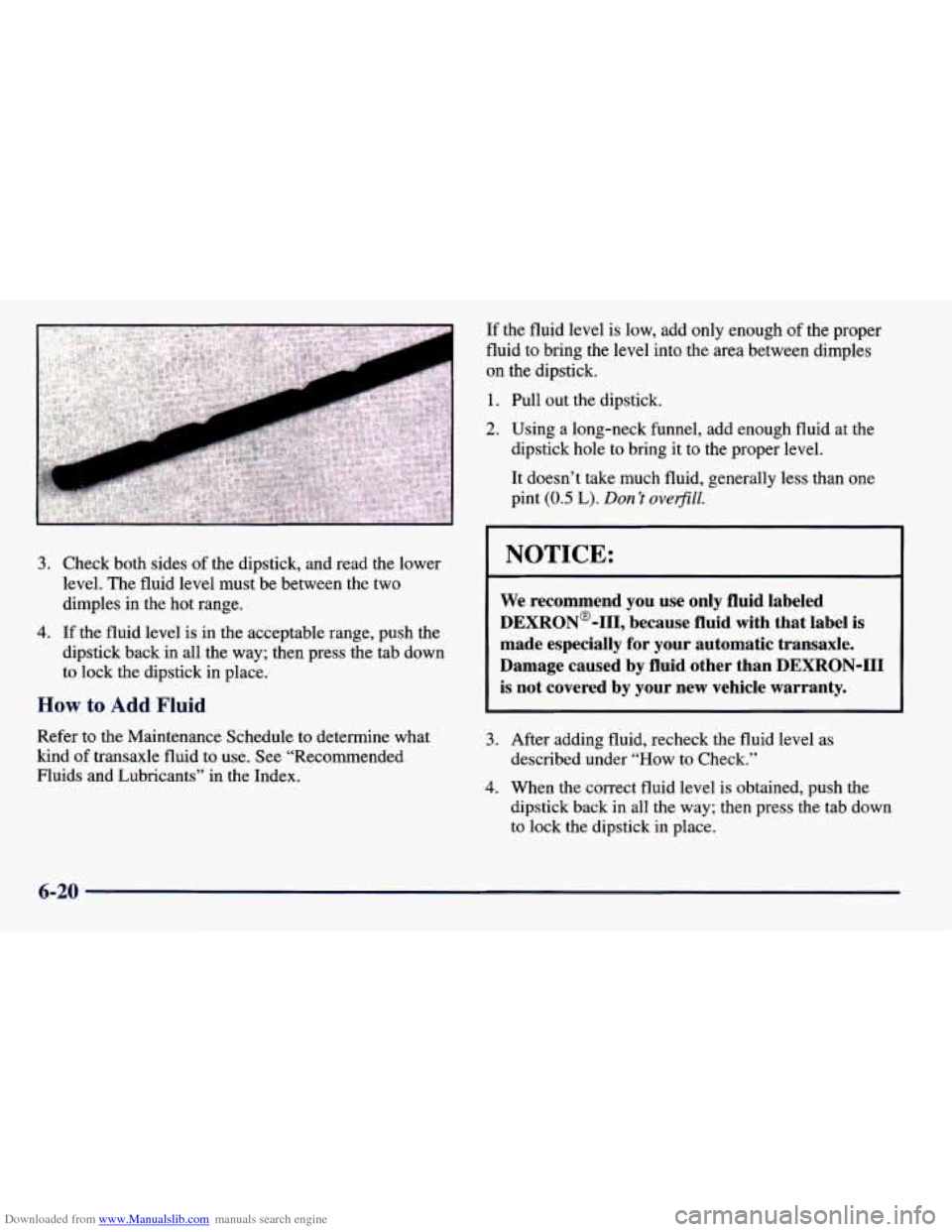
Check both sides of the dipstick, and read the lower
level.
The fluid level must be between the two
dimples
in the hot range.
If the fluid level is in the acceptable range, push the
dipstick back in all the way; then press the tab down
to lock the dipstick in place.
How to Add Fluid
Refer to the Maintenance Schedule to determine what
kind
of transaxle fluid to use. See “Recommended
Fluids
and Lubricants” in the Index. If
the fluid level is low, add only enough
of the proper
fluid to bring the level into the area between dimples
on the dipstick.
1. Pull out the dipstick.
2. Using a long-neck funnel, add enough fluid at the
dipstick hole to bring it to the proper level.
It doesn’t take much fluid, generally less than one
pint
(0.5 L). Don’t overfill.
NOTICE:
We recommend you use only fluid labeled
DEXRON@-111, because fluid with that label is
made especially for your automatic transaxle. Damage caused by fluid other than
DEXRON-111
~ is not covered by your new vehicle warranty.
3. After adding fluid, recheck the fluid level as
described under “How to Check.”
4. When the correct fluid level is obtained, push the
dipstick back
in all the way; then press the tab down
to lock the dipstick
in place.
6-20
Page 248 of 364
Downloaded from www.Manualslib.com manuals search engine 3. If the fluid level is good, install the plug and be sure
it is fully seated.
If the fluid level is low, add more
fluid as described in the next steps.
How to Add Fluid
Here’s how to add fluid. Refer to the Maintenance
Schedule to determine what kind of fluid to use. See
“Recommended Fluids and Lubricants” in the Index.
1. Remove the filler plug.
2. Add fluid at the filler plug hole. Add only enough
fluid to bring the fluid level up
to the bottom of the
filler plug hole.
3. Install the filler plug. Be sure the plug is fully seated.
Hydraulic Clutch
The hydraulic clutch linkage in your vehicle is
self-adjusting. The clutch master cylinder reservoir
is
filled with hydraulic clutch fluid.
It isn’t a good idea to “top off’ your clutch fluid. Adding
fluid won’t correct a leak.
A fluid loss in this system could indicate a problem.
Have the system inspected and repaired.
When to Check and What to Use
Refer to the Maintenance Schedule to determine how
often you should check the fluid level in your clutch
master cylinder reservoir and for the proper fluid. See
“Owner Checks and Services” and “Recommended
Fluids and Lubricants’’ in the Index.
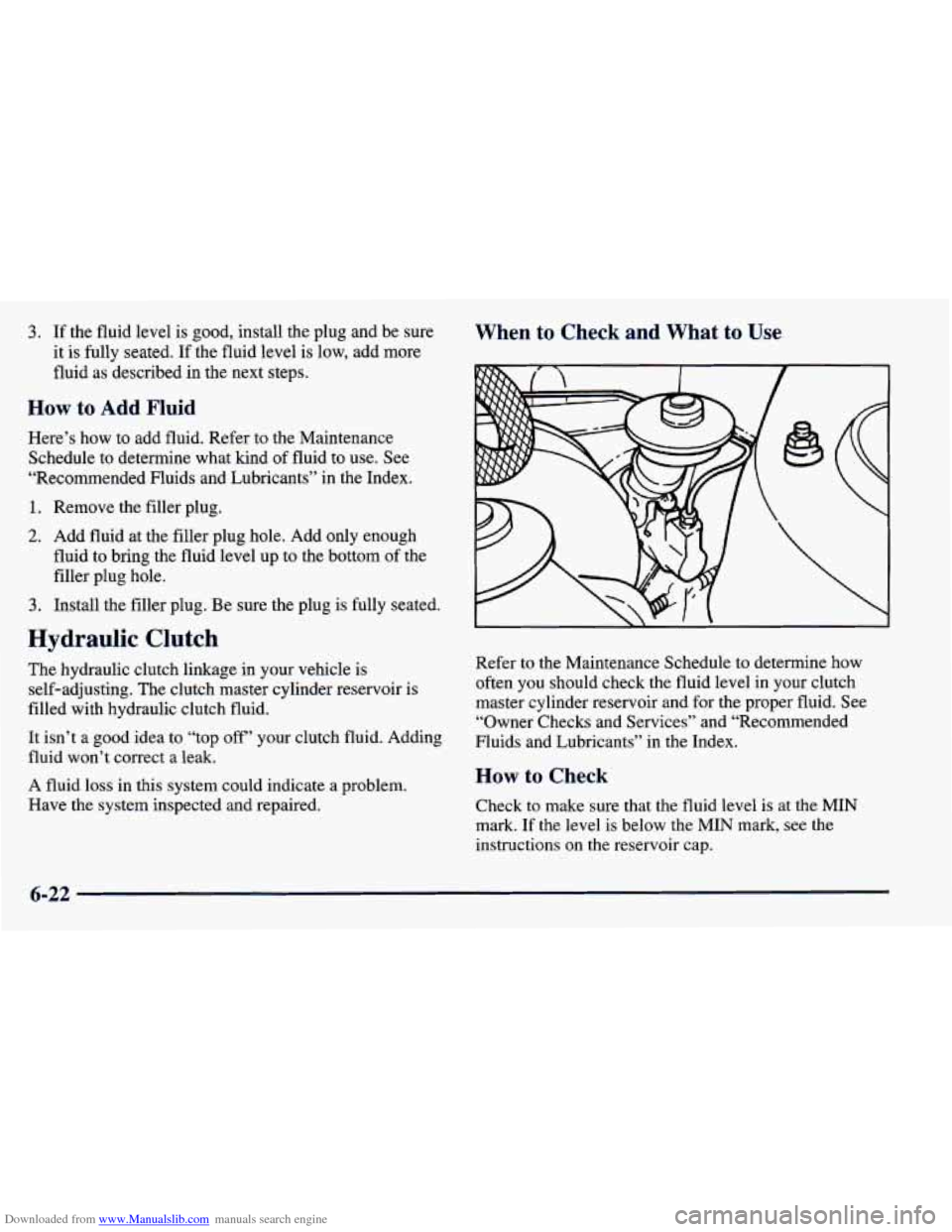
How to Check
Check to make sure that the fluid level is at the MIN
mark. If the level is below the MIN mark, see the
instructions on the reservoir cap.
6-22
Page 257 of 364
Downloaded from www.Manualslib.com manuals search engine Brake Wear
Your vehicle has front disc brakes and rear drum brakes.
Disc brake pads have built-in wear indicators that
make a high-pitched warning sound when the brake
pads are worn and new pads are needed. The sound may
come and
go or be heard all the time your vehicle is
moving (except when you are pushing on the brake pedal firmly).
The brake wear warning sound means that soon
your brakes won’t work well. That could lead to
an accident. When you hear the brake wear
warning sound, have your vehicle serviced.
I NOTICE:
I
Some driving conditions or climates may cause a
brake squeal when the brakes are first applied or
lightly applied. This does not mean something
is
wrong with your brakes.
Properly torqued wheel nuts are necessary to help
prevent brake pulsation. When tires are rotated, inspect
brake pads for wear and evenly torque wheel nuts in the
proper sequence to
GM specifications.
Your rear drum brakes don’t have wear indicators, but
if you ever hear a rear brake rubbing noise, have the
rear brake linings inspected immediately. Also, the rear
brake drums should be removed and inspected each time
the tires are removed for rotation or changing. When
you have the front brake pads replaced, have the rear
brakes inspected, too.
Brake linings should always be replaced as complete
axle sets.
Continuing to drive with worn-out brake pads
could result in costly brake repair.
See “Brake System Inspection” in Section 7 of this
manual under Part
C “Periodic Maintenance
Inspections.”
Brake Pedal Tra
See your dealer if the brake pedal does not return to
normal height, or if there is a rapid increase in pedal
travel. This could be a sign
of brake trouble.
Page 265 of 364

Downloaded from www.Manualslib.com manuals search engine Tire Inspection and Rotation
Tires should be rotated every 6,000 to 8,000 miles
(10 000 to 13 000 km). Any time you notice unusual
wear, rotate your tires as soon as possible and check
wheel alignment. Also check for damaged tires or
wheels. See “When It’s Time for New Tires” and
“Wheel Replacement” later in this section for
more information.
The purpose of regular rotation is to achieve more
uniform wear for all tires on the vehicle. The first
rotation is the most important. See “Scheduled
Maintenance Services” in the Index for scheduled
rotation intervals. Don’t include the compact spare tire
in your
tire rotation.
After the tires have been rotated, adjust the front
and rear inflation pressures as shown on the
Tire-Loading Information label. Make certain that
all wheel nuts are properly tightened. See “Wheel
Nut Torque” in the Index.
When rotating your tires, always
use the correct rotation
pattern shown here.
-
A CA u T1GI.C:
Rust or dirt on a wheel, or on the parts to which
it is fastened, can make wheel nuts become loose
after
a time. The wheel could come off and cause
an accident. When you change
a wheel, remove
any rust or dirt from places where the wheel
attaches to the vehicle. In an emergency, you can
use
a cloth or a paper towel to do this; but be
sure to use a scraper or wire brush later, if you
need to, to get all the rust or
dirt off. (See
“Changing
a Flat Tire” in the Index.)
I
6-39
Page 277 of 364
Downloaded from www.Manualslib.com manuals search engine Underbody Maintenance
Chemicals used for ice and snow removal and dust
control can collect on the underbody. If these are
not removed, accelerated corrosion (rust) can occur
on the underbody parts such as fuel lines, frame, floor
pan and exhaust system even though they have corrosion protection.
At least
every spring, flush these materials from the
underbody with plain water. Clean any areas where mud
and other debris can collect.
Dirt packed in closed areas
of the frame should be loosened before being flushed.
Your dealer or an underbody car washing system can
do this for you.
Chemical Paint Spotting
Some weather and atmospheric conditions can create
a chemical fallout. Airborne pollutants can fall upon
and attack painted surfaces on your vehicle. This
damage can take
two forms: blotchy, ringlet-shaped
discolorations, and small irregular dark spots etched
into the paint surface.
Although no defect
in the paint job causes this,
Chevrolet will repair, at no charge to the owner, the surfaces of new vehicles damaged by this fallout
condition within
12 months or 12,000 miles (20 000 km)
of purchase, whichever occurs first.
6-51
Page 286 of 364

Downloaded from www.Manualslib.com manuals search engine Vehicle Dimensions
Wheelbase ................ .97.1 inches (247 cm)
Length
................... 175.0 inches (445 cm)
Width
.................... .66.7 inches (169 cm)
Height
.................... .53.5 inches (1 36 cm)
Tread Front
................... .57.9 inches (147 cm)
Rear
.................... -57.5 inches (146 cm)
Air Conditioning Refrigerants
Not all air conditioning refrigerants are the same.
If the air conditioning system
in your vehicle needs
refrigerant, be sure the proper refrigerant
is used. If
you’re not sure, ask your dealer.
Normal Maintenance
Replacement Parts
Air Cleaner Filter .......... GM Part No. 94853522
Battery
............................... .35-60
Engine Oil Filter .......... GM Part No. 25014441
Fuel Filter
................ GM Part No. 94854620
PCV Valve
............... GM Part No. 94853556
Radiator Pressure Cap
........... 15 psi (105 kPa)
Spark Plug*
Denso K16TR11 ........ 0.043 inch (1.1 mm) gap
NGK BKRSEKB-11
..... 0.043 inch (1.1 mm) gap
*Your engine is fitted
with twin ground electrode spark
plugs. Use
only twin ground electrode spark plugs for
better engine performance.
6-60
Page 287 of 364

Downloaded from www.Manualslib.com manuals search engine 0 Section 7 Maintenance Schedule
This section covers the maintenance required for your vehicle. Your vehicle needs these services to retain its \
safety,
dependability and emission control performance.
7-2
7 -4
7-5
7-5
7-5
7-6
7-7
Short TripKity Maintenance Schedule
Long Triphlighway Maintenance Schedule
Part
B: Owner Checks and Services
Part C: Periodic Maintenance Inspections
Part D: Recommended Fluids and Lubricants
Part
E: Maintenance Record
Introduction
Part
A: Scheduled Maintenance Services
Maintenance Schedule
Short Trip/City Definition
Short TripKity Intervals
Long Tripmighway Definition
Long Tripmighway Intervals
7-8
7-26
7-37 7-42
7-44
7-46
7-1