Page 124 of 362
Downloaded from www.Manualslib.com manuals search engine The oil level monitoring system only checks oil level
during the brief period between key on and engine
crank. It does not monitor engine oil level when the
engine is running. Additionally, an oil level check is
only performed if the engine has been turned off for a
considerable period of time allowing the oil normally in
circulation to drain back into the oil pan.
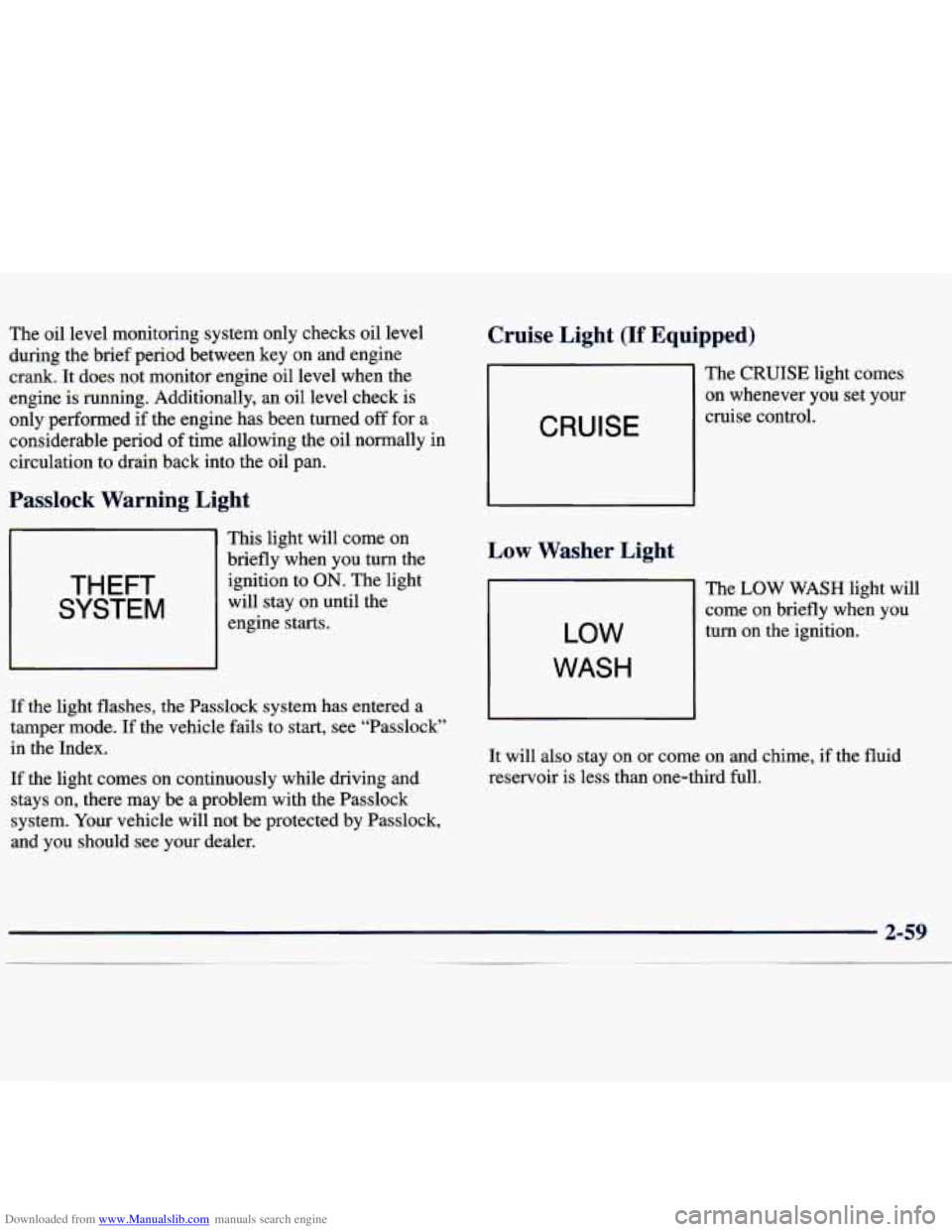
Passlock Warning Light
THEFT
SYSTEM
This light will come on
briefly when you
turn the
ignition to
ON. The light
will stay on until the
engine starts.
If the light flashes, the Passlock system has entered a
tamper mode. If the vehicle fails to start, see “Passlock”
in the Index.
If the light comes on continuously while driving and
stays on, there may be a problem with the Passlock
system. Your vehicle will not be protected by Passlock,
and you should see your dealer.
Cruise Light (If Equipped)
CRUISE
Low Washer Light
LOW
WASH
The CRUISE light comes
on whenever you set your
cruise control.
The
LOW WASH light will
come on briefly when you
turn on the ignition.
It will also stay on or come on and chime, if the fluid
reservoir is less than one-third full.
Page 158 of 362
Downloaded from www.Manualslib.com manuals search engine Avoid needless heavy braking. Some people drive in
spurts
-- heavy acceleration followed by heavy
braking
-- rather than keeping pace with traffic. This is a
mistake. Your brakes may not have time to cool between
hard stops. Your brakes
will wear out much faster if you
do a lot of heavy braking. If you keep pace with the
traffic and allow realistic following distances, you will eliminate a lot of unnecessary braking. That means
better braking and longer brake life.
If your engine ever stops while you’re driving, brake
normally but don’t pump your brakes. If you do, the
pedal may get harder
to push down. If your engine
stops,
you will still have some power brake assist. But
you will use it when
you brake. Once the power assist is
used up,
it may take longer to stop and the brake pedal
will be harder to push.
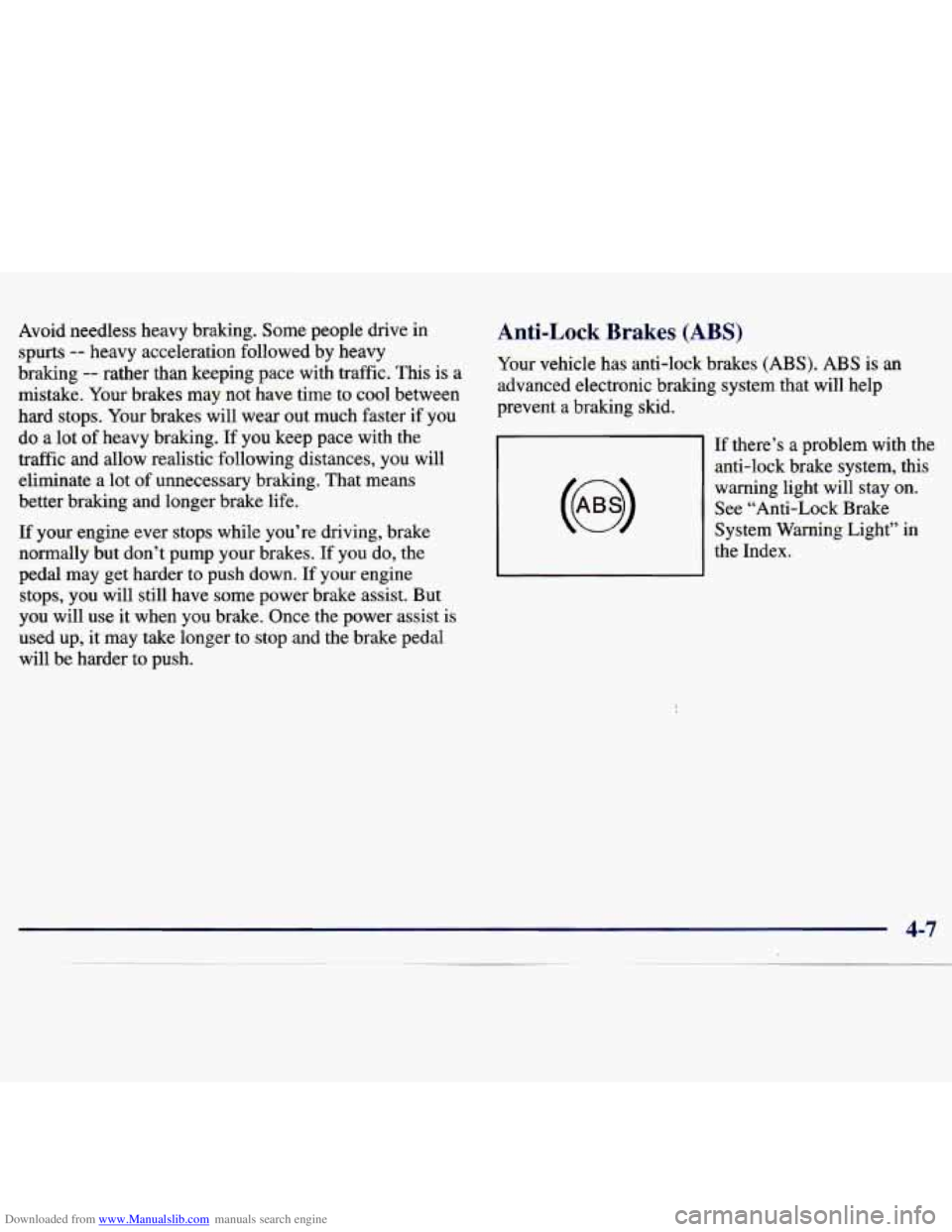
Anti-Lock Brakes (ABS)
Your vehicle has anti-lock brakes (ABS). ABS is an
advanced electronic braking system that will help
prevent
a braking skid.
If there’s a problem with the anti-lock brake system, this
warning light will stay on.
See “Anti-Lock Brake
System Warning Light” in
the Index.
Page 165 of 362
Downloaded from www.Manualslib.com manuals search engine Of course, traction is reduced when water, snow, ice,
gravel or other material is on the road. For safety, you’ll
want to slow down and adjust your driving to these
conditions. It is important to slow down on slippery surfaces because stopping distance will be longer and
vehicle control more limited.
While driving on a surface with reduced traction, try
your best to avoid sudden steering, acceleration or
braking (including engine braking by shifting to
a lower
gear). Any sudden changes could cause the tires to slide.
You may not realize the surface is slippery until your
vehicle is skidding. Learn to recognize warning
clues
-- such as enough water, ice or packed snow on
the road to make a “mirrored surface”
-- and slow
down when you have any doubt.
Remember: Any anti-lock brake system (ABS) helps
avoid only the braking skid.
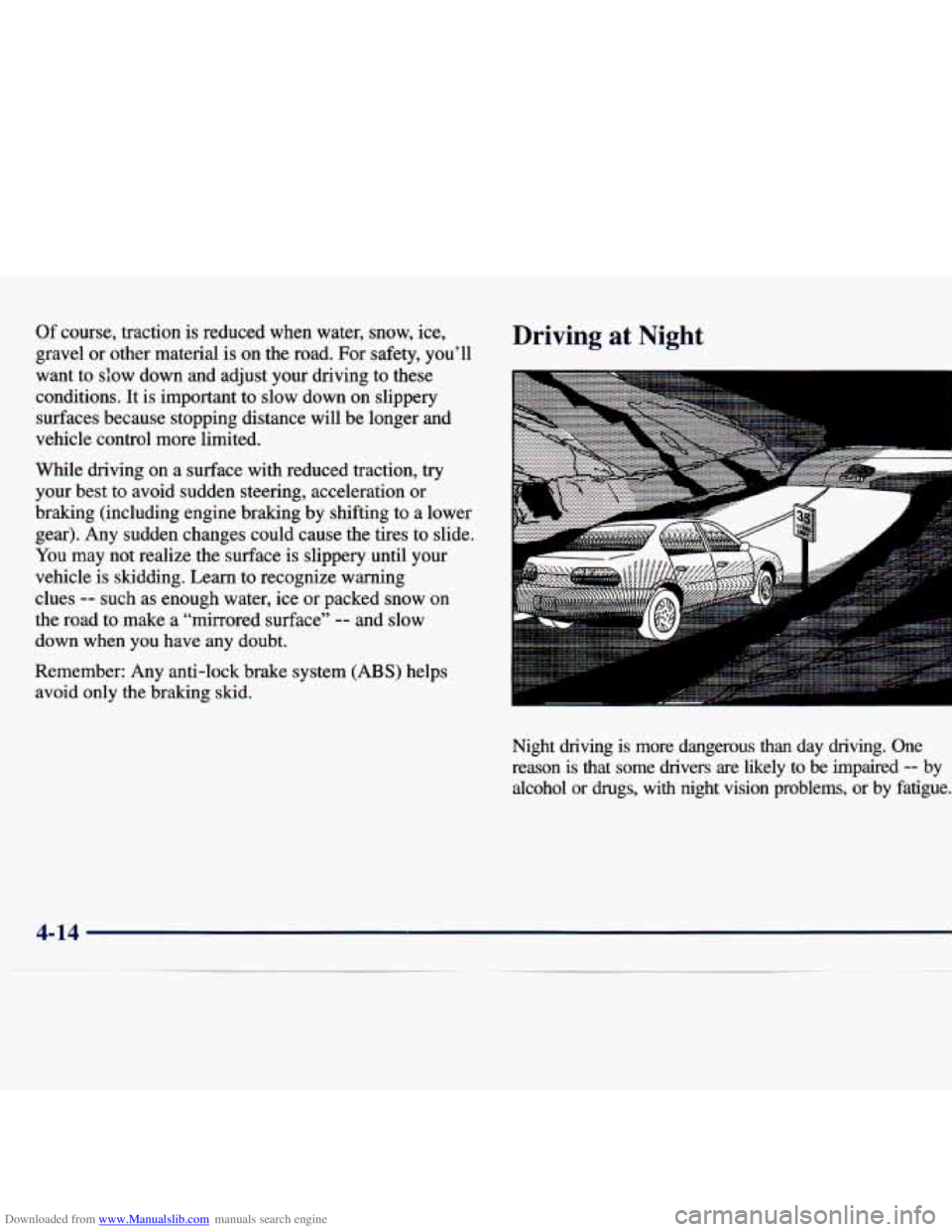
Driving at Night
Night driving is more dangerous than day driving. One
reason
is that some drivers are likely to be impaired -- by
alcohol or
drugs, with night vision problems, or by fatigue.
4-14
Page 170 of 362
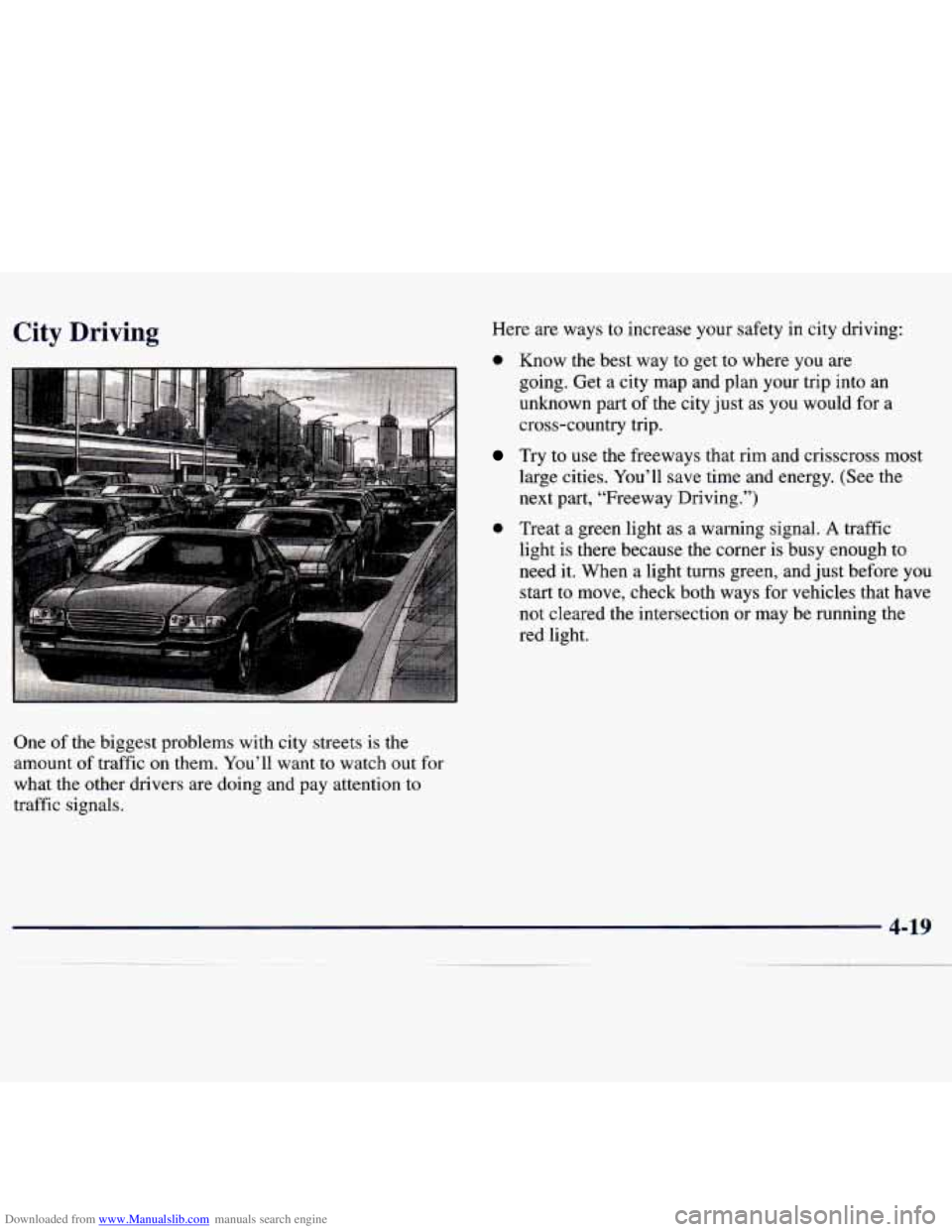
Downloaded from www.Manualslib.com manuals search engine City Driving Here are ways to increase your safety in city driving:
0 Know the best way to get to where you are
going. Get a city map and plan your trip into an
unknown part of the city just as you would for a
cross-country trip.
Try to use the freeways that rim and crisscross most
large cities. You’ll save time and energy. (See the
next part, “Freeway Driving.”)
0 Treat a green light as a warning signal. A traffic
light is there because the corner is busy enough to
need it. When a light turns green, and just before you
start to move, check both ways for vehicles that have
not cleared the intersection or may be running the
red light.
One
of the biggest problems with city streets is the
amount of traffic on them. You’ll want to watch out for
what the other drivers are doing and pay attention to
traffic signals.
Page 175 of 362
Downloaded from www.Manualslib.com manuals search engine I P'
I
I I Winter Driving
Here are some tips for winter driving:
e Have your vehicle in good shape for winter.
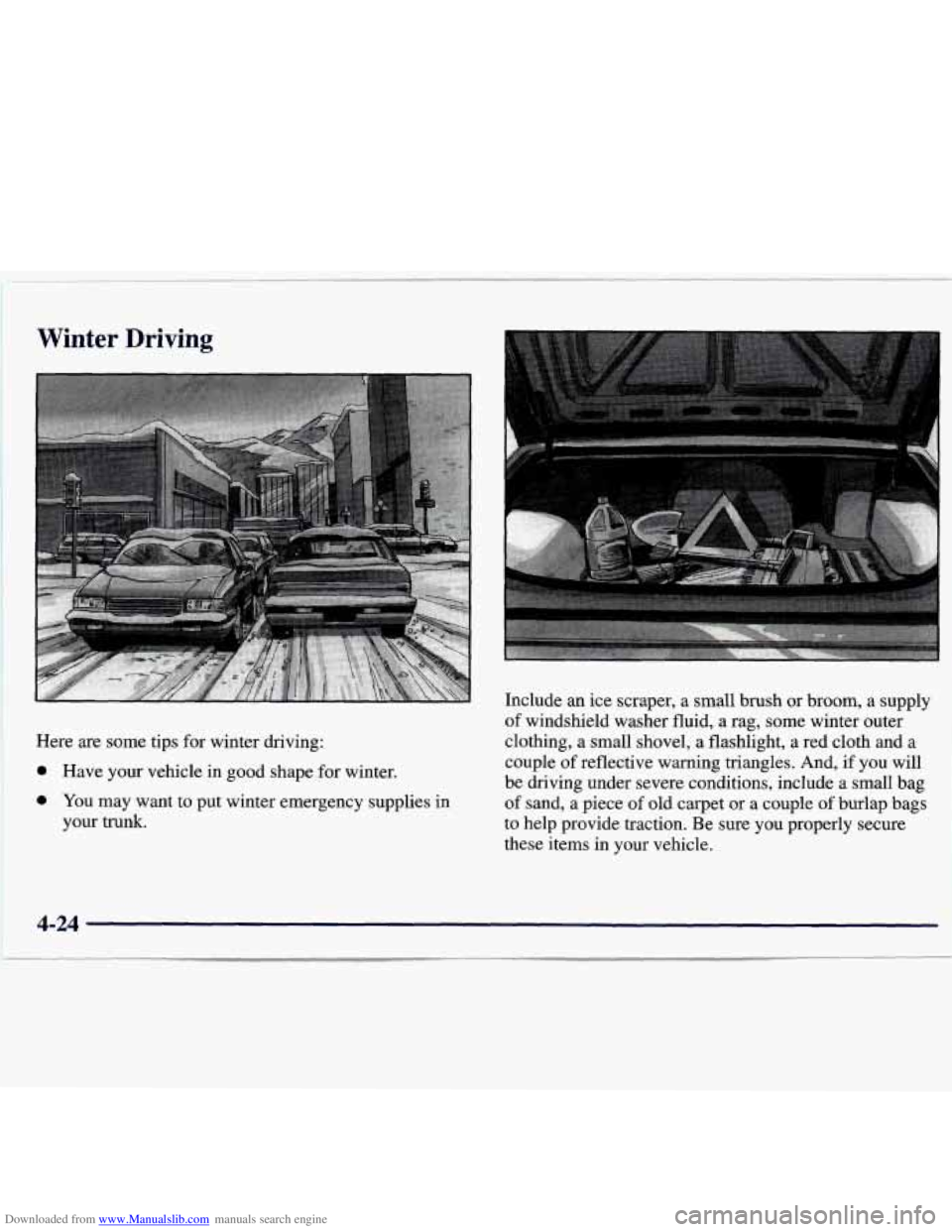
e You may want to put winter emergency supplies in
your
trunk.
Include an ice scraper, a small brush or broom, a supply
of windshield washer fluid, a rag, some winter outer
clothing, a small shovel, a flashlight,
a red cloth and a
couple of reflective warning triangles. And, if you
will
be driving under severe conditions, include a small bag
of sand, a piece of old carpet or a couple of burlap bags
to help provide traction. Be sure you properly secure
these items in your vehicle.
4-24
Page 192 of 362
Downloaded from www.Manualslib.com manuals search engine 0 Section 5 Problems on the Road
Here you’ll find what to do about some problems that can occur on the road.
5-2
5 -2
5-3
5-8
5-12
Hazard Warning Flashers
Other Warning Devices
Jump Starting
Towing Your Vehicle
Engine Overheating 5- 15
5-22
5-22
5-32
5-33
Cooling System
If a Tire Goes Flat
Changing a Flat Tire
Compact Spare Tire
If You’re Stuck: In Sand, Mud,
Ice or Snow
Page 193 of 362
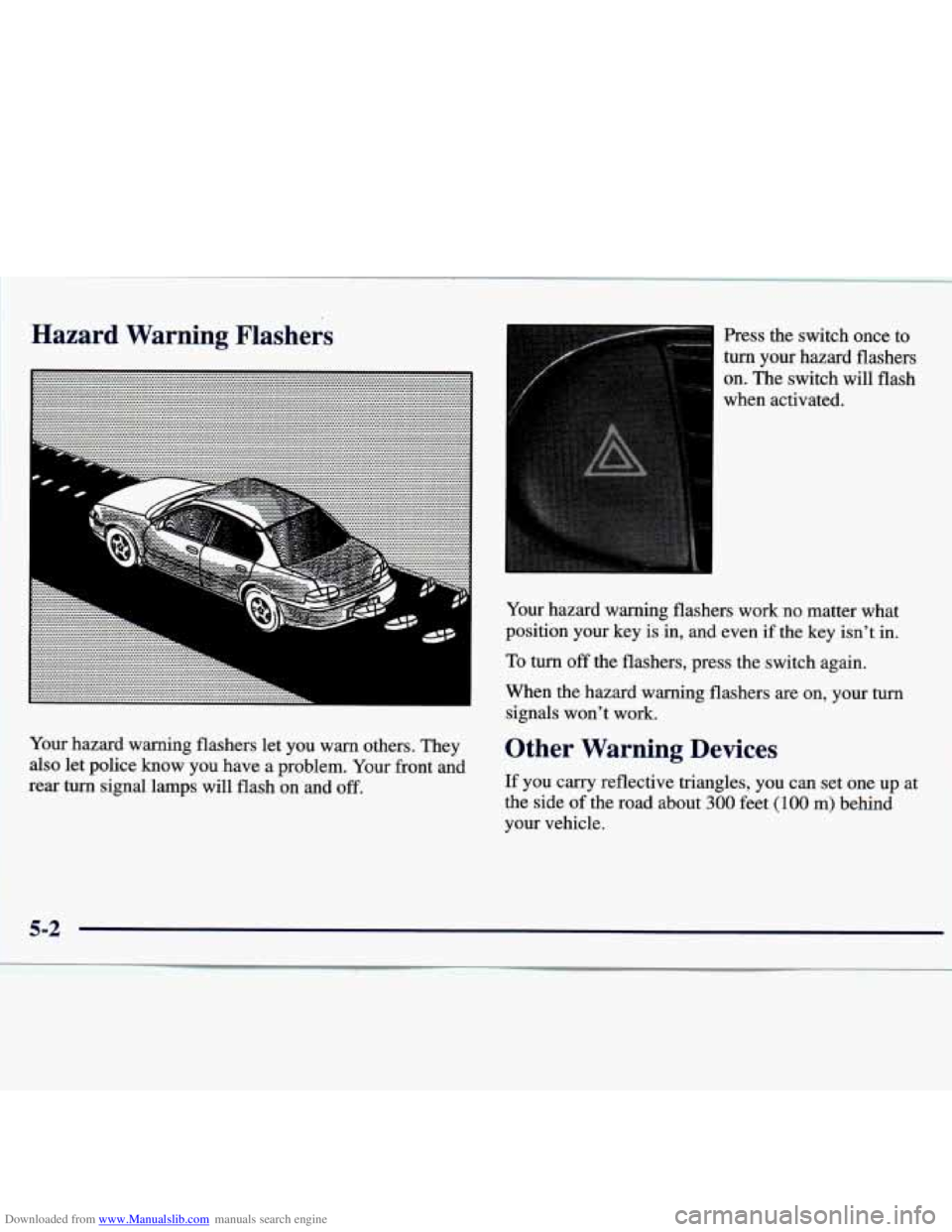
Downloaded from www.Manualslib.com manuals search engine Hazard Warning Flashers Press the switch once to
turn your hazard flashers
on. The switch will flash
when activated.
Your hazard warning flashers work no matter what
position your key is in, and even
if the key isn’t in.
Your hazard warning flashers let you warn others. They
also let police know you have a problem. Your front and
rear turn signal lamps will flash on and
off.
To turn off the flashers, press the switch again.
When the hazard warning flashers are on, your turn signals won’t work.
Other Warning Devices
If you carry reflective triangles, you can set one up at
the side
of the road about 300 feet (100 m) behind
your vehicle.
5-2
Page 199 of 362
Downloaded from www.Manualslib.com manuals search engine Towing Your Vehicle
Try to have a Chevrolet dealer or a professional towing
service tow your vehicle. They can provide the right
equipment and know-how to tow your vehicle without
damage. (See “Roadside Assistance” in the Index.)
If your vehicle has been changed or modified since it
was factory-new by adding aftermarket items like fog
lamps, aero skirting, or special tires and wheels, these
instructions and illustrations may not be correct.
Before you do anything,
turn on the hazard
warning flashers.
When you call, tell the towing service:
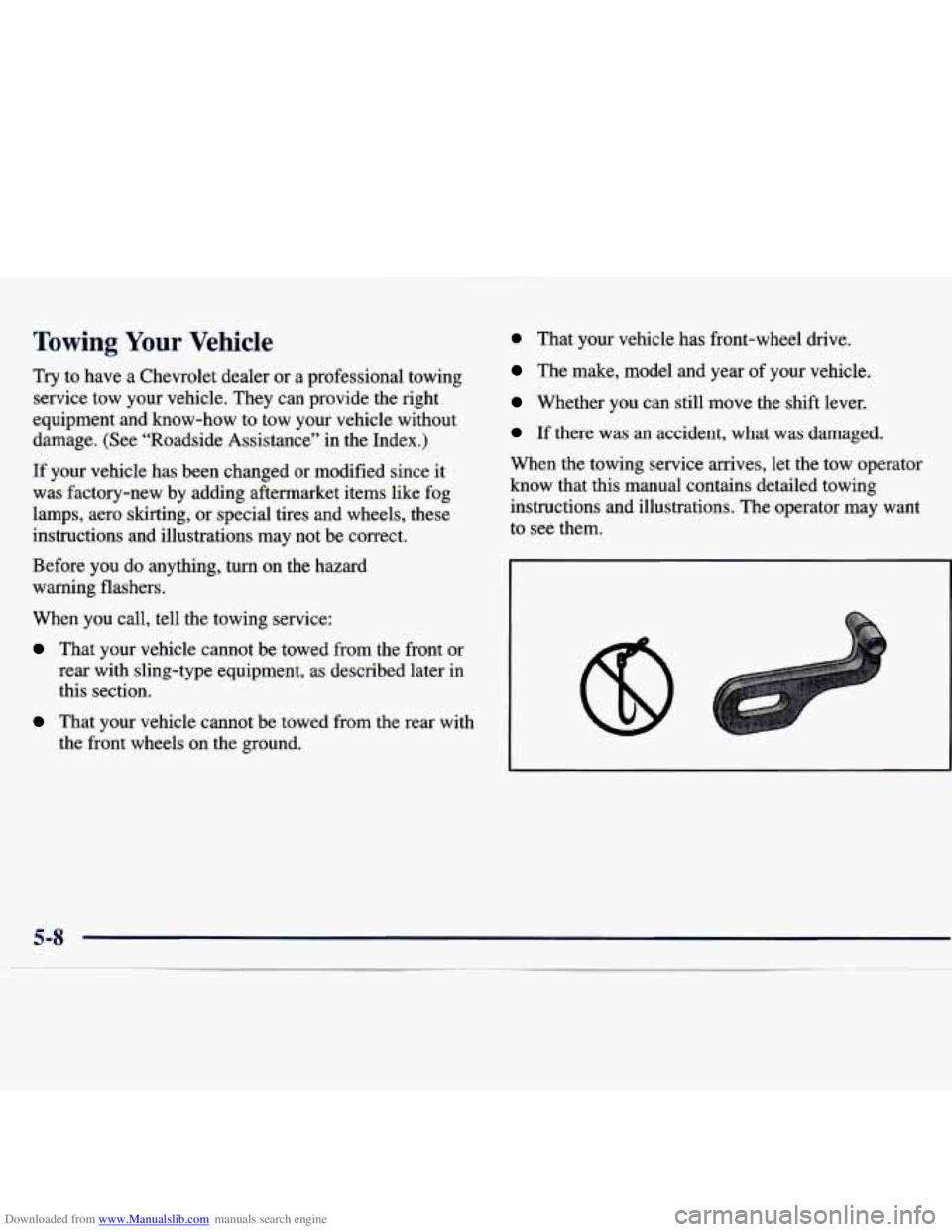
That your vehicle cannot be towed from the front or
rear with sling-type equipment, as described later in
this section.
That your vehicle cannot be towed from the rear with
the front wheels on the ground.
0 That your vehicle has front-wheel drive.
The make, model and year of your vehicle.
Whether you can still move the shift lever.
If there was an accident, what was damaged.
When the towing service arrives, let the tow operator know that this manual contains detailed towing
instructions and illustrations. The operator may want
to see them.