Page 51 of 362
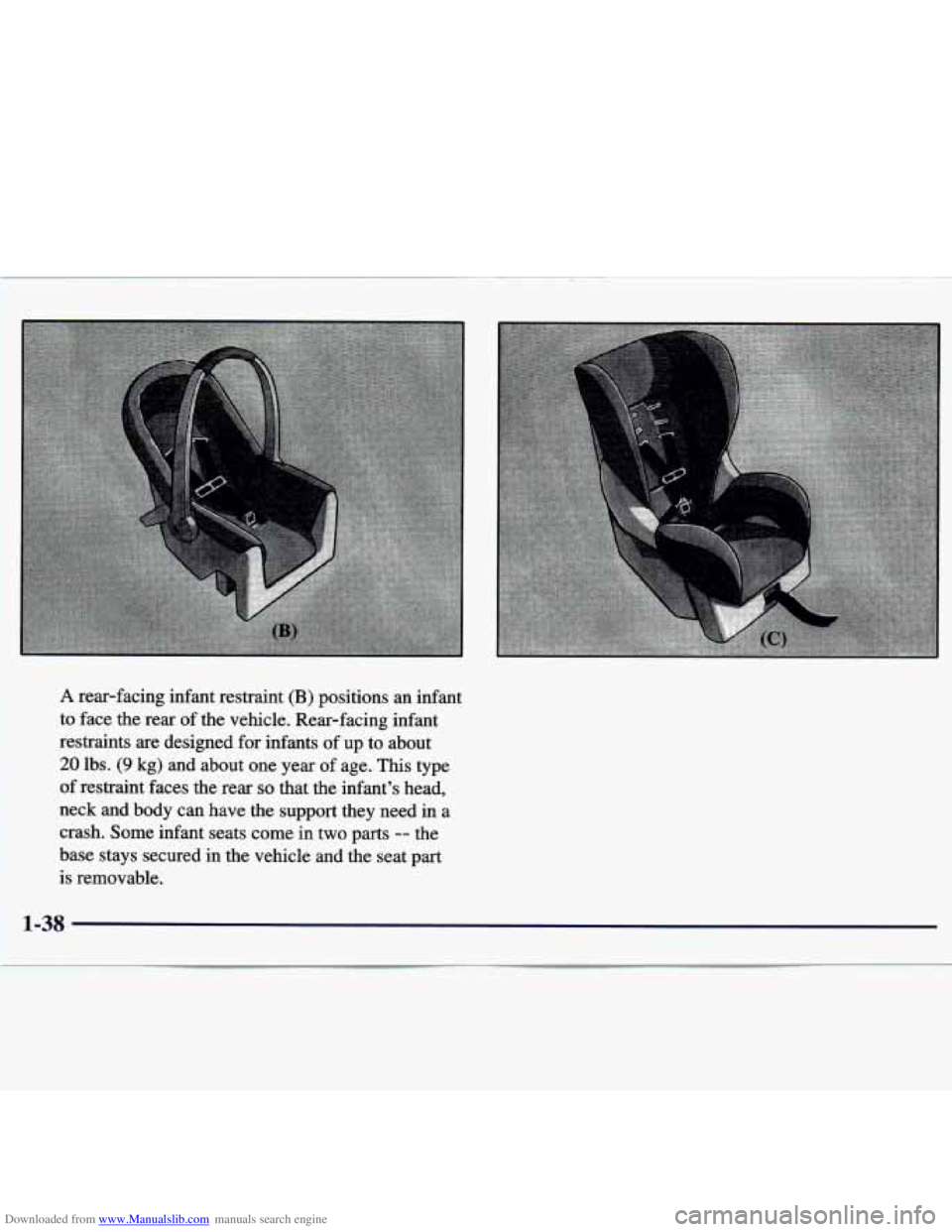
Downloaded from www.Manualslib.com manuals search engine A rear-facing infant restraint (B) positions an infant
to face the rear of the vehicle. Rear-facing infant
restraints are designed for infants of up to about
20 lbs. (9 kg) and about one year of age. This type
of restraint faces the rear
so that the infant’s head,
neck and body can have the support they need in a
crash. Some infant seats come in two parts
-- the
base stays secured in the vehicle and the seat part is removable.
1-38
Page 54 of 362
Downloaded from www.Manualslib.com manuals search engine When choosing a child restraint, be sure the child
restraint is designed to be used in a vehicle. If it is, it
will have a label saying that it meets Federal Motor
Vehicle Safety Standards.
Then follow the instructions for the restraint.
You may
find these instructions on the restraint itself or in a
booklet, or both. These restraints use the belt system in
your vehicle, but the child also has to be secured within
the restraint to help reduce the chance
of personal injury.
The instructions that come with the infant or child
restraint will show you how to do that. Both the owner’s
manual and the child restraint instructions are important,
so if either one of these is not available, obtain a
replacement copy from the manufacturer.
Where to Put the Restraint
Accident statistics show that children are safer if they
are restrained in the rear rather than the front seat. We at
General Motors therefore recommend that you put your
child restraint in the rear seat.
Never put a rear-facing
child restraint in the front passenger seat. Here’s why:
A child in a rearfacing child restraint can be
seriously injured if the right front passenger’s air
bag inflates even though your vehicle has reduced-force frontal air bags. This is because
the back of a rearfacing child restraint would be
very close to the inflating air bag. Always secure
a rear-facing child restraint in the rear seat.
You may, however, secure a forward-facing child
restraint in the right front seat. Before you secure
a forward-facing child restraint, always move the
front passenger seat as far back as it will go. Or,
secure the child restraint in the rear seat.
Wherever you install it, be sure to secure the child
restraint properly.
Keep in mind that an unsecured child restraint can move
around in a collision or sudden stop and injure people in
the vehicle. Be sure to properly secure
any child
restraint in your vehicle
-- even when no child is in it.
1-41
Page 55 of 362
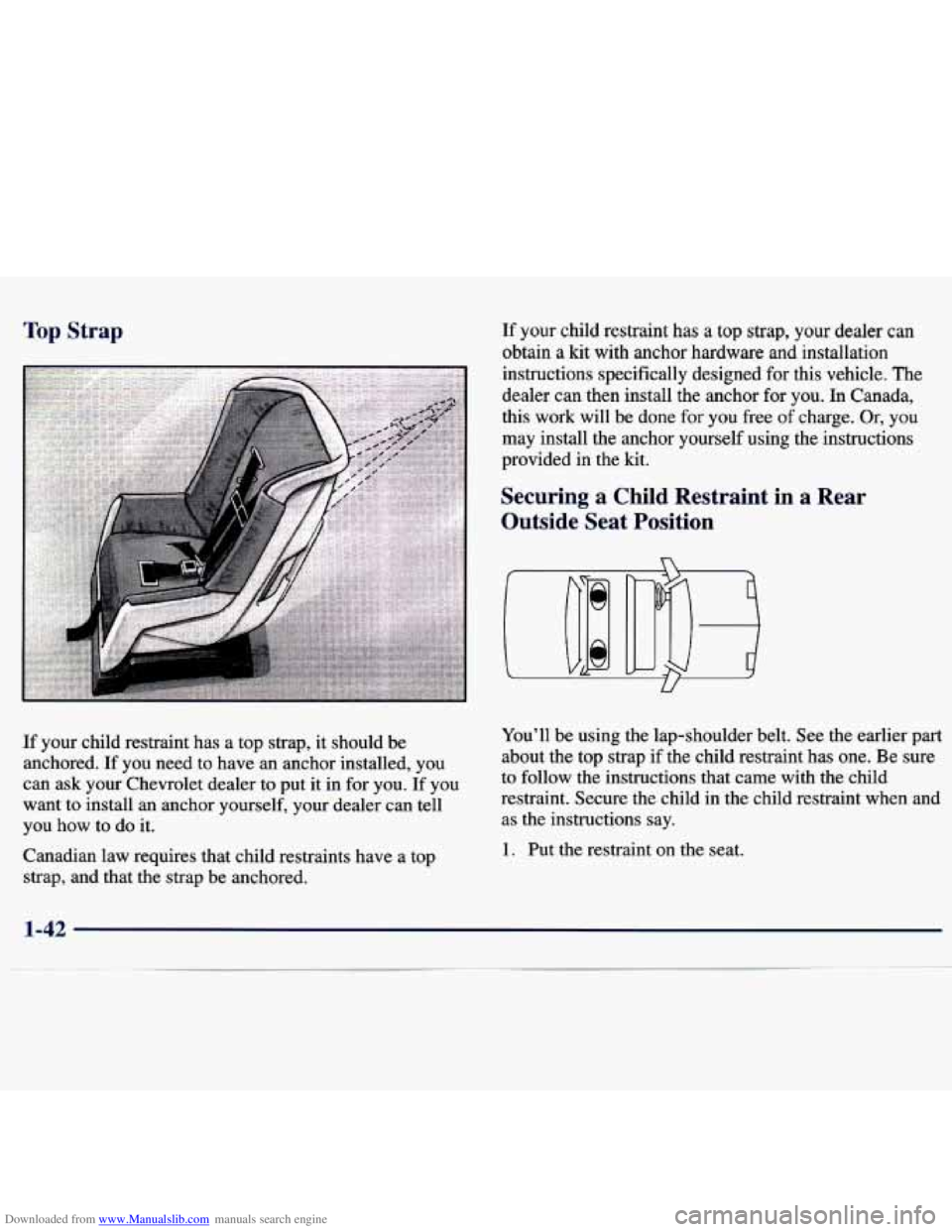
Downloaded from www.Manualslib.com manuals search engine Top Strap
If your child restraint has a top strap, it should be
anchored. If you need to have an anchor installed, you
can ask your Chevrolet dealer to put it in for
you. If you
want to install
an anchor yourself, your dealer can tell
you how to do it.
Canadian law requires that child restraints have a top strap, and that the strap be anchored.
If your child restraint has a top strap, your dealer can
obtain a kit with anchor hardware and installation
instructions specifically designed for this vehicle. The
dealer
can then install the anchor for you. In Canada,
this work will be done
for you free of charge. Or, you
may install the anchor yourself using the instructions
provided in the kit.
Securing a Child Restraint in a Rear
Outside Seat Position
You'll be using the lap-shoulder belt. See the earlier part
about the top strap if the child restraint has one. Be sure
to follow the instructions that came with the child
restraint. Secure the child in the child restraint when and as the instructions say.
1. Put the restraint on the seat.
1-42
Page 57 of 362
Downloaded from www.Manualslib.com manuals search engine To remove the child restraint, just unbuckle the vehicle’s
safety belt
and let it go back all the way. The safety belt
will move freely again and be ready to work for
an adult
or larger child passenger.
Securing a Child Restraint in the Center
Rear Seat Position
U
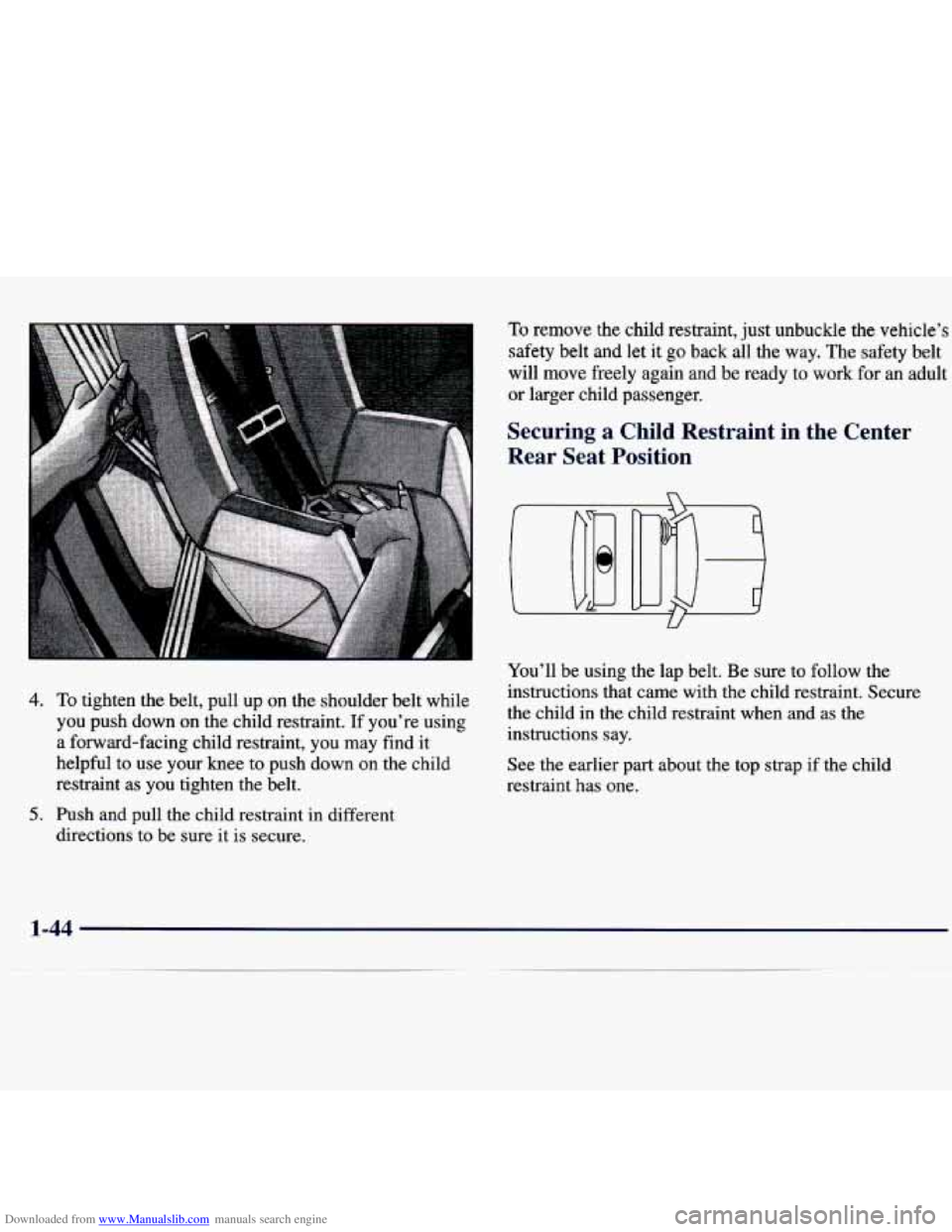
4. To tighten the belt, pull up on the shoulder belt while
you push down on the child restraint. If you’re using
a forward-facing child restraint, you may find it
helpful to use
your knee to push down on the child
restraint as
you tighten the belt.
directions to
be sure it is secure.
5. Push and pull the child restraint in different You’ll
be using the lap belt. Be sure to follow the
instructions that came with the child restraint. Secure
the child in the child restraint when and as the
instructions say.
See the earlier part about the top strap if the child
restraint has one.
1-44
Page 59 of 362
Downloaded from www.Manualslib.com manuals search engine 6. Push and pull the child restraint in different
directions
to be sure it is secure.
To remove the child restraint, just unbuckle the vehicle’s
safety belt. It will be ready to work for
an adult or larger
child passenger.
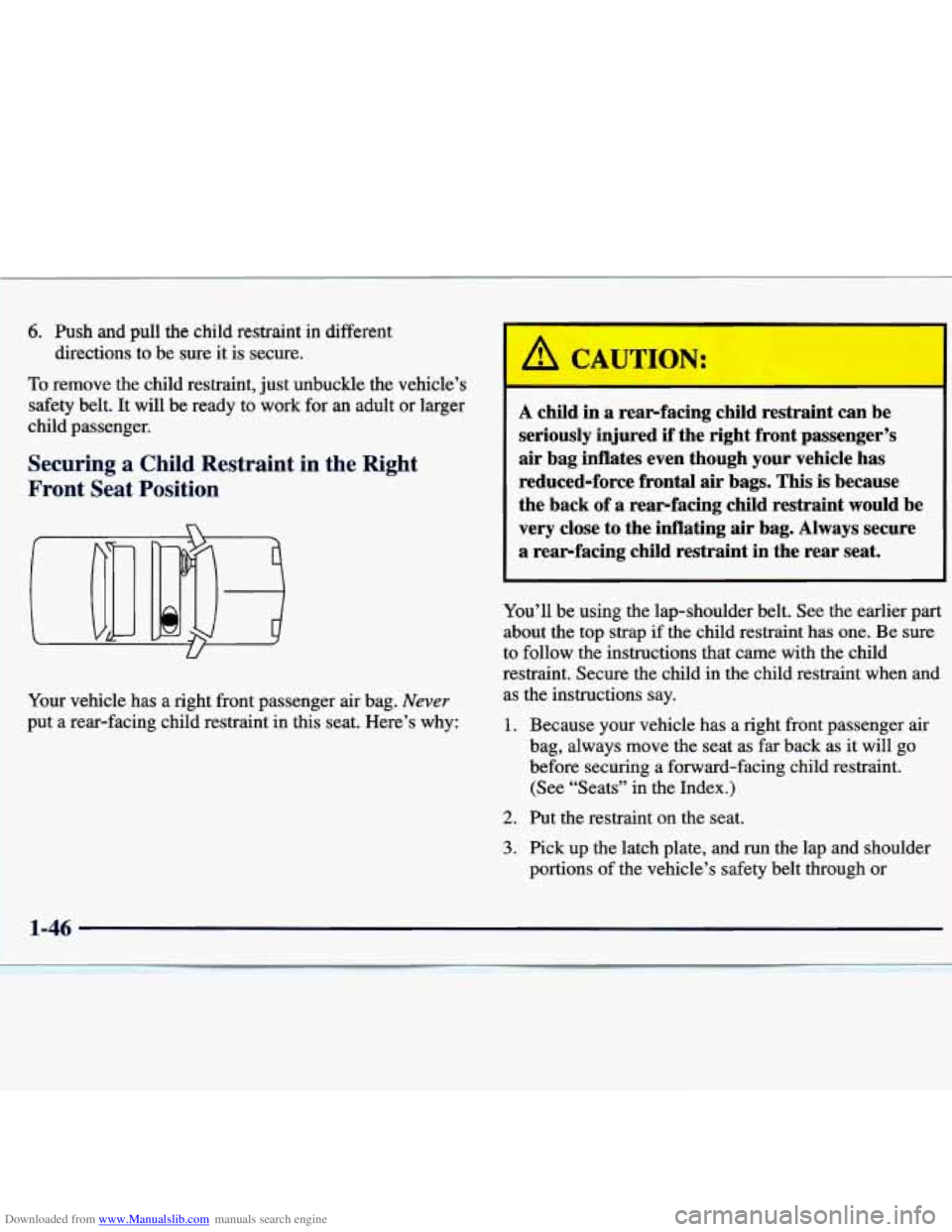
Securing a Child Restraint in the Right
Front Seat Position
Your vehicle has a right front passenger air bag. Never
put a rear-facing child restraint in this seat. Here’s why:
1-46
/1 CAUTION:
A child in a rear-facing child restraint can be
seriously injured
if the right front passenger’s
air bag inflates even though your vehicle has
reduced-force frontal air bags. This is because
the back
of a rearfacing child restraint would be
very close to the inflating air bag. Always secure
a rearfacing child restraint in the rear seat.
Page 61 of 362
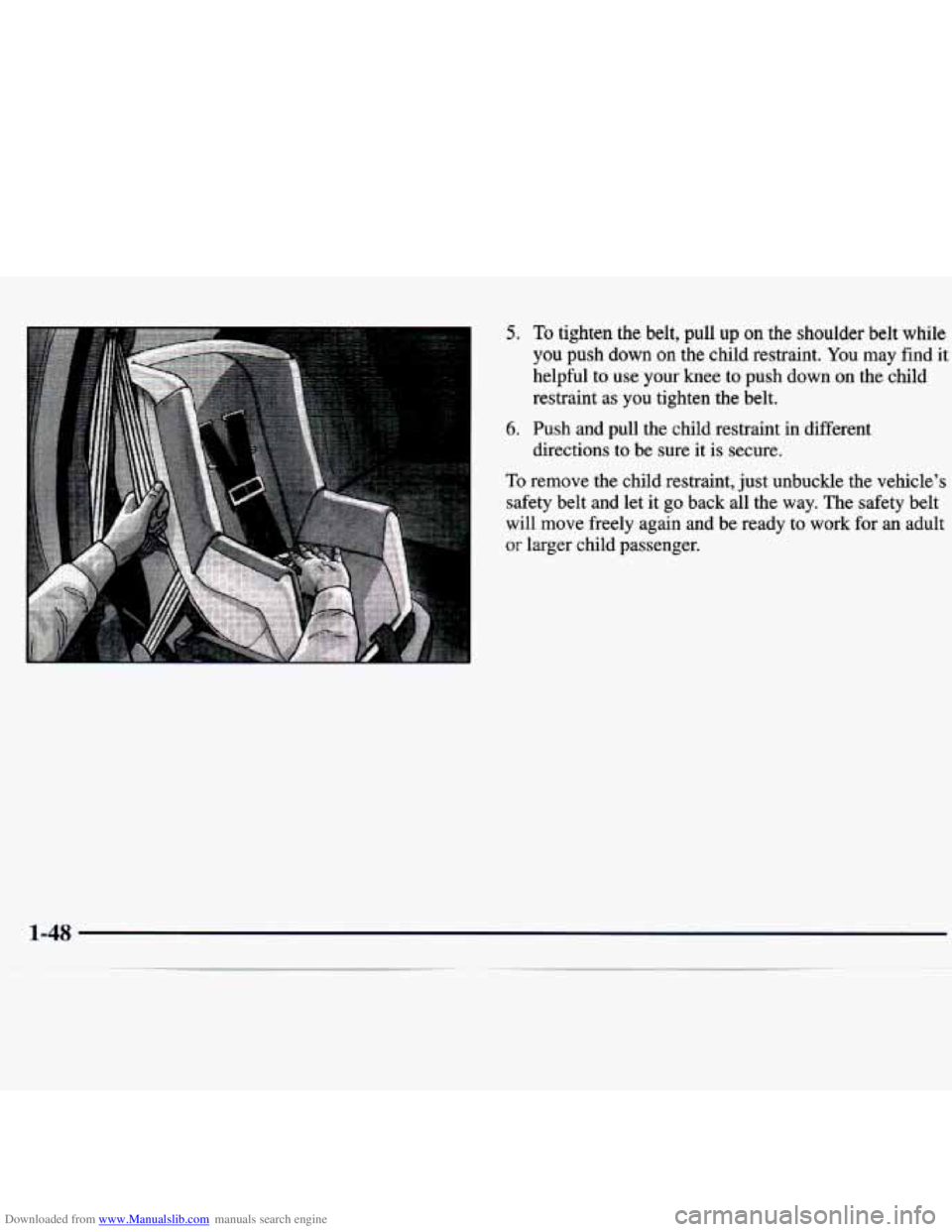
Downloaded from www.Manualslib.com manuals search engine 5. To tighten the belt, pull up on the shoulder belt while
you push down on the child restraint. You may find it
helpful to use your knee to push down
on the child
restraint as you tighten the belt.
directions to be sure it is secure.
6. Push and pull the child restraint in different
To remove the child restraint, just unbuckle the vehicle’s
safety belt and let it go back all the way. The safety belt \
will move freely again and be ready to work for an adult
or larger child passenger.
1-48
Page 70 of 362
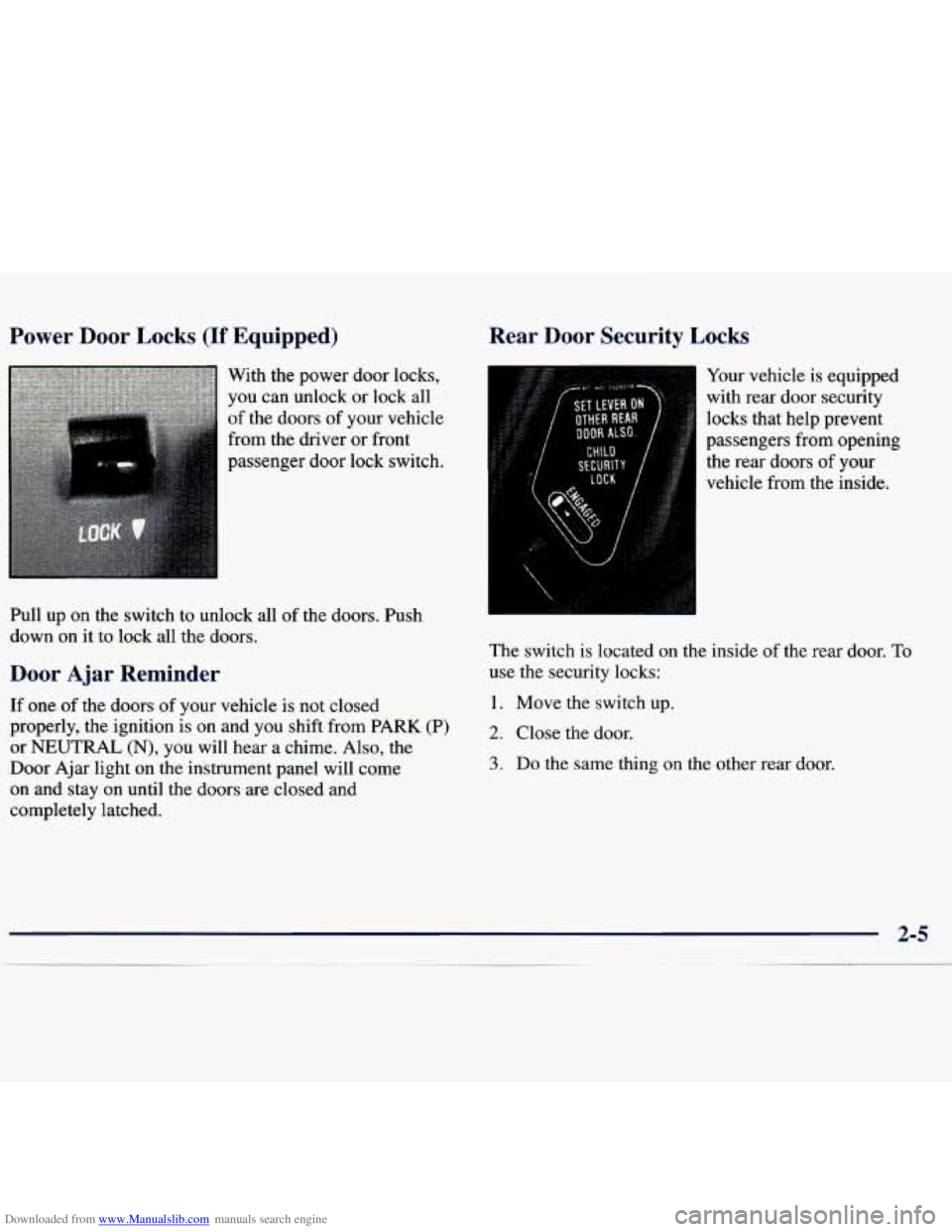
Downloaded from www.Manualslib.com manuals search engine Power Door Locks (If Equipped) Rear Door Security Locks
With the power
door locks,
you can unlock or lock all
of the doors of your vehicle
from the driver or front
passenger door lock switch.
Pull
up on the switch to unlock all of the doors. Push
down on it to lock all the doors.
Door Ajar Reminder
If one of the doors of your vehicle is not closed
properly, the ignition is on and
you shift from PARK (P)
or
NEUTRAL (N), you will hear a chime. Also, the
Door Ajar light on the instrument panel will come
on and stay
on until the doors are closed and
completely latched.
Your vehicle is equipped
with rear door security
locks that help prevent
passengers from opening
the rear doors of your
vehicle from the inside.
The switch is located
on the inside of the rear door. To
use the security locks:
1. Move the switch up.
2. Close the door.
3. Do the same thing on the other rear door.
Page 71 of 362
Downloaded from www.Manualslib.com manuals search engine The rear doors of your vehicle cannot be opened from
the inside when this feature is in use. If you want to
open
a rear door when the security lock is on:
1. Unlock the door from the inside.
2. Then open the door from the outside.
If you don’t cancel the security lock feature, adults or
older children who ride in the rear won’t be able to open \
the rear door from the inside. You should let adults and
older children know how these security locks work, and
how to cancel the locks.
To cancel the rear door lock:
1. Unlock the door from the inside and open it from
the outside.
2. Move the switch down.
3. Do the same for the other rear door.
The rear doors will now work normally.
Leaving Your Vehicle
If you are leaving your vehicle, open your door and
set the locks from the inside, then get out and close
the door.
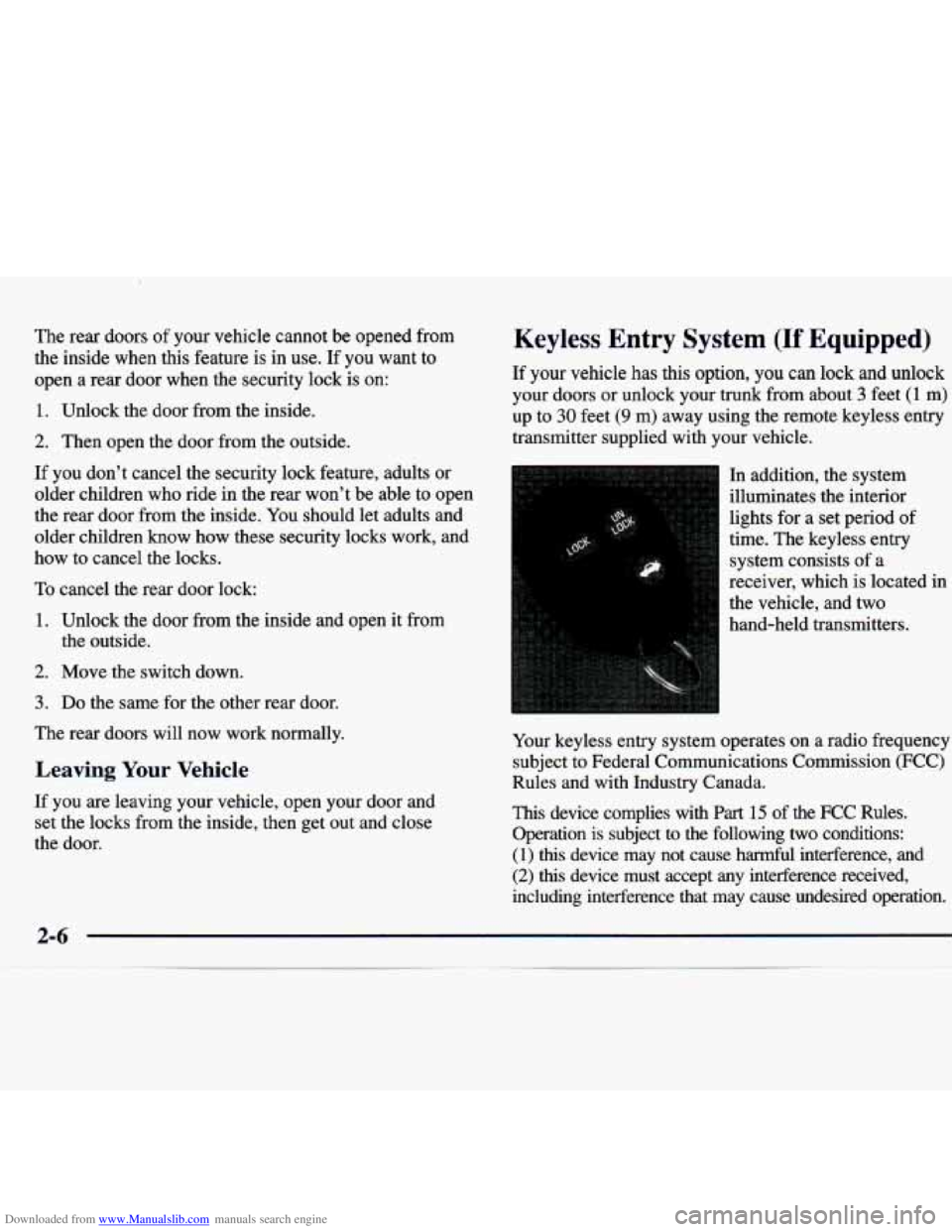
Keyless Entry System (If Equipped)
If your vehicle has this option, you can lock and unlock
your doors or unlock your trunk from about
3 feet (1 m)
up to
30 feet (9 m) away using the remote keyless entry
transmitter supplied with your vehicle.
In addition, the system
illuminates the interior
lights for a set period of
time. The keyless entry
system consists of a
receiver, which is located in
the vehicle, and two
hand-held transmitters.
Your keyless entry system operates on a radio frequency
subject to Federal Communications Commission
(FCC)
Rules and with Industry Canada.
This device complies with Part 15 of the FCC Rules.
Operation is subject to the following
two conditions:
(1)
this device may not cause harmful interference, and
(2) this device must accept any interference received,
including interference that may cause undesired operation.