1998 CHEVROLET EXPRESS overheating
[x] Cancel search: overheatingPage 128 of 386
Downloaded from www.Manualslib.com manuals search engine Anti-Lock Brake System Warning Light
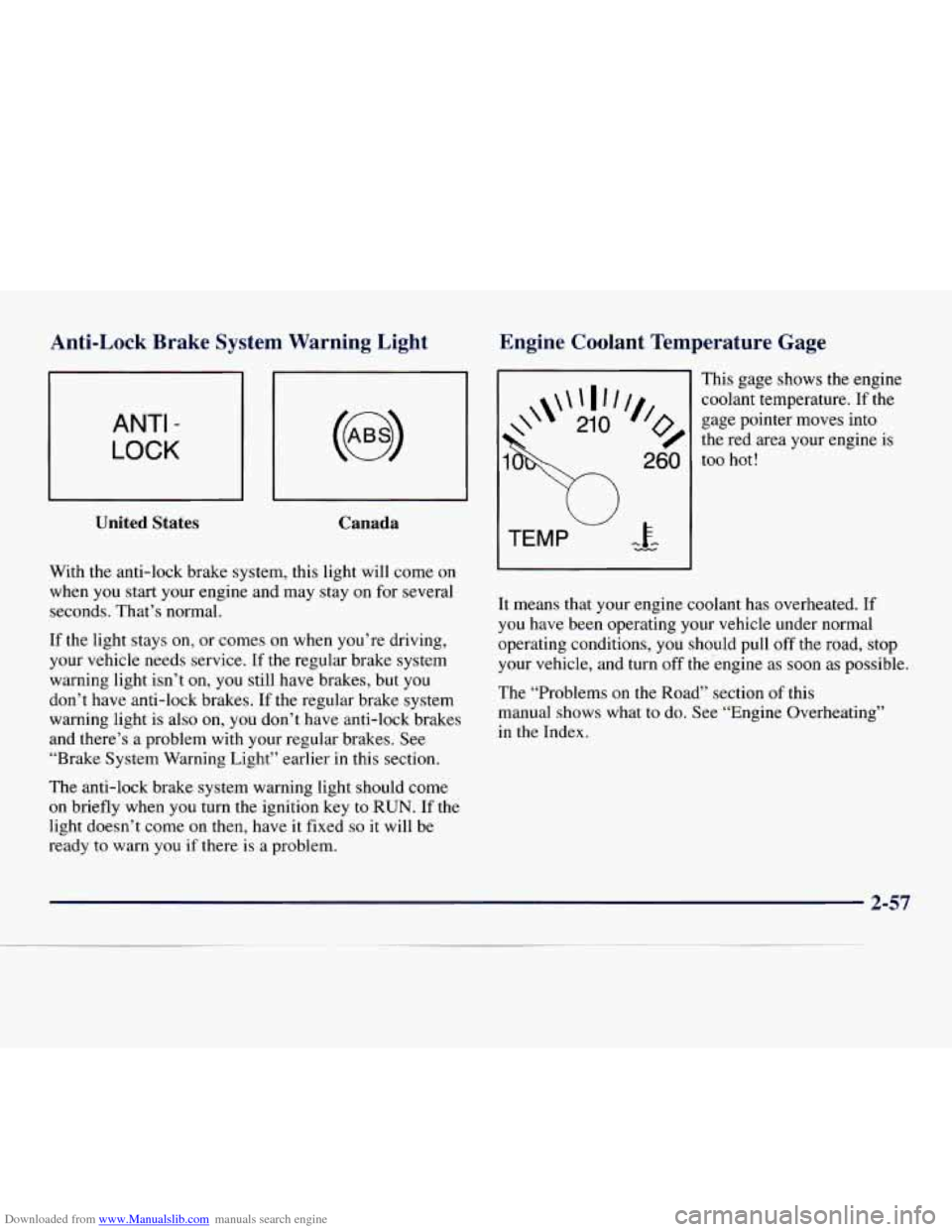
ANTI -
LOCK
United States Canada
With the anti-lock brake system, this light will come on
when you start your engine and may stay on for several
seconds. That’s normal.
If the light stays
on, or comes on when you’re driving,
your vehicle needs service. If the regular brake system
warning light isn’t
on, you still have brakes, but you
don’t have anti-lock brakes. If the regular brake system
warning light is also on, you don’t have anti-lock brakes
and there’s a problem with your regular brakes. See
“Brake System Warning Light” earlier in this section.
The anti-lock brake system warning light should come
on briefly when
you turn the ignition key to RUN. If the
light doesn’t come on then, have it fixed
so it will be
ready
to warn you if there is a problem.
Engine Coolant Temperature (I ~ - -:
This gage shows the engine
coolant temperature. If the
gage pointer moves into
the red area your engine is
too hot!
It means that your engine coolant has overheated. If
you have been operating your vehicle under normal
operating conditions,
you should pull off the road, stop
your vehicle, and turn
off the ‘engine as soon as possible.
The “Problems on the Road” section
of this
manual shows what to do. See “Engine Overheating”
in the Index.
2-57
Page 198 of 386

Downloaded from www.Manualslib.com manuals search engine Making Turns
NOTICE:
Making very sharp turns while trailering could
cause the trailer to come in contact with the vehicle. Your vehicle could be damaged. Avoid
making very sharp turns while trailering.
When you’re turning with a trailer, make wider turns than normal.
Do this so your trailer won’t strike soft shoulders,
curbs, road signs, trees or other objects. Avoid jerky or
sudden maneuvers. Signal well in advance.
lhrn Signals When Towing a Trailer
When you tow a trailer, your vehicle has to have extra
wiring and a heavy-duty turn signal flasher (included in
the optional trailering package).
The arrows on your instrument panel will flash
whenever you signal a turn or lane change. Properly
hooked up, the trailer lamps will also flash, telling other
drivers you’re about to turn, change lanes or stop. When
towing
a trailer, the arrows on your instrument
panel will flash for turns even if the bulbs
on the trailer
are burned out. Thus,
you may think drivers behind
you are seeing your signal when they are not. It’s
important to check occasionally
to be sure the trailer
bulbs are still working.
Driving On Grades
Reduce speed and shift to a lower gear before you start
down a long or steep downgrade. If you don’t shift
down, you might have
to use your brakes so much that
they would get hot and no longer work well.
On a long uphill grade, shift down and reduce your
speed
to around 45 mph (70 kdh) to reduce the
possibility of engine and transmission overheating.
When towing at high altitude
on steep uphill grades,
consider the following: Engine coolant will boil at a lower
temperature than
at normal altitudes. If you turn your
engine
off immediately after towing at high altitude on
steep uphill grades, your vehicle may show signs similar
to
engine overheating. To avoid this, let the engine run while
parked (preferably
on level ground) with the automatic
transmission in PARK
(P) for a few minutes before tumine
the engine off. If you do get the overheat warning, see
“Engine Overheating”
in the Index.
4-35
Page 202 of 386

Downloaded from www.Manualslib.com manuals search engine Section 5 Problems on the Road
Here you’ll find what to do about some problems that can occur on the road.
5-2
5-2
5-3
5-8
5-1 1
Hazard Warning Flashers
Other Warning Devices
Jump Starting
Towing Your Vehicle
Engine Overheating (Gasoline Engine) 5- 14
5-21
5-2 1
5-22
5-36
Cooling System (Gasoline Engines)
Engine Fan Noise
If a Tire Goes Flat
Changing a Flat Tire
If You’re Stuck: In Sand, Mud, Ice or Snow
5-1
Page 212 of 386
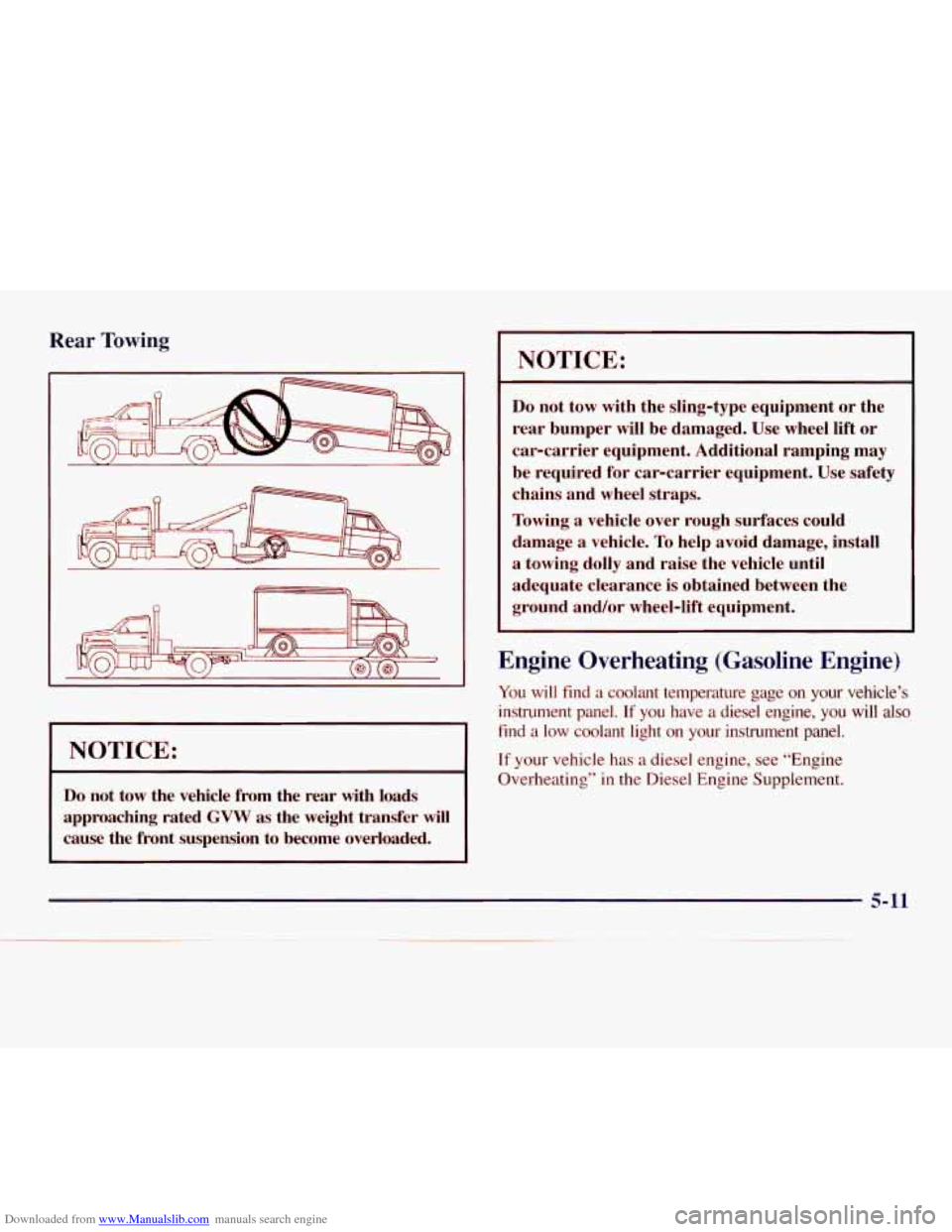
Downloaded from www.Manualslib.com manuals search engine Rear Towing
I NOTICE:
Do not tow the vehicle from the rear with loads
approaching rated
GVW as the weight transfer will
cause the front suspension to become overloaded.
I
NOTICE:
Do not tow with the sling-type equipment or the
rear bumper will be damaged. Use wheel lift or
car-carrier equipment. Additional ramping may
be required for car-carrier equipment. Use safety
chains and wheel straps.
Towing a vehicle over rough surfaces could
damage a vehicle.
To help avoid damage, install
a towing dolly and raise the vehicle until
adequate clearance is obtained between the
ground and/or wheel-lift equipment.
Engine Overheating (Gasoline Engine)
You will find a coolant temperature gage on your vehicle’s
instrument panel.
If you have a diesel engine, you will also
find a low coolant light on your instrument panel.
If your vehicle has a diesel engine, see “Engine
Overheating” in the Diesel Engine Supplement.
5-11
Page 260 of 386

Downloaded from www.Manualslib.com manuals search engine Rear Axle What to Use
When to Check and Change Lubricant
Refer to the Maintenance Schedule to determine how
often
to check the lubricant and when to change it. See
“Scheduled Maintenance Services” in the Index.
How to Check Lubricant
If the level is below the
bottom
of the filler plug
hole, you’ll need to add
some lubricant. Add enough
lubricant to raise the level
to the bottom of the filler
plug hole. Refer
to the Maintenance Schedule to determine what
kind of lubricant to use. See “Recommended Fluids and
Lubricants” in the Index.
Engine Coolant
The cooling s stem in your vehicle is filled with
DEX-COOL engine coolant. This coolant is designed
to remain in your vehicle for
5 years or 150,000 miles
(240
000 kmg whichever occurs first, if you add only
DEX-COOL extended life coolant.
8
The following explains your cooling system and how to
add coolant when it is low. If you have a problem with
engine overheating, see “Engine Overheating” in the
Index.
A 50/50 mixture of water and DEX-COOL@
coolant will:
0 Give freezing protection down to -34°F (-37°C).
Give boiling protection up to 265 “F (1 29” C).
Protect against rust and corrosion.
0 Help keep the proper engine temperature.
0 Let the warning lights and gages work as
they should.
Page 263 of 386
Downloaded from www.Manualslib.com manuals search engine Adding Coolant
If you need more coolant, add the proper DEX-COOL'
coolant mixture at the coolant recovery tank.
I
Wrning the radiator pressure cap when the
engine and radiator are hot can allow steam
and scalding liquids to blow out and burn you
badly. With the coolant recovery tank, you will
almost never have
to add coolant at the radiator.
Never turn the radiator pressure cap
-- even a
little
-- when the engine and radiator are hot.
Add coolant mixture at the recovery tank, but be careful
not to spill it.
A CAUTION:
You can be burned if you spill coolant on hot
engine parts. Coolant contains ethylene glycol,
and it will burn
if the engine parts are hot
enough. Don't spill coolant on
a hot engine.
Radiator Pressure Cap
The radiator pressure cap must be tightly installed with
the arrows
on the cap lined up with the overflow tube on
the radiator filler neck.
NOTICE:
Your radiator cap is a pressure-type cap and
must be tightly installed to prevent coolant loss
and possible engine damage from overheating.
Be sure the arrows on the cap line up with the
overflow tube on the radiator filler neck.
6-24
Page 280 of 386

Downloaded from www.Manualslib.com manuals search engine 2.
3.
4.
5.
6.
7.
Press down on the blade assembly pivot locking tab.
Pull down on the blade assembly to release it from
the wiper arm hook.
Remove the insert from the blade assembly. The
insert has two notches at one end that are locked by
bottom claws
of the blade assembly. At the notched
end, pull
the insert from the blade assembly.
To install the new wiper insert, slide the notched
end last, into the end with two blade claws. Slide
the insert all the way through the blade claws at the
opposite end.
Be sure that the notches are locked by the bottom
claws. Make sure that all other claws are properly
locked
on both sides of the insert slot.
Put the blade assembly pivot in the wiper arm
hook. Pull up until the pivot locking tab locks in
the hook slot.
Carefully lower the wiper
arm and blade assembly
into the windshield.
Tires
Yo%fS%%v vehicle comes with high-quality tires made by
a leading tire manufacturer. If you ever have questions
about your tire warranty and where to
obtain service, see
your
GM Warranty booklet for details.
A CAUTIOI.:
Poorly maintained and improperly used tires
are dangerous.
0
0
0
0
Overloading your tires can cause
overheating as
a result of too much friction.
You could have an air-out and a serious
accident. See “Loading Your Vehicle” in
the Index.
Underinflated tires pose the same danger
as overloaded tires. The resulting accident
could cause serious injury. Check all tires
frequently to maintain the recommended
pressure. Tire pressure should be checked
when your tires are cold.
Overinflated tires are more likely
to be
cut, punctured
or broken by a sudden
impact
-- such as when you hit a pothole.
Keep tires at the recommended pressure.
Worn, old tires can cause accidents.
If your
tread is badly worn, or if your tires have
been damaged, replace them.
6-41
Page 377 of 386

Downloaded from www.Manualslib.com manuals search engine Engine ....................................... 6-10
Coolant
..................................... 6-21
Coolant Level Check
.......................... 7-38
Coolant Temperature Gage
..................... 2-57
Cooling System
.............................. 5- 14
Exhaust
...................... 2.29.2.30.2.33 .4.26
FuseBlock
.................................. 6-65
Identification
........................... 6.60. 6.67
OilLevelCheck
.............................. 7-38
Overheating
................................. 5-11
Running While Parked ......................... 2-30
Starting Your
................................ 2- 18
EngineOil
.................................... 6-12
Adding
..................................... 6-13
Additives
................................... 6-15
Checking ................................... 6-13
Pressure Gage
................................ 2-60
Used
....................................... 6-16
Whentochange
.............................. 6-15
Exhaust, Engine
................. 2-29.2-30,2-33, 4-26
Engine Coolant Heater
........................... 2-20
Engine Oil (Continued)
Exterior Lamps
................................. 2-40
Fabric Cleaning
............................... 6-52
Filling a Portable Fuel Container .................... 6-7
FillingYourTank
................................ 6-5
Filter. Air
..................................... 6-16
Finish Care
.................................... 6-55
Finish Damage
................................. 6-57 First Gear. Automatic Transmission
................ 2-23
Flashers. Hazard Warning
......................... 5-2
Flat Tire. Changing
............................. 5-22
Fluids and Lubricants
............................ 7-44
Foreign Countries. Fuel
........................... 6-5
French Language Manual
11
Front Parkingnurn Signal Lamp Bulb Replacement .... 6-35
Front Storage Area
.............................. 2-48
FrontTowing
.................................. 5-10
Fuel .......................................... 6-3
Canada ...................................... 6-3
Filling
a Portable Container ...................... 6-7
FillingYourTank
.............................. 6-5
Gage
....................................... 2-63
In Foreign Countries
........................... 6-5
Tankcapacity
............................... 6-69
Fuses and Circuit Breakers
....................... 6-61
.. ...........................
Gages
Engine Coolant Temperature
.................... 2-57
Engine Oil Pressure
........................... 2-60
Fuel
....................................... 2-63
Speedometer
................................. 2-52
Voltmeter
................................... 2-55
GAWR
....................................... 4-27
Gear Positions. Automatic Transmission
............. 2-21
Gross Axle Weight Rating
........................ 4-27
Gross Vehicle Weight Rating
...................... 4-27
Guide en Franpis
11
GVWR ....................................... 4-27
.. .................................
9-4