1998 CHEVROLET CAVALIER light
[x] Cancel search: lightPage 303 of 400
Downloaded from www.Manualslib.com manuals search engine Uniform Tire Quality Grading
The following information relates to the system developed
by the United States National Highway Traffic Safety Administration, which grades tires by treadwear, traction
and temperature performance.
(This applies only to
vehicles sold in the United States.) The grades are molded
on the sidewalls of most passenger car tires. The Uniform
Tire Quality Grading system does not apply to deep tread, winter-type snow tires, space-saver or temporary use spare
tires, tires with nominal rim diameters of 10 to
12 inches
(25 to 30 cm), or to some limited-production tires.
While the tires available on General Motors passenger
cars and light trucks may vary with respect to these grades, they must also conform to Federal safety
requirements and additional General Motors Tire
Performance Criteria (TPC) standards.
Treadwear
The treadwear grade is a comparative rating based on
the wear rate of the tire when tested under controlled
conditions on a specified government test course. For
example, a tire graded 150 would wear one and
a half
(1
1/2) times as well on the government course as a tire
graded
100. The relative performance of tires depends
upon the actual conditions of their use, however, and
may depart significantly from the norm due to variations in driving habits, service practices and differences in
road characteristics and climate.
Traction -- A, B, C
The traction grades, from highest to lowest, are A, B, and
C,
and they represent the tire’s ability to stop on wet
pavement as measured under controlled conditions on specified government test surfaces
of asphalt and concrete.
A tire marked
C may have poor traction performance.
Warning: The traction grade assigned to this tire is based
on braking (straight ahead) traction tests and does not include cornering (turning) traction.
Temperature -- A, B, C
The temperature grades are A (the highest), B, and C,
representing the tire’s resistance to the generation of
heat and its ability to dissipate heat when tested under
controlled conditions on
a specified indoor laboratory
test wheel. Sustained high temperature can cause the
material of the tire to degenerate and reduce tire life, and
excessive temperature can lead to sudden tire failure.
The grade C corresponds to a level of performance
which all passenger car tires must meet under the
Federal Motor Vehicle Safety Standard
No. 109. Grades
B and A represent higher levels of performance on the
laboratory test wheel than the minimum required by law.
6-45
Page 311 of 400
Downloaded from www.Manualslib.com manuals search engine NOTICE:
Cleaning Your Convertible Top
Your convertible top should be cleaned often. If you use
an automatic vehicle wash, use one with water jets and
hanging cloths. High pressure car washes may cause
When you hand wash the top, do it in partial shade. Use
a mild soap, lukewarm water and a soft sponge.
A
Machine compounding or aggressive polishing on
a basecoatklearcoat paint finish may dull the
water to enter your vehicle.
finish or leave swirl marks.
Foreign materials such as calcium chloride and other chamois or\
cloth may leave lint on the top, and a brush
salts, ice melting agents, road oil and tar, tree sap, bird can chafe the threads in the top fabric. Don’t use
droppings, chemicals from industrial chimneys, etc., can detergen\
ts, harsh cleaners, solvents or bleaching agents.
damage your vehicle’s finish if they remain on painted surfaces. Wash the vehicle as soon as possible. If
necessary, use non-abrasive cleaners that are marked safe for painted surfaces to remove foreign matter.
Exterior painted surfaces are subject to aging, weather and chemical fallout that can take their toll over a period
of years.
You can help to keep the paint finish looking
new
by keeping your vehicle garaged or covered
whenever possible. Wet
the entire vehicle and wash the top evenly to avoid
spots
or rings. Let the soap remain on the fabric for a
few minutes. When the top is really dirty, use a mild
foam-type cleaner. Thoroughly rinse the entire vehicle,
then let the top dry
in direct sunlight.
6-53
Page 317 of 400
Downloaded from www.Manualslib.com manuals search engine Fuses and Circuit Breakers
The wiring circuits in your vehicle are protected from
short circuits by a combination of fuses, circuit breakers
and fusible thermal links. This greatly reduces the
chance of damage caused by electrical problems.
Look at the silver-colored band inside the fuse. If the
band is broken or melted, replace the fuse.
Be sure you
replace a bad fuse with a new one of the identical size
and rating.
If you ever have a problem on the road and don’t have a
spare fuse, you can borrow one that has the same
amperage. Just pick some feature of your vehicle that
you can get along without
-- like the radio or cigarette
lighter
-- and use its fuse if it is the correct amperage.
Replace it as soon
as you can.
There are two fuse blocks in your vehicle: the
instrument panel
fuse block and the engine compartment
fuse block.
Instrument Panel Fuse Block
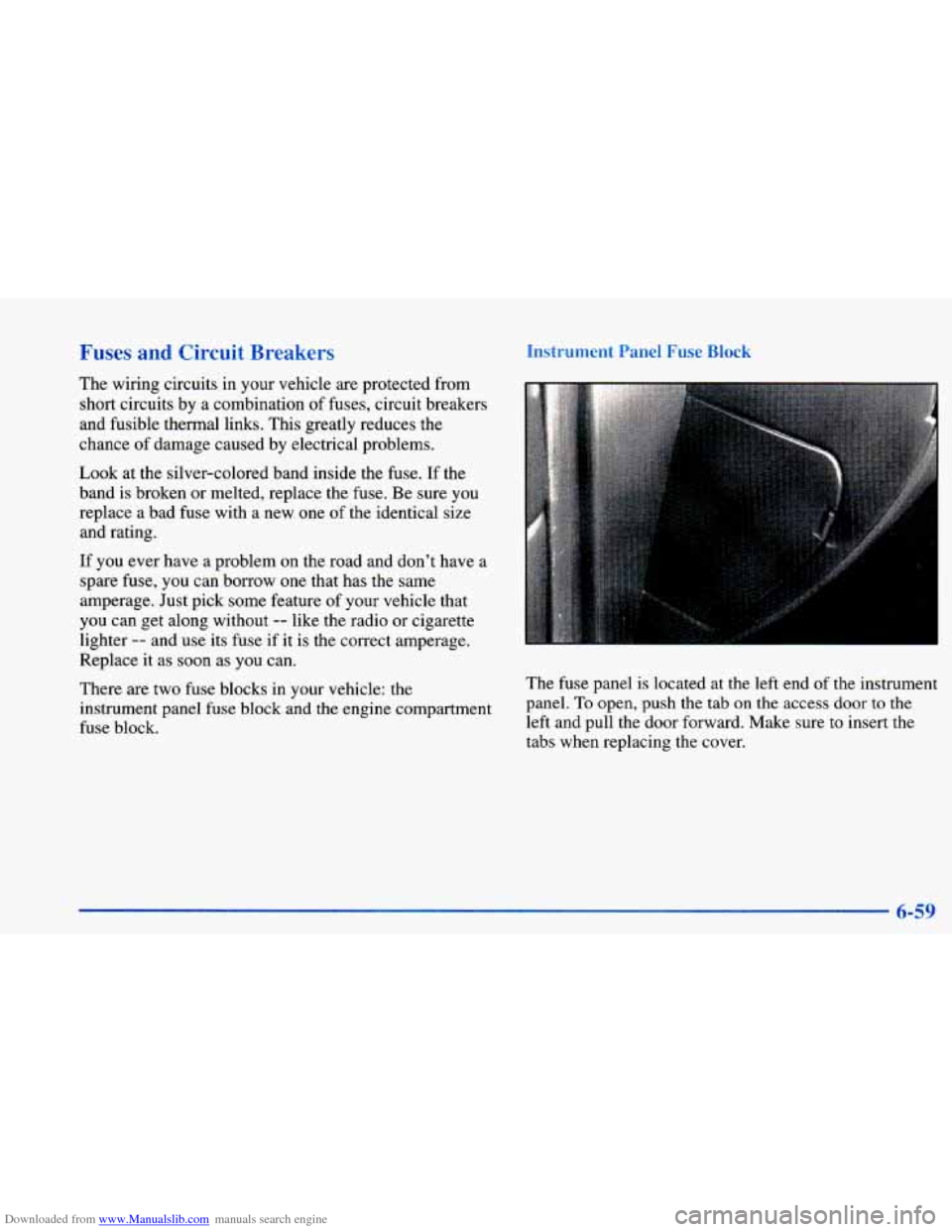
The fuse panel is located at the left end of the instrument
panel.
To open, push the tab on the access door to the
left and pull the door forward.
Make sure to insert the
tabs when replacing the cover.
6-59
Page 318 of 400
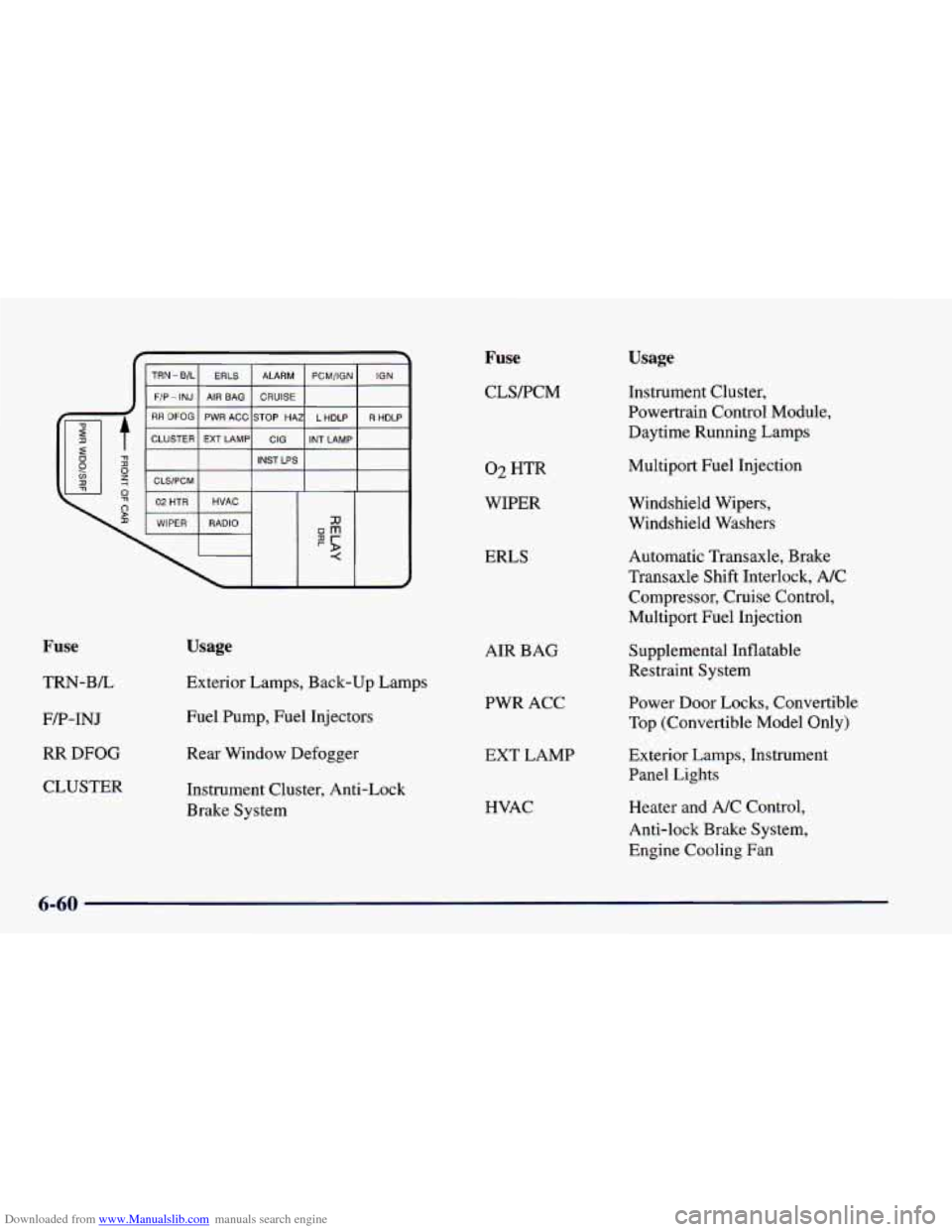
Downloaded from www.Manualslib.com manuals search engine Fuse
TRN-BL FA'-INJ
RR DFOG
CLUSTER
Usage
Exterior Lamps, Back-up Lamps
Fuel Pump, Fuel Injectors
Rear Window Defogger
Instrument Cluster, Anti-Lock
Brake System
Fuse
CLSRCM
02 HTR
WIPER
ERLS
AIR BAG
PWR ACC
EXT LAMP
HVAC
Usage
Instrument Cluster,
Powertrain Control Module,
Daytime Running Lamps
Multiport Fuel Injection
Windshield Wipers,
Windshield Washers Automatic Transaxle, Brake
Transaxle Shift Interlock, A/C
Compressor, Cruise Control,
Multiport Fuel Injection
Supplemental Inflatable
Restraint System
Power Door Locks, Convertible
Top (Convertible Model Only)
Exterior Lamps, Instrument
Panel Lights
Heater and A/C Control,
Anti-lock Brake System,
Engine Cooling Fan
6-60
Page 319 of 400
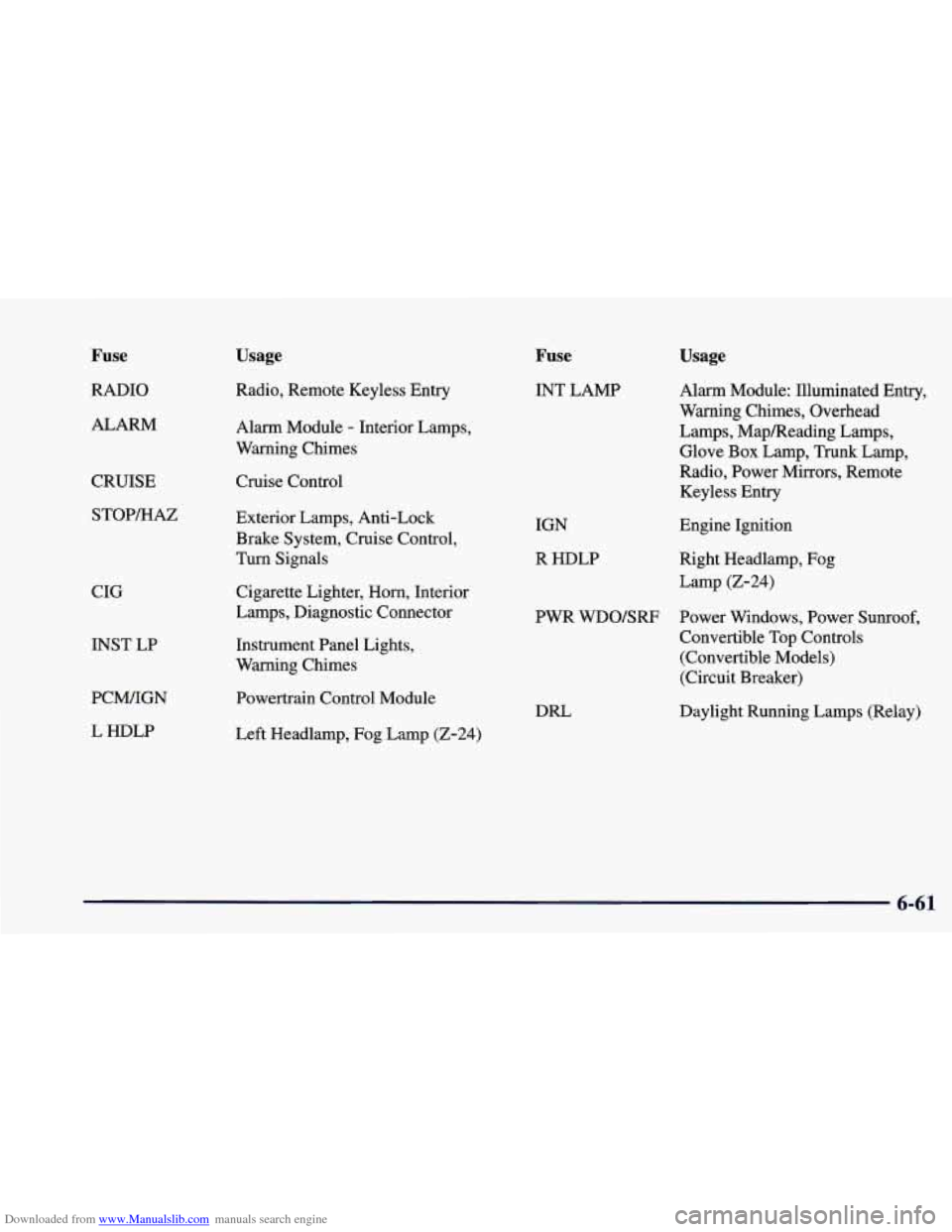
Downloaded from www.Manualslib.com manuals search engine Fuse
RADIO
ALARM CRUISE STOP/HAZ
CIG
INST LP
PCM/IGN
L HDLP
Usage
Radio, Remote Keyless Entry
Alarm Module
- Interior Lamps,
Warning Chimes
Cruise Control
Exterior Lamps, Anti-Lock
Brake System, Cruise Control,
Turn Signals Cigarette Lighter,
Horn, Interior
Lamps, Diagnostic Connector
Instrument Panel Lights,
Warning Chimes
Powertrain Control Module
Left Headlamp, Fog Lamp
(2-24)
Fuse
INT LAMP
IGN
R HDLP
Usage
Alarm Module: Illuminated Entry,
Warning Chimes, Overhead
Lamps, MapReading Lamps,
Glove Box Lamp, Trunk Lamp,
Radio, Power Mirrors, Remote Keyless
Entry
Engine Ignition
Right Headlamp, Fog
Lamp
(2-24)
PWR WDO/SRF Power Windows, Power Sunroof,
Convertible Top Controls
(Convertible Models)
(Circuit Breaker)
DRL Daylight Running Lamps (Relay)
6-61
Page 320 of 400
Downloaded from www.Manualslib.com manuals search engine Engine Compartment Fuse Block
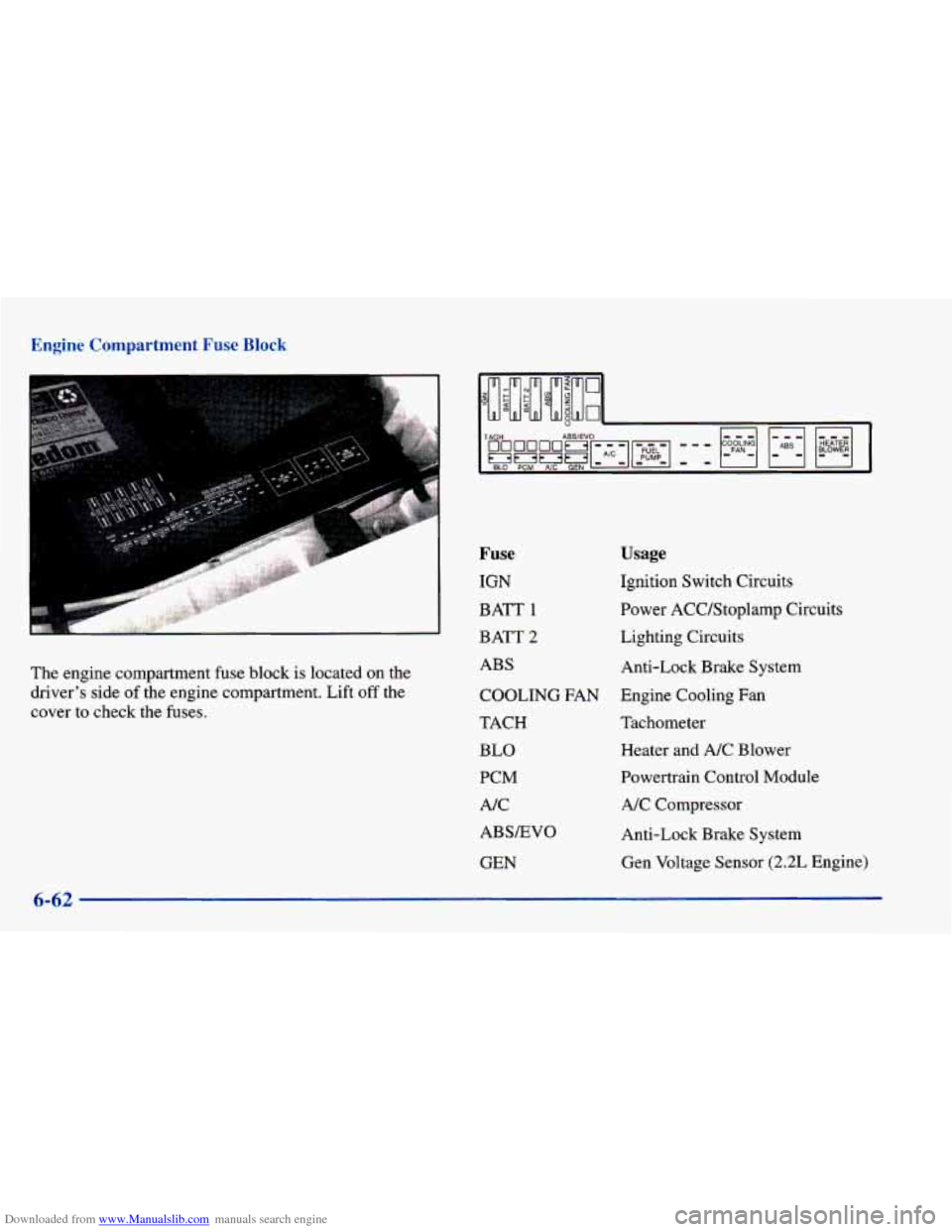
The engine compartment fuse block is located on the
driver’s side
of the engine compartment. Lift off the
cover to check the fuses.
Fuse
IGN
BATT 1
BATT 2
ABS
COOLING FAN
TACH
BLO
PCM AIC
ABSEVO
GEN
Usage
Ignition Switch Circuits
Power ACC/Stoplamp Circuits
Lighting Circuits
Anti-Lock Brake System
Engine Cooling Fan
Tachometer
Heater and
A/C Blower
Powertrain Control Module
A/C Compressor
Anti-Lock Brake System
Gen Voltage Sensor (2.2L Engine)
6-62
Page 357 of 400
Downloaded from www.Manualslib.com manuals search engine At Least Twice a Year
Restraint System Check
Make sure the safety belt reminder light and all your
belts, buckles, latch plates, retractors and anchorages are working properly. Look for any other loose or damaged
safety belt system parts. If you see anything that might
keep a safety belt system from doing its job, have it
repaired. Have any torn
or frayed safety belts replaced.
Also look for any opened or broken air bag coverings,
and have them repaired or replaced. (The air bag system
does not need regular maintenance.)
Wiper Blade Check
Inspect wiper blades for wear or cracking. Replace blade
inserts that appear worn or damaged or that streak or
miss areas of the windshield. Also see “Wiper Blades,
Cleaning” in the Index.
Manual Transaxle Check
Check the transaxle fluid level; add if needed. See
“Manual Transaxle” in the Index. Check for leaks.
A fluid loss may indicate a problem. Have the system
inspected and repaired if needed.
Automatic Transaxle Check (Three-Speed Only)
Check the transaxle fluid level; add if needed. See
“Automatic Transaxle” in the Index.
A fluid loss
may indicate a problem. Check the system and
repair if needed.
Automatic Transaxle Inspection (Four-Speed Only)
It is not necessary to check the transaxle fluid level. A
transaxle fluid leak is the only reason for fluid loss.
Check for leaks. If a leak occurs, take the vehicle to
your Chevrolet dealership Service Department and have it repaired as soon as possible.
Hydraulic Clutch System Check
Check the fluid level in the clutch reservoir. See
“Hydraulic Clutch Fluid” in the Index. A fluid loss in
this system could indicate a problem. Have the system
inspected and repaired at once.
7-31
Page 374 of 400
Downloaded from www.Manualslib.com manuals search engine ROADSIDE Courtesy R*l Care PROVIDES:
Roadside Basic Care services (as outlined previously)
Plus:
FREE Non-Warranty Towing (to the closest dealer from a legal roadway)
FREE LocksmitWKey Service (when keys are lost
on the road or locked inside)
FREE Flat Tire Service (spare installed on the road)
FREE Jump Start (at home or on the road)
FREE Fuel Delivery ($5 of fuel delivered on
the road) Chevrolet offers Courtesy Transportation for customers
needing warranty service. Courtesy Transportation will
be offered in conjunction with the coverage provided by the Bumper to Bumper New Vehicle Limited Warranty to eligible purchasers of
1998 Chevrolet passenger car
and light duty trucks. (Please see your selling dealer
for details.)
Note:
Courtesy Care is available to retail and retail lease
customers operating
1998 and newer Chevrolet vehicles
for
a period of 3 years/36,000 miles (60 000 km),
whichever occurs first. All Courtesy Care services must
be pre-arranged by Chevrolet Roadside or dealer
Service Management.
Basic Care and Courtesy Care are not part of or
included in the coverage provided by the New Vehicle
Limited Warranty. Chevrolet reserves the right to
modify or discontinue
Basic Care and Courtesy Care
at any time.
8-6