1998 CHEVROLET CAVALIER light
[x] Cancel search: lightPage 73 of 400
Downloaded from www.Manualslib.com manuals search engine Safety Belt Extender
If the vehicle’s safety belt will fasten around you, you
should use it.
But if a safety belt isn’t long enough to fasten, your
dealer will order
you an extender. It’s free. When you go
in to order it, take the heaviest coat you will wear, so the
extender will be long enough for you. The extender will
be just for you, and just for the seat in your vehicle that
you choose. Don’t let someone else use it, and use it
only for the seat it is made to fit. To wear it, just attach it
to the regular safety belt.
Checking Your Restraint Systems
Now and then, make sure the safety belt reminder light
and all your belts, buckles, latch plates, retractors
and
anchorages are working properly. Look for any other
loose or damaged safety belt system parts. If you see
anything that might keep
a safety belt system from
doing its job, have it repaired.
Torn or frayed safety belts may not protect you in a
crash. They can rip apart under impact forces. If a belt is
torn or frayed, get a new one right away.
Replacing Restraint System Parts
After
a Crash
If you’ve had a crash, do you need new belts?
After
a very minor collision, nothing may be necessary.
But if the belts were stretched, as
they would be if worn
during a more severe crash, then you need new belts.
If belts are cut or damaged, replace them. Collision
damage also may mean you will need to have safety belt
or seat parts repaired or replaced. New parts
and repairs
may be necessary even if the belt wasn’t being used at
the time of the collision.
If an air bag inflates, you’ll need to replace air bag
system parts. See the part
on the air bag system earlier
in this section.
Also look for any opened or broken air bag covers, and
have them repaired or replaced. (The air bag system
does not need regular maintenance.)
1-55
Page 77 of 400

Downloaded from www.Manualslib.com manuals search engine 0 Section 2 Features and Controls
Here you can learn about the many standard and optional featur\
es on your vehicle, and information on starting,
shifting and braking. Also explained are the instrument panel and the warning systems that tell you if everything is
working properly
-- and what to do if you have a problem.
2-2
2-4
2-6
2-11
2- 12
2-13
2-
13
2- 15
2-18
2- 19
2-24
2-26
2-27
2-29
2-29
Keys
Door Locks Keyless Entry System (If Equipped)
Theft
Passlock@
New Vehicle “Break-In”
Ignition Positions
Starting Your Engine
Engine Coolant Heater (If Equipped) Automatic Transaxle Operation
Manual Transaxle Operation
Parking Brake
Shifting Into PARK (P)
(Automatic Transaxle Only)
Shifting Out of Park
(P)
(Automatic Transaxle)
Parking Your Vehicle
(Manual Transaxle Models Only)
2-30
2-30
2-3 1
2-32
2-33
2-33
2-40
2-43
2-45
2-47
2-48
2-48
2-49
2-49
2-60
2-62 2-65 Parking Over Things That Burn
Engine Exhaust
Running Your Engine While You’re Parked
(Automatic Transaxle)
Windows
Tilt Wheel (If Equipped)
Turn SignalMultifunction Lever
Exterior Lamps
Interior Lamps
Mirrors Storage Compartments
Ashtrays and Cigarette Lighter Sun Visors
Sunroof
(If Equipped)
Convertible Top (If Equipped) Instrument Panel
Instrument Panel Clusters
Warning Lights, Indicators and Gages
2-1
Page 87 of 400
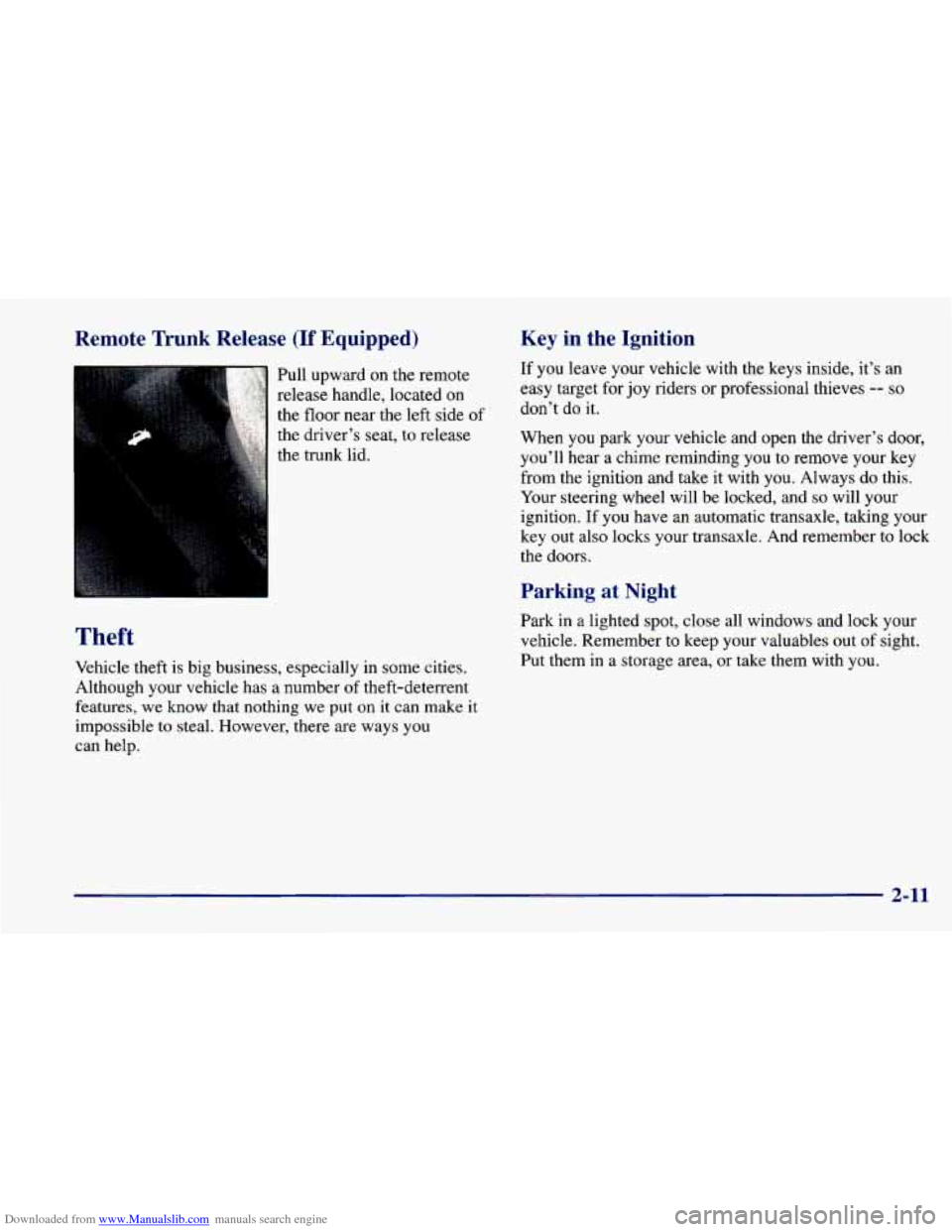
Downloaded from www.Manualslib.com manuals search engine Remote Trunk Release (If Equipped)
Pull upward on the remote
release handle, located on
the
floor near the left side of
the driver’s seat, to release
the trunk lid.
Key in the Ignition
Theft
Vehicle theft is big busines s, especially in some cities.
Although your vehicle has a number
of theft-deterrent
features,
we know that nothing we put on it can make it
impossible to steal. However, there are ways you
can help.
If you leave your vehicle with the keys inside, it’s an
easy target for joy riders or professional thieves
-- so
don’t do it.
When
you park your vehicle and open the driver’s door,
you’ll hear a chime reminding you to remove your key
from the ignition and take it with you. Always do this.
Your steering wheel will be locked, and
so will your
ignition. If you have an automatic transaxle, taking your
key out also locks your transaxle. And remember to lock
the doors.
Parking at Night
Park in a lighted spot, close all windows and lock your
vehicle. Remember
to keep your valuables out of sight.
Put them
in a storage area, or take them with you.
2-11
Page 88 of 400
Downloaded from www.Manualslib.com manuals search engine Parking Lots
If you park in a lot where someone will be watching
your vehicle, it’s best to lock it up and take your keys.
But what if
you have to leave your key?
If possible, park in a busy, well lit area.
Put your valuables in a storage area, like your
trunk
or glove box. Be sure to close and lock the
storage area.
Close all windows.
Lock all the doors except the driver’s.
Passlock‘
During normal operation, the THEFT SYSTEM light
will go off after the engine is started.
If the engine stalls and the THEFT SYSTEM light
flashes, wait until
the light stops flashing before trying
to restart the engine. Remember to release the key from
the START position as soon as the engine starts.
Your vehicle
is equipped with the Passlock
theft-deterrent system.
Passlock is a passive theft-deterrent system. The system is armed once the key is removed from the ignition.
Passlock enables fuel if the ignition lock cylinder
is
turned with a valid key. If a correct key is not used, fuel
is disabled. If you
are driving and the THEFT SYSTEM light
comes on, you will be able to restart the engine if you
turn the engine off. However, your Passlock system is
not working properly and must be serviced
by your
dealer. Your vehicle
is not protected by Passlock at this
time. You may also want to check the fuses (see “Fuses
and Circuit Breakers” in the Index). See your dealer
for service.
If the THEFT SYSTEM light comes on while the engine
is running, a problem has been detected and the system
may need service. See your dealer for service.
In an emergency, call the Chevrolet Roadside Assistance
Center at 1-800-CHEV-USA
(1-800-243-8872).
(In Canada call 1-800-268-6800.)
2- 12
Page 90 of 400
Downloaded from www.Manualslib.com manuals search engine OFF (C): This position unlocks the steering wheel,
ignition and transaxle, but does not send electrical
power to any accessories. The instrument cluster and the
automatic transaxle gear shift indicator have electrical
power while in
OFF. Use this position if your vehicle
must be pushed or towed, but never try to push-start
your vehicle. A warning chime will sound if you open
the driver’s door when the ignition is
off and the key is
in the ignition.
RUN (D): This is a position to which the switch returns
after you start your engine and release the switch. The
switch stays in
RUN when the engine is running. But
even when the engine is not running, you can use
RUN
to operate your electrical power accessories, and to
display some instrument panel warning lights.
START (E): This position starts the engine. When the
engine starts, release the key. The ignition switch will
return to
RUN for normal driving.
Note that even if the engine is not running, the positions
ACCESSORY and RUN are on positions that allow
you
to operate your electrical accessories, such as the radio.
On manual transaxle vehicles, turning the key to
LOCK will lock the steering column and result in
a loss of ability to steer the vehicle. This could
cause a collision.
If you need to turn the engine
off while the vehicle
is moving, turn the key only
to
OFF. Don’t press the key release button while
the vehicle is moving.
I NOTICE:
If your key seems stuck in LOCK and you can’t
turn
it, be sure you are using the correct key; if
so, is it all the way in? If it is, then turn the
steering wheel left and right while you turn the
key hard. But turn the key only
with your hand.
Using a tool to force it could break the key or the
ignition switch.
If none of this works, then your
vehicle needs service.
2-14
Page 102 of 400
Downloaded from www.Manualslib.com manuals search engine Up Shift Light (Manual Transaxle)
I SHIFT 1
If you have a manual
transaxle, you
have an
SHIFT light. This light
will show you when to shift
to the next higher gear for
the best fuel economy.
When this light comes on, you can shift to the next
higher gear if weather, road and traffic conditions let
you. For the best fuel economy, accelerate slowly and
shift when the light comes on.
While you accelerate, it i! ~ ormal for the light to
go
on and off if you quickly change the position
of the accelerator. Ignore the SHIFT light when
you downshift.
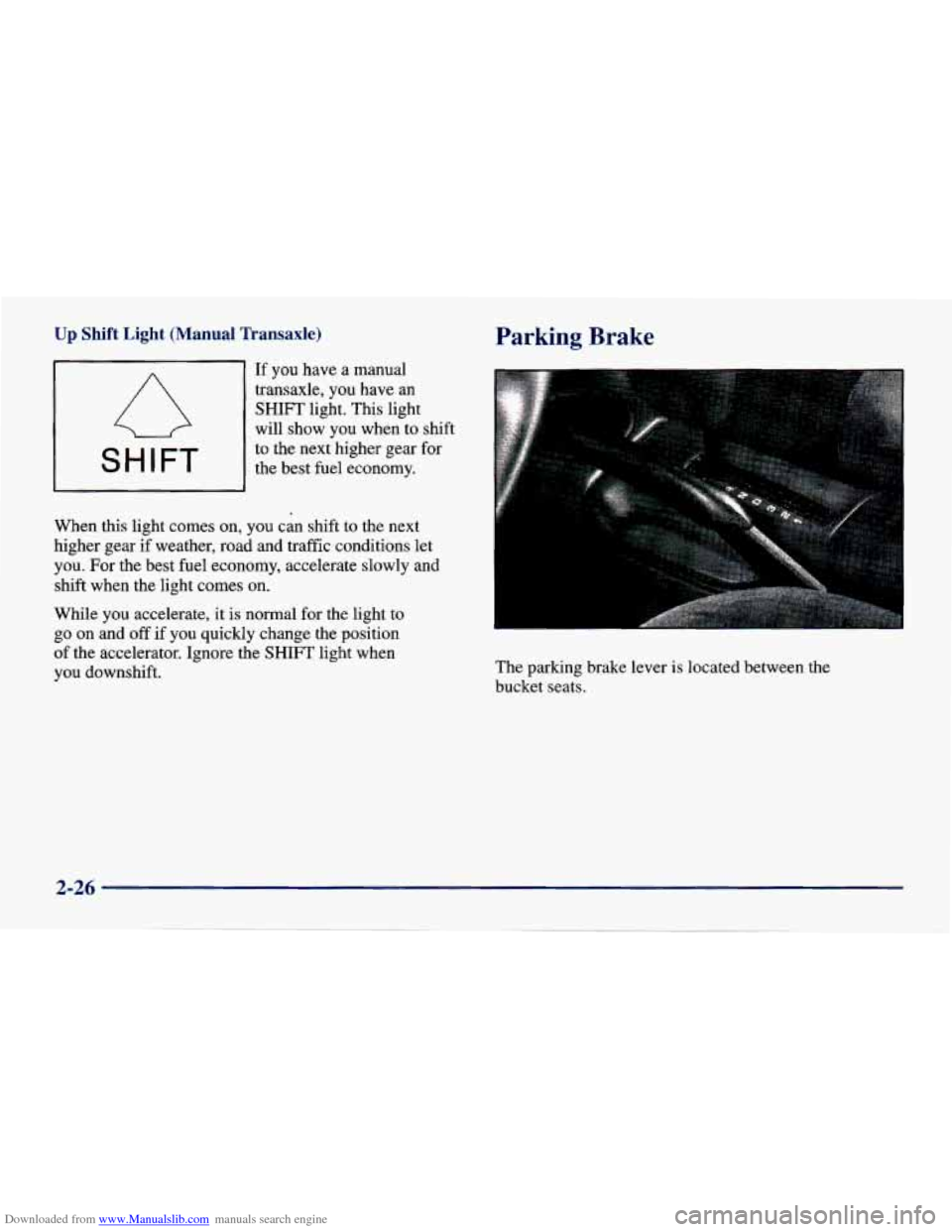
Parking Brake
The parking brake lever is located between the
bucket seats.
Page 103 of 400
Downloaded from www.Manualslib.com manuals search engine To set the parking brake, hold the brake pedal down and
pull up
on the parhng brake lever. If the ignition is on,
the brake system warning light will come on.
To release the parking brake, hold the brake pedal down.
Pull the parking brake lever up until you can press the
release button. Hold the release button
in as you move
the brake lever all the way down.
NOTICE:
Driving with the parking brake on can cause
your rear brakes to overheat. You may have to
replace them, and you could also damage other
parts of your vehicle.
Shifting Into PARK (P)
(Automatic Transaxle Only)
It can be dangerous to get out of your vehicle if
the shift lever is not fully in PARK (P) with the
parking brake
firmly set. Your vehicle can roll. If
you have left the engine running, the vehicle can
move suddenly. You or others could be injured.
To be sure your vehicle won’t move, even when
you’re on fairly level ground, use the
steps that
follow.
If you’re pulling a trailer, see “Towing a
Trailer” in the Index.
1. Hold the brake pedal down and set the
parking brake.
.
2-27
Page 110 of 400
Downloaded from www.Manualslib.com manuals search engine lhrn Signal and Lane Change Indicator
The turn signal has two upward (for right) and two
downward (for left) positions. These positions allow
you
to signal a turn or a lane change.
To signal a turn, move the lever all the way up or down.
When the turn is finished, the lever will return
automatically.
I I
Q
An arrow on the instrument
panel will flash in the
direction of the turn or
lane change.
To signal a lane change, just raise or lower the lever
until the arrow starts to flash. Hold it there until you
complete your lane change. The lever will return by
itself when you release it.
As you signal a turn or a lane change, if the arrows don’t
flash rapidly, a signal bulb may be burned out and other
drivers won’t see your turn signal.
If a bulb is burned out, replace it to help avoid an
accident. If the arrows don’t go on at all when you
signal a
turn, check the fuse (see “Fuses and Circuit
Breakers” in the Index) and
for burned-out bulbs.
Headlamp High/Low Beam Changer
To change the headlamps from low beam to high or high
beam to low, pull the turn signal lever all the way
toward you. Then release it.
When the high beams
are on, this light on the
instrument panel will
also be on.
Flash-To-Pass
This feature lets you use your high-beam headlamps to
signal a driver in front of
you that you want to pass.
To use it, pull the turn signal/multifunction lever toward
you until the high-beam headlamps come on, then
release the lever to turn them off.
2-34