1998 CHEVROLET CAVALIER check engine
[x] Cancel search: check enginePage 88 of 400
Downloaded from www.Manualslib.com manuals search engine Parking Lots
If you park in a lot where someone will be watching
your vehicle, it’s best to lock it up and take your keys.
But what if
you have to leave your key?
If possible, park in a busy, well lit area.
Put your valuables in a storage area, like your
trunk
or glove box. Be sure to close and lock the
storage area.
Close all windows.
Lock all the doors except the driver’s.
Passlock‘
During normal operation, the THEFT SYSTEM light
will go off after the engine is started.
If the engine stalls and the THEFT SYSTEM light
flashes, wait until
the light stops flashing before trying
to restart the engine. Remember to release the key from
the START position as soon as the engine starts.
Your vehicle
is equipped with the Passlock
theft-deterrent system.
Passlock is a passive theft-deterrent system. The system is armed once the key is removed from the ignition.
Passlock enables fuel if the ignition lock cylinder
is
turned with a valid key. If a correct key is not used, fuel
is disabled. If you
are driving and the THEFT SYSTEM light
comes on, you will be able to restart the engine if you
turn the engine off. However, your Passlock system is
not working properly and must be serviced
by your
dealer. Your vehicle
is not protected by Passlock at this
time. You may also want to check the fuses (see “Fuses
and Circuit Breakers” in the Index). See your dealer
for service.
If the THEFT SYSTEM light comes on while the engine
is running, a problem has been detected and the system
may need service. See your dealer for service.
In an emergency, call the Chevrolet Roadside Assistance
Center at 1-800-CHEV-USA
(1-800-243-8872).
(In Canada call 1-800-268-6800.)
2- 12
Page 92 of 400
Downloaded from www.Manualslib.com manuals search engine Starting Your 2.2 Liter Engine
1. Without pushing the accelerator pedal, turn your
ignition key to START. When the engine starts, let
go of the key. The idle speed will go down as your
engine gets warm.
r NOTICE:
Holding your key in START for longer than
15 seconds at a time will cause your battery to be
drained much sooner. And the excessive heat can
damage your starter motor.
2. If your engine still won’t start (or starts but then
stops), it could be flooded with too much gasoline.
Try pushing your accelerator pedal all the way to the
floor and holding it there as you hold the key in
START for about three seconds.
If the vehicle starts
briefly but then stops again, do the same thing, but
this time keep
the pedal down for five or six seconds.
This clears the
extra gasoline from the engine.
NOTICE:
Your engine is designed to work with the
electronics in your vehicle. If you add electrical
parts or accessories, you could change the
way
the engine operates. Before adding electrical
equipment, check with your dealer.
If you don’t,
your engine might not perform properly.
If you ever have to have your vehicle towed, see
the part of this manual that tells how
to do it
without damaging your vehicle. See “Towing
Your Vehicle” in the Index.
2-16
Page 93 of 400
Downloaded from www.Manualslib.com manuals search engine Starting Your 2.4 Liter Engine
1. With your foot off the accelerator pedal, turn your
ignition key to
START. When the engine starts, let
go
of the key. The idle speed will go down as your
engine warms
up.
NOTICE:
Holding your key in START for longer than
15 seconds at a time will cause your battery to be
drained much sooner. And the excessive heat can
damage your starter motor.
2. If the engine doesn’t start right away, and if the
weather is very cold (below -20” F or -29” C), push
the accelerator pedal about one-quarter
of the way
down while
you turn the key to START. Do this
until the engine starts. As soon as it does, let go
of the key.
3. If your engine still won’t start (or starts but then stops),
it could be flooded with too much gasoline. Try
pushing your accelerator pedal all the way to the floor
and holding it there as you hold the key in START for
a maximurn of 15 seconds. This clears the extra
gasoline
from the engine. If the engine still won’t start
or starts briefly but then stops again, repeat step 1 or 2,
depending on temperature. When the engine starts,
release the key and the accelerator pedal.
NOTICE:
1 Your engine is designed to work with the
electronics in your vehicle.
If you add electrical
parts or accessories, you could change the
way
the engine operates. Before adding electrical
~ equipment, check with your dealer. If you don’t,
your engine might not perform properly.
If you ever have to have your vehicle towed, see
the part
of this manual that tells how to do it
without damaging your vehicle. See “Towing.
Your Vehicle” in the Index.
2-17
Page 110 of 400
Downloaded from www.Manualslib.com manuals search engine lhrn Signal and Lane Change Indicator
The turn signal has two upward (for right) and two
downward (for left) positions. These positions allow
you
to signal a turn or a lane change.
To signal a turn, move the lever all the way up or down.
When the turn is finished, the lever will return
automatically.
I I
Q
An arrow on the instrument
panel will flash in the
direction of the turn or
lane change.
To signal a lane change, just raise or lower the lever
until the arrow starts to flash. Hold it there until you
complete your lane change. The lever will return by
itself when you release it.
As you signal a turn or a lane change, if the arrows don’t
flash rapidly, a signal bulb may be burned out and other
drivers won’t see your turn signal.
If a bulb is burned out, replace it to help avoid an
accident. If the arrows don’t go on at all when you
signal a
turn, check the fuse (see “Fuses and Circuit
Breakers” in the Index) and
for burned-out bulbs.
Headlamp High/Low Beam Changer
To change the headlamps from low beam to high or high
beam to low, pull the turn signal lever all the way
toward you. Then release it.
When the high beams
are on, this light on the
instrument panel will
also be on.
Flash-To-Pass
This feature lets you use your high-beam headlamps to
signal a driver in front of
you that you want to pass.
To use it, pull the turn signal/multifunction lever toward
you until the high-beam headlamps come on, then
release the lever to turn them off.
2-34
Page 122 of 400
Downloaded from www.Manualslib.com manuals search engine Power Remote Control Mirrors
(If Equipped)
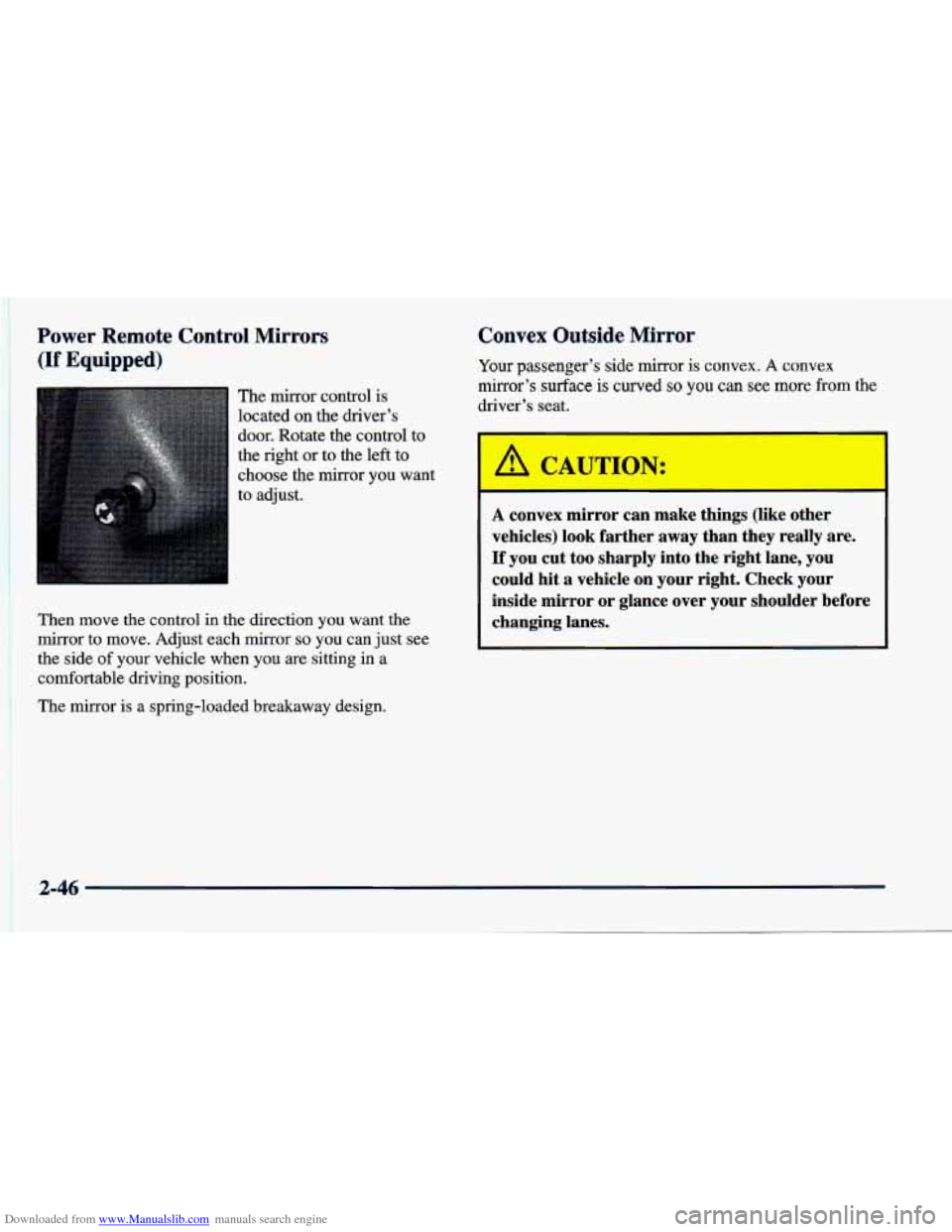
The mirror control is
located on the driver’s
door. Rotate the control to
the right or to the left to
choose the
mirror you want
to adjust.
Convex Outside Mirror
Your passenger’s side mirror is convex, A convex
mirror’s surface is curved so you can see more from the
driver’s seat.
Then
move the control in the direction you want the
mirror to move. Adjust each
mirror so you can just see
the side of your vehicle when you are sitting in
a
comfortable driving position.
The mirror is a spring-loaded breakaway design.
‘ A CA ‘TION:
FL
A convex mirror can make things (like other
vehicles) look farther away than they really are.
If you cut too sharply into the right lane, you
could hit a vehicle on your right. Check your
inside mirror or glance over your shoulder before
changing
lanes.
2-46
Page 133 of 400
Downloaded from www.Manualslib.com manuals search engine Lowering the Top Manually
NOTICE:
Do not attempt to lower the top manually as
damage to the vehicle will occur.
If the top fails to
raise or lower completely, see “Raising the Top
Manually” following.
Raising the Top Manually
1. Set the parking brake and shift your automatic
transaxle to PARK (P) or your manual transaxle to
NEUTRAL (N). Turn the engine off.
2. Push the button in the latch handle and rotate the
handle down.
3. Open the trunk.
If your vehicle loses power, or something else happens
that prevents you from raising the top electrically, you
may need to raise the top manually.
This will allow you
to safely drive the vehicle until you can get the top
repaired. Raising the convertible top manually should only be done in an emergency and requires two people.
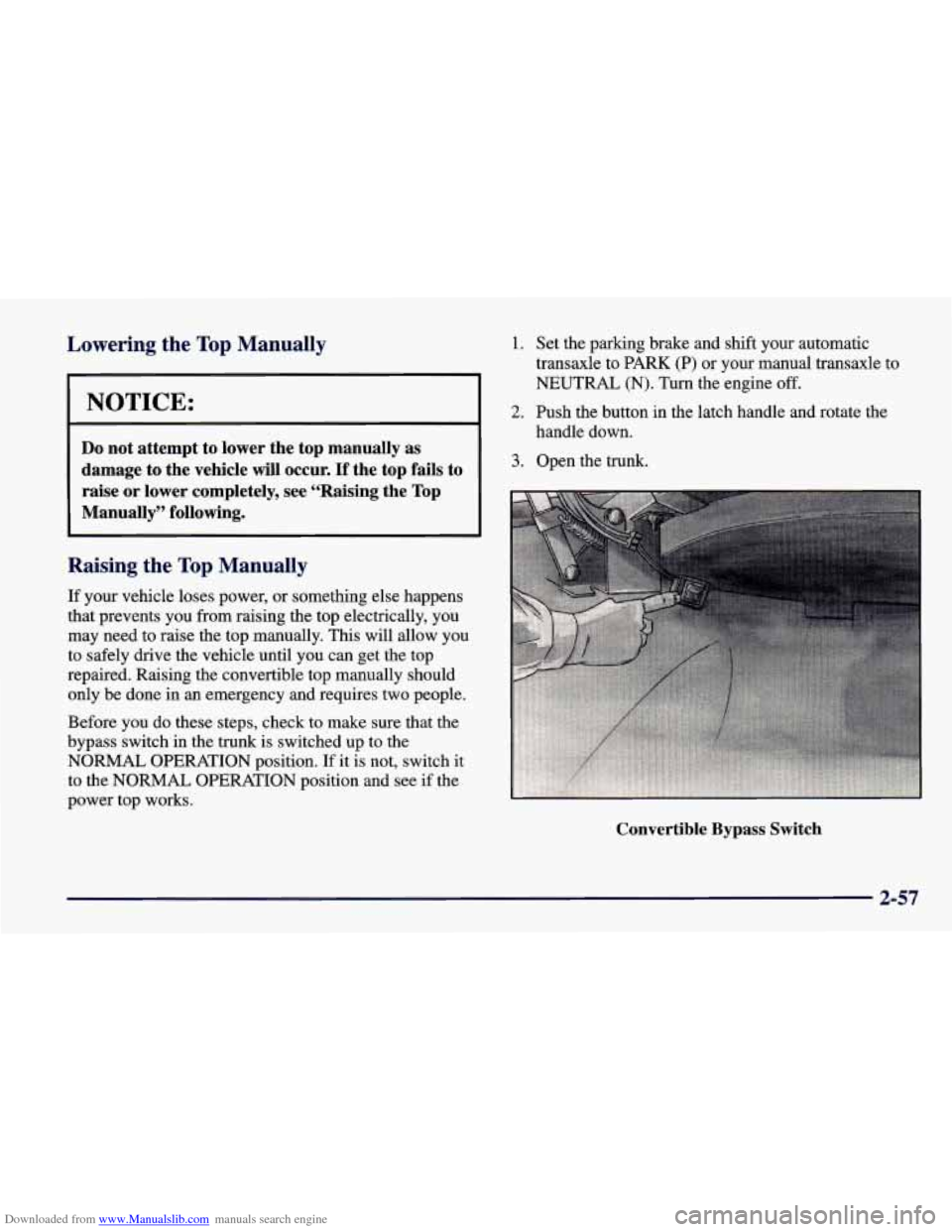
Before you do these steps, check to make sure that the
bypass switch in the trunk is switched up to the
NORMAL OPERATION position.
If it is not, switch it
to the NORMAL OPERATION position and see
if the
power top works.
Convertible Bypass Switch
2-57
Page 141 of 400
Downloaded from www.Manualslib.com manuals search engine I’achometer (If Equipped)
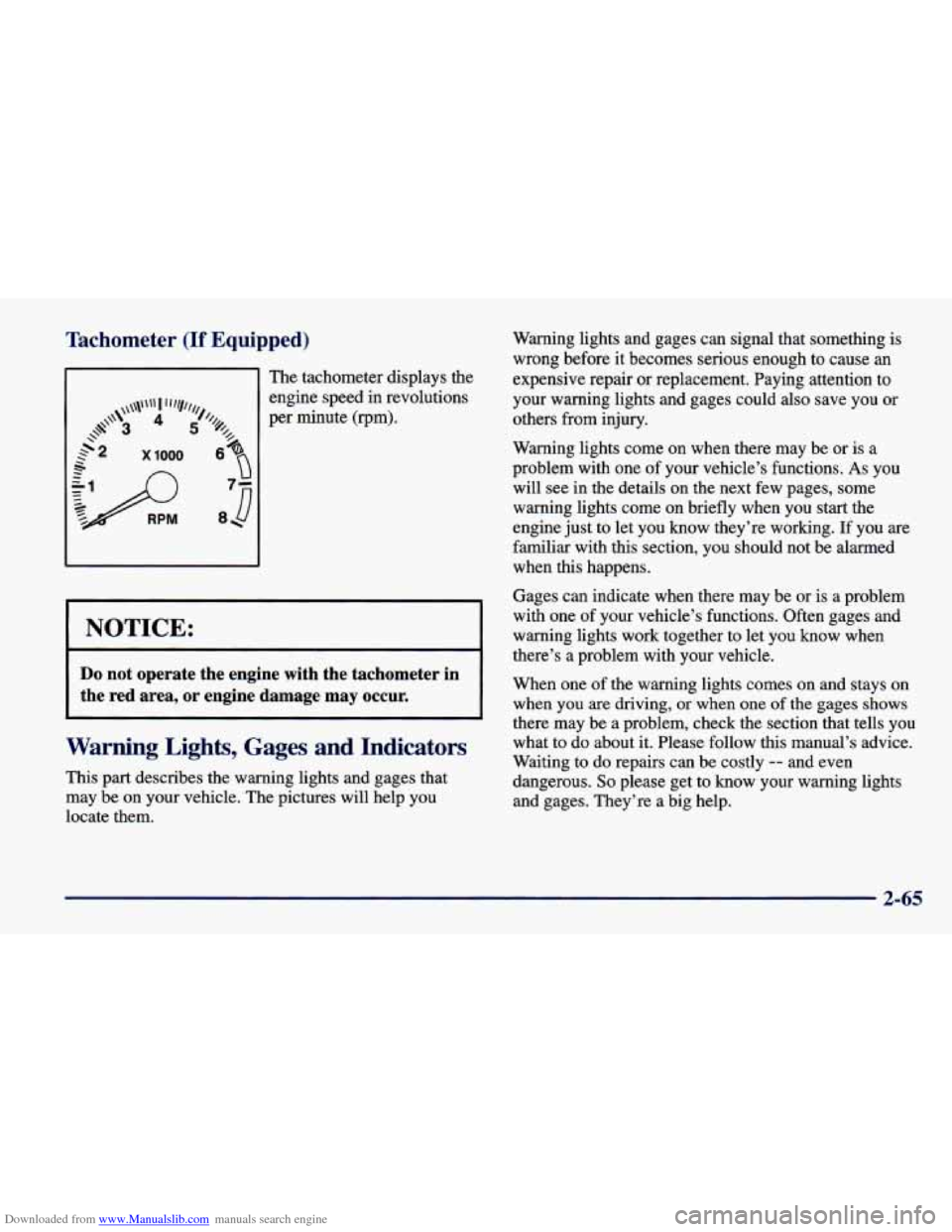
The tachometer displays the
engine speed
in revolutions
per minute (rpm).
I NOTICE:
Do not operate the engine with the tachometer in
the red area, or engine damage may occur.
Warning Lights, Gages and Indicators
This part describes the warning lights and gages that
may be on your vehicle. The pictures will help you
locate them. Warning lights and gages can signal that something
is
wrong before
it becomes serious enough to cause an
expensive repair or replacement. Paying attention
to
your warning lights and gages could also save you or
others from injury.
Warning lights come on when there may be or is a
problem with one of your vehicle’s functions.
As you
will see in the details on the next few pages, some
warning lights come on briefly when you start the
engine just
to let you know they’re working. If you are
familiar with this section, you should not be alarmed
when this happens.
Gages can indicate when there may be or is
a problem
with one of your vehicle’s functions. Often gages and
warning lights work together to let you know when
there’s a problem with your vehicle.
When one of the warning lights comes on and stays on
when you are driving, or when one
of the gages shows
there may be a problem, check the section that tells you
what to do about it. Please follow this manual’s advice.
Waiting to do repairs can be costly
-- and even
dangerous.
So please get to know your warning lights
and gages. They’re a big help.
2-65
Page 142 of 400
Downloaded from www.Manualslib.com manuals search engine Safety Belt Reminder Light
When the key is turned to RUN or START, a chime will
come on for about eight seconds to remind people to
fasten their safety belts, unless the driver’s safety belt is
already buckled.
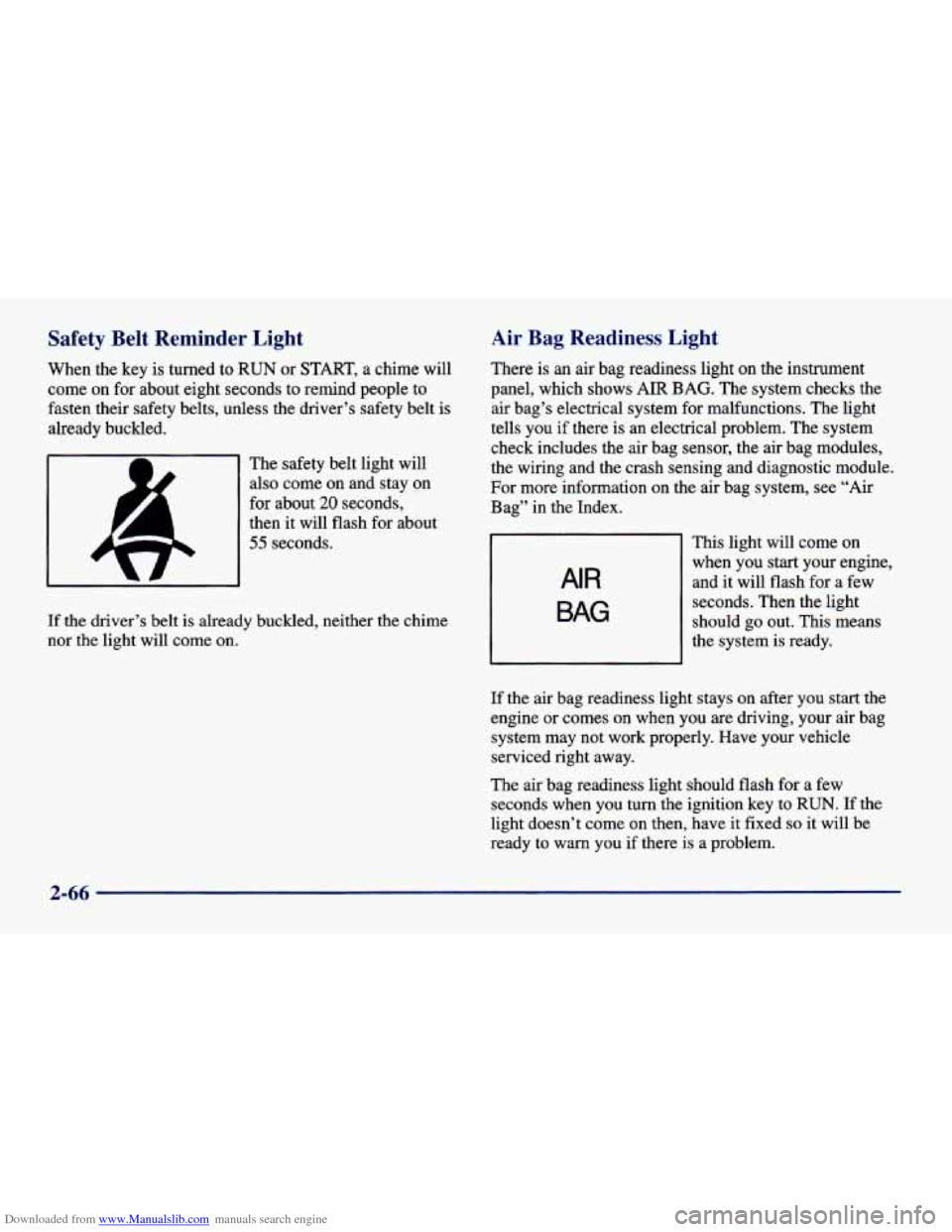
The safety belt light will
also come on and stay on
for about
20 seconds,
then it
will flash for about
55 seconds.
If the driver’s belt is already buckled, neither the chime
nor the light will come on.
Air Bag Readiness Light
There is an air bag readiness light on the instrument
panel, which shows
AIR BAG. The system checks the
air bag’s electrical system for malfunctions. The light
tells you if there is an electrical problem. The system
check includes the air bag sensor, the air bag modules,
the wiring and the crash sensing and diagnostic module.
For more information on the air bag system, see
“Air
Bag” in the Index.
AIR
BAG
This light will come on
when you start your engine,
and it will flash
for a few
seconds. Then the light
should go out. This means
the system is ready.
If the air bag readiness light stays on after you start the
engine or comes on when you are driving, your air bag
system may not work properly. Have your vehicle
serviced right away.
The air bag readiness light should flash for a few
seconds when you turn the ignition key to
RUN. If the
light doesn’t come
on then, have it fixed so it will be
ready to
warn you if there is a problem.
2-66