1998 CHEVROLET ASTRO light
[x] Cancel search: lightPage 309 of 414
Downloaded from www.Manualslib.com manuals search engine Uniform Tire Quality Grading Treadwe:
The following information relates to the system
developed by the United States National Highway
Traffic Safety Administration, which grades tires by
treadwear, traction and temperature performance. (This
applies only to vehicles sold in the United States.) The
grades are molded
on the sidewalls of most passenger
car tires. The Uniform Tire Quality Grading system does
not apply to deep tread, winter-type snow tires,
space-saver or temporary use spare tires, tires with
nominal rim diameters of 10 to
12 inches (25 to 30 cm),
or
to some limited-production tires.
While the tires available on General Motors passenger
cars and light trucks may vary with respect
to these
grades, they must also conform to Federal safety
requirements and additional General Motors Tire
Performance Criteria (TPC) standards.
The treadwear grade is a comparative rating based on
the wear rate of the tire when tested under controlled
conditions
on a specified government test course. For
example, a tire graded 150 would wear one and
a half
(1 1/2) times as well on the government course as a tire
graded
100. The relative performance of tires depends
upon the actual conditions
of their use, however, and
may depart significantly from the norm due to variations
in driving habits, service practices and differences in
road characteristics and climate.
Traction -- A, B, C
The traction grades, from highest to lowest, are A, B,
and C, and they represent the tire’s ability to stop on wet
pavement as measured under controlled conditions
on
specified government test surfaces of asphalt and concrete.
A
tire marked C may have poor traction performance.
Warning: The traction grade assigned
to this tire is based
on braking (straight ahead) traction tests and does not
include cornering (turning) traction.
- 6-47
Page 320 of 414
Downloaded from www.Manualslib.com manuals search engine Appearance Care Materials Chart
PART NUMBER
994954
1050 172
1050 173
1050 174
1050214
1050427
10529 18**
1052925
1052929
1052930
1234572
1
12345725
I2377964
12377966
12377984
SIZE DESCRIPTION USAGE
23 in. x 25 in. Polishing Cloth - Wax Treated Exterior polishing cloth
16
oz. (0.473 L) Tar and Road Oil Remover Removes tar, road oil and asphalt
16 oz. (0.473 L) I Chrome Cleaner and Polish I Use on chrome, stainless steel, nickel, copper and brass I
16 oz. (0.473 L) I White Sidewall Tire Cleaner I Removes soil and black marks from whitewalls I
32 oz. (0.946 L) Vinyl Cleaner Cleans vinyl tops, upholstery and convertible tops
23
oz. (0.680 L) Glass Cleaner Removes dirt, grime, smoke and fingerprints
8 oz. (0.237 L) I Armor All Protectant Protects leather, wood,
acrylics, Plexiglas , plastic,
rubber and vinyl
16 oz. (0.473 L) Multi-Purpose Interior Clean- Cleans carpets, seats, interior trim, door panels
I er and floor mats I I
16 02. (0.473 L) I Wheel Cleaner I Spray on and rinse with water
8 oz. (0.237 L) I Capture Dry Spot Remover I Attracts, absorbs and removes soils -*
2.5 sq. ft. Synthetic Chamois
12
oz. (0.354 L) Silicone Tire Shine
16 02, (0.473 L) Finish Enhancer
16 oz. (0.473 L) Cleaner Wax
16
oz. (0.473 L) Surface Cleaner Shines vehicle without scratching
Spray on tire shine
Removes dust, fingerprints and surface contaminants
Removes light scratches and oxidation and protects finish
Removes contaminants, blemishes and swirl marks
6-58
Page 323 of 414
Downloaded from www.Manualslib.com manuals search engine 11
Fuses and Circuit Breakers
The wiring circuits in your vehicle are protected from
short circuits by a combination of fuses, circuit breakers
and fusible thermal links. This greatly reduces the
chance of fires caused by electrical problems.
Look at the silver-colored band inside the fuse. If the
band is broken or melted, replace the fuse. Be sure you
replace a bad fuse with a new one of the identical size
and rating.
Spare fuses and a fuse puller are located in the
underhood electrical center.
You can remove fuses with
the fuse puller. Remember to replace any of the spare
fuses you use,
so you will have some if you ever need
them again.
If you ever have a problem on the road and don’t have a
spare fuse, you can borrow one that has the same
amperage. Just pick some feature of your vehicle that
you can get along without
-- like the radio or cigarette
lighter
-- and use its fuse, if it is the correct amperage.
Replace
it as soon as you can.
There are two fuse blocks in your vehicle: one is inside
the vehicle and one is in the engine compartment.
Instrument Panel Fuse Block
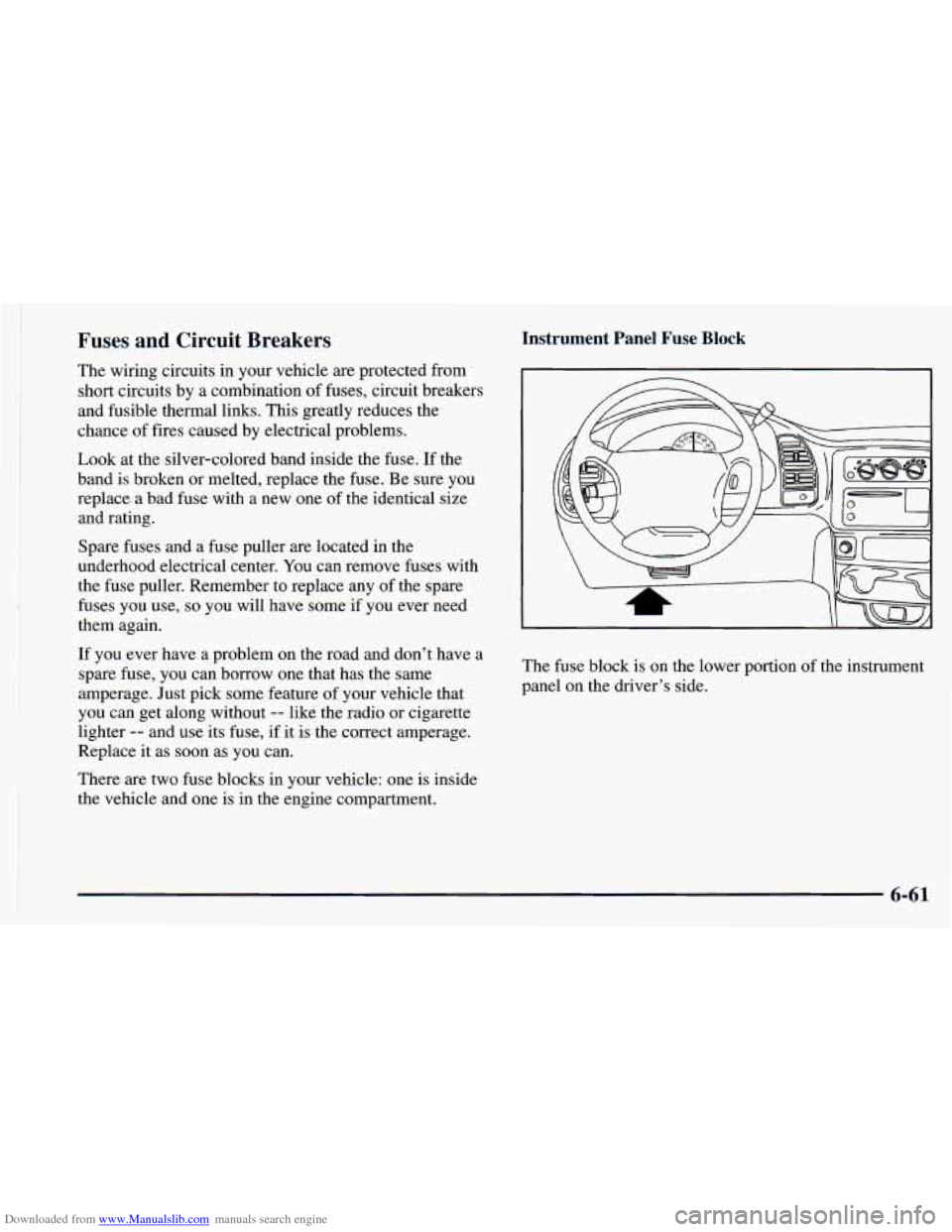
The fuse block is on the lower portion of the instrument
panel on the driver’s side.
6-61
Page 324 of 414

Downloaded from www.Manualslib.com manuals search engine / 18 24
5 11 17 23 c7 c7 c7 17
4 ~ 10 16
3 9 15 21 c7 E7 c7 E7
2 8 14 20 c7 c7 11 17
7 13 19 E7 c7 c7 E3
FuseKircuit
Breaker Usage
4
8
9
2
3
FuseKircuit Breaker
Usage I
1 Stop/Turn/Hazard Lamps, CHMSL,
! Chime Module
Not Used
Courtesy Lamps, Power Outside
Mirrors, Glove
Box Lamp, Dome
Reading Lamps, Vanity Mirror Lamps
10
11
DRL Relay, DRL Module, Chime
Headlamp Switch, Keyless Entry,
Cluster, Overhead Console, Interior
Lamps Module
Not Used
Cruise Module, Cruise Control Switch
Power Outlets, DLC, Subwoofer
Amplifier Starter Enable Relay
I
License Plate Lamp, Taillamps, I
Parking Lamps, Ashtray Lamp, Panel
Lights, Trailer Taillamps, Front and
Rear Sidemarker Lamps, Door Switch
Illumination, Headlamp Switch
Illumination, Rear Seat Audio
Illumination
Air
Bag System
Wiper Motor, Washer Pump, Upfitter
Relay Coil
Page 325 of 414

Downloaded from www.Manualslib.com manuals search engine FuseKircuit Breaker Usage
12
13
14
15
16
17
L, M 1, M2 Blower Motor, Rear A/C
Relay Coil, Front Cont. Temp. Door
Motor,
HI Blower Relay, Defogger
Timer Coil
Cigar Lighter, Door Lock Switches,
Dutch Door Release Module
Cluster Illum, HVAC Controls, Chime
Module, Radio Illumination, Rear Heat
Switch Illumination, Rear
Wiper/Washer Switch Illumination,
Rear Liftgate Switch Illumination,
Remote Cassette Illumination, O/H
Console
DRL Lamps
Front Turn Signals, Rear Turn Signals,
Trailer Turn Signals, Back-up Lamps,
BTSI Solenoid
Radio: ATC (Standby), 2000 Series
(Main Feed), Rear Seat Audio Controls 19
20
FuseKircuit
Breaker Usage
18 VCM-Ign 3, VCM-Brake, LCWAL,
Cruise Stepper Motor Signal
Radio: ATC (Main Feed),
2000 Series
(Standby)
PRNDL/ Odometer, TCC Enable and
PWM Solenoid, Shift A and Shift B
Solenoids, 3-2 Downshift Solenoid
21
22
23
24
A
B Not Used
Security/Steering Module
Rear Wiper, Rear Washer Pump
Not Used (Circuit Breaker) Power Door
Lock
Relay, 6-way Power Seat, Remote
Control Door Lock Receiver, Dutch
Door Module, Dutch Door Release
(Circuit Breaker) Power Windows
6-63
Page 326 of 414

Downloaded from www.Manualslib.com manuals search engine Underhood Electrical Center
c
SThRTER ENABLE ENABLE =CLAY
(,,,) (-) (COLI-
I
I
[ LIGHTING 1
(7)
(T)
(-)
(-)
The underhood electrical center is located toward the
rear
of the engine compartment on the driver’s side.
Lift the hood and open
the cover to gain access to this
fuse block.
Feed Usage
AUX B Upfitter Battery Feed
AUX A Upfitter Accessory Feed
Relay
A/C Relay (Rear Heat and A/C)
Upfitter Accessory Relay
Starter Enable Relay
A/C Enable Relay
Export Only Relay
Fuel Pump Relay
6-64
Page 327 of 414

Downloaded from www.Manualslib.com manuals search engine Fuse/Circuit Breaker Usage
UPFIT-BATT Upfitter Battery Power Stud, Trailer
UPFIT-ACCY Upfitter Accessory Relay
Wiring
Harness
Spare
Fuse Puller*
Spare
Spare
ECM-B
HORN
A/C COMP
RR DEFOG
ENG-I
Fuse/Circuit Breaker Usage
IGN-E
ECM-I
Not used
LIGHTING
Not used
Not used Fuel Pump Relay and Motor, VCM,
Oil Pressure Switch/Sender
Horn Relay and Horn
A/C Enable Relay and Compressor
Heater-A/C Control Selector Switch,
Rear Window Defogger
Oxygen Sensors, Camshaft Position
Sensor, Mass Air Flow Sensor,
Evaporative Emission Canister Purge
Solenoid, Linear EGR Valve
Solenoid, VCM EGR HI BATT
IGN A
IGN B
ABS
NC
RR HTRIAC
Spare A/C
Enable Relay Coil
Fuel Injectors
1-6, Crankshaft
Position Sensor, VCM, Coil Driver
Module (EST)
Park Lamps Fuse, DRL Fuse,
Headlamp and Panel Dimmer Switch
SteeringBecurity Fuse, Courtesy
Fuse, ACSY CB, Stop/Hazard Fuse,
Auxiliary Power Fuse, Cigar Lighter
Fuse, Radio Battery Fuse
Starter Relay, Ignition Switch
Ignition Switch
Electronic Brake Control Module Blower Motor Resistor, Blower
Relay
Auxiliary Heater NC Relay
Not used
*A fuse puller is included
in the underhood electrical
center. You will also find spare fuses.
6-65
Page 376 of 414

Downloaded from www.Manualslib.com manuals search engine At Least Twice a Year Automatic lkansmission Check
Restraint System Check
Make sure the safety belt reminder light and all your
belts, buckles, latch plates, retractors and anchorages are
working properly. If your vehicle has a built-in child
restraint, also periodically make sure the harness straps,
latch plates, buckle, clip, retractors and anchorages are
working properly. Look for any other loose or damaged
safety belt and built-in child restraint system parts. If
you see anything that might keep a safety belt or built-in
child restraint system from doing its
job, have it
repaired. Have any torn or frayed safety belts or harness
straps replaced.
Also look for
any opened or broken air bag coverings,
and have them repaired or replaced. (The air bag system
does
not need regular maintenance.)
Wiper Blade Check
Inspect wiper blades for wear or cracking. Replace blade
inserts that appear worn or damaged or that streak or
miss areas
of the windshield. Also see “Wiper Blades,
Cleaning” in the Index. Check the transmission fluid
level; add if needed.
See
“Automatic Transmission’’ in the Index. A fluid loss
may indicate a problem. Check the system and repair
if needed.
At Least Once a Year
Key Lock Cylinders Service
Lubricate the key lock cylinders with the lubricant
specified in Part
D.
Body Lubrication Service
Lubricate all body door hinges, the body hood, fuel
door and rear compartment hinges, latches and locks
including interior glove box and console doors, and any
moving seat hardware. Lubricate the hood safety lever
pivot and prop rod pivot. Part
D tells you what to use.
More frequent lubrication may be required when
exposed to a corrosive environment.
7-42