Page 207 of 414
Downloaded from www.Manualslib.com manuals search engine Include an ice scraper, a small brush or broom, a supply
of windshield washer fluid, a rag, some winter outer
clothing, a small shovel, a flashlight, a red cloth and
reflective warning triangles. And, if
you will be driving
under severe conditions, include a small bag
of sand, a
piece of old carpet or a couple of burlap bags to help
provide traction. Be sure you properly secure these
items in your vehicle.
Driving ‘---3w or Ice
Most of the time, those places where your tires meet the
road probably have good traction.
However, if there is snow or ice between your tires and
the road,
you can have a very slippery situation. You’ll
have a lot less traction or “grip” and will need to be
very careful.
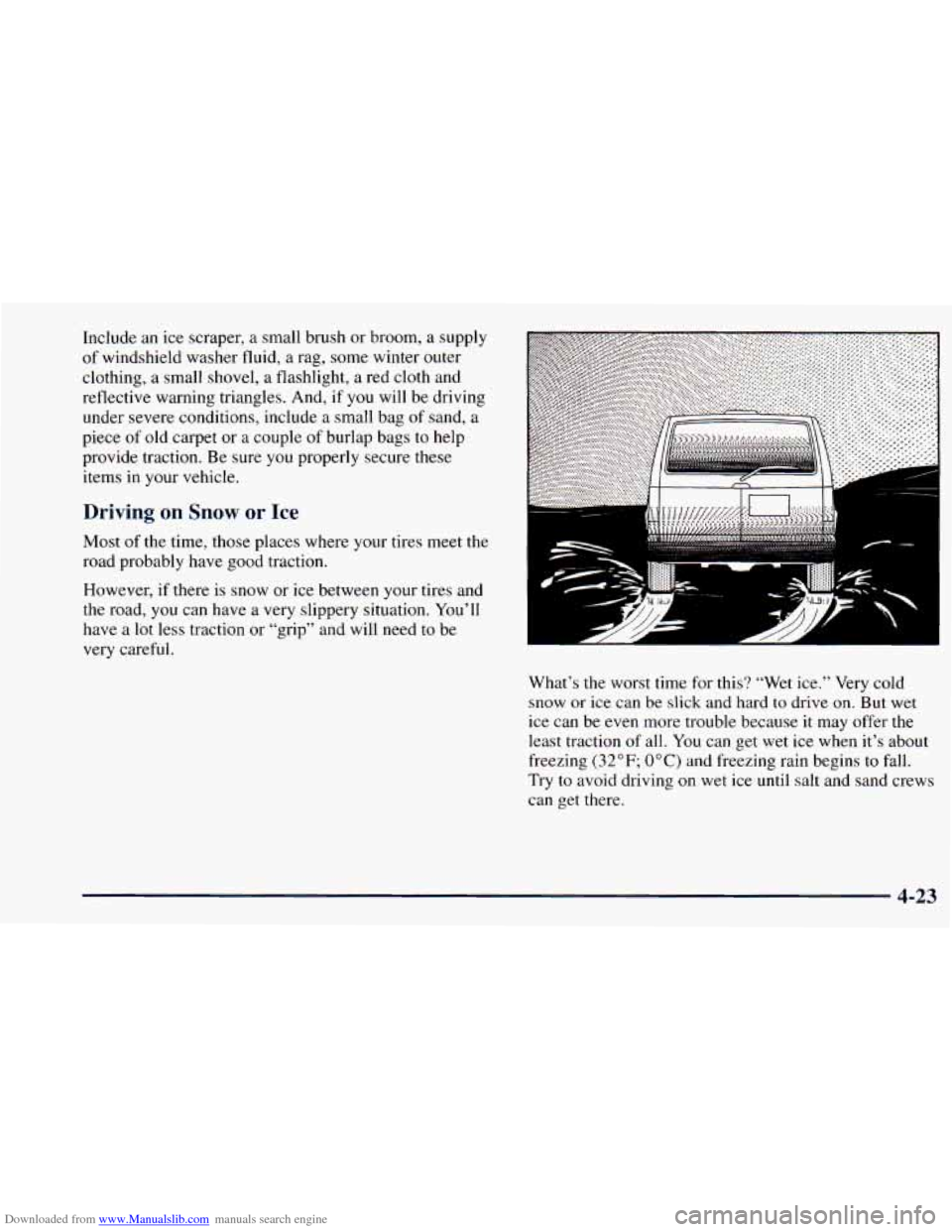
What’s the worst time for this? “Wet ice.” Very cold
snow or ice can
be slick and hard to drive on. But wet
ice can be even more trouble because it may offer the
least traction
of all. You can get wet ice when it’s about
freezing
(32°F; OOC) and freezing rain begins to fall.
Try
to avoid driving on wet ice until salt and sand crews
can get there.
4-23
Page 219 of 414
Downloaded from www.Manualslib.com manuals search engine Making Turns
NOTICE:
Making very sharp turns while trailering could cause the trailer
to come in contact with the
vehicle.
Your vehicle could be damaged. Avoid
making very sharp turns while trailering.
When you’re turning with a trailer, make wider turns than
normal. Do this so your trailer won’t strike soft shoulders,
curbs, road signs, trees or other objects. Avoid jerky or
sudden maneuvers. Signal well
in advance.
Turn Signals When Towing a Trailer
When you tow a trailer, your vehicle has to have extra
wiring (included in the optional trailering package).
The arrows on your instrument panel will flash
whenever you signal a turn or lane change. Properly
hooked
up, the trailer lamps
drivers you’re about to turn, will
also flash, telling other
change lanes or stop. When
towing a trailer, the arrows on your instrument
panel will flash
for turns even if the bulbs on the trailer
are burned out. Thus, you may think drivers behind you
are seeing your signal when they are not. It’s important
to check occasionally to be sure the trailer bulbs are
still working.
Driving On Grades
Reduce speed and shift to a lower gear before you start
down a long or steep downgrade. If you don’t shift
down, you might have to use your brakes
so much that
they would get hot and no longer work well.
On a long uphill grade, shift down and reduce your
speed
to around 45 mph (70 kdh) to reduce the
possibility of engine and transmission overheating.
When towing
at high altitude on steep uphill grades,
consider the following: Engine coolant will boil at a
lower temperature than at normal altitudes. If you turn
your engine off immediately after towing at high altitude
on steep uphill grades, your vehicle may show signs
similar to engine overheating.
To avoid this, let the
engine
run while parked (preferably on level ground)
with the automatic transmission in
PARK (P) for a few
minutes before turning the engine off. If you do get the
overheat warning, see “Engine Overheating” in
the Index.
4-35
Page 223 of 414
Downloaded from www.Manualslib.com manuals search engine Section 5 Problems on the Road
Here you’ll find what to do about some problems that can occur on the road.
5-2
5-3 5-3
5-7
5-13
5- 15 Hazard
Warning Flashers
Other Warning Devices
Jump Starting
Towing Your Vehicle
Engine Overheating
Cooling System 5-22
5-22
5-23
5-36 5-37 Engine
Fan Noise
If a Tire Goes Flat
Changing a Flat Tire
Compact Spare Tire
If You’re Stuck: In Sand, Mud, Ice, or Snow
5-1
Page 224 of 414
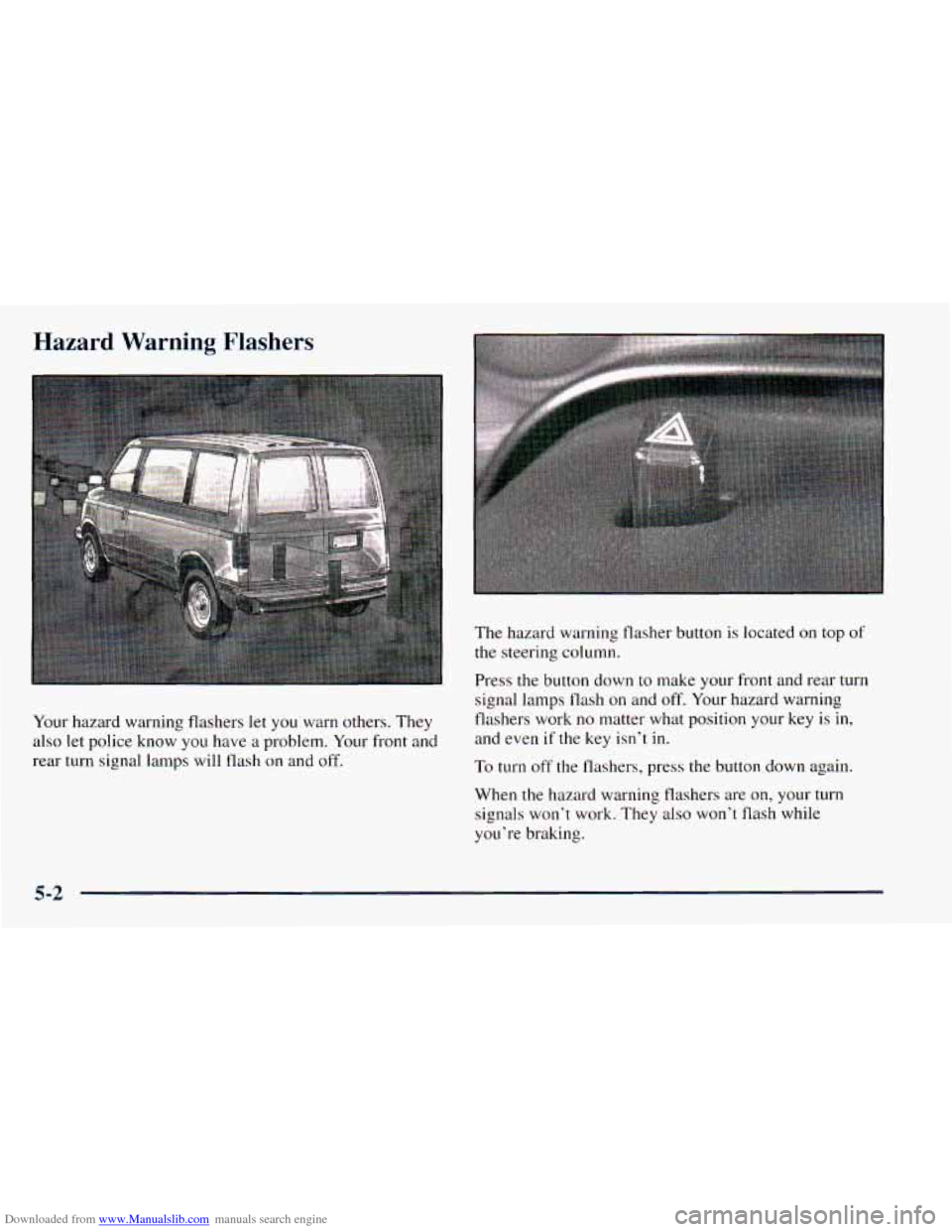
Downloaded from www.Manualslib.com manuals search engine Hazard Warning Flashers
Your hazard warning flashers let you warn others. They
also let police know you have a problem. Your front and
rear turn signal
lamps will flash on and off. The
hazard warning
flasher button is located on top of
the steering column.
Press the button down to make your front and rear turn
signal lamps flash
on and off. Your hazard warning
flashers work no matter what position your
key is in,
and even if the key isn’t in.
To turn off the flashers, press the button down again.
When the hazard warning flashers are
on, your turn
signals won’t work. They also won’t flash while
you’re braking.
5-2
Page 225 of 414

Downloaded from www.Manualslib.com manuals search engine Other Warning Devices
If you carry reflective triangles, you can set one up
at the side
of the road about 300 feet (100 m) behind
your vehicle.
Jump Starting
If your battery has run down, you may want to use
another vehicle and some jumper cables
to start your
vehicle. But please follow the numbered steps
to do
it safely.
Batteries can hurt you. They can be dangerous
because:
They contain acid that can burn you.
They contain gas that can explode or ignite.
They contain enough electricity to
If you don’t follow these steps exactly, some or
all
of these things can hurt you.
burn
you.
NOTICE:
Ignoring these steps could result in costly
damage to your vehicle that wouldn’t be
covered by your warranty.
Trying to start your vehicle by pushing or pulling
it won’t work, and it could damage your vehicle.
1. Check the other vehicle. It must have a 12-volt
battery with
a negative ground system.
NOTICE:
If the other system isn’t a 12-volt system with a
negative ground, both vehicles can be damaged.
2. Get the vehicles close enough
so the jumper cables
can reach, but be sure
the vehicles aren’t touching
each other. If they are, it could cause a ground
connection
you don’t want. You wouldn’t be able to
start your vehicle, and
the bad grounding could
damage the electrical systems.
5-3
Page 229 of 414
Downloaded from www.Manualslib.com manuals search engine Towing Your Vehicle
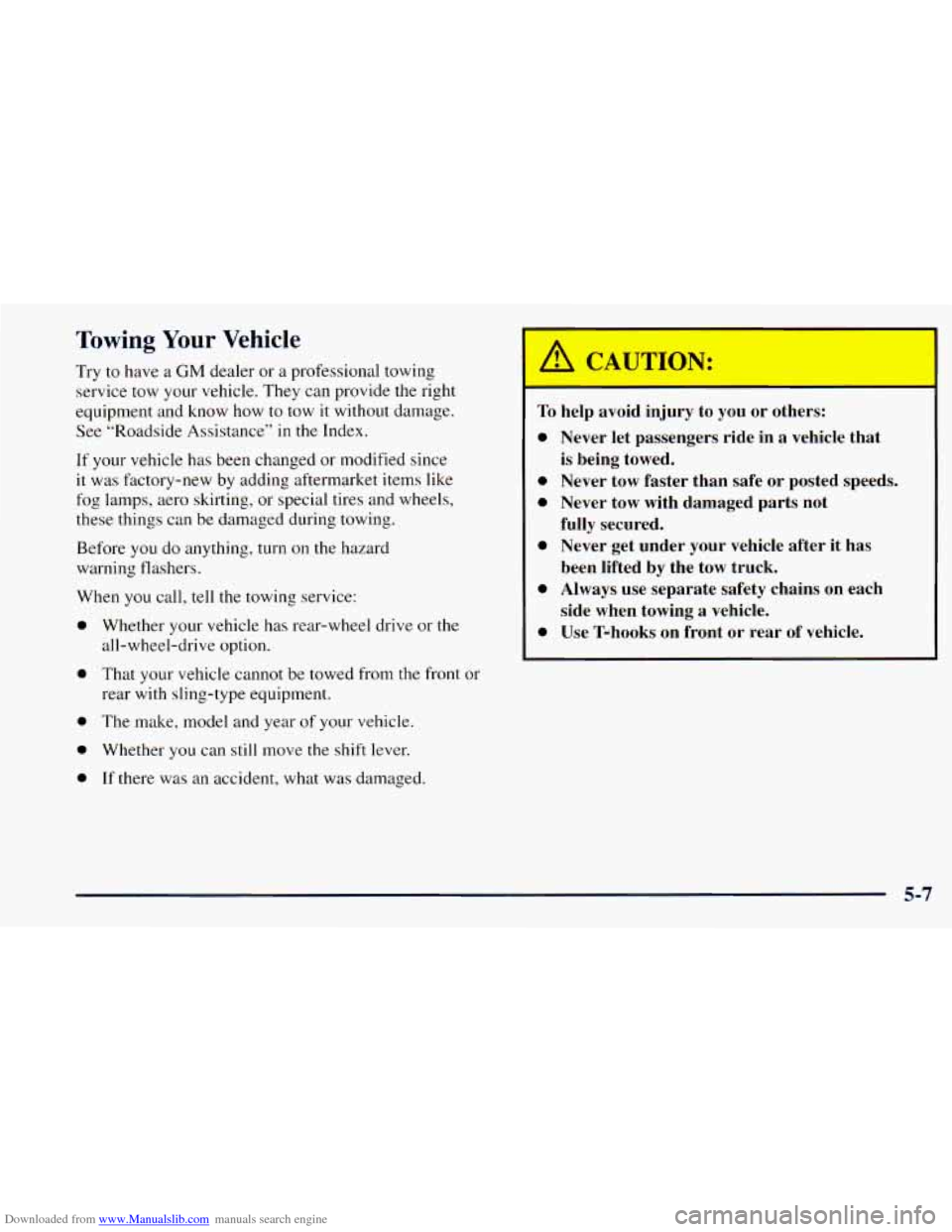
Try to have a GM dealer or a professional towing
service tow your vehicle. They can provide the right
equipment and know how
to tow it without damage.
See “Roadside Assistance” in the Index.
If
your vehicle has been changed or modified since
it was factory-new by adding aftermarket items like
fog lamps, aero skirting, or special tires and wheels,
these things can be damaged during towing.
Before you do anything, turn
on the hazard
warning flashers.
When you call,
tell the towing service:
0
0
0
0
0
Whether your vehicle has rear-wheel drive or the
all-wheel-drive option.
That your vehicle cannot be towed from the front or
rear with sling-type equipment.
The make, model and year
of your vehicle.
Whether
you can still move the shift lever.
If there was an accident, what was damaged.
I /1 CAUTION:
To
0
0
0
0
0
0
help avoid
injury to
you or others:
Never let passengers ride in
a vehicle that
is being towed.
Never tow faster than safe or posted speeds.
Never tow with damaged parts not
fully secured.
Never get under your vehicle after it has
been lifted by the tow truck.
Always use separate safety chains on each
side when towing
a vehicle.
Use T-hooks on front or rear
of vehicle.
5-7
Page 236 of 414
Downloaded from www.Manualslib.com manuals search engine If No Steam Is Coming From Your Engine
If you get the overheat warning but see or hear no
steam, the problem may not be too serious. Sometimes
the engine can get a little too hot when you:
Climb a long hill on a hot day.
Stop after high-speed driving.
Idle for long periods in traffic.
0 Tow a trailer. See “Driving on Grades” in the Index.
If
you get the overheat warning with no sign of steam,
try this for a minute or
so:
I. Turn off your air conditioner.
2. Turn on your heater to full hot at the highest fan
speed and open the window as necessary.
3. If you’re in a traffic jam, shift to NEUTRAL (N);
otherwise, shift to the highest gear while
driving
-- DRIVE (D).
If you no longer have the overheat warning, you
can drive. Just
to be safe, drive slower for about
10 minutes. If the warning doesn’t come back on,
you can drive normally.
If
the warning continues, pull over, stop, and park
your vehicle right away.
If there’s still
no sign of steam, push the accelerator
until the engine speed is about twice as fast as normal
idle speed. Bring the engine speed back
to normal idle
speed after two or three minutes. Now see if the warning
stops. But then,
if you still have the warning, turn ofs
the engine nncl get everyone out of the vehicle until it
cools down.
You
may decide not to lift the hood but to get service
help right away.
5-14
Page 238 of 414
Downloaded from www.Manualslib.com manuals search engine [6h, CAUTION:
Heater and radiator hoses, and other engine
parts, can be very hot. Don’t touch them.
If you
do, you can be burned.
Don’t run the engine if there is
a leak. If you run
the engine, it could lose all coolant. That could
cause an engine fire, and you could be burned.
Get any leak fixed before you drive the vehicle.
I NOTICE: I
Engine damage from running your engine
without coolant isn’t covered by your warranty.
If there seems to be no leak, start the engine again.
See if
the engine cooling fan speed increases when
idle speed is doubled
by pushing the accelerator pedal
down. If it doesn’t,
your vehicle needs service. Turn
off the engine.
How to Add Coolant to the Coolant
Recovery Tank
If you haven’t found a problem yet, but the coolant
level isn’t at the
ADD mark, add a 50/50 mixture of
clean water (preferably distilled) and DEX-COOL@
engine coolant at the coolant recovery tank. (See
“Engine Coolant” in the Index for more information.)
A CAUTION:
Adding only plain water to your cooling system
can be dangerous. Plain water, or some other
liquid like alcohol, can boil before the proper
coolant mixture will. Your vehicle’s coolant
warning system is set for the proper coolant
mixture. With plain water or the wrong mixture,
your engine could get too hot but you wouldn’t
get the overheat warning. Your engine could
catch fire and you
or others could be burned.
Use a
50/50 mixture of clean water and
DEX-COOL@ coolant.
5-16