1998 CHEVROLET ASTRO trailer
[x] Cancel search: trailerPage 220 of 414
Downloaded from www.Manualslib.com manuals search engine Parking on Hills
You really should not park your vehicle, with a trailer
attached,
on a hill. If something goes wrong, your rig
could start
to move. People can be injured, and both
your vehicle and
the trailer can be damaged.
But if you ever have
to park your rig on a hill, here’s
how to do
it:
1. Apply your regular brakes, but don’t shift into
2. Have someone place chocks under the trailer wheels.
3. When the wheel chocks are in place, release the
regular brakes until the chocks absorb the load.
4. Reapply the regular brakes. Then apply your parking
brake, and shift to
PARK (P).
5. Release the regular brakes.
PARK (P) yet.
When You Are Ready to Leave After
Parking on a Hill
1. Apply your regular brakes and hold the pedal down
while
you:
0 Start your engine;
Shift into a gear; and
Release the parking brake.
2. Let up on the brake pedal.
:ks.
3. Drive slowly until the trailer is clear of the choc
4. Stop and have someone pick up and store the chocks.
Maintenance When Trailer Towing
Your vehicle will need service more often when you’re
pulling a trailer. See the Maintenance Schedule for more
on this. Things that are especially important in trailer
operation are automatic transmission fluid (don’t
overfill), engine oil, axle lubricant, belt, cooling system
and brake adjustment. Each
of these is covered in this
manual, and the Index will help
you find them quickly.
If you’re trailering, it’s a good idea
to review these
sections before you start your trip.
Check periodically to see that all hitch nuts and bolts
are tight.
4-36
Page 221 of 414
Downloaded from www.Manualslib.com manuals search engine Trailer Wiring Harness
If you have the optional trailering package, your vehicle
will have an eight-wire
harness, including the center
high-mounted stoplamp battery feed wire. The harness
is stored
on the passenger’s side of the vehicle near the
rear wheel well. This harness has
a 30 amp battery feed
wire and
no connector, and should be wired by a
qualified electrical technician. After choosing an
aftermarket trailer mating connector pair, have the
technician attach one connector to
the eight-wire trailer
harness and the other connector to the wiring harness on
the trailer. Be sure the wiring harness on the trailer is
taped or strapped to the trailer’s frame rail and leave
it
loose enough so the wiring doesn’t bend or break, but
not
so loose that it drags on the ground. The eight-wire
harness must be routed out of your vehicle between the
rear door and the floor, with enough of the harness left
on both sides so that the trailer or the body won’t pull it. If
you do
not have the optional trailering package, your
vehicle will
still have a trailering harness. The harness is
located near the passenger’s side rear wheel well. It
consists
of six wires that may be used by after-market
trailer hitch installers.
The technician can use the
following color code chart when connecting
the wiring
harness
to your trailer.
Brown: Rear lamps.
0 Yellow: Left stoplamp and turn signal.
Dark Green: Right stoplamp and turn signal.
White (Heavy Gage): Ground.
0 Light Green: Back-up lamps.
0 White (Light Gage): Center High-Mounted
Stoplamp.
Blue: Auxiliary circuit (eight-wire harness only).
0 Orange: Fused auxiliary (eight-wire harness only).
Store the harness
in its original place. Wrap the harness
together and tie
it neatly so it won’t be damaged.
4-37
Page 236 of 414
Downloaded from www.Manualslib.com manuals search engine If No Steam Is Coming From Your Engine
If you get the overheat warning but see or hear no
steam, the problem may not be too serious. Sometimes
the engine can get a little too hot when you:
Climb a long hill on a hot day.
Stop after high-speed driving.
Idle for long periods in traffic.
0 Tow a trailer. See “Driving on Grades” in the Index.
If
you get the overheat warning with no sign of steam,
try this for a minute or
so:
I. Turn off your air conditioner.
2. Turn on your heater to full hot at the highest fan
speed and open the window as necessary.
3. If you’re in a traffic jam, shift to NEUTRAL (N);
otherwise, shift to the highest gear while
driving
-- DRIVE (D).
If you no longer have the overheat warning, you
can drive. Just
to be safe, drive slower for about
10 minutes. If the warning doesn’t come back on,
you can drive normally.
If
the warning continues, pull over, stop, and park
your vehicle right away.
If there’s still
no sign of steam, push the accelerator
until the engine speed is about twice as fast as normal
idle speed. Bring the engine speed back
to normal idle
speed after two or three minutes. Now see if the warning
stops. But then,
if you still have the warning, turn ofs
the engine nncl get everyone out of the vehicle until it
cools down.
You
may decide not to lift the hood but to get service
help right away.
5-14
Page 244 of 414
Downloaded from www.Manualslib.com manuals search engine Engine Fan Noise
This vehicle has a clutched engine cooling fan. When
the clutch is engaged, the fan spins faster to provide
more air to cool the engine. In most everyday driving
conditions, the clutch is not
fully engaged. This
improves fuel economy and reduces fan noise. Under
heavy vehicle loading, trailer towing andor high
outside temperatures, the fan speed increases when the
clutch engages.
So you may hear an increase in fan
noise. This is normal and should not be mistaken
as the
transmission slipping or making extra shifts. It is merely
the cooling system functioning properly. The fan will
slow down when additional cooling
is not required and
the clutch disengages.
You may also hear this fan noise when you start the
engine. It will go away
as the fan clutch disengages.
If a Tire Goes Flat
It’s unusual for a tire to “blow out” while you’re driving,
especially
if you maintain your tires properly. If air goes
out of
a tire, it’s much more likely to leak out slowly.
But
if you should ever have a “blowout,” here are a few
tips about what to expect and what
to do:
If a front tire fails, the flat tire will create a drag that
pulls the vehicle toward that side. Take your foot off
the
accelerator pedal and grip the steering wheel firmly.
Steer
to maintain lane position, and then gently brake to
a stop well out of the traffic lane.
A rear blowout, particularly on a curve, acts much like a
skid and may require the same correction you’d use in a
skid. In any rear blowout, remove your foot from the
accelerator pedal. Get the vehicle under control by
steering the way you want the vehicle to go. It may be
very bumpy and noisy, but you can still steer. Gently
brake to
a stop -- well off the road if possible.
If
a tire goes flat, the next part shows how to use your
jacking equipment to change a flat tire safely.
5-22
Page 276 of 414

Downloaded from www.Manualslib.com manuals search engine Engine Oil Additives
Don't add anything to your oil, Your dealer is ready to
advise if you think something should be added.
When to Change Engine Oil
If any one of these is true for you, use the short trip/city
maintenance schedule:
0
0
0
e
0
Most trips are less than 5 to 10 miles (8 to 16 km).
This
is particularly important when outside
temperatures are below freezing.
Most trips include extensive idling (such as frequent
driving in stop-and-go traffic).
Most trips are through dusty areas.
You frequently tow a trailer or use a carrier on top of
your vehicle.
The vehicle is used for delivery service, police, taxi
or other commercial apl :ation.
Driving under these conc'"ions c
Ses engine oil to
break down sooner. If any one oi rnese is true for your
vehicle, then you need to change your oil and filter
every
3,000 miles (5 000 km) or 3 months -- whichever
occurs first. If
none
of them is true, use the long trip/highway
maintenance schedule. Change the oil and filter every
7,500 miles (12 500 km) or 12 months -- whichever
occurs first. Driving a vehicle with a fully warmed
engine under highway conditions causes engine oil
to
break down slower.
What to Do with Used Oil
Did you know that used engine oil contains certain
elements that may be unhealthy for your skin and could
even cause cancer? Don't
let used oil stay on your skin
for very long. Clean your skin and nails with soap and
water, or a good hand cleaner. Wash or properly throw
away clothing or rags containing used engine oil. (See
the manufacturer's warnings about the use and disposal
of oil products.)
Used oil can be a real threat to the environment. If you
change your own oil, be sure
to drain all free-flowing oil
from the filter before disposal. Don't ever dispose
of oil
by putting it
in the trash, pouring it on the ground, into
sewers,
or into streams or bodies of water. Instead,
recycle
it by taking it to a place that collects used oil. If
you have a problem properly disposing of your used
oil,
ask your dealer, a service station or a local recycling
center for help.
6-14
Page 282 of 414
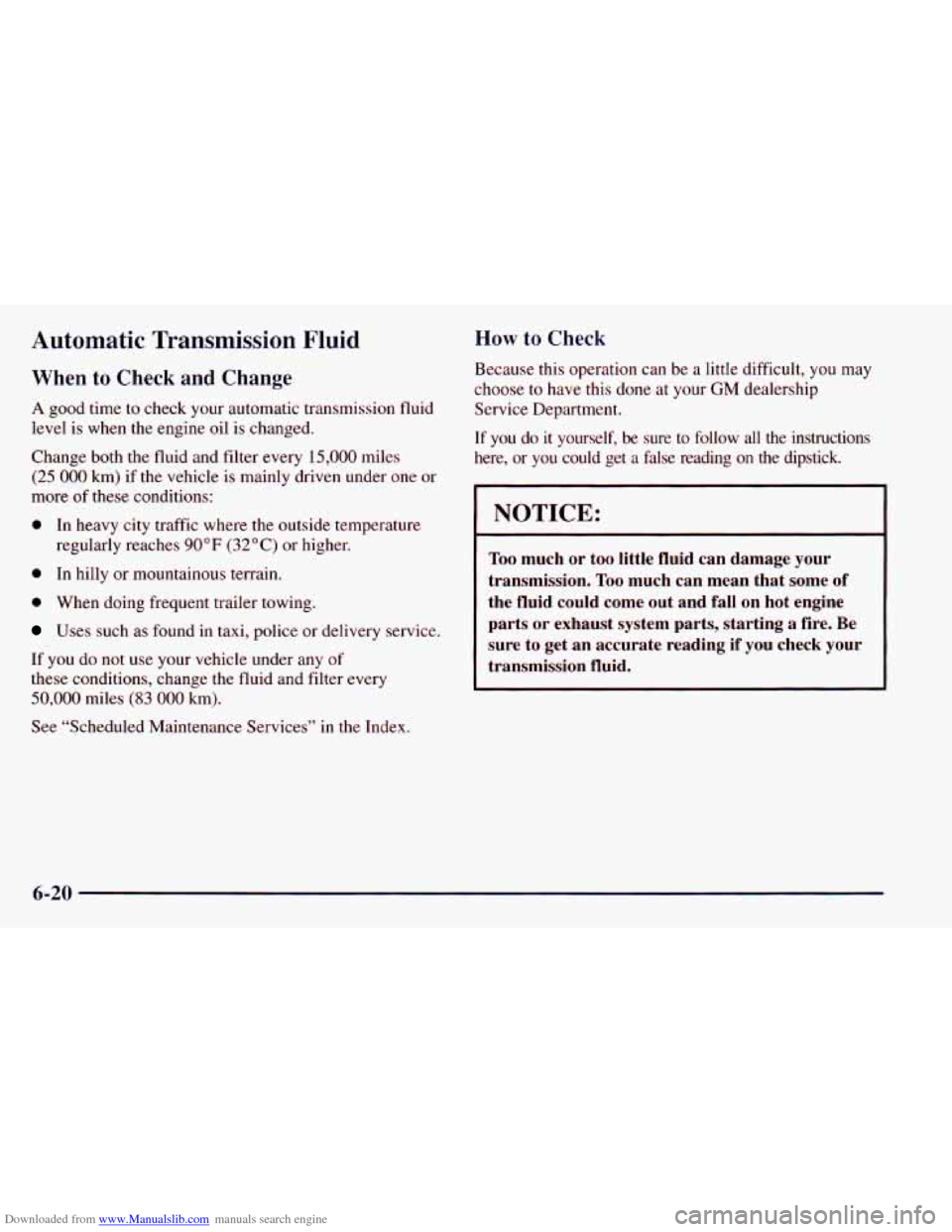
Downloaded from www.Manualslib.com manuals search engine Automatic Transmission Fluid
When to Check and Change
How to Check
Because this operation can be a little difficult, you may
choose
to have this done at your GM dealership ~
A good time to check your automatic transmission fluid Service Department.
level is when the engine oil
is changed.
Change both the fluid and filter every
15,000 miles here, or you could get a false reading on the dipstick.\
(25 000 km) if the vehicle is mainly driven under one or If
you do
it yourself, be sure to follow all the instructions
more of these conditions:
0 In heavy city traffic where the outside temperature
0 In hilly or mountainous terrain.
0 When doing frequent trailer towing.
regularly reaches
90°F (32 “C) or
higher.
NOTICE:
Too much or too little fluid can damage your
transmission.
Too much can mean that some of
the fluid could come out and fall on hot engine
Uses such as found in taxi, police or delivery service.
If you do not
use your vehicle under any of
these conditions, change the fluid and filter every
50,000 miles (83 000 km).
parts or exhaust system parts, starting a fire. Be
sure to get an accurate reading if you check your
transmission fluid.
See “Scheduled Maintenance Services’’ in the Index.
6-20
Page 283 of 414
Downloaded from www.Manualslib.com manuals search engine I
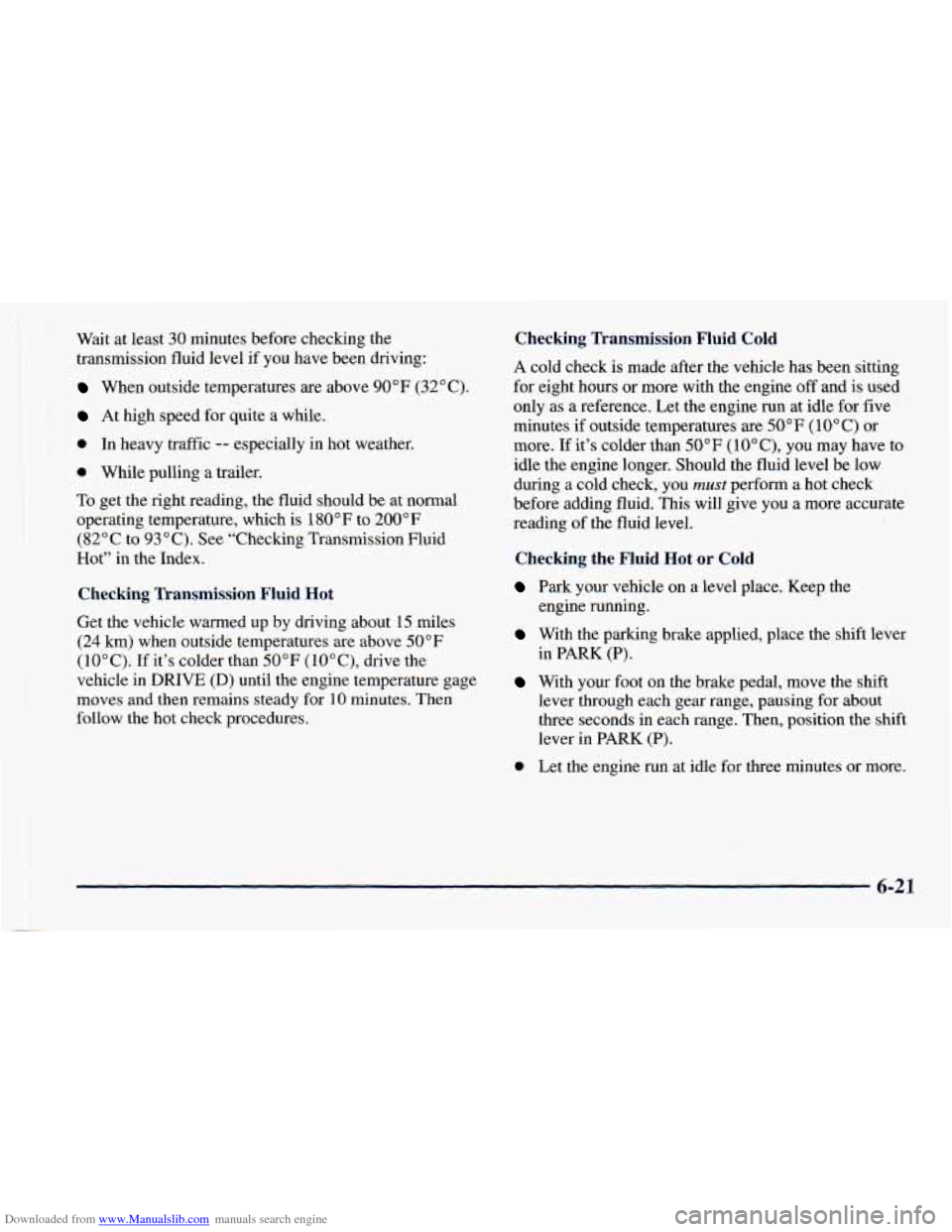
’Wait at least 30 minutes before checking the
transmission fluid level if you have been driving:
When outside temperatures are above 90°F (32°C).
At high speed for quite a while.
0 In heavy traffic -- especially in hot weather.
0 While pulling a trailer.
To get the right reading, the fluid should be at normal
operating temperature, which
is 180°F to 200°F
182°C to 93 ” C). See “Checking Transmission Fluid
’Hot” in the Index.
Checking Transmission Fluid Hot
Get the vehicle warmed up by driving about 15 miles
(24 km) when outside temperatures are above 50°F
(10°C). If it’s colder than 50°F (lO”C), drive the
vehicle in DRIVE
(D) until the engine temperature gage
moves and then remains steady for
10 minutes. Then
follow the hot check procedures.
Checking Transmission Fluid Cold
A cold check is made after the vehicle has been sitting
for eight hours or more with the engine off and is used
only as a reference. Let the engine run at idle for five
minutes
if outside temperatures are 50°F (10°C) or
more. If it’s colder than
50°F ( 10°C), you may have to
idle the engine longer. Should the fluid level be low
during
a cold check, you must perform a hot check
before adding fluid. This will give you a more accurate
reading
of the fluid level.
Checking the Fluid Hot or Cold
Park your vehicle on a level place. Keep the
engine running.
With the parking brake applied, place the shift lever
in PARK (P)
.
With your foot on the brake pedal, move the shift
lever through each gear range, pausing for about
three seconds in each range. Then, position the shift
lever in
PARK (P).
0 Let the engine run at idle for three minutes or more.
6-21
Page 324 of 414

Downloaded from www.Manualslib.com manuals search engine / 18 24
5 11 17 23 c7 c7 c7 17
4 ~ 10 16
3 9 15 21 c7 E7 c7 E7
2 8 14 20 c7 c7 11 17
7 13 19 E7 c7 c7 E3
FuseKircuit
Breaker Usage
4
8
9
2
3
FuseKircuit Breaker
Usage I
1 Stop/Turn/Hazard Lamps, CHMSL,
! Chime Module
Not Used
Courtesy Lamps, Power Outside
Mirrors, Glove
Box Lamp, Dome
Reading Lamps, Vanity Mirror Lamps
10
11
DRL Relay, DRL Module, Chime
Headlamp Switch, Keyless Entry,
Cluster, Overhead Console, Interior
Lamps Module
Not Used
Cruise Module, Cruise Control Switch
Power Outlets, DLC, Subwoofer
Amplifier Starter Enable Relay
I
License Plate Lamp, Taillamps, I
Parking Lamps, Ashtray Lamp, Panel
Lights, Trailer Taillamps, Front and
Rear Sidemarker Lamps, Door Switch
Illumination, Headlamp Switch
Illumination, Rear Seat Audio
Illumination
Air
Bag System
Wiper Motor, Washer Pump, Upfitter
Relay Coil