Page 64 of 414
Downloaded from www.Manualslib.com manuals search engine Removing the Child trom the Built-in Child Restraint
11. Adjust the position of the harness on the child’s
shoulders by moving the clip up or down along the
harness. On each side
of the harness, the shoulder
part should be centered near the child’s shoulder.
The harness should be away from the child’s face
and neck, but not falling from the child’s shoulders.
If you expect that the child will sleep while riding, you
can recline the seatback. See “Seats” in the Index.
1. Unfasten the shoulder harness clip.
1-50
Page 67 of 414
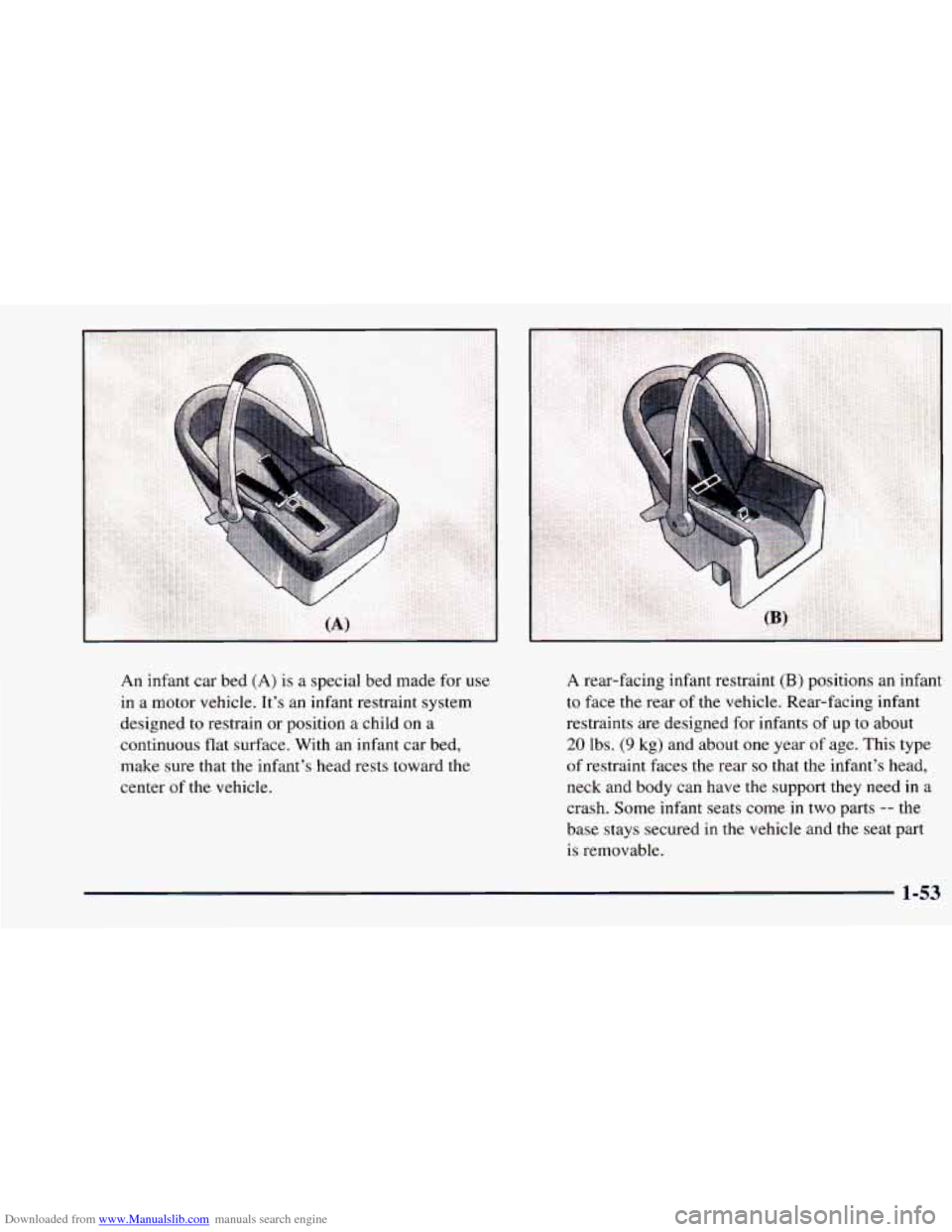
Downloaded from www.Manualslib.com manuals search engine An infant car bed (A) is a special bed made for use
in a motor vehicle. It’s an infant restraint system
designed
to restrain or position a child on a
continuous flat surface. With an infant car bed,
make sure that the infant’s head rests toward the
center of the vehicle. A
rear-facing infant restraint
(B) positions an infant
to face the rear of the vehicle. Rear-facing infant
restraints are designed for infants of up
to about
20 lbs. (9 kg) and about one year of age. This type
of restraint faces the rear so that the infant’s head,
neck and body can have the support they need in a
crash. Some infant seats come in two parts
-- the
base stays secured in the vehicle and the seat part
is removable.
1-53
Page 70 of 414

Downloaded from www.Manualslib.com manuals search engine A booster seat (F, G) is designed for children who
are about
40 to 60 lbs. (18 to 27 kg) and about
four
to eight years of age. It’s designed to improve
the fit
of the vehicle’s safety belt system. Booster
seats with shields use lap-only belts; however,
booster seats without shields use lap-shoulder
belts. Booster seats can also help a child to see
out the window. When choosing
a child restraint, be sure the child
restraint
is designed to be used in a vehicle. If it is, it
will have a label saying that it meets Federal Motor
Vehicle Safety Standards.
Then follow the instructions
for the restraint. You may
find these instructions on the restraint itself or in a
booklet,
or both. These restraints use the belt system in
your vehicle, but the child also has to be secured within
the restraint
to help reduce the chance of personal injury.
The instructions that come with the infant or child
restraint will show you how to do that. Both the owner’s
manual and the child restraint instructions are important,
so if either one of these is not available, obtain a
replacement copy from the manufacturer.
Where to Put the Restraint
(Except Cargo Vans)
Accident statistics show that children are safer if they
are restrained in the rear rather than the front seat. We at
General Motors therefore recommend that
you put your
child restraint in a rear seat.
Never put a rear-facing
child restraint in the front passenger seat. Here’s why:
1-56
Page 77 of 414
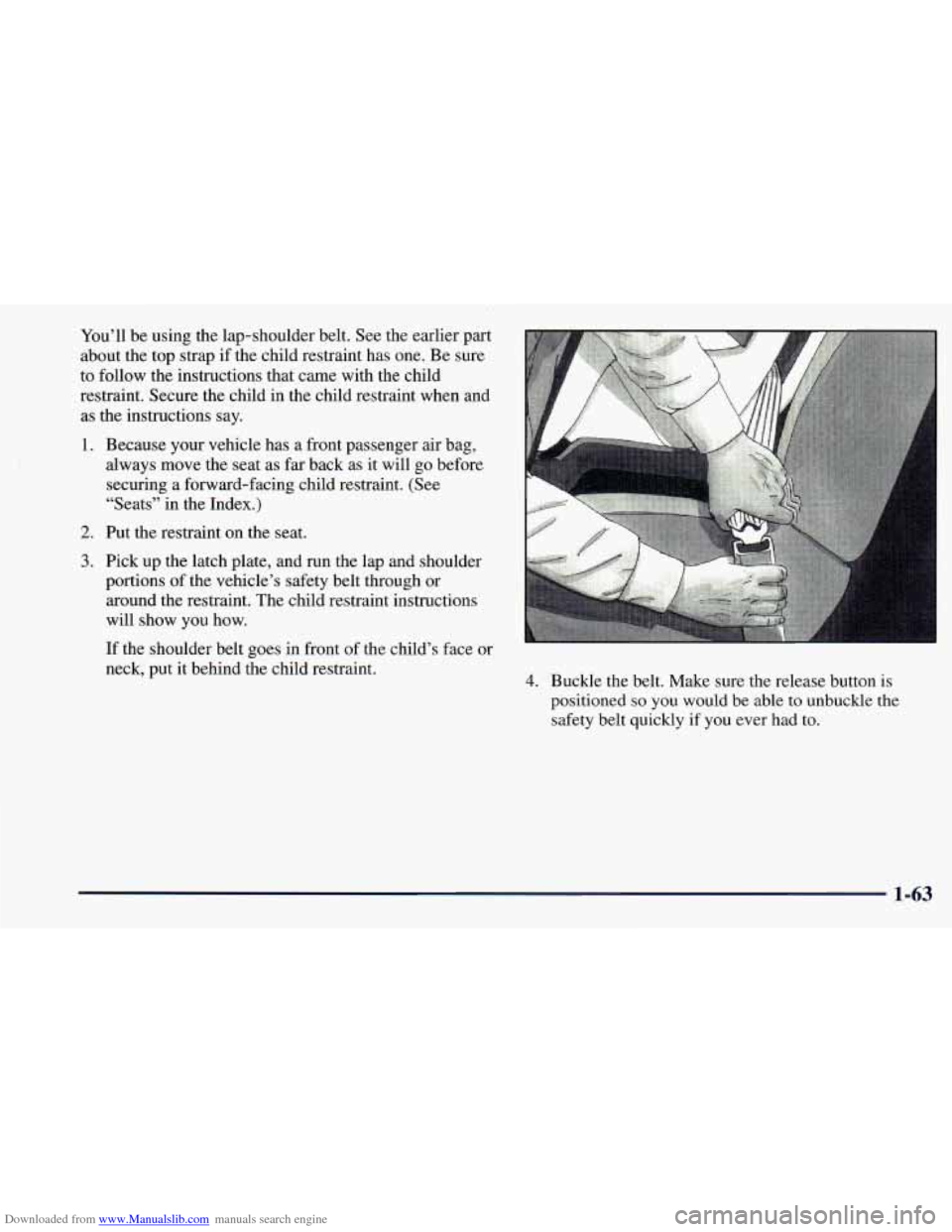
Downloaded from www.Manualslib.com manuals search engine You’ll be using the lap-shoulder belt. See the earlier part
about the top strap if the child restraint has one. Be sure
to follow the instructions that came with the child
restraint. Secure the child in the child restraint when and
as the instructions say.
1. Because your vehicle has a front passenger air bag,
always move the seat as far back as it will
go before
securing a forward-facing child restraint. (See
“Seats” in the Index.)
2. Put the restraint on the seat.
3. Pick up the latch plate, and run the lap and shoulder
portions of the vehicle’s safety belt through or
around the restraint. The child restraint instructions
will show you how.
If the shoulder belt goes in front of the child’s face or
neck, put it behind the child restraint.
4. Buckle the belt. Make sure the release button is
positioned
so you would be able to unbuckle the
safety belt quickly if you ever had to.
1-63
Page 159 of 414
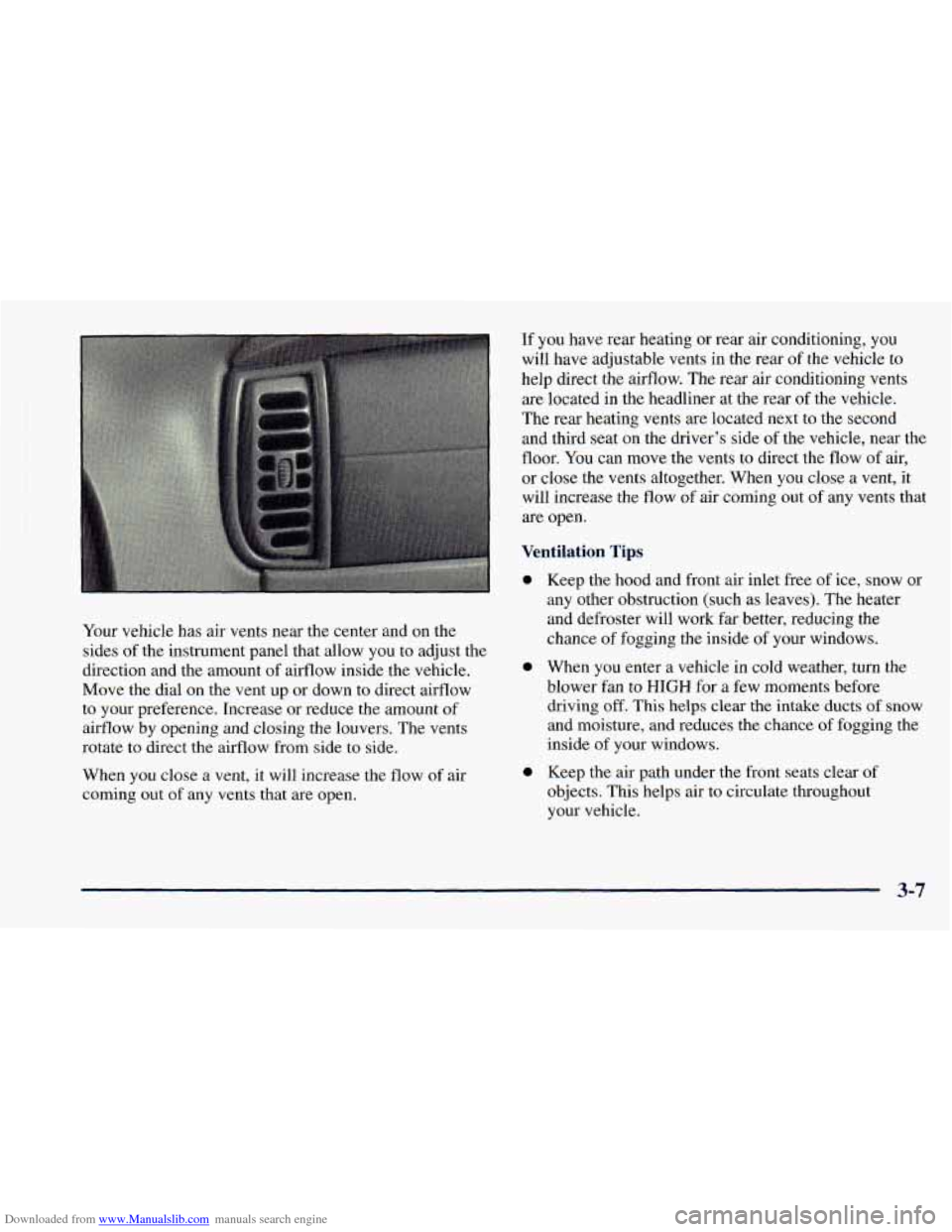
Downloaded from www.Manualslib.com manuals search engine Your vehicle has air vents near the center and on the
sides of the instrument panel that allow you to adjust the
direction and the amount of airflow inside the vehicle.
Move the dial on the vent up or down to direct airflow
to your preference. Increase or reduce the amount of
airflow by opening and closing the louvers. The vents
rotate to direct the airflow from side to side.
When you close a vent, it will increase the flow of air
coming out of any vents that are open. If you
have rear heating or rear air conditioning, you
will have adjustable vents in the rear of the vehicle to
help direct the airflow. The rear air conditioning vents are located in the headliner at the rear
of the vehicle.
The rear heating vents are located next to the second
and third seat
on the driver’s side of the vehicle, near the
floor.
You can move the vents to direct the flow of air,
or close the vents altogether. When you close a vent, it
will increase the flow of air coming out of any vents that
are open.
Ventilation Tips
e
e
a
Keep the hood and front air inlet free of ice, snow or
any other obstruction (such as leaves). The heater
and defroster will work
far better, reducing the
chance
of fogging the inside of your windows.
When you enter a vehicle in cold weather, turn the
blower fan to HIGH for
a few moments before
driving off.
This helps clear the intake ducts of snow
and moisture, and reduces the chance of fogging the
inside of your windows.
Keep the air path under the front seats clear of
objects. This helps air to circulate throughout
your vehicle.
3-7
Page 211 of 414

Downloaded from www.Manualslib.com manuals search engine /1 CAUTION:
Do not load your vehicle any heavier than the
GVWR, or either the maximum front or rear GAWR.
If you do, parts on your vehicle can
break, or it can change the way your vehicle
handles. These could cause you to lose control.
Also, overloading can shorten the life of
your vehicle.
Using heavier suspension components to get added
durability might not change your weight ratings.
Ask
your dealer to help you load your vehicle the right way.
NOTICE:
~
Your warranty does not cover parts or
components that fail because of overloading.
If you put things inside your vehicle -- like suitcases,
tools, packages, or anything else
-- they will go as fast
as the vehicle goes. If
you have to stop or turn quickly,
or
if there is a crash, they’ll keep going.
A CAUTION:
Things you put inside your vehicle can strike and
injure people in a sudden stop or turn, or in a crash.
0 Put things in the cargo area of your vehicle.
0 Never stack heavier things, like suitcases,
Try to spread the weight evenly.
inside the vehicle
so that some of them are
above the tops of the seats.
Don’t leave an unsecured child restraint in
your vehicle.
When you carry something inside the
vehicle, secure it whenever you can.
0 Don’t leave a seat folded down unless you
need to.
Payload
The Payload Capacity is shown on the Certificatiooire
label. This is the maximum load capacity that your
vehicle can carry. Be sure to include the weight of the
people inside as part
of your load. If you added any
accessories or equipment after your vehicle left the
factory, remember
to subtract the weight of these things
from
the payload. Your dealer can help you with this.
4-27
Page 277 of 414
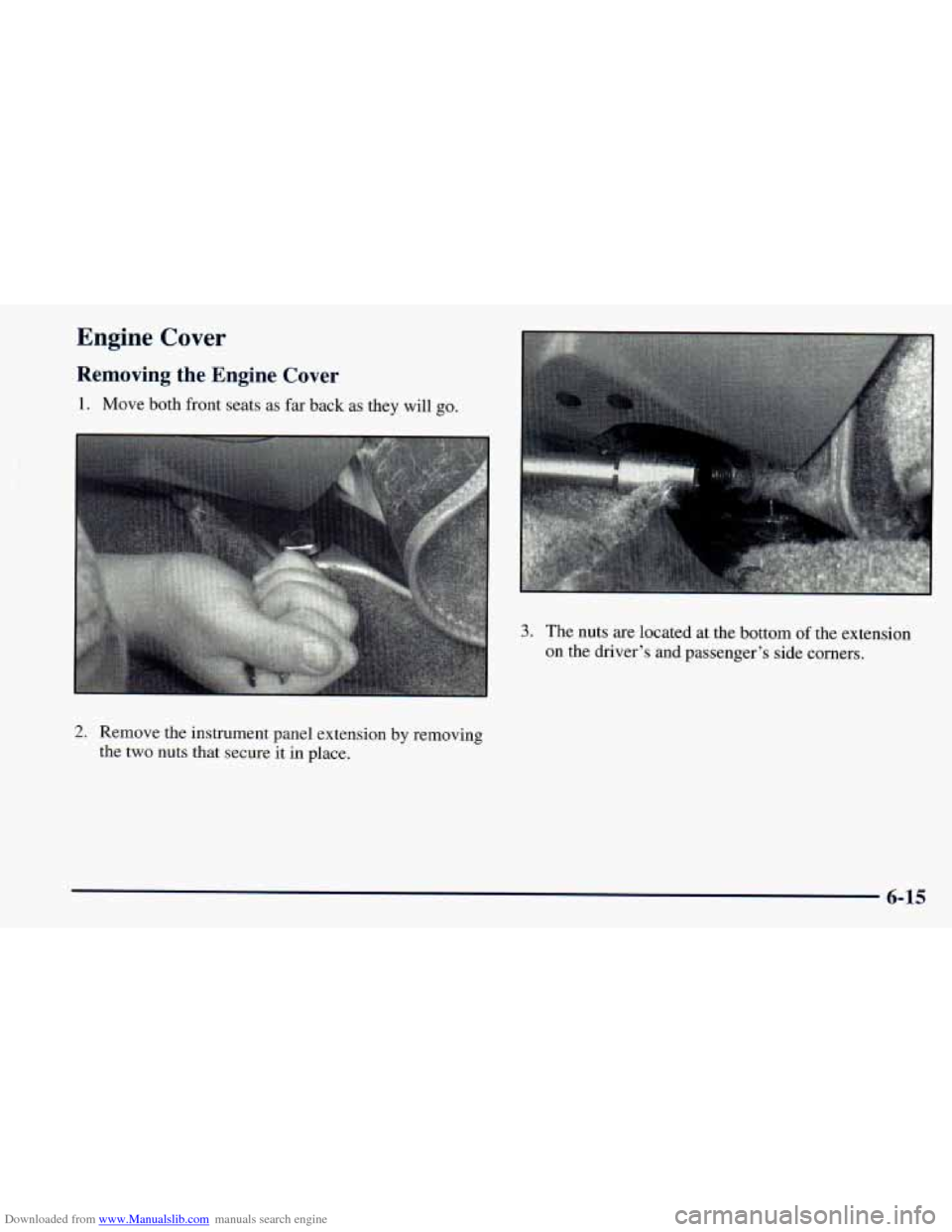
Downloaded from www.Manualslib.com manuals search engine Engine Cover
Removing the Engine Cover
1. Move both front seats as far back as they will go.
2. Remove the instrument panel extension by removing
the two nuts that secure it in place.
3. The nuts are located at the bottom of the extension
on the driver’s and passenger’s side corners.
6-15
Page 320 of 414
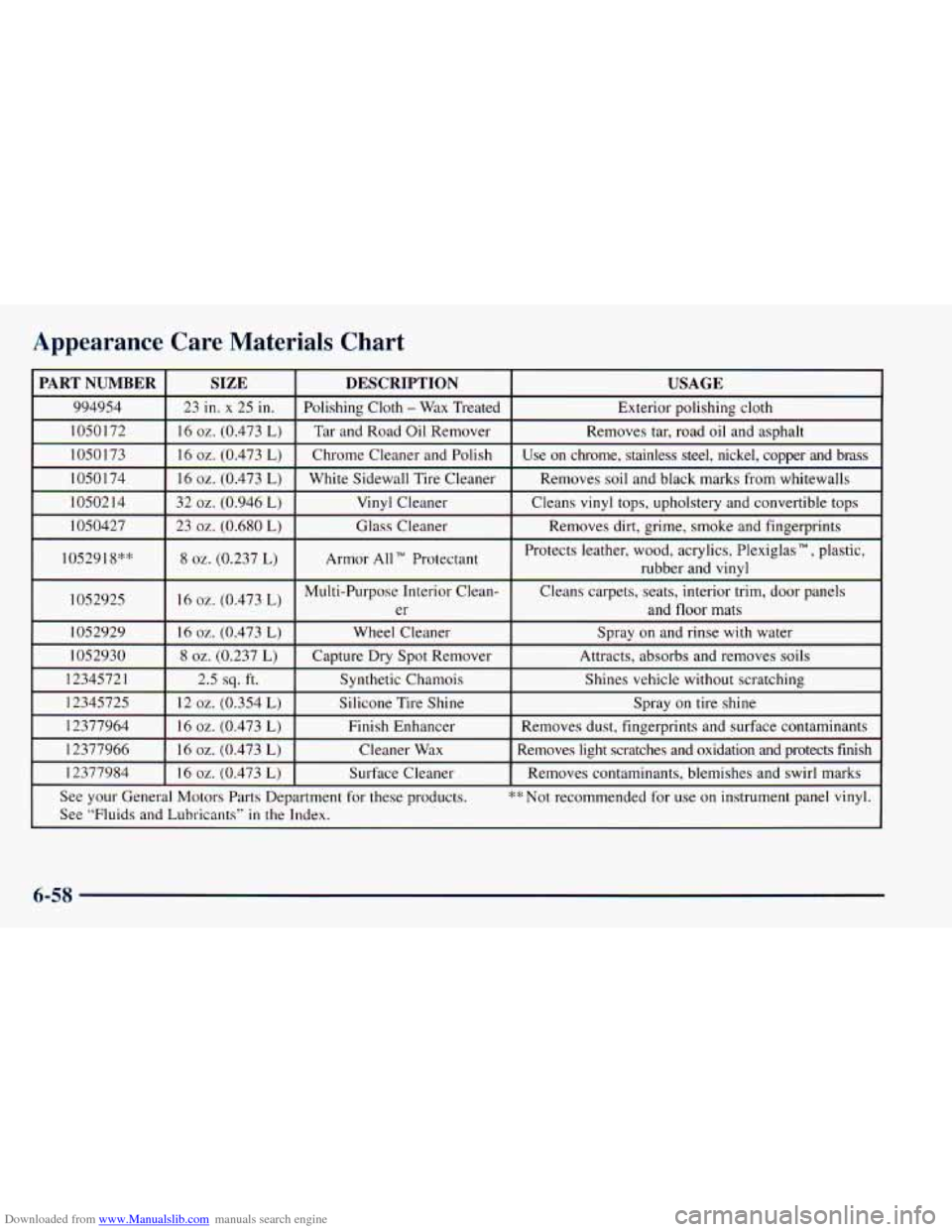
Downloaded from www.Manualslib.com manuals search engine Appearance Care Materials Chart
PART NUMBER
994954
1050 172
1050 173
1050 174
1050214
1050427
10529 18**
1052925
1052929
1052930
1234572
1
12345725
I2377964
12377966
12377984
SIZE DESCRIPTION USAGE
23 in. x 25 in. Polishing Cloth - Wax Treated Exterior polishing cloth
16
oz. (0.473 L) Tar and Road Oil Remover Removes tar, road oil and asphalt
16 oz. (0.473 L) I Chrome Cleaner and Polish I Use on chrome, stainless steel, nickel, copper and brass I
16 oz. (0.473 L) I White Sidewall Tire Cleaner I Removes soil and black marks from whitewalls I
32 oz. (0.946 L) Vinyl Cleaner Cleans vinyl tops, upholstery and convertible tops
23
oz. (0.680 L) Glass Cleaner Removes dirt, grime, smoke and fingerprints
8 oz. (0.237 L) I Armor All Protectant Protects leather, wood,
acrylics, Plexiglas , plastic,
rubber and vinyl
16 oz. (0.473 L) Multi-Purpose Interior Clean- Cleans carpets, seats, interior trim, door panels
I er and floor mats I I
16 02. (0.473 L) I Wheel Cleaner I Spray on and rinse with water
8 oz. (0.237 L) I Capture Dry Spot Remover I Attracts, absorbs and removes soils -*
2.5 sq. ft. Synthetic Chamois
12
oz. (0.354 L) Silicone Tire Shine
16 02, (0.473 L) Finish Enhancer
16 oz. (0.473 L) Cleaner Wax
16
oz. (0.473 L) Surface Cleaner Shines vehicle without scratching
Spray on tire shine
Removes dust, fingerprints and surface contaminants
Removes light scratches and oxidation and protects finish
Removes contaminants, blemishes and swirl marks
6-58