Page 76 of 414

Downloaded from www.Manualslib.com manuals search engine 6. Push and pull the child restraint in different
To remove the child restraint, just unbuckle the vehicle’s
safety belt. It will be ready to work for
an adult or larger
child passenger.
directions to be sure
it
is secure.
Securing a Child Restraint in the Right
Front Seat Position
Your vehicle has a front passenger air bag. Never put a
rear-facing child restraint in this seat. Here’s why:
A CAUTION:
I
A child in a rear-facing child restraint can be
seriously injured if the front passenger’s
air bag
inflates, even
if your vehicle has reduced-force
frontal air bags. This
is because the back of a
rearfacing child restraint would be very close to
the inflating air bag.
If your vehicle is a
passenger van, always secure a rearfacing child
restraint in a rear seat.
If your vehicle is a cargo van, do not use a
rearfacing child restraint in this vehicle. If a
forward-facing child restraint is suitable for your
child, always move the passenger seat as far back
as it will go.
i
1-62
Page 77 of 414
Downloaded from www.Manualslib.com manuals search engine You’ll be using the lap-shoulder belt. See the earlier part
about the top strap if the child restraint has one. Be sure
to follow the instructions that came with the child
restraint. Secure the child in the child restraint when and
as the instructions say.
1. Because your vehicle has a front passenger air bag,
always move the seat as far back as it will
go before
securing a forward-facing child restraint. (See
“Seats” in the Index.)
2. Put the restraint on the seat.
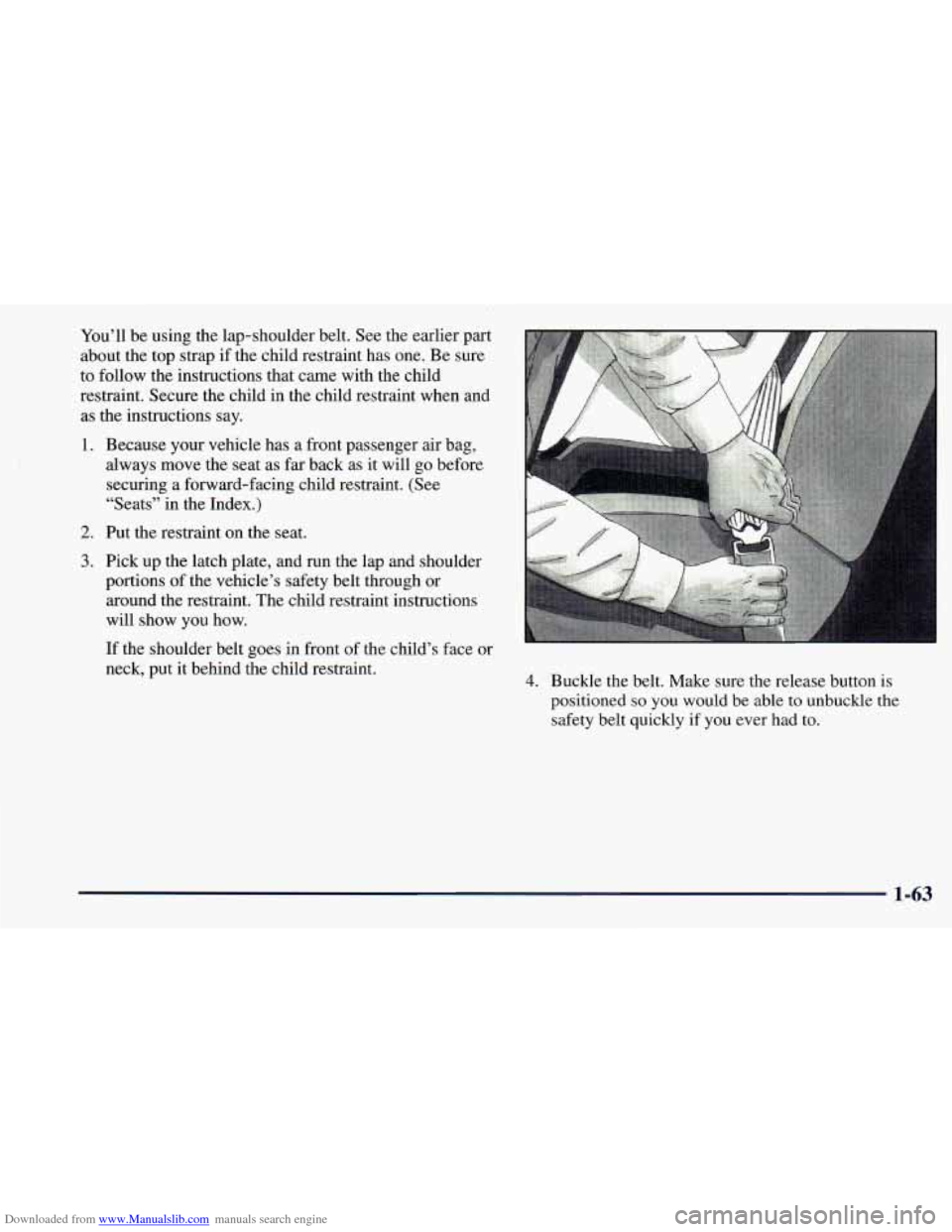
3. Pick up the latch plate, and run the lap and shoulder
portions of the vehicle’s safety belt through or
around the restraint. The child restraint instructions
will show you how.
If the shoulder belt goes in front of the child’s face or
neck, put it behind the child restraint.
4. Buckle the belt. Make sure the release button is
positioned
so you would be able to unbuckle the
safety belt quickly if you ever had to.
1-63
Page 78 of 414
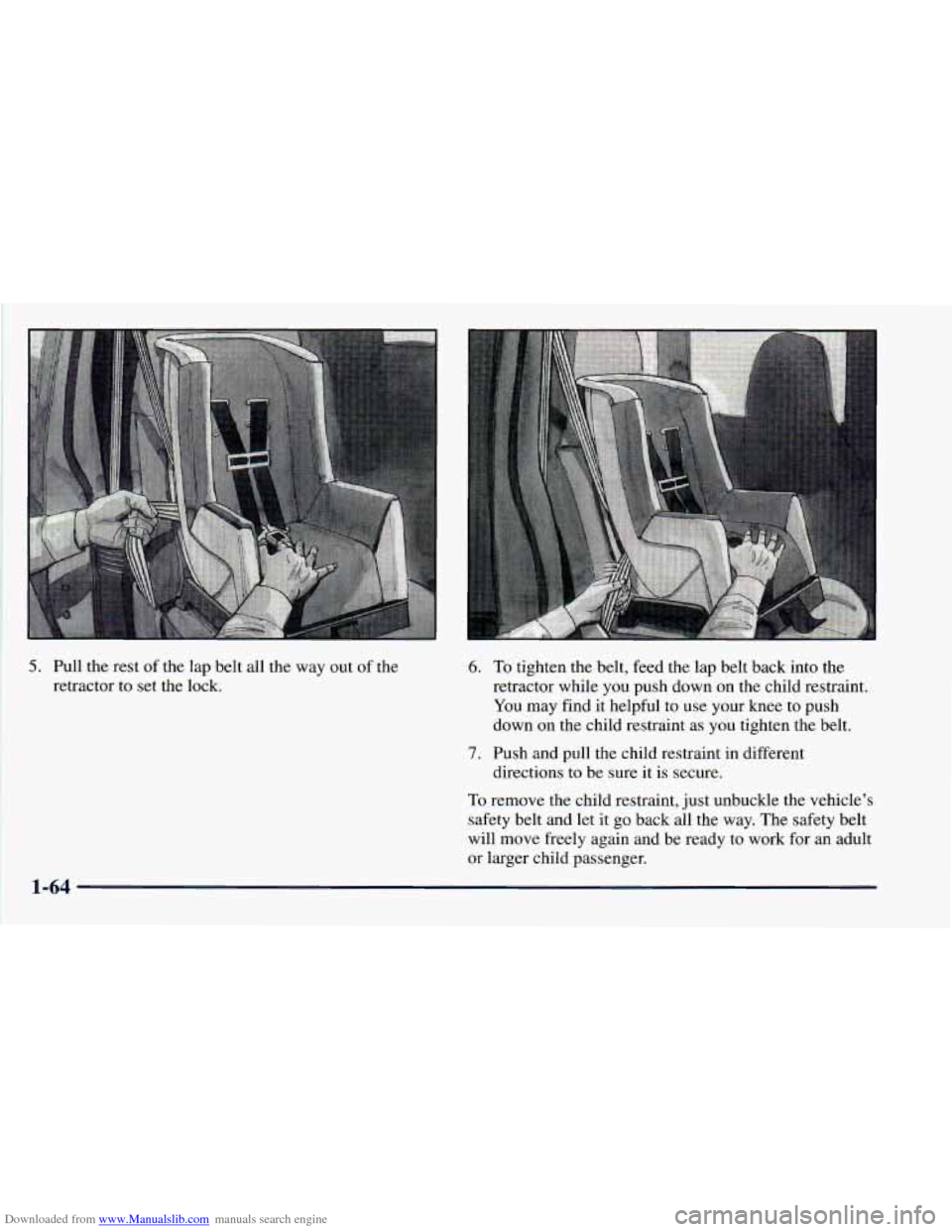
Downloaded from www.Manualslib.com manuals search engine 5. Pull the rest of the lap belt all the way out of the
retractor to set the lock. 6.
7.
To tighten the belt, feed the lap belt back into the
retractor while
you push down on the child restraint.
You may find it helpful to use your knee to push
down on the child restraint as you tighten the belt.
Push and pull the child restraint in different
directions to be sure it is secure.
To remove the child restraint, just unbuckle the vehicle’s
safety belt and let it go back all the way. The safety belt
will move freely again and be ready
to work for an adult
or larger child passenger.
1-64
Page 94 of 414
Downloaded from www.Manualslib.com manuals search engine Synchronization
Synchronization may be necessary due to the security
method used by this system. The transmitter does not
send the same signal twice to the receiver.
The receiver
will not respond to a signal it has been sent previously.
This will prevent anyone from recording and playing
back the signal from the transmitter.
To resynchronize your transmitter, stand close to your
vehicle and simultaneously press and hold the
LOCK
and UNLOCK buttons on the transmitter for eight
seconds. The door locks should cycle
to confirm
synchronization.
If the locks do not cycle, see your
dealer for service.
Sliding Door
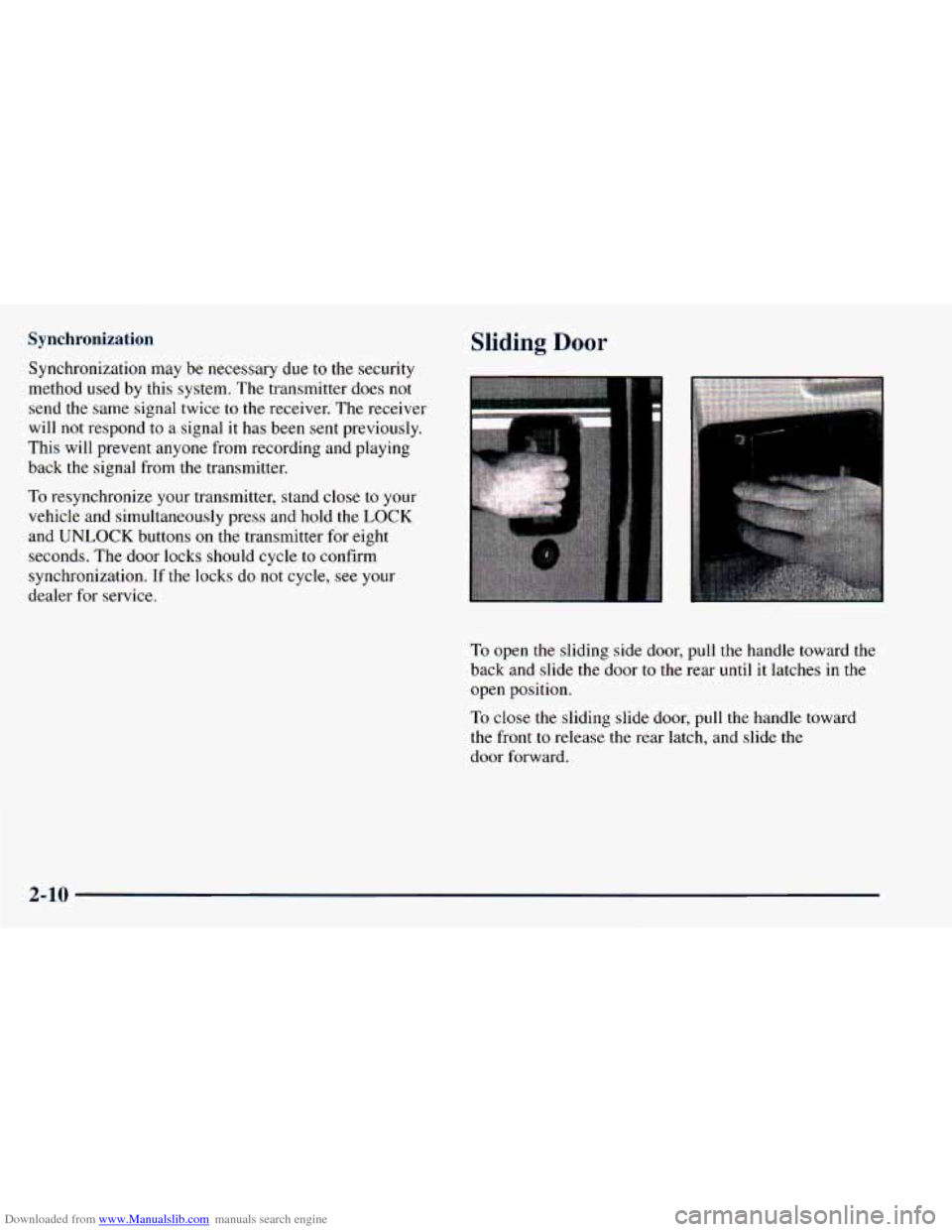
To open the sliding side door, pull the handle toward the
back and slide the door to
the rear until it latches in the
open position.
To close the sliding slide door, pull the handle toward
the front
to release the rear latch, and slide the
door forward.
2-10
Page 95 of 414
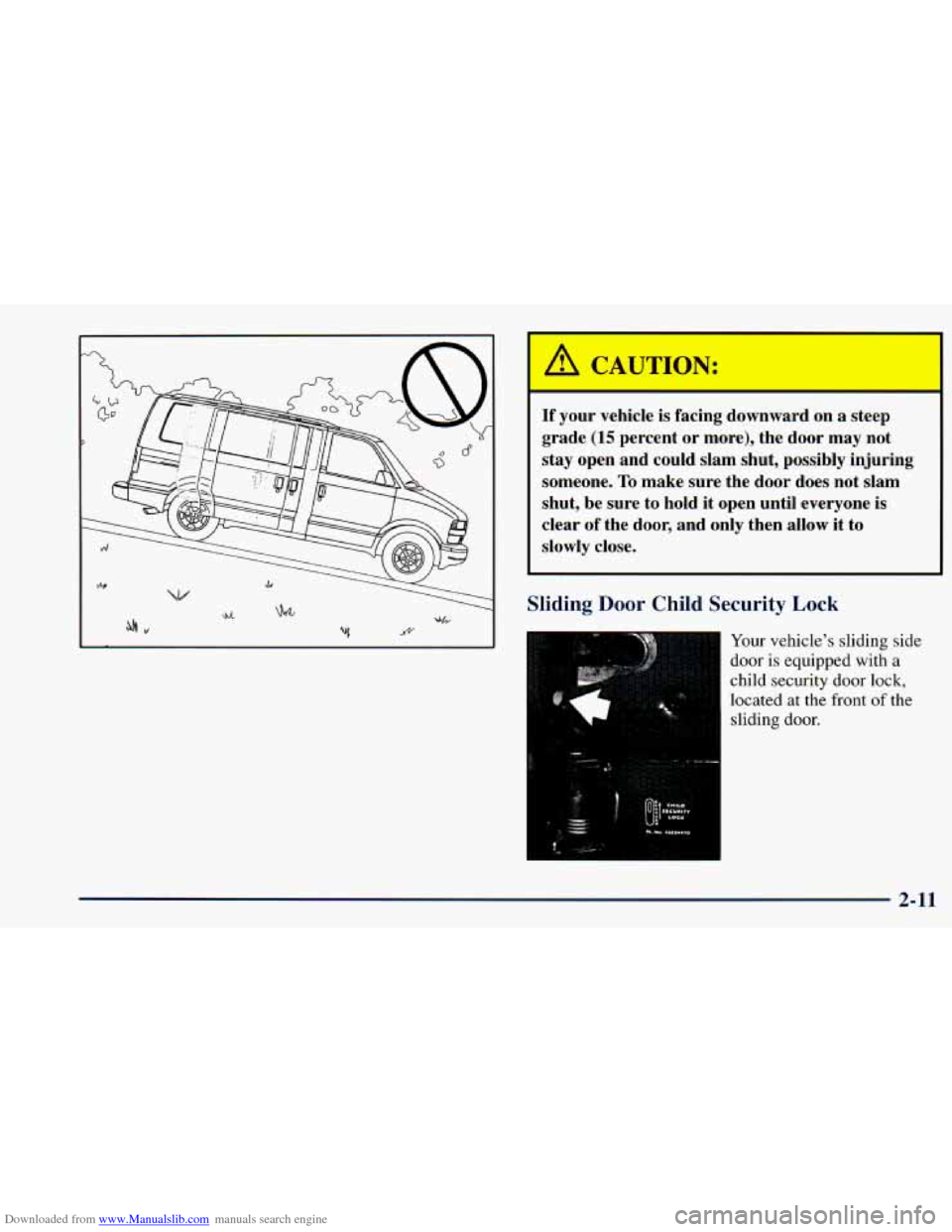
Downloaded from www.Manualslib.com manuals search engine If yc vehi is fac .g do! rd on a steep
grade
(15 percent or more), the door may not
stay open and could slam shut, possibly injuring
someone.
To make sure the door does not slam
shut, be sure to hold it open until everyone is
clear of the door, and only then allow it to
slowly close.
Sliding Door Child Security Lock
Your vehicle's sliding side
door is equipped with
a
child security door lock,
located at the front
of the
sliding door.
2-11
Page 96 of 414

Downloaded from www.Manualslib.com manuals search engine There are two labels on your vehicle to remind you that
you have this feature. One can be seen from the outside
on your sliding door. It is located near the bottom of the
door glass, toward the front of the door.
Lu c3
c3
z w
n
a
l- I
The other label is at the
front of the sliding door,
near the child security
door lock.
This feature prevents passengers from opening the
sliding side door from the inside.
To use this feature, do the following:
1. Move the lever all the way up.
2. Close the door. To
open the sliding side door while the child security
lock
is engaged, unlock the door and open it from
the outside.
If you don’t cancel the security lock feature, adults or
older children who ride in the rear won’t be able to open
the sliding door from the inside.
You should let adults
and older children know how the security door lock
works, and how
to cancel the lock.
Canceling the Sliding Door Child
Security
Lock
To cancel the child security lock:
1. Unlock the door and open it from the outside.
2. Move the lever all the way down.
2-12
Page 98 of 414
Downloaded from www.Manualslib.com manuals search engine To lock the power lock system from the outside, insert
the key in the hatch release button and turn it
to the
right. All doors will lock.
Also, see the Caution following “Hatch,” located in
this section.
Theft
Vehicle theft is big business, especially in some cities.
Although your vehicle has a number
of theft-deterrent
features, we know that nothing we put on it can make it
impossible to steal. However, there
are ways you
can help.
Key in the Ignition
If you leave your vehicle with the keys inside, it’s an
easy target for joy riders or professional thieves
-- so
don’t do it.
When
you park your vehicle and open the driver’s door,
you’ll hear a chime reminding you to remove your key
from the ignition and take it with you. Always do this.
Your steering wheel will be locked, and
so will your
ignition and transmission. And remember to lock
the doors.
Parking at Night
Park in a lighted spot, close all windows and lock your
vehicle. Remember
to keep your valuables out of sight.
Put them in a storage area,
or take them with you.
Parking Lots
If you park in a lot where someone will be watching
your vehicle, it’s best
to lock it up and take your keys.
But what if
you have to leave your key? Do not leave
valuables in your vehicle, since there is no locking area
in which
to secure them. Lock all doors except
the driver’s.
Passlock@
Your vehicle is equipped with the Passlock
theft-deterrent system.
Passlock is a passive theft-deterrent system. The system
is armed once the key is removed from
the ignition.
Passlock enables fuel if the ignition lock cylinder
is
turned with a valid key. If a correct key is not used, fuel
is disabled.
During normal operation, the SECURITY light will go
off after the engine is started.
2-14
Page 99 of 414

Downloaded from www.Manualslib.com manuals search engine If the engine stalls and the SECURITY light flashes,
wait until the light stops flashing before trying to restart
the engine. Remember to release the key from the
START position as soon as the engine starts.
If you are driving and the SECURITY light comes on,
you will be able to restart the engine if you turn the
engine
off. However, your Passlock system is not
working properly and must be serviced by your dealer.
Your vehicle is not protected by Passlock at this time.
You may also want
to check the fuses (see “Fuses and
Circuit Breakers”
in the Index). See your dealer
for service.
If the SECURITY light comes on while the engine is
running, a problem has been detected and the system
may need service. See your dealer for service.
In an emergency, call
the GM Roadside Assistance
Center.
See “Roadside Assistance” in the Index.
New Vehicle “Break-In”
NOTICE:
Your vehicle doesn’t need an elaborate
“break-in.” But it will perform better in the long
run if you follow these guidelines:
0
0
0
0
Keep your speed at 55 mph (88 kmh) or
less for the first
500 miles (805 km).
Don’t drive at any one speed
-- fast or
slow
-- for the first 500 miles (805 km).
Don’t make full-throttle starts.
Avoid making hard stops for the first
200 miles (322 km) or so. During this time
your new brake linings aren’t yet broken
in. Hard stops with new linings can mean
premature wear and earlier replacement.
Follow this breaking-in guideline every
time you get new brake linings.
Don’t tow
a trailer during break-in.
See “Towing
a Trailer” in the Index for
more information.
2-15