1998 CHEVROLET ASTRO brake
[x] Cancel search: brakePage 110 of 414
Downloaded from www.Manualslib.com manuals search engine Shifting Out of PARK (P)
Your vehicle has a brake-transmission shift interlock.
You have
to fully apply your regular brake before you
can shift from PARK (P) when the ignition is in the
RUN position. See "Automatic Transmission" in
the Index.
If you cannot shift out of PARK (P), ease pressure on
the shift lever
-- push the shift lever all the way into
PARK
(P) as you maintain brake application. Then
move the shift lever into the gear you want.
If you ever hold the brake pedal down but still can't
shift out of PARK
(P), try this:
1. Turn the key to OFF.
2. Apply and hold the brake until the end of Step 4.
3. Shift to NEUTRAL (N).
4. Start the vehicle and then shift to the drive gear
you want.
5. Have the vehicle fixed as soon as you can.
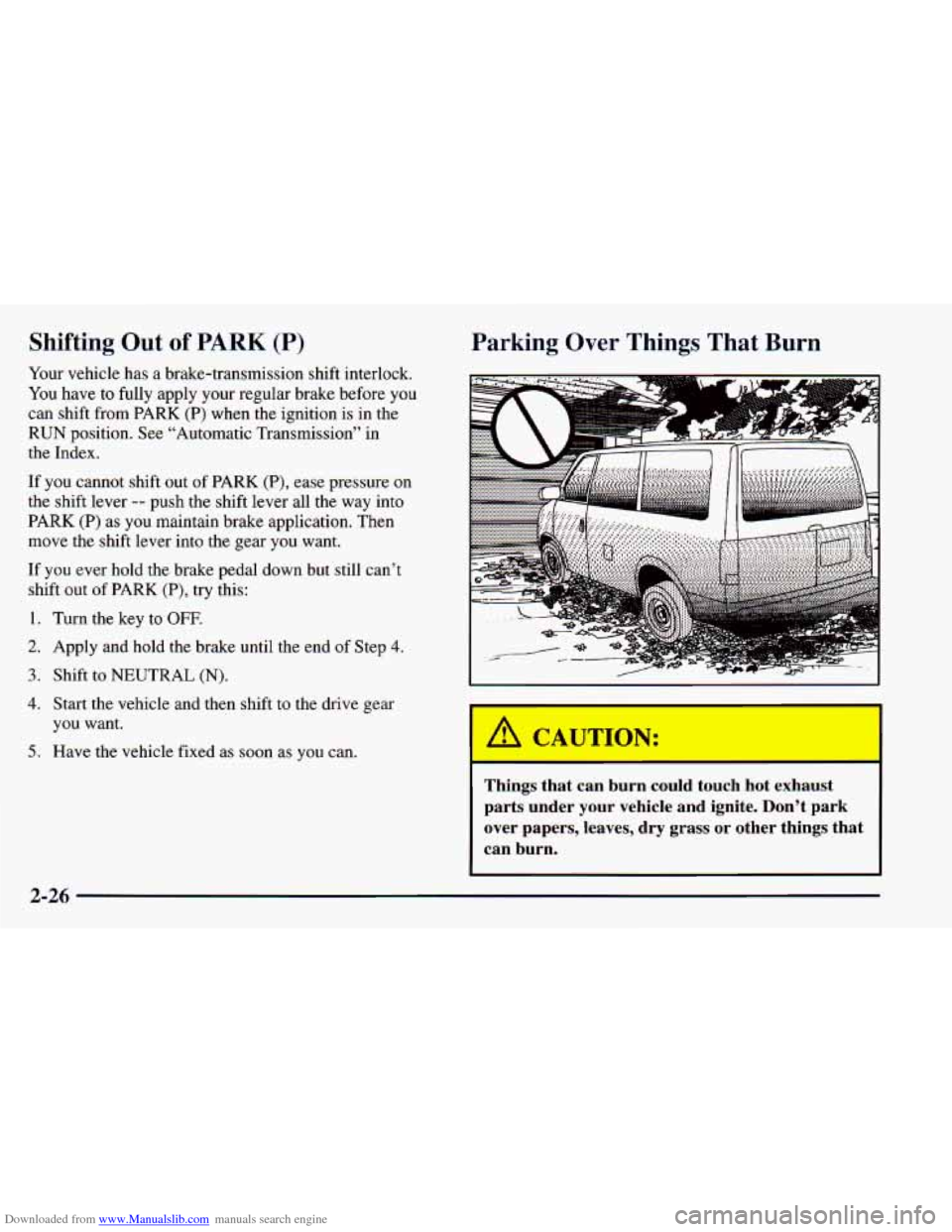
Parking Over Things That Burn
I A CAUTION:
Y
Things that can burn could touch hot exhaust
parts under your vehicle and ignite. Don't park
over papers, leaves, dry grass or other things that
can burn.
2-26
Page 112 of 414
Downloaded from www.Manualslib.com manuals search engine A CAUTION:
It can be dangerous to get out of your vehicle if
the shift lever is not fully in
PARK (P) with the
parking brake firmly set. Your vehicle can roll.
Don’t leave your vehicle when the engine is
running unless you have to. If you’ve left the
engine running, the vehicle can move suddenly.
You or others could be injured. To be sure your
vehicle won’t move, even when you’re on
fairly
level ground, always set your parking brake and
move the shift lever to
PARK (P).
Locking Rear Axle (Option)
If you have this feature, your locking rear axle can give
you additional traction on snow, mud, ice, sand or
gravel. It works like a standard axle most of the time,
but when one
of the rear wheels has no traction and the
other does, this feature will allow the wheel with
traction to move
the vehicle.
All-Wheel Drive (Option)
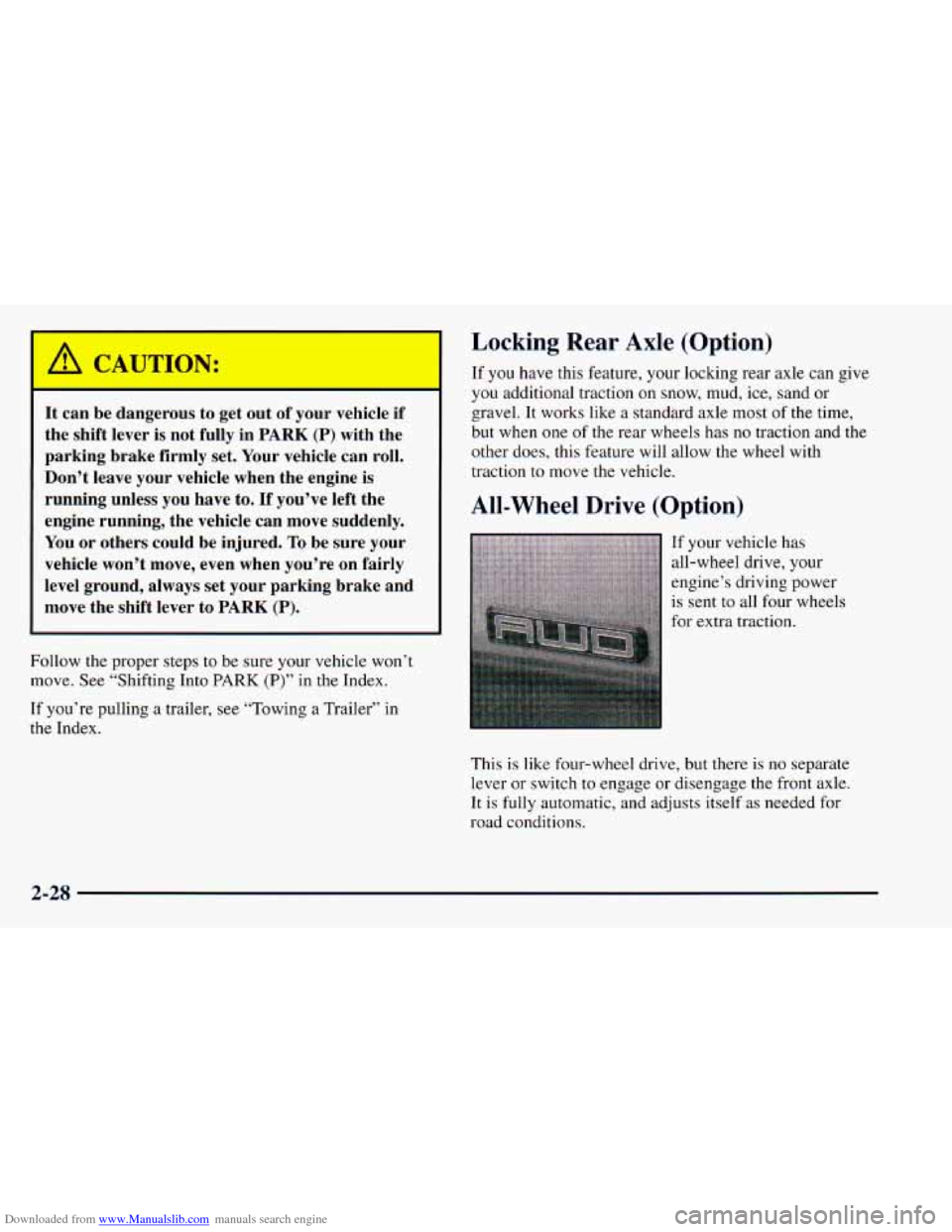
If your vehicle has
all-wheel drive, your
engine’s driving power
is sent to all four wheels
for extra traction.
Follow
the proper steps to be sure your vehicle won’t
move. See “Shifting Into
PARK (P)” in the Index.
If you’re pulling a trailer, see “Towing a Trailer’’ in
the Index.
This is like four-wheel drive, but there
is no separate
lever or switch
to engage or disengage the front axle.
It is fully automatic, and adjusts itself as needed for
road conditions.
2-2s
Page 118 of 414

Downloaded from www.Manualslib.com manuals search engine To wash the window, push in on the switch. Window
washer fluid will continue to spray until the switch is
released. The wiper will continue with three more wipes
and then return to the setting that was chosen before the
lever was pushed.
The rear window washer uses the same fluid bottle as
the front windshield washer.
If the fluid level is low in
the washer bottle,
you may not be able to wash your rear
window.
If you can wash your windshield, but not your
rear window, check the fluid level.
Cruise Control (Option)
With cruise control, you can maintain a speed of about
25 mph (40 km/h) or more without keeping your foot on
the accelerator.
This can really help on long trips.
Cruise control does not work at speeds below about
25 mph (40 kmk).
When you apply your brakes, the cruise control
shuts off.
A CAUTION: I
-
Cruise control can be dan- rous where you
can’t drive safely
at a steady speed. So,
don’t use your cruise control on winding
roads or in heavy traffic.
slippery roads. On such roads, fast changes
in tire traction can cause needless wheel
spinning, and you could lose control. Don’t
use cruise control on slippery roads.
Cruise control can be dangerous on
Setting Cruise Control
1 A CAUTION:
If y - __ leave your cruise control switch on when
you’re not using cruise, you might hit
a button
and go into cruise when you don’t want to. You
could be startled and even lose control. Keep the
cruise control switch
off until you want to use it.
Page 119 of 414
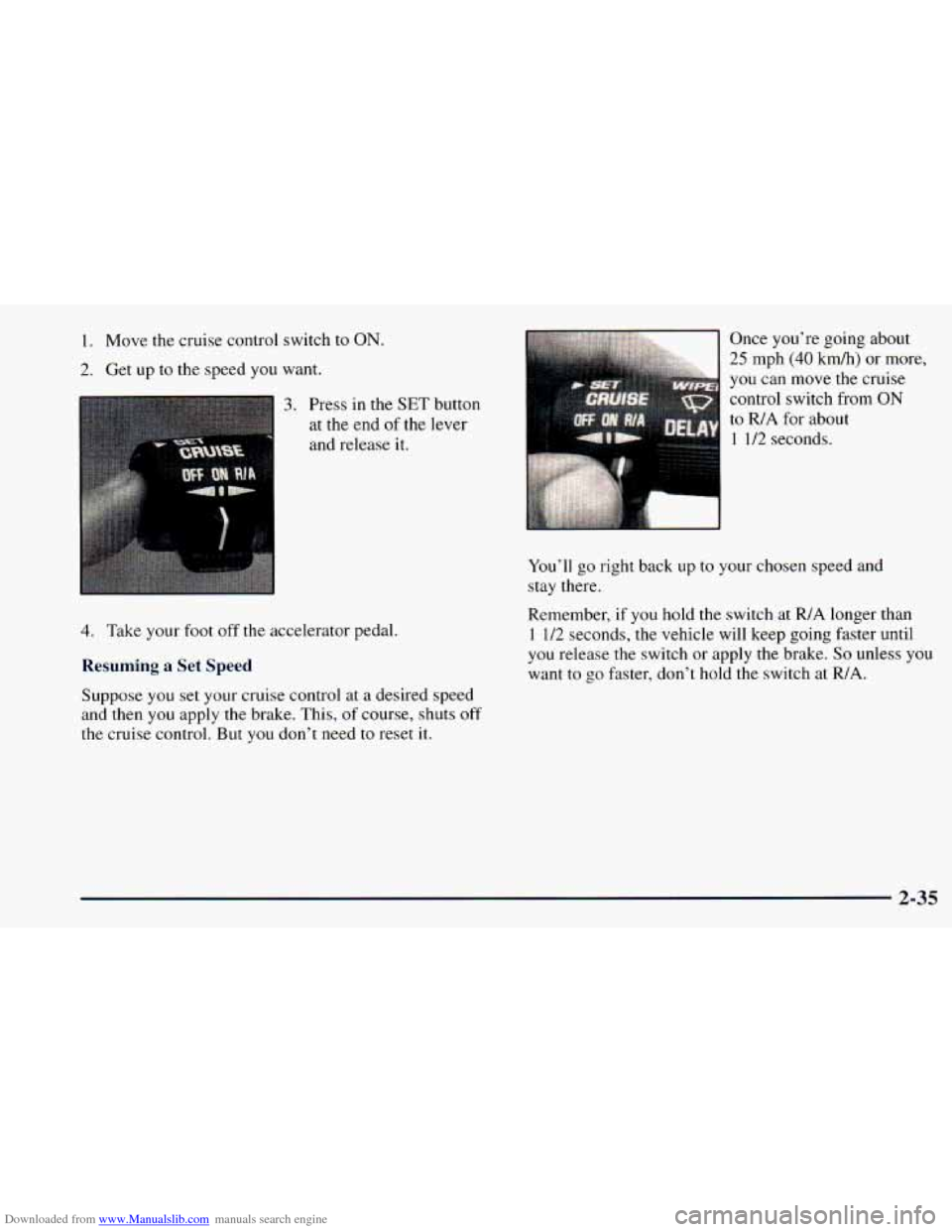
Downloaded from www.Manualslib.com manuals search engine 1. Move the cruise control switch to ON.
2. Get up to the speed you want.
3. Press in the SET button
at the end of the lever
and release it.
4. Take your foot off the accelerator pedal.
Resuming a Set Speed
Suppose you set your cruise control at a desired speed
and then you apply the brake. This,
of course, shuts off
the cruise control. But you don’t need to reset it.
. . ...., Once you’re going about
25 mph (40 km/h) or more,
you can move the cruise
control switch from
ON
to R/A for about
You’ll go right back up to your chosen speed and
stay there.
Remember, if you hold the switch at R/A longer than
1
1/2 seconds, the vehicle will keep going faster until
you release the switch or apply the brake. So unless you
want to go faster, don’t hold
the switch at R/A.
2-35
Page 120 of 414

Downloaded from www.Manualslib.com manuals search engine Incr-- 19 Speed While Using Cruise Cont---t1
The two ways to go to a higher speed:
Use the accelerator pedal to get to the higher speed.
Press the button at the end
of the lever, then release
the button and the accelerator pedal. You’ll now
cruise at the higher speed.
Move the cruise switch from ON to WA. Hold it
there until you get up to the speed you want, and
then release the switch. (To increase your speed in
very small amounts, move the switch to
R/A for less
than
3/4 of a second. Each time you do this, your
vehicle will go about
1 mph (1.6 kdh) faster.)
Reducing Speed While Using Cruise Control
There are two ways to reduce your speed while using
cruise control:
Press the button at the end of the lever until you
reach the lower speed you want, then release it.
To slow down in very small amounts, press the
button for less than half
a second. Each time you do
this, you’ll go
1 mph (1.6 kmh) slower.
Passing Another Vehicle While Using Cruise Control
Use the accelerator pedal to increase your speed. When
you take your foot off the pedal, your vehicle will slow
down to the cruise control speed you set earlier.
Using Cruise Control on Hills
How well your cruise control will work on hills depends
upon your speed, load and the steepness
of the hills.
When going up steep hills, you may want to step on the
accelerator pedal to maintain your speed. When going
downhill,
you may have to brake or shift to a lower gear
to keep your speed down. Of course, applying the brake
takes
you out of cruise control. Many drivers find this to
be too much trouble and don’t
use cruise control on
steep hills.
Ending Cruise Control
There are two ways to turn off the cruise control:
Step lightly on the brake pedal.
0 Move the cruise switch to OFF.
Erasing Speed Memory
When you turn off the cruise control or the ignition,
your cruise control set speed memory is erased.
2-36
Page 122 of 414

Downloaded from www.Manualslib.com manuals search engine Daytime Running Lamps
Daytime Running Lamps (DRL) can make it easier for
others to
see the front of your vehicle during the day.
DRL can be helpful in many different driving
conditions, but they can be especially helpful in the
short periods after dawn and before sunset.
The DRL system will make your headlamps come on at
a reduced brightness when:
0 the ignition is on,
0 the headlamp switch is off and
0 the parking brake is released.
When the DRL
are on, only your headlamp
-
s will be on.
The taillamps, sidemarker and other lamps won’t be on.
Your instrument panel won’t be lit up either.
When it begins to get dark, your DRL indicator light is
a
reminder to turn your headlamp switch on. The other
lamps that come on with your headlamps will also
come on.
When you turn the headlamp switch
off, the regular
lamps will go off, and your headlamps will change to
the reduced brightness of DRL. To
idle your vehicle with the DRL off, set the parking
brake. The DRL will stay off until you release the
parking brake.
As with any vehicle, you should turn on the regular
headlamp system when you need it.
Interior Lamps
Dome Lamps
2-38
Page 144 of 414
Downloaded from www.Manualslib.com manuals search engine You can only drive for a short time with the readings in
either warning
zone. If you must drive, turn off all
unnecessary accessories.
Readings in either warning zone indicate a possible
problem in the electrical system. Have the vehicle
serviced as soon as possible.
Brake System Warning Light
When the ignition is on, the brake system warning light
will come
on when you set your parking brake. The light
will stay on if your parking brake doesn’t release
fully.
If it stays on after your parking brake is fully released, it
means
you have a brake problem.
Your vehicle’s hydraulic brake system is divided into
two parts. If one part isn’t working, the other part can
still work and stop
you. For good braking, though, you
need both parts working well.
If the warning light comes on, there could be a brake
problem. Have
your brake system inspected right away.
BRAKE
This light should come on
briefly when
you turn the
ignition key to
RUN. If it
doesn’t come
on then, have
it fixed so it will be ready to
warn
you if there’s
a problem.
If the light comes on while you are driving, pull off the
road and stop carefully. You may notice that the pedal is
harder to push. Or, the pedal may go closer
to the floor.
It may take longer to stop. If the light is still on, have the
vehicle towed for service. (See “Towing Your Vehicle”
in the Index.)
A CAUi iON:
-
Your brake system may not be working prop( y
if the brake system warning light is on. Driving
with the brake system warning light on can lead
to an accident. If the light
is still on after you’ve
pulled off the road and stopped carefully, have
the vehicle towed for service.
2-60
Page 145 of 414
Downloaded from www.Manualslib.com manuals search engine Anti-Lock Brake System Warning Light
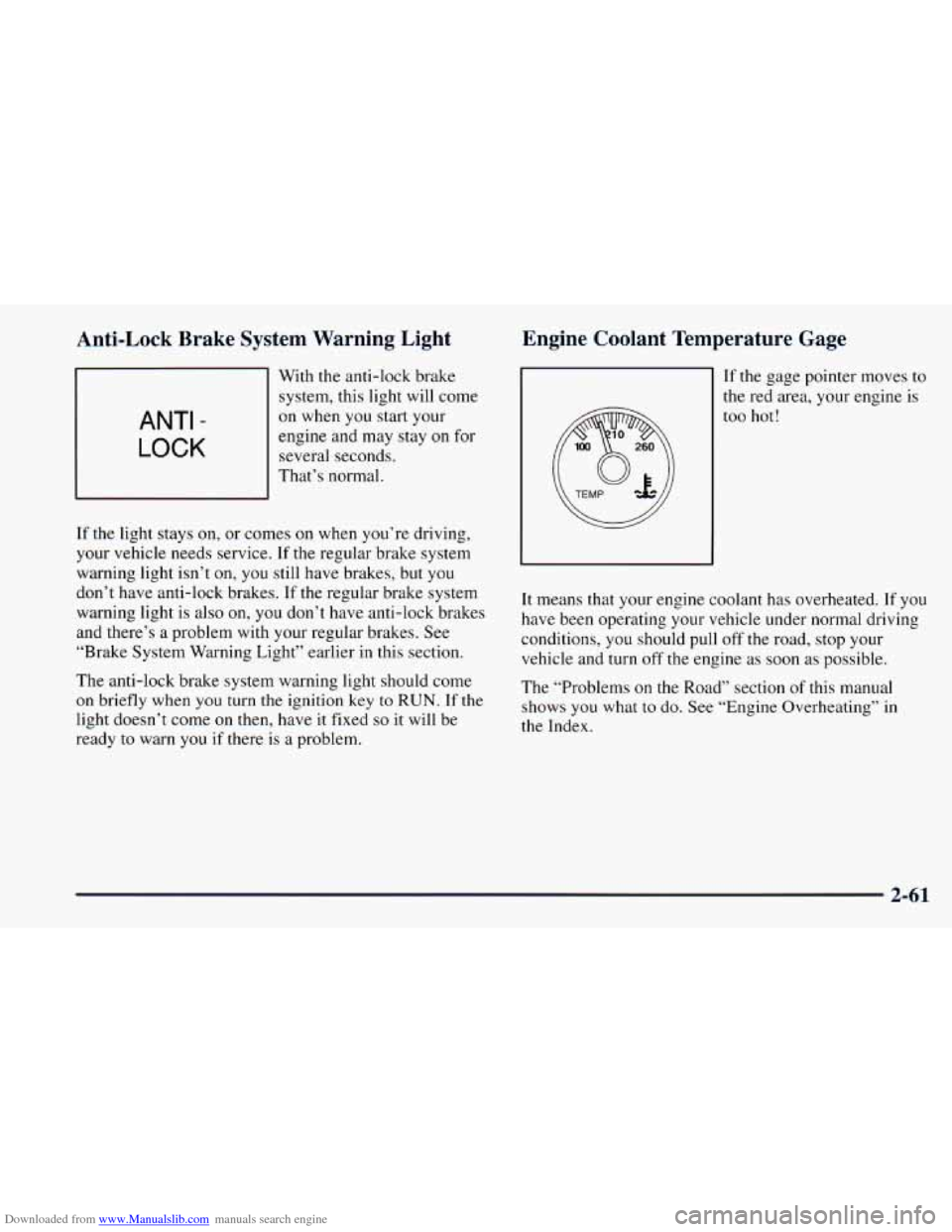
ANTI -
LOCK
With the anti-lock brake
system, this light will come
on when
you start your
engine and may stay
on for
several seconds.
That’s normal.
If the light stays on, or comes on when you’re driving,
your vehicle needs service.
If the regular brake system
warning light isn’t on,
you still have brakes, but you
don’t have anti-lock brakes.
If the regular brake system
warning light is also on, you don’t have anti-lock brakes
and there’s a problem with your regular brakes. See
“Brake System Warning Light’’ earlier in this section.
The anti-lock brake system warning light should come
on briefly when you turn the ignition key to RUN. If the
light doesn’t come on then, have
it fixed so it will be
ready to warn
you if there is a problem.
Engine Coolant Temperature Gage
If the gage pointer moves to
the red area, your engine
is
too hot!
It means that your engine coolant has overheated. If you
have been operating your vehicle under normal driving
conditions,
you should pull off the road, stop your
vehicle and turn off the engine as soon as possible.
The “Problems on the Road” section of this manual
shows
you what to do. See “Engine Overheating” in
the Index.
2-61