1998 CADILLAC ELDORADO change wheel
[x] Cancel search: change wheelPage 213 of 380
Downloaded from www.Manualslib.com manuals search engine Loss of Control
Let’s review what driving experts say about what
happens when the three control systems (brakes, steering
and acceleration) don’t have enough friction where the
tires meet the road to do what the driver has asked.
In any emergency, don’t give up. Keep trying to steer and
constantly seek
an escape route or area of less danger.
Skidding
In a skid, a driver can lose control of the vehicle.
Defensive drivers avoid most skids by taking reasonable
care suited to existing conditions, and by not “overdriving“
those conditions. But skids are always possible.
The three types
of skids correspond to your vehicle’s
three control systems. In the braking skid, your wheels
aren’t rolling. In the steering or cornering skid, too
much speed or steering in a curve causes tires to slip and
lose cornering force. And
in the acceleration skid, too
much throttle causes the driving wheels to spin.
A cornering skid is best handled by easing your foot off
the accelerator pedal.
Remember: Any traction control system helps avoid
only the acceleration skid.
If your traction control system is off, then an
acceleration skid is also best handled by easing your
foot
off the accelerator pedal. If
your vehicle starts
to slide, ease your foot off the
accelerator pedal and quickly steer the way you want the
vehicle to go.
If you start steering quickly enough, your
vehicle may straighten out. Always be ready
for a
second skid if it occurs.
If you have Stabilitrak,
you may see the STABILITY
ENGAGED message
on the Driver Information Center.
See “Stability Engaged Message” in the Index.
Of course, traction is reduced when water, snow, ice,
gravel
or other material is on the road. For safety, you’ll
want to slow down and adjust your driving to these
conditions.
It is important to slow down on slippery
surfaces because stopping distance will be longer and
vehicle control more limited.
While driving
on a surface with reduced traction, try
your best
to avoid sudden steering, acceleration or
braking (including engine braking by shifting to a lower
gear). Any sudden changes could cause the tires to
slide.
You may not realize the surface is slippery until
your vehicle is skidding. Learn to recognize warning
clues
-- such as enough water, ice or packed snow on
the road
to make a “mirrored surface” -- and slow
down when you have any doubt.
Remember: Any anti-lock brake system (ABS) helps
avoid only the braking skid.
4-15
Page 230 of 380

Downloaded from www.Manualslib.com manuals search engine Towing a Trailer
A CAUTION:
If you don’t use the correct equipment and drive
properly, you can lose control when you pull a
trailer. For example, if the trailer
is too heavy, the
brakes may not work well
-- or even at all. You
and your passengers could be seriously injured.
You may also damage your vehicle; the resulting
repairs would not
be covered by your warranty.
Pull
a trailer only if you have followed all the
steps in this section.
Ask your dealer for advice
and information about towing
a trailer with
your vehicle.
Your vehicle can tow a trailer
if it is equipped with the
proper trailer towing equipment.
To identify what the
vehicle trailering capacity is for your vehicle, you
should read the information in “Weight of
the Trailer’’
that appears later in this section. But trailering is
different than just driving your vehicle by itself.
Trailering means changes in handling, durability and fuel
economy. Successful, safe trailering takes correct
equipment, and it has to be used properly.
That’s the reason for
this part. In it are many
time-tested, important trailering tips and safety rules.
Many
of these are important for your safety and that of
your passengers. So please read this section carefully
before
you pull a trailer.
Load-pulling components such as
the engine, transaxle,
wheel assemblies and tires are forced to work harder
against the drag
of the added weight. The engine is
required
to operate at relatively higher speeds and under
greater loads, generating extra heat. What’s more, the
trailer adds considerably to wind resistance, increasing
the pulling requirements.
If You Do Decide To Pull A Trailer
If you do, here are some important points:
There are many different laws, including speed limit
restrictions, having
to do with trailering. Make sure
your rig will be legal, not
only where you live but
also where you’ll be driving.
A good source for this
information can be state
or provincial police.
Consider using a sway control. You can ask a hitch
dealer about sway controls.
4-32
Page 235 of 380
Downloaded from www.Manualslib.com manuals search engine Backing Up Turn Signals When Towing a Trailer
Hold the bottom of the steering wheel with one hand.
Then, to move the trailer
to the left, just move that hand
to
the left. To move the trailer to the right, move your
hand
to the right. Always back up slowly and, if
possible, have someone guide you.
Making Turns
I NOTICE:
Making very sharp turns while trailering could
cause the trailer to come in contact with the
vehicle. Your vehicle could be damaged. Avoid
making very sharp turns while trailering.
When you’re turning with a trailer, make wider turns
than normal.
Do this so your trailer won’t strike
soft shoulders, curbs, road signs, trees or other
objects. Avoid jerky or sudden maneuvers. Signal
well in advance. When you tow
a trailer,
your vehicle may need a
different
turn signal flasher and/or extra wiring. Check
with your Cadillac dealer. The green arrows
on your
instrument panel will flash whenever
you signal a turn
or lane change. Properly hooked up, the trailer lamps
will also flash, telling other drivers you’re about to turn,
change lanes or stop.
When towing a trailer, the green arrows on your
instrument panel will flash for turns even if the bulbs on
the trailer are burned
out. Thus, you may think drivers
behind you are seeing your signal when they are not. It’s
important to check occasionally
to be sure the trailer
bulbs are still working.
Driving On Grades
Reduce speed and shift to a lower gear before you start
down a long or steep downgrade. If
you don’t shift
down, you might have
to use your brakes so much that
they would get hot and no longer work well.
On a long uphill grade, shift down and reduce your
speed
to around 45 mph (70 kmh) or less to reduce the
possibility
of engine and transaxle overheating.
4-37
Page 248 of 380
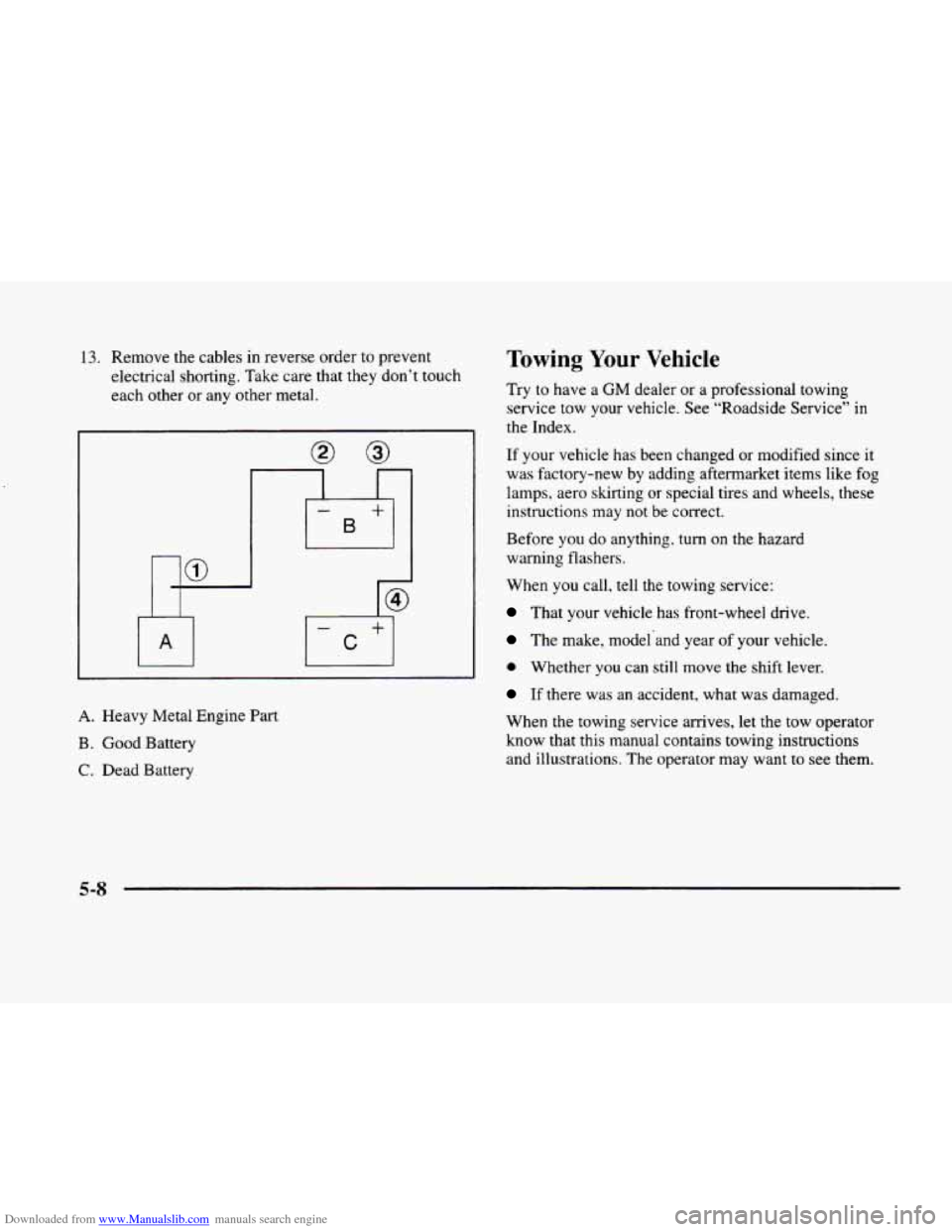
Downloaded from www.Manualslib.com manuals search engine 13. Remove the cables in reverse order to prevent
electrical shorting. Take care that they don’t touch
each other
or any other metal.
A. Heavy Metal Engine Part
B. Good Battery
C. Dead Battery
1
Towing Your Vehicle
Try to have a GM dealer or a professional towing
service tow your vehicle.
See “Roadside Service” in
the Index.
If your vehicle has been changed or modified since it
was factory-new by adding aftermarket items like fog
lamps, aero skirting
or special tires and wheels, these
instructions may not be correct.
Before
you do anything, turn on the hazard
warning flashers.
When you call, tell the towing service:
That your vehicle has front-wheel drive.
The make, model’and year of your vehicle.
0 Whether you can still move the shift lever.
If there was an accident, what was damaged.
When the towing service arrives, let the tow operator
know that this manual contains towing instructions
and illustrations.
The operator may want to see them.
Page 264 of 380
Downloaded from www.Manualslib.com manuals search engine If a Tire Goes Flat
It’s unusual for a tire to “blow out” while you’re driving.
especially
if you maintain your tires properly. If air goes
out
of a tire, it’s much more likely to leak out slowly.
But if you should ever have a “blowout,” here are
a few
tips about what
to expect and what to do:
If a front tire fails, the flat tire will create a drag that
pulls the vehicle toward that side. Take your foot off the
accelerator pedal and grip the steering wheel firmly.
Steer to maintain lane position, and then gently brake
to
a stop well out of the traffic lane.
A rear blowout, particularly on a curve. acts much like a
skid and may require the same correction you’d use in a
skid. In any rear blowout, remove your foot from the
accelerator pedal. Get the vehicle under control by
steering the way
you want the vehicle to go. It may be
very bumpy and noisy, but you can still steer. Gently
brake
to a stop -- well off the road if possible.
If
a tire goes flat, the next part shows how to use your
jacking equipment to change a flat tire safely.
Changing a Flat Tire
If a tire goes flat, avoid further tire and wheel damage
by driving slowly
to a level place. Turn on your hazard
warning flashers.
I A CAUTION:
Changing a tire can cause an injury. The vehicle
can slip
off the jack and roll over you or other
people.
You and they could be badly injured.
Find
a level place to change your tire. To help
prevent the vehicle from moving:
1. Put the shift lever in PARK (P).
2, Set the parking brake firmly.
3. lhrn off the engine.
To be even more certain the vehicle won’t move,
you can put blocks
at the front and rear of the
tire farthest away from the one being changed.
That would be the tire on the other side
of the
vehicle,
at the opposite end.
5-24
Page 270 of 380

Downloaded from www.Manualslib.com manuals search engine 4. Raise the vehicle by turning the jack handle to the
right. Raise
the vehicle far enough off the ground for
the spare tire to fit
under the vehicle.
5. Remove all wheel nuts and take off the flat tire.
6. Remove any rust or dirt
from the wheel bolts,
mounting surfaces and
spare wheel.
I A CAUTION:
Rust or dirt on the wheel, or on the parts to
which it is fastened, can make the wheel nuts
become loose after
a time. The wheel could come
off and cause
an accident. When you change a
wheel, remove any rust or dirt from the places
where the wheel attaches to the vehicle. In an
emergency, you can use a cloth
or a paper towel
to do this; but be sure
to use a scraper or wire
brush later,
if you need to, to get all the rust or
dirt off.
5-30
Page 321 of 380
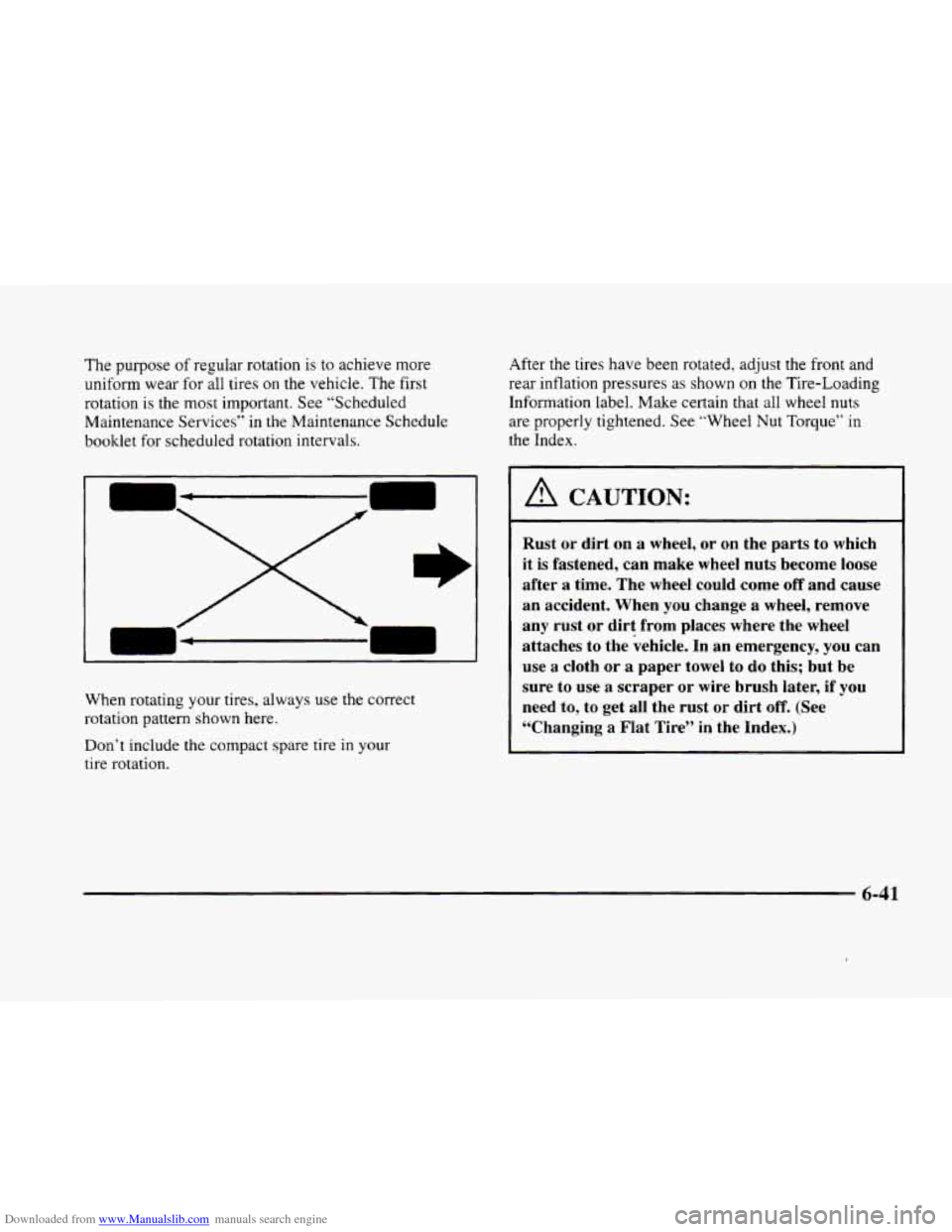
Downloaded from www.Manualslib.com manuals search engine The purpose of regular rotation is to achieve more
uniform wear for all tires
on the vehicle. The first
rotation is
the most important. See “Scheduled
Maintenance Services” in
the Maintenance Schedule
booklet for scheduled rotation intervals.
When rotating your tires, always
use the correct
rotation pattern shown here.
Don’t include the compact spare tire
in your
tire rotation. After the tires have been rotated,
adjust
the front and
rear inflation pressures as shown
on the Tire-Loading
Information label. Make certain that all wheel nuts
are properly tightened. See “Wheel Nut Torque” in
the Index.
I A CAUTION:
Rust or dirt on a wheel, or on the parts to which
it
is fastened, can make wheel nuts become loose
after a time. The wheel could come
off and cause
an accident. When you change
a wheel, remove
any rust or dirt from places where the wheel
attaches to the vehicle.
In an emergency, you can
use a cloth or a paper towel
to do this; but be
sure to use a scraper or wire brush later, if you
need to, to get all the rust or dirt
off. (See
“Changing a Flat Tire” in the Index.)
6-41
Page 344 of 380

Downloaded from www.Manualslib.com manuals search engine Replacement Bulbs
Application Number
Headlamps Composite Inner High Beam
....................... 9005
Outer Low Beam ....................... 9006
Front Turn Signal ..................... 2357 NA
Center High-Mounted Stoplamp (CHMSL) ... 1156
Rear Turn Signal and Taillamp ............. 2057
Capacities and Specifications
Displacement ......... 279 cubic inches (4 565 cc)
Engine Specifications
Type .......................... 4.6L DOHC V8
Eldorado ............................... Y
ETC .................................. 9
VIN Engine Code
Horsepower Eldorado
.............. 275 (bhp) @ 5600 rpm
ETC ................. 300 (bhp) @ 6000 rpm
205 (kWj @ 5600 rprn
224 (kWj @ 6000 rpm Torque
Eldorado
............. 300 (lb-ft) @ 4000 rpm
ETC ................ 295 (lb-ft) @ 4400 rpm
Firing Order
................... 1-2-7-3-4-5-6-8
407
(N-m)
@ 4000 rpm
400 (N-m) @ 4400 rpm
Thermostat Starts
To Open . . 177-184°F (81-85°C)
Capacities
Crankcase (Engine Oil
Transaxle (4T80-E) .......... 15 quarts (14.2 Lj
with Filter Change) ........... 7.5 quarts (7.1 L)
Engine Cooling System
........ 12.5 quarts ( 1 1.8 L)
R- 134a Refrigerant .............. 2 lbs. (0.91 kg)
Wheel Base
............... 108 inches (274.3 cm)
Length
................. 200.2 inches (508.6 cm)
Height
................... 53.6 inches ( 136.2 cm)
Fuel Tank
....... : ........... 20 gallons
(75.7 L)
Vehicle Dimensions
Width ................... 75.5 inches (191.8 cmj
Front Tread
............... 60.9 inches (154.7 cm)
6-64