Page 261 of 346
Downloaded from www.Manualslib.com manuals search engine Checking Engine Oil
Pull out the dipstick and clean it with a paper towel or
cloth, then push it back in all the way. Remove it again,
keeping the tip down, and check the level.
When to Add Engine Oil
If the oil is at or below the MIN mark, then you’ll need
to add at least one quart
of oil. But you must use the
right kind. This part explains what kind
of oil to use. For
crankcase capacity, see “Capacities and Specifications”
in the Index.
NOTICE:
Don’t add too much oil. If your engine has so
much oil that the oil level gets above the upper
mark that shows the proper operating range,
your engine could be damaged.
The oil fill cap is located
behind the engine oil
dipstick and next to the
engine block on the driver’s
side
of the engine. Turn the
cap to the left to remove
it.
6-12
Page 267 of 346
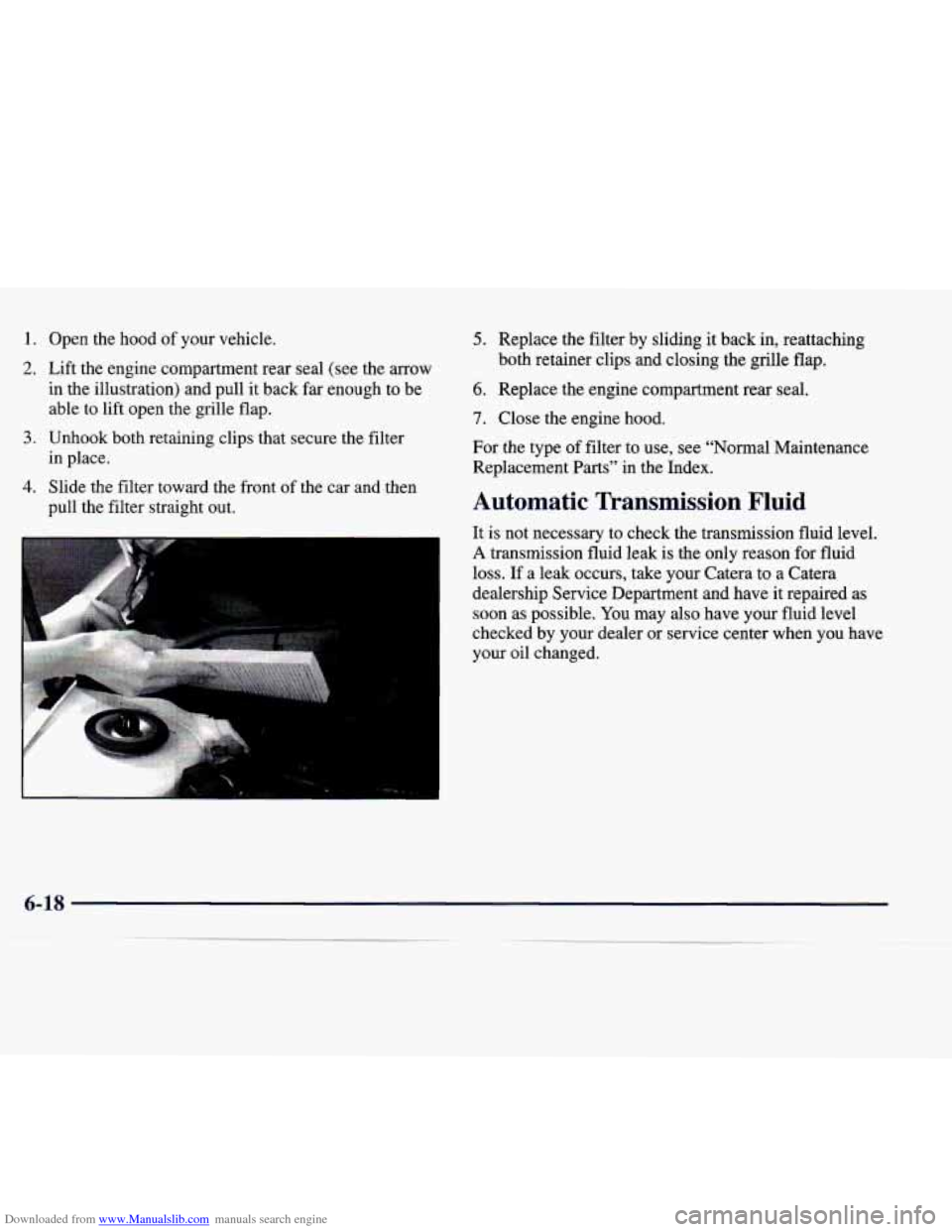
Downloaded from www.Manualslib.com manuals search engine 1. Open the hood of your vehicle.
2. Lift the engine compartment rear seal (see the arrow
in the illustration) and pull it back far enough to be
able to lift open the grille flap.
in place.
pull the filter straight out.
3. Unhook both retaining clips that secure the filter
4. Slide the filter toward the front of the car and then
5. Replace the filter by sliding it back in, reattaching
6. Replace the engine compartment rear seal.
7. Close the engine hood.
both retainer clips and closing the grille flap.
For the type of filter to use, see “Normal Maintenance
Replacement Parts” in the Index.
Automatic Transmissio~ Fluid
It is not necessary to check the transmission fluid level.
A transmission fluid leak is the only reason for fluid
loss. If a leak occurs, take your Catera to
a Catera
dealership Service Department and have it repaired as
soon as possible. You may
also have your fluid level
checked by your dealer
or service center when you have
your oil changed.
Page 268 of 346

Downloaded from www.Manualslib.com manuals search engine Change both the fluid and filter every 50,000 miles
(83 000 km) if the vehicle is mainly driven under one or
more
of these conditions:
In heavy city traffic where the outside temperature
In hilly or mountainous terrain.
When doing frequent trailer towing.
Uses such as found in taxi, police or delivery service.
If you do not use your vehicle under any of these
conditions, the fluid and filter do not require changing.
regularly
reaches
90” F (32” C) or higher.
NOTICE:
We recommend you use only fluid labeled
DEXRON@-m, because fluid with that label
is
made especially for your automatic transmission.
Damage
caused by fluid other than DEXRON@-III
is not covered by your new vehicle warranty.
Rear Axle
When to Check Lubricant
Refer to the Maintenance Schedule to determine how
often to check the lubricant. See “Periodic Maintenance
Inspections” and “Scheduled Maintenance Services” in
the Maintenance Schedule booklet.
How to Check Lubricant
If the level is below the bottom of the filler plug hole,
you’ll need to add some lubricant. Add enough lubricant
to raise the level to the bottom of the filler plug hole.
Page 270 of 346

Downloaded from www.Manualslib.com manuals search engine What to Use
Use a mixture of one-half clean water (preferably
distilled) and one-half
DEX-COOL@ coolant which
won’t damage aluminum parts.
If you use this mixture,
you don’t need to add anything else.
Adding only plain water to your cooling system
can be dangerous. Plain water, or some other
liquid like alcohol, can boil before the proper
coolant mixture will. Your vehicle’s coolant
warning system
is set for the proper coolant
mixture. With plain water or the wrong mixture,
your engine could get too hot but you wouldn’t
get the overheat warning. Your engine could
catch fire and you or others could be burned.
Use
a 50/50 mixture of clean water and
DEX-COOL@ coolant.
NOTICE:
If you use an improper coolant mixture, your
engine could overheat and be badly damaged.
The repair cost wouldn’t be covered by your
warranty. Too much water
in the mixture can
freeze and crack the engine, radiator, heater core
and other parts.
If you have to add coolant more than four times a year,
have your dealer check your cooling system.
NOTICE:
If you use the proper coolant, you don’t have to
add extra inhibitors or additives which claim to
improve the system. These can be harmful.
6-21
Page 271 of 346
Downloaded from www.Manualslib.com manuals search engine Checking Coolant
The surge tank is located behind the air cleaner on the
passenger’s side
of the engine.
The cooling system when hot is under a lot
of pressure.
If the low coolant warning light on the instrument panel
appears, you will need to add coolant.
= I
Turning the surge tank pressure cap when the
engine and radiator are hot can allow steam and
scalding liquids to blow out and burn you badly.
Never turn the surge tank pressure cap
-- even a
little
-- when the engine and radiator are hot.
When your engine is cold, the coolant level should be at
the KALTKOLD line (seam).
1
If the light comes on, it
means you’re low on
engine coolant.
]I I I
For more information, see “Low Coolant Light” in
the Index.
6-22
.- - ------
Page 273 of 346

Downloaded from www.Manualslib.com manuals search engine Power Steering Fluid
The power steering fluid reservoir is located between
the battery and the brake master cylinder on the driver’s
side of the engine.
How To Check Power Steering Fluid
When the engine compartment is cool, wipe the cap and
the top
of the reservoir clean, then unscrew the cap and
wipe the dipstick with
a clean rag. Replace the cap and
completely tighten it. Then remove the cap again and
look at the fluid level on the dipstick.
The level should be at the full mark. There are two lines
on the dipstick. The top line is the “full” mark and th\
e
bottom line is the “add” mark (which means that fluid
should be added). If necessary, add only enough fluid to
bring the level up to the full mark.
What to Use
To determine what kind of fluid to use, see
“Recommended Fluids and Lubricants” in the
Maintenance Schedule booklet. Always use the proper
fluid. Failure to use the proper fluid can cause leaks and
damage hoses and seals.
When to Check Power Steering Fluid
It is not necessary to regularly check power steering
fluid unless you suspect there is a leak in the system or
you hear an unusual noise. A fluid loss in this system
could indicate a problem. Have the system inspected
and repaired.
6-24
Page 282 of 346

Downloaded from www.Manualslib.com manuals search engine Headlamp Aiming
Your vehicle has the composite headlamp system. These
headlamps have horizontal and vertical aim indicators.
The aim has been pre-set at the factory and should need
no further adjustment.
If your vehicle is damaged in an accident and the
headlamp aim seems to be affected, see your dealer.
Headlamps on damaged vehicles may require
recalibration of the horizontal aim by your dealer.
0
0
0
To check the aim, the vehicle should be properly
prepared as follows:
Place the vehicle on a level pad or surface.
The vehicle should not have any snow, ice or mud
attached to it.
The vehicle should be fully assembled and all other
work stopped while headlamp aiming is being done.
There should not be any cargo or loading of the
vehicle, except it should have a full tank of fuel and
one person or
160 lbs. (75 kg) on the driver's seat.
Tires should be properly inflated.
Rock the vehicle to stabilize the suspension.
0
0
0
I NOTICE:
To make sure your headlamps are aimed
properly, read all the instructions before
beginning. Failure to follow these instructions could cause damage to headlamp parts.
For the vertical adjustment, state inspection stations
generally will allow a reading of plus
0.76 degrees or
minus
0.76 degrees from the center of the bubble.
1 6-33
Page 283 of 346
Downloaded from www.Manualslib.com manuals search engine It is recommended that the upper limit not exceed plus
0.4 degrees from the center of the bubble. Other drivers
may flash their high beams at you
if your adjustment is
much above plus
0.4 degrees.
If you find that the headlamp aiming needs adjustment,
follow these steps:
1. With a screwdriver, unscrew the fastener on the
headlamp cover and then remove the cover to be able
to see the back of the headlamp assembly.
2. Check the vertical aim for each headlamp and adjust
it as necessary. The vertical aim adjustment screw is
located on the outboard side
of the headlamp
assembly. You can see the level through the
headlamp assembly.
Turn the vertical aiming screw
until the bubble in the level
is centered at 0 (zero).
3. If the horizontal aim needs adjusting, see
your dealer.
Adjustment screws can be turned with an
E8 Tom@
socket
or a T15 Torx screwdriver.
6-34


