Page 139 of 179

13 8
Conduct the following work immedi-
ately prior to storing the vehicle:
1 Activate the parking brake and foot-
brake to dry them; this will prevent
the brake disks and drums from cor-
roding.
2 Store the vehicle in a dry, well-venti-
lated room, shift into reverse gear or
set the selector lever to position P
and chock the wheels to prevent roll-
ing. Do not set the parking brake.
3 Remove the battery, recharge and
store in a cool, frost-free room.
During storage, recharge the battery
every three months, as otherwise it will
become unusable. Every time the bat-
tery is discharged, especially over
extended periods, its service life is
reduced.
Removing vehicle from storageRecharge the battery and replace if
necessary.
Then have Inspection I carried out by
your BMW Retailer.a
Storage periods during which the
battery is disconnected are not taken
into consideration by the Service Inter-
val Display for changing the brake fluid.
Therefore, make sure that the brake fluid
is changed every two years at the latest,
regardless of the display. Additional
notes: refer to page 128.c
Vehicle storage
Page 147 of 179
14 6
a
Change tires only on a flat, hard
surface affording good traction. Avoid
jacking the car on a soft or slippery sup-
port surface (snow, ice, loose gravel,
etc.), as it could slide sideways.
Take extra care to ensure that the base
of the jack is positioned on a solid sup-
port surface.
Never use wooden blocks or similar
objects to support the base of the jack,
as the weight of the car could exceed
their support capacity.
Never lie beneath the vehicle or start
the engine while the car is supported by
the jack - risk of fatal injury.
Additional precautions to observe when
changing flat tires:
When pulling over on the roadside to
change a tire, always try to park the car
as far as possible from passing traffic.
Switch on the hazard flashers.
All passengers should be outside the
car and well away from your immediate
working area (e.g., behind the guard-
rail).Turn the steering wheel to the straight-
ahead position, remove the key and
engage the steering lock. Shift into 1st
or reverse (selector lever in Park with
automatic) and engage the parking
brake.
If a warning triangle or portable hazard
warning lamp is available, set it up on
the roadside at an appropriate distance
from the rear of the vehicle. Observe all
safety guidelines and regulations.c
b
To avoid rattling noises, note the
positions of the tools and return them to
their original positions.c
To change the tire you will need
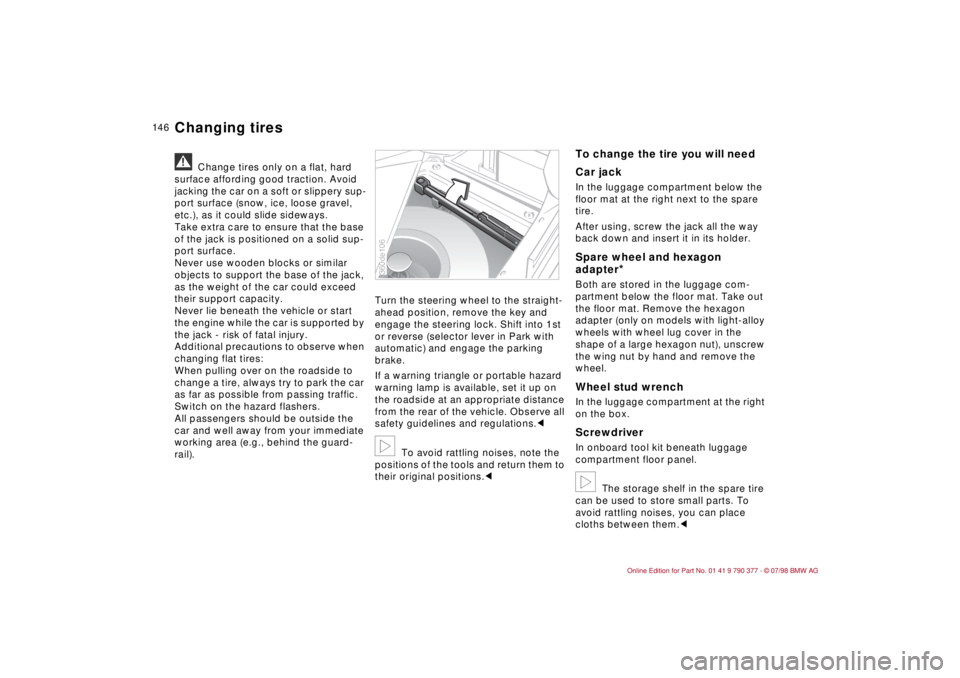
Car jackIn the luggage compartment below the
floor mat at the right next to the spare
tire.
After using, screw the jack all the way
back down and insert it in its holder.Spare wheel and hexagon
adapter
*
Both are stored in the luggage com-
partment below the floor mat. Take out
the floor mat. Remove the hexagon
adapter (only on models with light-alloy
wheels with wheel lug cover in the
shape of a large hexagon nut), unscrew
the wing nut by hand and remove the
wheel.Wheel stud wrench In the luggage compartment at the right
on the box. ScrewdriverIn onboard tool kit beneath luggage
compartment floor panel.b
The storage shelf in the spare tire
can be used to store small parts. To
avoid rattling noises, you can place
cloths between them.c
360de106
Changing tires
Page 148 of 179

14 7
At a glanceControlsCar careRepairsTechnicalDataIndex
Procedure1 Wheel bolt cover
* removal.
Steel disk wheel: remove wheel cover
by hand. Light-alloy wheel with lug
cap in the shape of a large hexagon
nut: position the hexagon adapter on
the lug bolt cover, apply the lug
wrench and turn it to the left.2 Loosen lug bolts 1/2 turn.
3 Remove the respective cover cap
from the jacking point. Depending on
the vehicle version, remove the pro-
tective cap either by inserting the
screwdriver into the slot and turning
to the left (arrow in left illustration) or
by pressing in the cap on the bottom
(arrow in illustration above).4 Insert the jack all the way into the
support while ensuring that the base
of the jack is securely positioned on
the road surface. Always chock the
wheels to prevent the vehicle from
rolling.
5 Turn the handle to raise the jack until
the wheel is free of the ground.
a
The vehicle jack is designed for
changing tires only. Never use it to raise
another vehicle model or a load of an-
other kind, since that could result in ac-
cidents and personal injury.
Never lie beneath the vehicle when it is
supported by the jack Ð risk of fatal inju-
ry!c
6 Unscrew the lug bolts and remove the
wheel.
360de108
365de061
360de109
Changing tires
Page 149 of 179
14 8
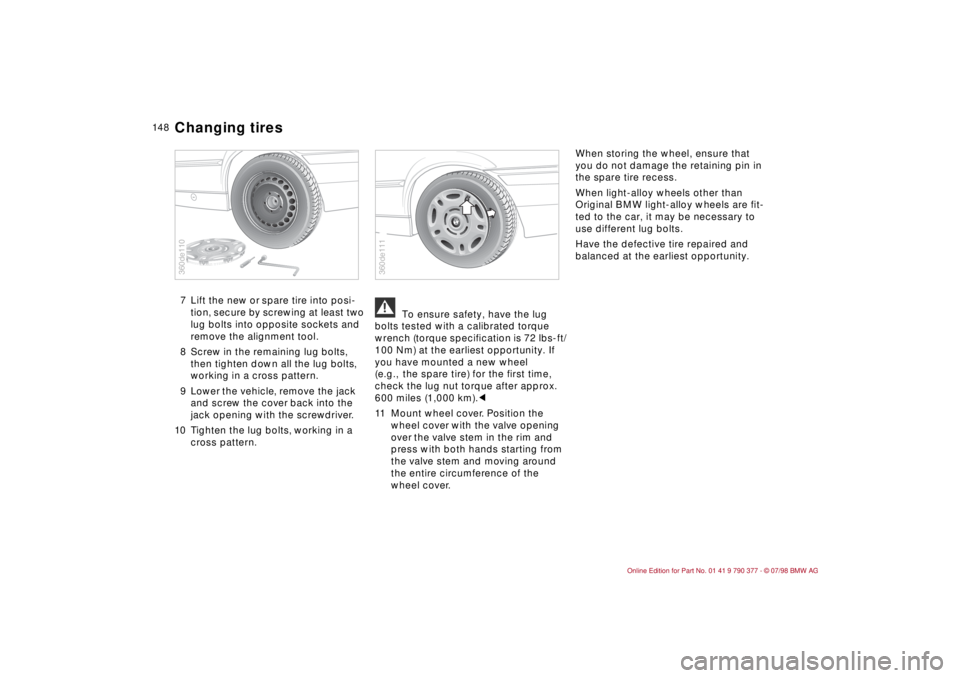
7 Lift the new or spare tire into posi-
tion, secure by screwing at least two
lug bolts into opposite sockets and
remove the alignment tool.
8 Screw in the remaining lug bolts,
then tighten down all the lug bolts,
working in a cross pattern.
9 Lower the vehicle, remove the jack
and screw the cover back into the
jack opening with the screwdriver.
10 Tighten the lug bolts, working in a
cross pattern.
a
To ensure safety, have the lug
bolts tested with a calibrated torque
wrench (torque specification is 72 lbs-ft/
100 Nm) at the earliest opportunity. If
you have mounted a new wheel
(e.g., the spare tire) for the first time,
check the lug nut torque after approx.
600 miles (1,000 km).c
11 Mount wheel cover. Position the
wheel cover with the valve opening
over the valve stem in the rim and
press with both hands starting from
the valve stem and moving around
the entire circumference of the
wheel cover.When storing the wheel, ensure that
you do not damage the retaining pin in
the spare tire recess.
When light-alloy wheels other than
Original BMW light-alloy wheels are fit-
ted to the car, it may be necessary to
use different lug bolts.
Have the defective tire repaired and
balanced at the earliest opportunity.
360de110
BMW
360de111
Changing tires
Page 155 of 179
15 4
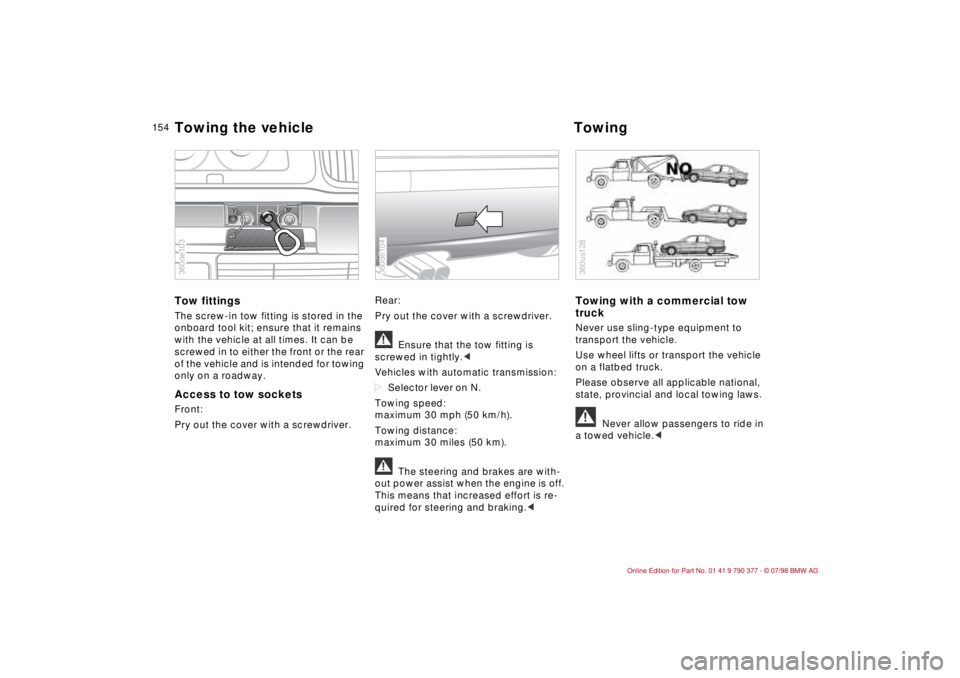
Tow fittingsThe screw-in tow fitting is stored in the
onboard tool kit; ensure that it remains
with the vehicle at all times. It can be
screwed in to either the front or the rear
of the vehicle and is intended for towing
only on a roadway. Access to tow socketsFront:
Pry out the cover with a screwdriver.Rear:
Pry out the cover with a screwdriver.
a
Ensure that the tow fitting is
screwed in tightly.c
Vehicles with automatic transmission:
dSelector lever on N.
Towing speed:
maximum 30 mph (50 km/h).
Towing distance:
maximum 30 miles (50 km).
a
The steering and brakes are with-
out power assist when the engine is off.
This means that increased effort is re-
quired for steering and braking.c
Towing with a commercial tow
truckNever use sling-type equipment to
transport the vehicle.
Use wheel lifts or transport the vehicle
on a flatbed truck.
Please observe all applicable national,
state, provincial and local towing laws.a
Never allow passengers to ride in
a towed vehicle.c
360de103
360de104
360us128
Towing the vehicle Towing
Page 157 of 179

15 6
Deceleration sensors continuously
monitor the physical forces acting upon
the vehicle. If a frontal impact results in
deceleration, for which the protection
afforded by safety belts no longer suf-
fices, the gas generators of the driver's
and the passenger's airbags ignite
simultaneously. The passenger's air-
bag is activated only when a special
sensor indicates that the front passen-
ger's seat is occupied.
In the event of a severe side impact the
side airbag
* is activated on the side on
which the impact occurred.
The airbags, which are under the cover
of the steering wheel, in the instrument
panel or the side trim panels of the front
doors, are deployed and inflated by the
gas within a few milliseconds. In the
process they tear or push apart the pro-grammed separation points in their
upholstered covers.
Because the inflation process must be
virtually instantaneous, it is necessarily
accompanied by a certain amount of
ignition and inflation noise. The gas
which the system employs to inflate the
airbag is not dangerous, and the asso-
ciated smoke is quickly dissipated.
The entire process is completed within
one twentieth of a second.Automatic Stability Control plus Trac-
tion helps maintain stable and con-
trolled vehicle response by inhibiting
slip at the drive wheels.
The system employs special sensors to
monitor wheelspeed and relay the data
to the system's electronic control unit,
which uses this information to calculate
slip rates at the individual wheels.
Depending on the driving situation, two
forms of remedial action can then be
taken by the system: it reacts to slip-
page caused by large amounts of
excess torque by instructing the engine
management system to reduce power
output. As a supplementary measure,
the system will also respond to an
especially pronounced tendency to-
ward traction loss at either of the drive
wheels with automatic individual appli-
cation of the affected wheel's brakes.
This achieves a locking action compa-
rable with a controlled limited-slip dif-
ferential. This brake action is active up
to 25 mph (40 km/h). From 25 mph
(40 km/h) upward, a diminished brake
action improves the traction up to
60 mph (100 km/h).
390de012Airbags ASC+T*
Page 162 of 179
At a glanceControls Car careRepairsTechnicalDataIndex
16 1
BMW 318i
SedanBMW 318is
CoupeBMW 318i
Convertible
Length in. (mm) 174.5 (4,433) 174.5 (4,433) 174.5 (4,433)
Width in. (mm) 66.9 (1,698) 67.3 (1,710) 67.3 (1,710)
Height (unloaded) in. (mm) 54.8 (1,393) 53.8 (1,366) 53.1 (1,348)
Wheelbase in. (mm) 106.3 (2,700) 106.3 (2,700) 106.3 (2,700)
Track, front in. (mm) 55.8 (1,418) 55.4 (1,408) 55.4 (1,408)
Track, rear in. (mm) 56.3 (1,431) 55.9 (1,421) 55.9 (1,421)
Minimum turning circle
D
ft. (m) 35.4 (10.8) 35.4 (10.8) 35.4 (10.8)
BMW 323is
CoupeBMW 323i
Convertible
Length in. (mm) 174.5 (4,433) 174.5 (4,433)
Width in. (mm) 67.3 (1,710) 67.3 (1,710)
Height (unloaded) in. (mm) 53.8 (1,366) 53.1 (1,348)
Wheelbase in. (mm) 106.3 (2,700) 106.3 (2,700)
Track, front in. (mm) 55.4 (1,408) 55.4 (1,408)
Track, rear in. (mm) 55.9 (1,421) 55.9 (1,421)
Minimum turning circle
D
ft. (m) 35.4 (10.8) 35.4 (10.8)
Dimensions
Page 163 of 179
16 2
BMW 328i
SedanBMW 328is
CoupeBMW 328i
Convertible
Length in. (mm) 174.5 (4,433) 174.5 (4,433) 174.5 (4,433)
Width in. (mm) 66.9 (1,698) 67.3 (1,710) 67.3 (1,710)
Height (unloaded) in. (mm) 54.8 (1,393) 53.8 (1,366) 53.1 (1,348)
Wheelbase in. (mm) 106.3 (2,700) 106.3 (2,700) 106.3 (2,700)
Track, front in. (mm) 55.4 (1,408) 55.4 (1,408) 55.4 (1,408)
Track, rear in. (mm) 55.9 (1,421) 55.9 (1,421) 55.9 (1,421)
Minimum turning circle
D
ft. (m) 35.4 (10.8) 35.4 (10.8) 35.4 (10.8)
Dimensions

