1998 BMW CONVERTIBLE wheel
[x] Cancel search: wheelPage 107 of 179

10 6
BrakesWinter road conditions substantially
reduce the amount of traction available
between the tires and the road surface;
the resulting - considerable - increases
in braking distance should be continu-
ally borne in mind.
ABS is intended to prevent the wheels
from locking under braking; to help the
vehicle to remain stable and sensitive to
steering. Should the ABS fail, with lock-
ing wheels as a result: Reduce the
pressure on the brake pedal until the
wheels just start to roll again while still
maintaining enough force to continue
braking. Then increase the pressure,
release the pressure when the wheels
lock, reapply pressure, etc.
This staggered braking procedure will
reduce stopping distances while help-
ing you maintain steering control.
It can allow you to steer around hazards
once you have reduced the pressure on
the brake pedal.
a
Never downshift to exploit engine
braking when driving on slippery road
surfaces; it could lead to loss of rear-
wheel traction and endanger vehicle
control. ABS and ASC+T can not protect
against such loss of traction, since they
have no effect on this kind of decelera-
tion.c
b
Disengage the clutch during hard
braking on road surfaces affording only
poor or uneven traction.c
Loss of lateral traction (sliding)Release the accelerator pedal and
depress the clutch pedal or push the
selector lever to position N with auto-
matic transmission. Countersteer care-
fully and attempt to regain control of the
vehicle.
ParkingSelect 1st or reverse gear. If your car is
equipped with an automatic transmis-
sion, select Park. Engage the parking
brake when parking on hills and
inclined surfaces. To prevent frost and
corrosion from locking the parking
brake liners at the drum, you can dry
them by gently pulling up the lever
while stopping (ensure that you do not
endanger following traffic).a
The brake lamps do not light up
when the parking brake is applied.c
Winter driving
Page 113 of 179

11 2
To maintain good handling and vehicle
response, use only tires of a single
tread configuration from a single manu-
facturer.
a
Do not use retreaded tires, as oth-
erwise driving safety may be impaired.
This is due to the possible variations in
casing structures and, in some cases, to
their extreme age, which can lead to a
decrease in their durability.cTread wear patterns differ at the front
and rear wheels according to the indi-
vidual operating conditions. In the inter-
est of safety and optimal vehicle
response, we advise against rotating
tires from front to rear and vice versa.
When considering the potential eco-
nomic benefits of interaxle tire rotation,
you must decide whether the expense
of having the tires rotated is likely to be
amortized during the anticipated exten-
sion in tire life. We recommend that you
discuss the matter with your BMW
Retailer.
Should you decide in favor of rotating
the tires, it is essential to observe the
following:
Leave the tires on the same side of the
vehicle (include spare in rotation pat-
tern as desired).
Braking response and traction may be
adversely affected.
Rotation should always be carried out
at short intervals, max. 3000 miles
(approx. 5000 km).
Following rotation always correct the
tire inflation pressure.Always replace tires after 10 years,
regardless of use or tread wear.
Spare tires over 6 years old should be
used only in case of emergency. Such a
tire should be replaced by a new tire
immediately, and should not be fitted
together with new tires.
The date on which the tire was manu-
factured is indicated by the code on
the sidewall: DOT ... 327 indicates that
the tire was manufactured in Week 32
of 1997.
Tire replacement Interaxle tire changes
Page 114 of 179
11 3
At a glanceControlsCar careRepairsTechnicalDataIndex
Tires and wheelsUse only BMW-approved tires.
Due to the high speeds which this vehi-
cle can reach, the use of specific
brands, specifications and dimensions
is mandatory. Consult any BMW
Retailer for details.
Observe national, provincial and state
regulations.
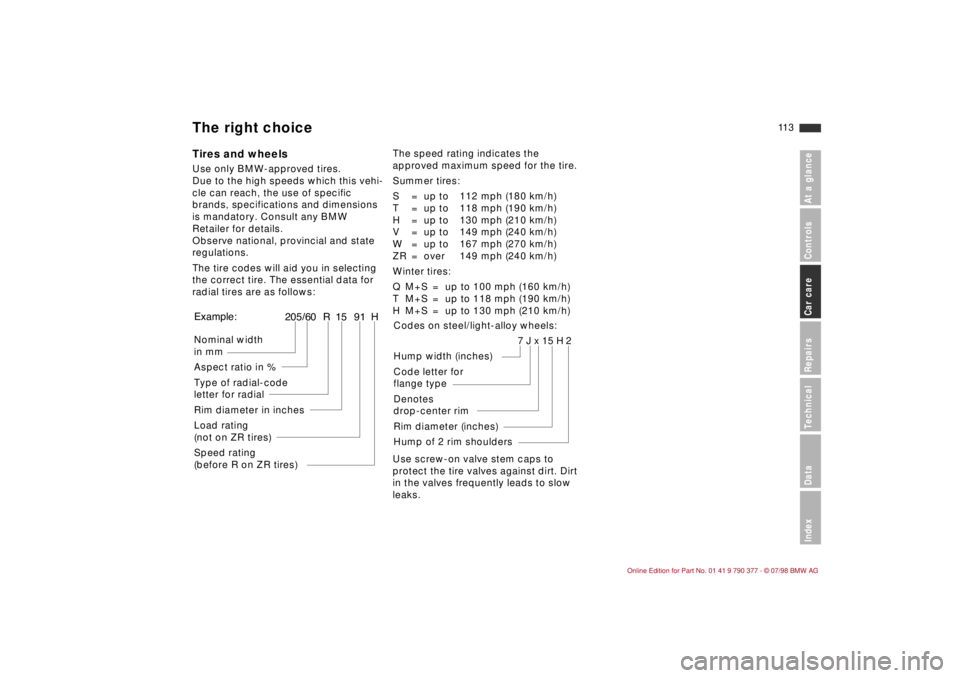
The tire codes will aid you in selecting
the correct tire. The essential data for
radial tires are as follows:The speed rating indicates the
approved maximum speed for the tire.
Summer tires:
S = up to 112 mph (180 km/h)
T = up to 118 mph (190 km/h)
H = up to 130 mph (210 km/h)
V = up to 149 mph (240 km/h)
W = up to 167 mph (270 km/h)
ZR = over 149 mph (240 km/h)
Winter tires:
Q M+S = up to 100 mph (160 km/h)
T M+S = up to 118 mph (190 km/h)
H M+S = up to 130 mph (210 km/h)
Use screw-on valve stem caps to
protect the tire valves against dirt. Dirt
in the valves frequently leads to slow
leaks.Example:Nominal width
in mm
Aspect ratio in %
Type of radial-code
letter for radial
Rim diameter in inches
Load rating
(not on ZR tires)
Speed rating
(before R on ZR tires)
205/60 R 15 91 H
Codes on steel/light-alloy wheels:
7 J x 15 H 2
Hump width (inches)
Code letter for
flange type
Denotes
drop-center rim
Rim diameter (inches)
Hump of 2 rim shoulders
The right choice
Page 115 of 179

11 4
We recommend winter tires (M+S radial
tires) for operation under inclement win-
ter driving conditions. Although all-sea-
son M+S tires provide better winter
traction than standard summer tires
with H, V, W and ZR speed ratings, they
generally fail to provide the same levels
of performance as standard snow tires
in winter driving.
If you fit winter tires, install radial tires
of the same tread configuration and
from a single manufacturer on all four
wheels (better still: on all five wheels).
This ensures safe tracking and steering
response.
Fit BMW-approved winter tires only.
Any BMW Retailer will be glad to pro-
vide you with information on the best
winter tires for your particular driving
conditions.Winter tires display a perceptible loss in
their ability to cope with winter driving
conditions once the tread wears to
below 0.16 in (4 mm), and should thus
be replaced.
Observe the specified tire inflation
pressures - and be sure to have the
wheel and tire assemblies balanced
every time you change the tires!
a
Never exceed the maximum speed
for which the tires are rated.
Unprofessional attempts by laymen to
service tires can lead to damage and ac-
cidents.
Have this work performed by skilled pro-
fessionals only. Your BMW Retailer will
be glad to assist you.c
Store tires in a cool, dry place, away
from light whenever possible. Protect
the tires from contact with oil, grease
and fuel.
Winter tires
Page 116 of 179

11 5
At a glanceControlsCar careRepairsTechnicalDataIndex
b
Size 185/65 R 15 88 T tires are
only for the BMW 318i Sedan.c
b
Sizes 225/55 R 15 92 V,
225/55 R 92 Q, T, H M+S, 225/50 ZR 16.
These tires are not suitable for use with
snow chains.c
ModiÞcations to the vehicle are required
before retrofitting tires in the above
dimensions.
Please consult your BMW Retailer.The use of fine-link BMW snow chains
*
on summer or winter tires is only per-
mitted in pairs on the rear wheels.
Always observe the tire manufacturerÕs
safety recommendations when fitting. Tire speciÞcations Steel rim
(wheel rim)Light-alloy wheel Rim offset
(mm)
BMW 318is Coupe, 318i Convertible, 318i Sedan
185/65 R 15 88 T 6 J x 15 H2 Ð 42
185/65 R 15 88 Q, T M+S
6 J x
15 H2
Ð42
205/60 R 15 91 H
6g Jx15 H2
7 J x 15 H2 47
205/60 R 15 91 Q, H M+S
6g Jx15 H2
7 J x 15 H2 47
225/55 R 15 92 V
6g Jx15
H2 7 J x 15 H2 47
225/50 R 16 92 Q M+S Ð 7 J x 16 H2 45/46
225/50 ZR 16 Ð 7 J x 16 H2 45/46
Approved wheels and tires
Page 117 of 179

11 6
b
Sizes 225/55 R 15 92 V,
225/55 R 92 Q, T, H M+S, 225/50 ZR 16.
These tires are not suitable for use with
snow chains.c
ModiÞcations to the vehicle are required
before retrofitting tires in the above
dimensions.
Please consult your BMW Retailer.The use of fine-link BMW snow chains
*
on summer or winter tires is only per-
mitted in pairs on the rear wheels.
Always observe the tire manufacturerÕs
safety recommendations when fitting. Tire speciÞcations Steel rim
(wheel rim)Light-alloy wheel Rim offset
(mm)
BMW 323is Coupe, 323i Convertible
185/65 R 15 88 Q M+S
6 J x
15 H2
Ð42
205/60 R 15 91 H
6g Jx15 H2
7 J x 15 H2 47
205/60 R 15 91 Q, H M+S
6g Jx15 H2
7 J x 15 H2 47
225/55 R 15 92 V
6g Jx15
H2 7 J x 15 H2 47
225/50 R 16 92 Q M+S Ð 7 J x 16 H2 45/46
225/50 ZR 16 Ð 7 J x 16 H2 45/46
Approved wheels and tires
Page 118 of 179

11 7
At a glanceControlsCar careRepairsTechnicalDataIndex
b
Size 225/50 ZR 16 tires are not
suitable for use with snow chains.c
ModiÞcations to the vehicle are required
if retrofitting these tires.
Please consult your BMW Retailer.The use of fine-link BMW snow chains
*
on summer or winter tires is only per-
mitted in pairs on the rear wheels.
Always observe the tire manufacturerÕs
safety recommendations when fitting. Tire speciÞcations Steel rim
(wheel rim)Light-alloy wheel Rim offset
(mm)
BMW 328is Coupe, 328i Convertible, 328i Sedan
205/60 R 15 91 H Ð 7 J x 15 H2 47
205/60 R 15 91 Q, H M+S
6g Jx15 H2
7 J x 15 H2 47
225/50 R 16 92 Q M+S Ð 7 J x 16 H2 45/46
225/50 ZR 16 Ð 7 J x 16 H2 45/46
Approved wheels and tires
Page 134 of 179

13 3
At a glanceControlsCar careRepairsTechnicalDataIndex
Waxing your carProtect the finish using carnauba or
synthetic-based waxes only.
The best way to determine when the
finish needs to be waxed is by noting
when water stops beading on the sur-
face.
You can use a glass cleaner to remove
any wax or silicone that may have been
left on the windows during waxing.b
A full range of car-care products is
available from your BMW Retailer.c
Paint damageYou can touch up small areas of dam-
age with BMW spray paint, a BWM
touch-up stick or BMW paint tape.
The paint color code for your car is pro-
vided on a sticker located next to the
type plate and on the first page of your
Service and Warranty Information book-
let.
Damage caused by flying stones,
scratches, etc. must be touched up
without delay to prevent rust from form-
ing.
If corrosion has started to form in an
area with paint damage, remove all rust
and clean the area, then prime the area
with a BMW Primer Stick. Finally, apply
the finish coat. Wait a few days, then
polish the repaired area. Finish by
applying a wax preservative.
More extensive paint damage should be
professionally repaired in accordance
with the manufacturer's instructions.
Your BMW Retailer uses original BMW
finish materials in accordance with offi-
cial repair procedures.
Caring for other vehicle compo-
nents and materialsLight-alloy wheels
* should be treated
with alloy wheel cleaner, particularly dur-
ing the winter months. Refrain from using
aggressive products containing acids,
strong alkalis or abrasives. Alloy wheels
should not be cleaned with a steam jet
operating at temperatures in excess of
140 5F (606) (note manufacturer's
instructions).
You can use window and glass cleaner to
clean inside window surfaces and mir-
rors without smearing and streaking.
Never use polishing pastes or abrasive
(quartz) cleansers on mirror lenses.
Clean plastic parts, imitation leather sur-
faces, the roof lining, the lenses of lamps,
the glass cover of the instrument panel
and all dull black sprayed parts with
water or products for the care of plastics.
Avoid soaking the headliner. Never use
solvents such as lacquer thinner, heavy-
duty grease remover, fuels, etc.
Rubber components should be cleaned
with water only; a rubber treatment or sil-
icone spray may also be applied.
Clean the wiper blades with soapy water.
The wiper blades should be replaced
twice a year, before and after the cold
season.
Caring for your car